Malta post-Franco (I)

Don’t feel guilty if you are still reeling from yesterday’s anti-climax in Parliament. Everybody (and I mean everybody) had different expectations and most of them were based on short-term assessments that were themselves based on a mixture of emotion, curiosity and differing levels of partisan intrigue. Insofar as the live unrolling of events was concerned you could not have written a better script. Christian Peregin of the Times could report every step as is without the need to colour the news. Classics abounded – Herrera’s Twistees, Franco’s phone, the MP’s reading the step-by-step account from the Times, the whips’ frenetic calls, the packed strangers gallery. This year’s Panto was not at the Manoel or Ta’ Qali… it was wired straight to your TV set, radio or computer.

Not many of us yelled “Look behind you” during the actual debate but we did get the full panto “booing and clapping” shortly after the session finished (see video) and the outcome was clear. The biggest surprise for J’accuse was that many people were surprised at the outcome. That there were many (many) men in the street still crossing their fingers rooting for Franco to vote in favour of the confidence motion was acceptable. That it became increasingly evident that the Labour party actually had hoped for this to happen exposed new levels of naivety within the party’s strategists.

There were less sighs of relief from the Nationalist party end but this was probably more due to the fact that they were fully aware of some sort of deal with Debono that had avoided the worst. The nationalist party would live to govern another few days but the exercise of damage limitation had not avoided multiple bruising and the attempt to portray any sense of triumphalism that Joseph’s side had been “defeated” would only expose a shallowness and falsity that aggravated matters further. The cracks had just got wider and hell did they know it.

That was the day that was. In the next few posts (later this afternoon) J’accuse will take an in-depth look at all the participants and try to analyse what this means in the long and short term.

In the first part we will look at the parties and take stock of their current position: Did Franco abstain because of his reluctance to gift Joseph Muscat with what he wanted or was a carrot dangled before him? How far into election mode are we? The parties were evidently unprepared for election mode – will the race without a warm up be advantageous to any of them? Will the No Confidence Saga leave any dents in any of the parties’ armour? Can Alternattiva Demokratika ride the wave of evident disgruntlement at the PLPN methodology? Will this election  lead to another Victory by Default?

The next part will focus on voters and their reasoning. Is the voter prepared to make his vote count? What are his criteria? Will the voter consider the possibility of breaking 50 years of PLPN duopoly? Can he? Are the signs of “two-tribes” politics subsiding or are they being reinforced with the new digital pepper added on?

All this and more in J’accuse’s “Malta Post-Franco” analysis starting today.

If you have not subscribed to our email updates then this is probably the best time to do so. Enter your email address (right column subscription box) and you will receive an email update every time a new post has been added to J'accuse. Also do not forget to check out the other blogs in our Akkuza Soapbox (also right column) who are also actively commenting on the current political situation as it unravels. 

When Daphne was right

Following the speculation in the media about possible alternative electoral methods the discussion has returned to focus on the “premio maggioranza” – the compensation of seats for the party winning a majority (even relative) of votes in an election. The “stability” excuse gets politicians thinking of mechanisms to make it less possible for a renegade “Franco” to shake the boat. It is indeed incredible how they cannot see the flaw in the premisses of their argument. First of all stability should not be the be all and end all. The cause of the current instability can be found in our constitutional articles – the famous “enjoys the support of the majority of the members”. The reason the Gonzi’s PN or Sant’s MLP had a one seat majority was because they did not get enough votes to justify more seats (don’t mention gerrymandering – it’s a case of PLPN games anyway- if that’s the problem just abolish districts).

Before I go on, remember that the “suggestion” is still that – a suggestion. None of the parties have been stupid enough to take a position official or semi-official. The Times carried an article with interviews with Joe Brincat and Ranier Fsadni  – that’s all. Still this question of “premio maggioranza” needs to be tackled once and for all. It’s nonsense. If something like an automatic three-seat margin is accepted then we might as well (as someone suggested) give 34 votes to the PM and 31 to the leader of the Opposition and then just vanish till the next election. Dynamic democracy needs a better definition and interpretation of the transfer of power from voter to representatives. It is by nature a transfer that remains dynamic and allows for scrutiny of the different branches of government that should be acting as trustees of the voter’s power.

Which brings me to this article from the past. From January 2008. The theme was the other side of the coin: the Wasted Vote. It is also another victim of a system envisaged to reward two parties excessively and to the exclusion of the rest. In this article I was replying to an article by Daphne Caruana Galizia on the Independent.

***

(Alas) Daphne’s Right

Posted on January 29, 2008

What follows is a letter that was NOT sent to the Malta Independent on Sunday for a number of reasons. It is a reply to Daphne Caruana Galizia’s article entitled “Settle down and read this, please“.

It has become a weird habit of politicians to apologise to editors for the space they use up in the letters pages whenever they write in with their contribution. Now I am neither a politician nor am I the apologetic type but I do feel a tinge of guilt that the subject matter of this letter requires more space than is the norm for a letter to the editor which in most circumstances should be short and to the point.

In her article last Sunday, columnist Daphne Caruana Galizia berated the “tiresome lawyer” Claire Bonello for ‘relentlessly whining’ against all that is Nationalist as well as for not declaring her bias towards Alternattiva Demokratika. There is much to be said about the necessity of declaring a bias that is obvious for all to see but that is not why I put fingers to keyboard to contribute to this discussion. What really interests me is the issue of “basic electoral mathematics” so ably brought up by Daphne – the matter of wasted votes.

It is a uniquely magical effect of this country’s electoral laws that give us a situation where – and Claire will surely pardon me for adapting her poster – you “Vote Harry, Get Freddie”. Daphne is right. So right on the issue of these peddling Alternattiva vote-catchers who prey on the arithmetically challenged chatterers of the Sliema Bourgeoisie. Surely they are aware that the votes they crave for their leader will be flushed down the electoral toilet. A vote for Alternattiva is the electoral equivalent of Professor Refalo’s negative marking in the Constitutional law exams for first year law students. You don’t just waste your vote, it’s also less votes for PN and hey presto one more feather in Freddie’s cap.

How funny that I should mention Constitutional law. That very constitution against which the laws of the land should be tested – the kelsenian grundnorm that guarantees that we live in a democratic country and not in a Banana Republic. Daphne is right. The current electoral formula does not allow you to focus on the party you want in power. It does not allow you to say “Hey. I don’t like the nationalists. I not even vote for the MLP when I’m dead lest my vote be counted with that of the living. Then why not vote for AD?”

Why not indeed. It seems that when you think that way you choose to ignore the ominous presence of a potentially disastrous party ready to pounce on Castille. Daphne believes that asking people to vote AD means ignoring the existence of MLP. Something like the child wishing the monster away and hoping the adults will deal with it. Which could be true. Only there is a bit of twisted logic in that too. It may be a step up from basic arithmetic but I am sure Daphne could bear with me as I explain.

You see the problem is that, as the European Parliament elections proved, given the chance 20,000 or so individuals would vote for a different kind of politician. Let me be clear about this. It does not necessarily have to be Alternattiva. My interest is the breaking of the stranglehold of bipartisan politics – and Alternattiva is currently the only plausible alternative I can think of. I see it as a Trojan Horse into the fortified battlements of MLPN. Getting rid of the dichotomy means getting rid of the parochial way of thinking and governing.

So, given the chance people will change voting habits. The bigwigs at MLPN noticed that and last year they dealt the final blow to this possibility. They took away the chance for thousands of voters (even Daphne’s chance) to vote for another party when irked with the two of them. They created the mathematical formula that underlies Daphne’s argument. She is right. Of course she is right.Under the present magical formula concocted by the PN and passed unanimously in parliament, 20,000 votes spread among the 13 districts of the country can be lost. A party garnering 20,000 votes will not get one single seat in parliamentThe magic words “proportional representation” have been neutered to an insulting situation where: if, and only if, two parties get elected to parliament under the present system then the seats shall be allocated proportionally to their national vote.

Daphne is right. What she is telling us is this. If you were ever thinking of changing the political spectrum in this country you have been royally screwed. The disincentive first trumpeted to the masses by then PM Fenech Adami – vote AD get Labour – is now here to stay. In one fell sweep, PN got rid of the only party that could seriously challenge its programs with an alternative vision of doing politics. It was one fell sweep that guaranteed the status quo in our political scene. What we have is an alternating chair. So long as Labour remain the band of inept politicians that the PN machinery depict, then PN’s place in government is virtually guaranteed.

Sorry Claire. You cannot go on campaigning without showing the second half of your poster. No “Vote Harry” without “Get Freddy”. I have other plans on my mind. You see Daphne, I too am one of the chatterers. I would love to not have been brutally disenfranchised by the electoral reforms. Like you I am often baffled at the way politicians in this country are ineffective because they live secure to see another day – since electoral scrutiny has turned into a PN vs. MLP farce. Our paths split the day you decided to accept the way MLPN voted to hold your vote to ransom.

I am fully aware of the repercussions of voting AD. I am fully aware of the “wasted vote syndrome” in our elections. Unlike you however I think that the responsibility is not mine to bear but that of MLPN and their electoral reform. Come election day I will exercise my right to vote. I will continue to use my vote to provoke change in Maltese politics. And the day my vote for Harry translates to a vote for Freddie I do not believe I should be the one to do the worrying… I’ll leave that to whoever came up with this wonderful idea that my vote is worthless and worth wasting.

The ball is in their court.

The last boathouse standing

Is it ironic, dramatic or downright farcical that in all this hullabaloo and with the two main parties completely at sea and in full panic mode, the AD can only* come up with a challenge regarding the boathouses at Armier? Throughout last Friday’s Xarabank Arnold Cassola seemed to provide the only reconciliatory potential for all the other members of the panel. They were at each other’s throats most of the time and Edwin and Michael had their tongues so far up Debono’s behind that they had trouble speaking but the moment Cassola attempted to use the precious space on public TV to highlight the deficiencies of bipartisan thinking and logic he was drowned by a concerted chorus of denigration.

I only watched Xarabank today and you may be surprised to find that even I thought that Franco was coherent in his arguments. I said coherent not justified. I particularly like his idea of a holistic approach to institutional reform intended to sanitise the business of government and democracy from the impending rot caused by the PLPN. I cannot not like this kind of thinking. It’s what J’accuse has been on about for a long long time. The retorts from Edwin and Michael were obvious – from the denial that PLPN act in their own interests to the dismissal of the importance of a role for other parties and forces in the country.

Then again it will be back to business once the election is called. As Arnold pointed out mid-program no reforms will take place before the next election. Forget a law on party financing, on data protection of individuals and other similar safeguards. Protect you from the parties? Ma tarax. I am told that NET TV reported today that the PL has started taking action in court to deprive expats from their votes. I am still waiting for the denial from Muscat. Who knows we might constitute an additional danger to the “instability” of the country. So yes. No changes before the election. Which means no new thresholds. No nationwide district. No tweaks in favour of proportional representation. AD are still up shit creek with no paddle and with no visible candidates to attract the protest voters who cannot get it into themselves to vote PL.

Which brings me to the boathouse challenge. It’s a legitimate challenge. AD wants PL and PN to commit to remove boathouses in Armier. Here’s Cacopardo:

With a general election seemingly on the radar, the Nationalist Party and Labour Party should take up Alternattiva Demo­kratika’s challenge and openly declare their stand on these boathouses if they want to gain credibility with the local environmental lobby, which has advanced into something more than a simple lobby.

It’s an important matter. Of the kind that has often the potential of exposing PLPN’s duplicity in these matters. Remember Gonzi’s letter to boathouse owners? Remember the pandering of PLPN to hunters? Last minute promises to specific sectors such as the LGBT movement are rumoured to have swung the last election. So AD is asking for something simple. A commitment. On paper. Will the big parties take up the challenge? Will voters give the challenge any importance?

My guess? AD will be ignored as they have always been. Because they are a non-entity. Like the last standing boathouse they are too small to be noticed. And anyway we are busy voting for the next party that is to become our permanent grudge. Busy shooting ourselves in the foot.

Because we have been taught to believe the stupid lie: if we want everything to change, then everything must remain the same.

Fuck you Tommasi di Lampedusa.


*not really only but it’s what is in the news right now.

Closing Time

This is the last article in the J’accuse series on the Malta Independent on Sunday. I have decided to concentrate on J’accuse the blog and limit any print contributions to an ad hoc basis. Until the next print adventure… it’s been emotional. Don’t forget to subscribe to J’accuse and receive updates by mail. Use the box below the video clip to the left of your screen. (Accuse Me!) 

Interesting times. 2012 has begun very much in the way 2011 ended: with the fireworks, the ominous cloud of crisis(es) and a general holding of breath for what is to come. Metaphorically we are still holding our breath and I am not just referring to the election-no-election saga but to the world of wider affairs and economic crises. Malta – the civilisation of 400,000 people at the centre of the known universe – kicked off the year with a horrible double-murder and then shifted its attention to one man who holds the fate of our political history for the short-term, foreseeable future.

I have often referred to the Chinese curse that goes “May you live in interesting times” that is based on the assumption that interesting times would involve war, blood and danger. Well insofar as insular politics are concerned it does not get more interesting than this. The survival instincts of every politician on the island are piqued at this moment – raring to plunge into another battle of passionate electoral proportions and no amount of Standard & Poor degrading will deviate their attention from the ultimate Holy Grail of a parliamentary seat.

Ah yes. We’ve been downgraded. The fact that Malta’s rating now has less A’s than Franco Debono’s school reports has a lot to do with the fact that this country forms part of an elite group of members of the eurozone who are also intimately tied with saving packages and funds intended to soften the damage of any impending crises. S&P were not very positive about these plans and chose to clip the credit ratings of Malta – and France, and Italy, and Spain, and Austria (among others).

Lost in Translation
Well the Merkozy efforts to recreate a solid European Union economically speaking, the S&P rating reviews based on eurozone performance, the events happening beyond the Mediterranean’s navel…. they’re aeons away from reality. Once you land in the island of milk & honey it’s time warp time and all that noise is lost in translation. Joseph Muscat’s election team has a new buzzword… 1996’s Hofra is 2012’s Instability. Sure, economic instability is happening far, far away and trickles down to us in the form of) budget tweaking but we also have political instability don’t we?

Which brings me to the greatest show on earth after the big bang (pace Jovanotti). Franco Debono is a colleague of mine in more ways than one. I too am an Old Aloysian (a year younger than Franco’s) and I too am a law graduate (same class of ‘99). Don’t ask me for my school or university report. In the first instance I was busy being the Aloysian equivalent of Just William – splitting my time between detention room duties and crazy dares as to who would get the grade closest to zero in our spot tests. At university I preferred to concentrate on the extra-curricular buzz of student politics while getting just enough results to have a degree of sorts conferred on me. Experience has taught me that in both cases my time was well spent. Anyway, as Franco would probably never say, this is not about me.

Franco Debono
I had thought of using this last article of mine (see conclusion) to write an open letter to Franco. I would appeal to the sense of disciplined logic that our Jesuit education imparted upon us (Serio et Constanter) and to the sense of social justice that might have trickled into our system at philosophy of law lectures. I would have appealed for a sense of perspective that has long been lost in the heat of the events that are unfolding before us. I would have shown a sense of solidarity with Franco in so far as a number of the causes he claims to champion are concerned.

Yes Franco, there are a few among us who understand the compelling need for change. We understand the incremental amount of damage that the bipartisan system, rules and methods are causing to the development and maturity of our country. I have long claimed through my blog that the PLPN are a huge handicap to open competition, transparent exchange of ideas and to the emancipation from our insular mentality. Franco you might have come to the same conclusion from within the system.

Then something went wrong. You probably got caught up in the vortex of twisted checks and balances that the system kicks on when it’s very own survival is threatened. And you did not help either. I would not be the first one to criticise your methor. Was it panic? Was it an inability to prevent yourself from becoming another politician caught in the rut? Was it an impatience with the rules of the system that insist that everybody wait his turn? Whatever happened forced you to switch to becoming a nervous contradiction – drowning your original crusade in a storm of tantrums, nervous reactions and inconsistencies. That is the picture people have of you now – even those applauding you only do so because of the enormous window of opportunism (sic) that you have thrown wide open for them.

Franco, we share certain convictions about the changes needed in our political system. Yes, even some fundamental constitutional changes might require discussing and implementing. Our similarity stops there. I may salute you for what seemed like the early courage that you displayed when you challenged the establishment. What I cannot salute is the manner in which you seem intent on undoing your achievement noisily, nervously and with an inexplicable unabashed sense of self-aggrandisement. The principles that you originally claimed to espouse have been watered down by your need to constantly focus attention on yourself – forgetting the fundamental tenet of a politician’s guide: that he is there to serve and be judged.

What’s left unwritten
There, I would have written that and more. I would conclude appealing to Franco’s sense of justice that should be enough to tell him that forcing an election now is the most irrational and counterproductive act he could ever commit. An election needs parties with a program for the next difficult years ahead. Muscat’s labour is aeons away from any coherent plan beyond the all important “getting into power” bit. Gonzi’s PN is still learning it’s lessons from the errors committed in 2008 and that ironically rewarded it with an extended government by coalition. My bet is that my appeal would have been superfluous. By now it is clear to me that come Thursday Franco will abstain on Labour’s motion if only to extend his current nervous honeymoon with the dizzy heights of power.

That is why this is not an open letter to Franco. I have written more about this in J’accuse – www.akkuza.com – particularly the two posts entitled “That Constitutional Question” and “Windows of Opportunism”. More of course will be added to the blog and this is where I break a sad bit of news for you, the reader. In the coming weeks and months if you feel the need to see what the J’accuse take on things is you will only be able to do so on the blog.

Closing Time
Yes. This is the end of the J’accuse series of articles on the Malta Independent on Sunday. I have decided to concentrate on the blogging side and take my ideas and crazy writing back to the blog where they started. I probably miss writing the weekly column much more than you will miss reading it. In any case it has been a great ride and I would like to thank my fellow adventurer Bertu who has prepared the last two toons for this series.

In this country that loves speculation and gossip I must rush to add that this decision of mine is in agreement with the Independent editors – I am merely taking the opportunity of a time of stock taking to refocus on the online blog that remains the primary mode of expression and promises to be an important actor in the coming months. So don’t forget to add www.akkuza.com to your bookmarks (if you hadn’t done so already) and to subscribe to the mail updates.

I hope that it’s been as pleasant for you to read this column as it has been for me to write it. Thank you all for your patience and custom. See you on the net.

Last one out, switch off the lights.

www.akkuza.com is Malta’s longest running quality blog. Since the 10th March 2005 provocative thinking worth reading. www.bertoons.com contains a full collection of the illustrations that have brought you a smile on Sunday over the last few years. P.S. The honeymoon was great – thank you to all the well-wishers.

Windows of Opportunism

The good news is that it would be a “landslide defeat”. Labour would probably stroll into government with a victory by default that affords it a “stable” three-seat margin (at least). Such a majority would ensure that Labour can afford to have at least one “Franco” or “JPO” without losing its parliamentary majority. If that’s what counts as stable government these days then Muscat’s dream team would be as solid as a rock.

If the stakes were all about getting into power and staying there then Labour would be the horse to bet on. The core voters would be joined by the disgruntled, the “about time we change” (it’s only fair) and the new clan of PN-haters to form an unassailable lead at the polls and Bob’s your uncle. Or is he?

Windows

Well it’s not all roses is it? Franco Debono is promising to be the hair that broke the (fragile) camel’s back. J’accuse has chronicled how his behaviour has exposed the weakness of a machine that was assembled solely for the purpose of winning an election to the detriment of any coherent plans and values of governance. Sure, economically an argument can be made that the Par idejn sodi motley crew has contributed to the weathering of the economic storm until now. Some circles might beg to differ and will claim that our micro-economy would never have really borne the brunt of the euro maelstrom anyway – so it’s not thanks to Tonio and Lawrence that we’re quite ok.

Although budget wise we got a half-hearted OK by the Commission this week (bar some expensive tweaks to the deficit) the government remains unaccountable for a long list of grudges and defects that is only aggravated by its perverse ability to antagonise through perceived arrogance. A disjointed team was exposed in the issues of Transport Reform, Divorce Legislation and social and criminal reform laws – not to mention the honoraria fiasco. There is much revising and soul-searching to be made.

For every mea culpa on the government side there was a mini-window of opportunity for a prepared opposition to shine. Do we have a beacon prepared to step in once the current set of governors crumbles? J’accuse is painfully aware of the over-used cliché of the “unelectability of the opposition”. The fact that it is oft repeated and the fact that it was a major weapon in the armoury of GonziPN’s last election victory does not make it outdated automatically.

Muscat’s Labour seems intent on repeating GonziPN’s fatal error of 2008. They prepare for some sort of electoral victory but is this a party that is proving that it has the right credentials to govern? The smokescreen of the Franco saga might invigorate Labour hopefuls and build their hope for a change in government. The removal of the power weary Nationalists would not come a moment too soon for them. The mistake they make is that they equate the satisfaction of removing an expired government with the automatic assumption that anyone who steps in by default will be good for the job.

Who do you want to be today?

As Anglu Farrugia and Joe Mizzi table a motion for a vote of no confidence (to be held on Thursday 19th) Muscat’s Labour is counting on a snap election and a short-cut to the corridors of power. What it will do with the power when it holds it is anybody’s guess. Until now we do know that Labour is not Nationalist. We have promises of utility bill cuts without an explanation as to where the money to cover these expenses will come from. We have a farcical approach to manifesto writing (the cards to my chest approach) coordinated by an old timer and now with an arriviste error-prone wannabe as a manifesto secretary.

At the moment when it could have made its will clear and its vote count – the divorce votes in parliament- Labour wavered. This was the party in opposition mind you, not the one in government. In that instance Muscat displayed an inability to muster his men and his party behind one clear progressive cause notwithstanding the fact that it was not nuclear science. Did Labour (in opposition) manage to block vote a YES to divorce? No it didn’t. Muscat – in opposition may I remind you – conjured up the FREE VOTE. What is the free vote other than an admission that the Labour leader could not really be sure which way his member’s consciences would be playing?

On a straightforward progressive policy that should have been a piece of cake Labour faltered. It failed to take a clear party position and was unable to be clear about the way it would vote. This was the party in opposition with no governmental power to lose. Opportunism dictated that Labour gives the impression of going both ways. Thankfully in the end common sense prevailed and parliament enacted a divorce law. But not thanks to Labour. Not thanks to the PN either but still… it’s not the point here.

From the Libyan crisis to the Euro Crisis to Transport issues it has been evident that Labour is operating on the knee-jerk opportunist basis. It is a short-term policy based on populism of the basest order. The error lies in the fact that Labour has chosen to emulate the PN in its worst form – that 2008 electoral bouillabaisse that Lawrence Gonzi is ruing to this day. this kind of electoral machine gets you to cut the ribbon but leaves you reeling under your own unmerited success.

Joseph Muscat might get to sit in the driving seat at a Castille office… the real worry is whether once the persian windows are thrown open and he is blinded by the sunlight coming from across the wesgħa tal-Furjana he better have a clue about where he wants to go next… otherwise he will find that it will take much less than a Franco Debono to bring him crashing down into reality.


That Constitutional Question

Identifying Lou Bondi’s pitch on Tuesday’s Bondi+ was not too difficult. Franco Debono is doing a good enough job of undermining any valid points he may have with his behavioural shifting from the conspiracy theorist to the unabashedly ambitious politician. Franco seems to be unable to reconcile the values of his political mission with his unbridled hunger to slither up the greasy ladder of power as we know it. His behaviour plays into the hands of the spin-doctors of  “taste” who are prepared to highlight his faux pas until they totally eclipse any reasonable matter he may rightly wish to bring onto the forefront of the national agenda.

Bondi desperately tried to pitch the Franco vs Gonzi angle repeatedly throughout the program – infamously culminating in Franco’s refusal to “parrot” the words that the anchorman (and Nationalist quasi-candidate endorser) had desperately tried to plant in his nervous interlocutor’s mouth all evening. One aspect of this angle pitched by Bondi was his continued insistence that Franco was way out of his rights when he threatened to bring down this government by withholding his confidence vote when the time comes.

In a little “f’hiex tifhem?” (a very typical Maltese challenge of “what’s your expertise in this”) moment Bondi referred to his university lecturing credentials (“I taught politics and not just sociology – ghandek zball madornali“) presumably inspired by Franco’s earlier stunt of using his school reports. For a second I was worried that the two would pull down their pants and compare the size of their private members (sic) but a little side jab about the “Santana booing incident” (as witnessed from the I’m A VIP Quasi-Minister section of the crowd) did the trick.

Back to the constitution.

For it is a constitutional issue we are talking about. Does a lone MP from the parliamentary group of the party in government have the right to threaten to bring down the government? In bipolar (sorry, bipartisan) Malta we tend to run off with the idea that the game is one of simple mathematics – you win an election, you have the autocratic right to govern (should I say Oligarchic Franco?). Sure, what with the pilfering and tweaking of the electoral laws we have perfected the English constitutional bipartisan system to perfection and driven more than one death blow to the possibility of proportional representation.

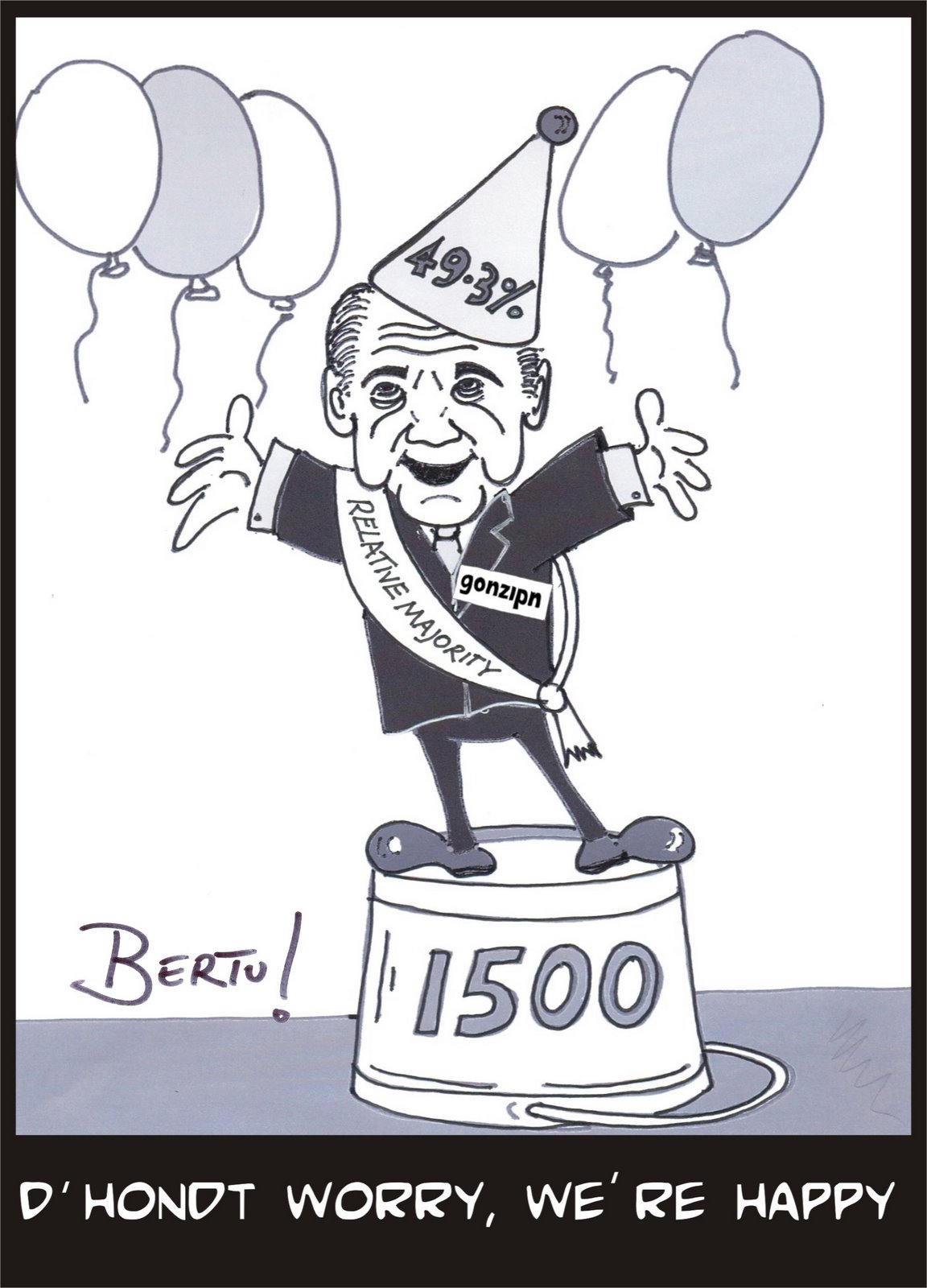
Last election’s carcades were hooting to the tune of a D’Hondt majority (see Bertoon illustration that we cooked up the next day). the D’Hondt system of voting combined with our “tweaked” constitutional provisions had led to a relative majority government – no party had obtained more than 50% of the votes but one party had 1,500 votes than the other. A constitutional clause had come into play and the way it worked was –

a) if only two parties are elected to parliament,
b) if none of the two parties obtain more than 50% of the votes,
then the party with the largest number of votes (a relative majority) will be entitled to an adjustment of seats in order to be able to enjoy a majority of seats in parliament. That’s all found in article 51(1)(ii) of the Constitution of Malta.

Interestingly (and useful for later discussion) the provisos to this article are a rare instance in which reference is made directly to “political parties”.  It’s interesting because the Constitutional structure relating to representation and government (and therefore to the management of the basic power entrusted by “the people”) centres around individual “representatives” as elected to parliament by universal suffrage. The constitutional link between elector and elected is direct – there was no original intention for the intermediaries we now call “political parties”*.

This important distinction between political parties and members can be clearly seen from the Constitutional article on the appointment of the Prime Minister – article 80:

Wherever there shall be occasion for the appointment of a Prime Minister, the President shall appoint as Prime Minister the member of the House of Representatives who, in his judgment , is best able to command the support of a majority of the members of that House (…)

Again. No parties. The President takes one good look at the House of Representatives and determines whether any member among them can count on “the support of a majority of the members” – that’s what is in play whenever a “confidence vote” comes into play. It’s an opportunity to put to test whether the PM still enjoys that  majority support. In the current context it’s what Joseph Muscat would like to table (a motion of confidence) and where Franco’s threat might come into play (by not voting for the PM and thus undermining his ability to “command the support of a majority”.

Now comes the hard part for hardcore nationalist voters to digest. Franco Debono is the latest symptom of the Coalition of the Diverse called GonziPN that oh-so-miraculously snatched victory from the jaws of defeat last election. The rainbow coalition within GonziPN was possible because of a lack of scrutiny, a loose combination of values (if any) and mainly because any candidate who could steal valuable votes that could lead to the relative majority victory (and therefore to the automatic majority in parliament) was backed to the hilt. Remember the JPO saga? Remember the spin masters backing what was very evidently a loose gun to the hilt – basta nitilghu?

So when the members of parliament finally took their place in the house of representatives Lawrence Gonzi could assume that he commands the support of the majority of members. He assumed it because any leader of a political party in Malta who has just won the election assumes that his party members will back him to govern. Easy. Alfred Sant assumed that in 1996. Lawrence Gonzi had no reason not to in 2008. The mechanism is not foolproof however. At the basis of the whole system remains the basic currency of power transfer – the representatives themselves. As Franco has reminded us more than once the “support of the representatives” cannot be taken for granted.

The mechanism of “support” or confidence is a check on the power of government. Viewed from outside the convoluted scenario that Franco has created around himself (with the help of the bloodsucking media) you will understand that the right of a member to withdraw his support is an important check in our democracy. It is just as important (if not more) as the existence of an opposition.

Even though our political parties operate on the assumption that “loyalty” is universally automatic they have now been exposed to the democratic truth that it is not. The failure is not of the system but of the arrogant assumption that the bipartisan mechanisms that the parties have written into the constitution will guarantee their permanent alternation. Franco’s methods might be obtuse and distasteful especially when they betray blatant and crude ambition but on a political level the renegade politician who disagrees with the party line was not only predictable but threatens to become a constant in the future.

The more political parties ignore the need to be coherent politically and the more they just throw anything at the electorate in the hope that something bites the more they can expect of “Franco-like” personalities. The failure to whip Franco into the party line is not a democratic failure or a constitutional flaw but a failure of the political party to operate as an effective vehicle of democratic representation.

D’hondt worry? Frankly it was only a matter of time. It’s actually a miracle it took this long for the shit to hit the fan.

* In a recent House of Commons document (Speaker’s Conference on Parliamentary Representation)  political parties were defined as “the mechanism by which people of any background can be actively involved in the tasks of shaping policy and deciding  how society should be governed. While they are not perfect organisations they are essential for the effective functioning of our democracy. Without the support of political parties it would be difficult for individual Members of Parliament, as legislators and/or as members of the Executive, to organise themselves effectively for the task of promoting the national interest—including by challenge to the Government, where that is necessary and appropriate—and ensuring that proposed new laws are proportionate, effective and accurately drafted.”