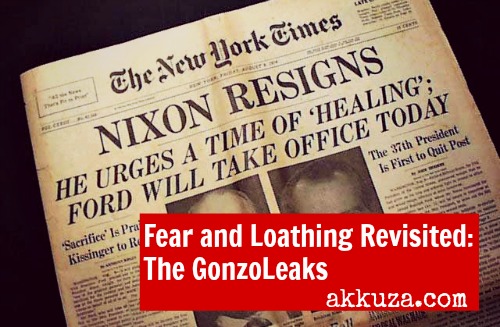
In an exclusive for J’accuse, an unidentified source has provided us with a massive leak of the “Gonzo Papers”. Here we reveal extracts from a document that first appeared in the New York Times on January 1, 1974 under the title “Fear and Loathing in the Bunker”. Given that the main protagonist in the document subsequently benefited from a presidential pardon the document has been redacted and real names replaced with fictitious references. Any similarity or resemblance to other real persons is purely coincidental.
[…]
It was almost too good to be true. Josephus Inhobbkom Muskat, the main villain of my political consciousness for as long as I can remember, was finally biting that bullet he’s been talking about all those years. The man that not even Cameron or Obama could tolerate had finally gone too far – and now he was walking the plank, on national T.V., six hours a day – with the whole world watching, as it were.
The phrase is permanently etched in some gray rim on the back of my brain. Nobody who was at the counting hall in Naxxar on that night in 2013 will ever forget it. Josephus Muskat is living in Castella today because of what happened that night in Naxxar.Louis Gonzo lost that election by a landslide of votes – mine among them – and if I had to do it again I would still vote for Arnie Kassel.
If nothing else, I take a certain pride in knowing that I helped spare the nation five more years of Gonzo– an administration that would have probably been equally corrupt and wrongheaded as Josephus Muskat’s, far more devious, and probably just competent enough to keep the ship from sinking until 2018. Then with the boiler about to explode from eight years of blather and neglect, Gonzo’s conservatives could have fled down the ratlines and left the disaster to whoever inherited it.
Muskat, at least was blessed with a mixture of arrogance and stupidity that caused him to blow the boilers almost immediately after taking command. By bringing in hundreds of thugs, fixers, and fascists to run the government he was able to cranks almost every problem he touched into a mind-bending crisis. About the only disaster he hasn’t brought upon us yet is an environmental meltdown or selling the nation’s sovereignty and assets on the cheap … but he still has time and the odds on his actually doing it are not all that long.
For now, we should make every effort to look at the bright side of the Muskat administration. It has been a failure of such monumental proportions that political apathy is no longer considered fashionable, or even safe, among thousands of people who only three years ago thought that anybody who disagreed openly with “the government” was either paranoid or subversive. Political candidates in 2018, at least, are going to have to deal with an angry, disillusioned electorate that is not likely to settle for flag-waving and pompous bullshit. The Panamagate spectacle was a shock, but the fact of a well-to-do Prime Minister’s aide and Ministerpaying less income tax than most construction workers while gasoline costs spiralled from Mellieha to Marsaxlokkand the spin of mass employment tends to personalise Muskat’s failures in a very visceral way. Even MPs have been shaken out of their slothful ruts, and the possibility of impeachment is beginning to look very real.
[…]
When he cold eye of history looks back on Josephus Muskat’s years of unrestrained power in Castella […] looking back at the nineties and noughties, the facts of Muskat and everything that happened to him – and to us – seem so queerly fated and inevitable that it is hard to reflect on those years and see them unfolding in another way.
[…]
One of the strangest things about these three downhill years of the Muskat premiership is that despite all the savage excesses committed by the people chosen to run the country, no real opposition or realistic alternative to Muskat’s cheap and mean-hearted view of the Maltese Dream has ever developed. It is almost as if that sour 2008 election rang down the curtain on career politicians.
This is the horror of Maltese politics today – not that Muskat and his fixers have been crippled, convicted, indicted, disgraced and even jailed – but that the only available alternatives are not much better; the same dim collection of burned-out hacks who have been fouling our air with their gibberish for the last twenty years,
How long, O Lord, how long? How much longer will we have to wait before some high powered-shark with a fistful of answers will finally bring us face to face with the ugly question that is already close to the surface in this country, that sooner or later even politicians will have to cope with it.
Is the democracy worth all the risks and problems that necessarily go with it? Or would we all be happier admitting that the whole thing was a lark from the start and now that it hasn’t worked to hell with it.
[…]
A few months ago I was getting a daily rush out of watching the nightmare unfold. There was a warm sense of poetic justice in seeing “fate” drive these money-changers out of the temple they had worked so hard to steal from its rightful owners. The word “paranoia” was no longer mentioned, except as a joke or by yahoos, in serious conversations about national politics. The truth was turning out to be much worse than my most “paranoid ravings” during that painful 2013 election.
But that high is beginning to fade, tailing down to a vague sense of angst. Whatever happens to Josephus Muskat when the wolves finally trip down his door seems almost beyond the point now. He has been down in his bunker for so long that even his friends will feel nervous if he tries to reemerge. All we can really ask of him is a semblance of self-restraint until some way can be found to get rid of him gracefully.
This is not a cheerful prospect, for Mr. Muskat or anyone else – but it would be a hell of a lot easier to cope with if we could pick up a glimmer of light at the end of this foul tunnel of a year that only mad dogs and milkmen can claim to have survived without serious brain damage.
Or maybe it’s just me. […]
[Hunter S. Thompson, 1 January, 1974]
The full unredacted text of the document can be found here.
Muscat is still holding the fort on Panamagate. In an earlier post I had suggested that his strategy would be that of buying time and if that is still the case then we have entered the fatigue stage where, after having weathered the bulk of the storm, Muscat will be counting on the inability of the general public to keep up with the momentum of the scandal. He will, in fact, be hoping that the general sense of weariness and helplessness that our citizens have when confronted with politics will have a saving effect on himself and his government.
The latest polls do not suggest as much and the slide in trust ratings together with the fact that corruption leapt to the top of public concerns mean that the effects of Panamagate are here to stay for a while yet. The crucial bit here is that the snowball effect of Panamagate has meant that your average citizen’s distrust in politics and politicians was spread wider than the protagonists of that particular saga and that Malta finally caught up with the rest of the world when it started to question the operations of a whole class of politicians.
In fact one of the positive outcomes of Panamagate is the “coming out” of public disapproval of our political class and of the system that that very same class has created in order to survive and grow. While the party in opposition attempted to form a national rally inspired by and for the purposes of Panamagate it has become increasingly the case that the focus has shifted onto the wider issue of the rotten state of our political establishment and that includes the party in opposition itself.
Part of the reason for the aforementioned shift lies in the defensive tactics of a government under siege. The strategy of spin by Muscat required a dose of counter-accusations of supposed or alleged corruption in the rank and file of the Nationalist MPs. It was very evidently a deviation tactic aimed at distracting all and sundry from the very obvious fact that Mizzi’s and Schembri’s position were untenable without the need of further proof. What ensued was an open barrage of exchanges with no holds barred. Truth, morality, public interest, the state of the nation – they all became expendable pawns in the partisan dialogue of insults and accusations.
The No Confidence Motion
In the middle of all this the nationalist party moved a motion of no confidence in the government. We all know of the infamous 13 hour debate and what has been very aptly described as the vote that resulted in 38 likes. In the middle of this debate we had one very interesting talk delivered by former Minister Mallia. Much of what Mallia said or did not say merits analysis.
In the first place it was evident that rather than use his time to defend the government’s achievements or to defend Konrad Mizzi’s position, Mallia was intent to unleash his remaining anger leftover from Malliagate – the infamous shooting incident involving his driver that cost Mallia his cabinet position. His speech targeted those who in his words attack an honest politican who is intent on serving the country and who ends up losing his chance to serve thanks to these “attacks”.
Secondly Mallia was quick to ride his reputation of an experienced lawyer by referring to his faith in the “rule of law”. This not too subtle shifting of goalposts would have been missed by the man in the streets but was a clear attempt to alter the standards that were under scrutiny. Political responsibility is not the same as criminal or legal liability. Mallia was in a way pandering to Muscat’s idea that “proof” of illegal funds was needed in order to have to get rid of Mizzi (and Schembri) – the kind of proof one would expect in a trial in a court of law. Mallia is either naive or ignorant in that respect: it is evident to any constitutional lawyer that the very rule of law he claims to love would have Mizzi and Schembri out on their arses the moment the very set up of a company in Panama is discovered.
Finally, and most importantly, watching Mallia speak brought back memories of politicians from what is by now a very different era of politics. Back in 1992 a huge earthquake struck Italian politics: we all remember it as Tangentopoli (“Kick Back Gate” if you like). What began as a magisterial investigation in illegal funding of parties ended up being an expurgation of a whole political class (Operation Clean Hands).
Mallia’s speech focused very much on attacks on the truth and on the suffering of the “honest politician” who is not in politics money but to serve. In his words, “attacks” by journalists were damaging the opportunities of politicians to serve. This sounded very much like a muffled appeal to both sides of the house to moderate their terms because in the long run it is the very politicians on both sides who risk “suffering” the ignominy of an extirpation.
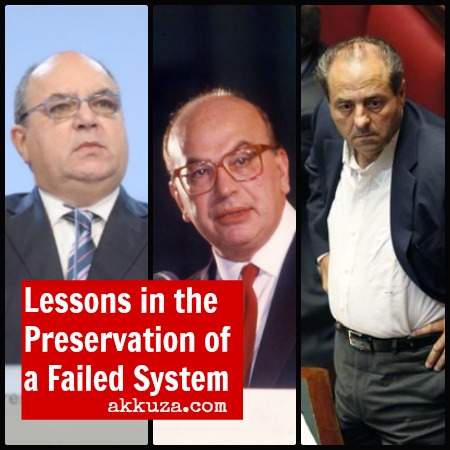
Back in 1992 Bettino Craxi, one of the gigantic figures of Italian politics, had stood up in the Italian Parliament shortly after the first scandals erupted and commented thus:
Su quanto sta accadendo la classe politica ha di che riflettere. (…) C’è un problema di moralizzazione della vita pubblica che deve essere affrontato con serietà e con rigore, senza infingimenti, ipocrisie, ingiustizie, processi sommari e grida spagnolesche. E’ tornato alla ribalta, in modo devastante, il problema del finanziamento dei Partiti, meglio del finanziamento del sistema politico nel suo complesso, delle sue degenerazioni, degli abusi che si compiono in suo nome, delle illegalita’ che si verificano da tempo, forse da tempo immemorabile. Bisogna innanzitutto dire la verita’ delle cose e non nascondersi dietro nobili e altisonanti parole di circostanza che molto spesso e in certi casi hanno tutto il sapore della menzogna.
Si è diffusa nel paese, nella vita delle istituzioni e della pubblica amministrazione, una rete di corruttele grandi e piccole che segnalano uno stato di crescente degrado della vita pubblica, uno stato di cose che suscita la piu’ viva indignazione, leggittimando un vero e proprio allarme sociale, ponendo l’urgenza di una rete di contrasto che riesca ad operare con rapidita’ e con efficacia.I casi sono della piu’ diversa natura, spesso confinano con il racket malavitoso, e talvolta si presentano con caratteri particolarmente odiosi di immoralita’ e di asocialita’.
E cosi’ all’ombra di un finanziamento irregolare ai Partiti e, ripeto, al sistema politico, fioriscono e si intrecciano casi di corruzione e di concussione, che come tali vanno definiti trattati provati e giudicati. E tuttavia, d’altra parte, cio’ che bisogna dire, e che tutti sanno del resto, e’ che buona parte del finanziamento politico e’ irregolare od illegale. I Partiti specie quelli che contano su apparati grandi, medi o piccoli, giornali, attivita’ propagandistiche, promozionali e associative, e con essi molte e varie strutture politiche e operative, hanno ricorso e ricorrono all’uso di risorse aggiuntive in forma irregolare od illegale.
Se gran parte di questa materia deve essere considerata materia puramente criminale allora gran parte del sistema sarebbe un sistema criminale. Non credo che ci sia nessuno in quest’aula, responsabile politico di organizzazioni importanti che possa alzarsi pronunciare un giuramento in senso contrario a quanto affermo: presto o tardi i fatti si incaricherebbero di dichiararlo spergiuro. (Bettino Craxi, June 1992).
That was at the outbreak of the scandal. The kickbacks that were investigated involved first and foremost the major political parties that had enjoyed a system of “democratic alternation” but that had developed a network of corrupt practices that later would be found to have overspilled in the business community. Political party kickbacks were parallel to grafts taken by individual politicians and the links spread straight into the arms of criminal activity. In his early defence in 1992, Craxi stressed that (I paraphrase) “the illegal funding of the political system (no matter how many negative judgements and reactions it may have generated) cannot be and cannot be used as an explosive to blow up a whole system, to delegitimize a political class, to create a climate where neither corrections nor an effective cleansing action can arise but only disintegration and adventure. For this situation we need a remedy, actually more than one remedy.”
I cannot help but noticing that Mallia’s impassioned apology for the workings of politicians in spite of what he perceives as “attacks” on their operation has inspirations that are rooted in the interventions of Craxi and politicians of his ilk back in 1992. 10 months later, in April 1993, Bettino Craxi was faced with a number of requests by the magistratura for authorisation to proceed (against him in court) and he had to make one last impassioned defence before the Camera dei Deputati. Almost 23 years ago to the day he stood up to make one of the longest speeches in defence of a failed system.
Si e’ invece fatto strada con la forza di una valanga un processo di criminalizzazione dei partiti e della classe politica. Un processo spesso generalizzato ed indiscriminato che ha investito in particolare la classe politica ed i partiti di governo anche se, per la parte che ha cominciato ad emergere, non ha risparmiato altri come era e come sara’ prima o poi inevitabile. (…) Ma di tutte l’erbe s’e’ fatto alla fine un fascio.
Tutto si è ridotto ad una unica accusa generalizzata. Le campagne propagandistiche hanno ruotato sovente solo attorno a slogans ed a brutali semplificazioni. Di questo si è incaricata infatti parte almeno della stampa e dell’informazione, andando ben al di là dei diritti e dei doveri propri dell’informazione, deformando spesso oltre misura, esaltando le ragioni dell’accusa e mettendo di canto quelle della difesa, travolgendo senza alcun rispetto diritti costituzionalmente garantiti con difese divenute praticamente impossibili, creando sovente un clima infame che ha distrutto persone, famiglie e generato tragedie.
La criminalizzazione della classe politica, giunta ormai al suo apice, si spinge verso le accuse piu’ estreme, formula accuse per i crimini piu’ gravi, piu’ infamanti e piu’ socialmente pericolosi. Un processo che quasi non sembra riguardare piu’ le singole persone, ma insieme ad esse tutto un tratto di storia, marchiato nel suo insieme. Un vero e proprio processo storico e politico ai Partiti che per lungo tempo hanno governato il Paese. (29th April 1993)
The echoes in Mallia’s speech 23 years later are incredible. It does not stop with Mallia mind you, even though Mallia’s speech was the most transparent in this respect. Politicians under attack for their unethical performances will ask you to be positive and focus on “all the good we have done” that cannot and should not be overshadowed by what they claim to be “slips of human error”. This spin is current today and it is no surprise that it was just as current in Craxi’s day.
Tutti i cicli, come è naturale passano, entrano in contraddizione, si esauriscono, degenerano. Sono cosi’ subentrati gli anni delle difficolta’ e della crisi, che stiamo ancora attraversando. Ma gli effetti e le conseguente di un periodo critico sarebbero stati ben diversi e ben piu’ onerosi se non avessimo avuto alle spalle il solido sviluppo realizzato nel corso degli anni ottanta ed un retroterra conquistato con un balzo in avanti poderoso.
It did not come without an admission though. Craxi’s line of reasoning was that parties have always been funded in a questionable manner and that this should not preclude an acknowledgement that they have functioned for the good of the state.
Cosi’ come nella vita della societa’ italiana non e’ nata negli anni ottanta la corruzione nella pubblica amministrazione e nella vita pubblica.
La vicenda dei finanziamenti alla politica, dei loro aspetti illegali, dei finanziamenti provenienti attraverso le vie piu’ disparate dell’estero, della ricerca di risorse aggiuntive rispetto poi ad una legge sul finanziamento pubblico ipocrita e ipocritamente accettata e generalmente non rispettata, accompagna la storia della societa’ politica italiana, dei suoi aspri conflitti, delle sue contraddizioni e delle sue ombre, dal dopoguerra sino ad oggi.
Non c’e’ dubbio che un troppo prolungato esercizio del potere da parte delle piu’ o meno medesime coalizioni di Partiti ha finito con il creare per loro un terreno piu’ facilmente praticabile per abusi e distorsioni che si sono verificate. Ma onestà e verità vorrebbero che in luogo di un processo falsato, forzato, ed esasperato, condotto prevalentemente in una direzione, si desse il via ad una ricostruzione per quanto possibile obiettiva ed appropriata di tutto l’insieme di cio’ che è accaduto.
Si tratta di una realta’ che non si puo’ dividere in due come una mela, tra buoni e cattivi, gli uni appena sfiorati dal sospetto, gli altri responsabili di ogni sorta di errori e nefandezze.
The appeal to morality and honesty in such times becomes almost an automatic reflex. I have already mentioned how jarring the appeal to “honest Maltese” was prior to the first rally in Valletta. This tendency to transform a political discussion into a dichotomy between “good and evil” is dangerous – dangerous both for the interlocutors who have suddenly arrogated unto themselves the questionable position of absolute purity as well as for the confused electors who are unable to detach themselves from the call of partisan loyalty when assessing such circumstances.
In this I will refer once again to Craxi’s swan song. In the heat of the affair, prior to his exposure to the courts and his subsequent self-imposed exile in Hammamet (Tunisia) he made one final appeal to a good sensed reform devoid of revolutionary lynch mobs. It sounds eerily relevant to today’s world:
Non credo del resto che la moralizzazione della vita pubblica possa esaurirsi con la denuncia ed il superamento dei sistemi di finanziamento illegale dei Partiti e delle attività politiche e con la condanna di tutte le forme degenerative che ne sono derivate. Non credo che solo in questo consista la questione della corruzione della vita pubblica. Non credo che il procedere in modo violento con l’inevitabile inasprimento dei traumi e dei conflitti che ne scaturira’ potra’ aprire un periodo ordinato e rigoglioso nella vita democratica. Non credo che per queste vie li Paese si incamminerà verso un periodo di rinascita economica,di riequilibrio sociale,di un rinnovamento politico ed istituzionale all’insegna di un grande decentramento dei poteri, nel consolidamento dell’unita’ della Nazione,e insieme di riconquista di un prestigio internazionale tanto piu’ necessario quanto piu’ aspre si vanno facendo la competizione e la conquista di aree di influenza nel mondo. C’e’ un problema democratico di rinnovamento e di ricambio della classe politica dirigente, c’è un problema di alternanza di forze nelle responsabilità di guida e di governo.
E’ un problema che deve essere risolto democraticamente, nel modo piu’ trasparente e diretto, senza provocare il soffocamento del pluralismo politico e senza fare ricorso alla barbarie della giustizia politica. Una politica che fosse intrisa di demagogia e di ipocrisia, non sarebbe destinata a fare lunga strada. Cosi’ come non e’ destinato a farla chi ancora oggi continua a non usare il linguaggio della verità, per non parlare di chi si presenta di fronte al paese con l’aria smemorata, con i tratti di chi non sapeva anche cio’ che avrebbe dovuto inevitabilmente sapere, di chi ha vissuto sino a ieri in preda a superficiali distrazioni, di chi denuncia nomenklature, ignorando la propria di cui continua a portare tutti i caratteri, e dimenticando il proprio ruolo, la propria responsabilità, di chi addirittura giudica dall’alto delle sue frequentazioni malavitose.
These quotes may be lengthy but they are necessary in order to have a look at the lessons that history provides us. It is very probable that by the time Craxi gave this speech he knew he would have little time left within the political sphere. His April 1993 speech would actually win him time as he would win that vote and stay out of the courts until December of that year when his prosecution was finally authorised. By May 1994 he was fleeing to Tunis to escape jail and where he would live till his death in 2000 under the protection of Tunisia’s leader Ben Ali (himself ousted in 2011 and charged with money laundering and drug trafficking sentenced to 35 years).
Lessons
Craxi’s story serves to remind us of how a political class will struggle and fight tooth and nail to survive. The defences it will put forward will rarely be different through the ages. In a system such as ours that has also been molded to allow for alternation between different networks of power we run the risk of seeing much of the same.
Unfortunately Malta does not have a strong judiciary or watchdogs. Konrad Mizzi and Keith Schembri have still not gotten so much as a slap on the wrist from anyone. Our tax authorities are proceeding at a slow pace but that is not even the point because tax authorities are not about political responsibility. Our Prime Minister hides behind a tax audit spirited out of one of his fantastical speeches full of management words but no political consequences. Our political parties – both of them – still inhabit a world where massive financing is taken as a basic requirement for their operation. No one questions whether paring down their size would be a good thing in itself.
We will continue to hear stories and accusations and counter-accusations of graft, politicla favours, political networks. In the meantime Malta lacks the momentum that existed in Italy under the system of aggressive togas or in Iceland with an aggregation of popular sentiment that could result in a proper change.
I will conclude by referring you once again to Mallia’s speech and his defence of the privacy of the honest politician. One of the “victims” of tangentopoli was a socialist member of the camera deputati. His name was Sergio Moroni and when faced with more avvisi di garanzia he decided to take his life, not before leaving an impassioned appeal addressed to the President of the Chamber (ex-President Giorgio Napolitano). At the risk of infuriating the readers with the length of this post I am reproducing his letter below.
Se vogliamo che tutto rimanga lo stesso, bisogna che tutto cambi.
« Egregio Signor Presidente,
ho deciso di indirizzare a Lei alcune brevi considerazioni prima di lasciare il mio seggio in Parlamento compiendo l’atto conclusivo di porre fine alla mia vita. È indubbio che stiamo vivendo mesi che segneranno un cambiamento radicale sul modo di essere nel nostro paese, della sua democrazia, delle istituzioni che ne sono l’espressione.
Al centro sta la crisi dei partiti (di tutti i partiti) che devono modificare sostanza e natura del loro ruolo. Eppure non è giusto che ciò avvenga attraverso un processo sommario e violento, per cui la ruota della fortuna assegna a singoli il compito delle “decimazioni” in uso presso alcuni eserciti, e per alcuni versi mi pare di ritrovarvi dei collegamenti. Né mi è estranea la convinzione che forze oscure coltivano disegni che nulla hanno a che fare con il rinnovamento e la “pulizia”. Un grande velo di ipocrisia (condivisa da tutti) ha coperto per lunghi anni i modi di vita dei partiti e i loro sistemi di finanziamento. C’è una cultura tutta italiana nel definire regole e leggi che si sa non potranno essere rispettate, muovendo dalla tacita intesa che insieme si definiranno solidarietà nel costruire le procedure e i comportamenti che violano queste regole.
Mi rendo conto che spesso non è facile la distinzione tra quanti hanno accettato di adeguarsi a procedure legalmente scorrette in una logica di partito e quanti invece ne hanno fatto strumento di interessi personali. Rimane comunque la necessità di distinguere, ancora prima sul piano morale che su quello legale. Né mi pare giusto che una vicenda tanto importante e delicata si consumi quotidianamente sulla base di cronache giornalistiche e televisive, a cui è consentito di distruggere immagine e dignità personale di uomini solo riportando dichiarazioni e affermazioni di altri. Mi rendo conto che esiste un diritto d’informazione, ma esistono anche i diritti delle persone e delle loro famiglie. A ciò si aggiunge la propensione allo sciacallaggio di soggetti politici che, ricercando un utile meschino, dimenticano di essere stati per molti versi protagonisti di un sistema rispetto al quale oggi si ergono a censori.
Non credo che questo nostro Paese costruirà il futuro che si merita coltivando un clima da “pogrom” nei confronti della classe politica, i cui limiti sono noti, ma che pure ha fatto dell’Italia uno dei Paesi più liberi dove i cittadini hanno potuto non solo esprimere le proprie idee, ma operare per realizzare positivamente le proprie capacità e competenze. Io ho iniziato giovanissimo, a solo 17 anni, la mia militanza politica nel Psi. Ricordo ancora con passione tante battaglie politiche e ideali, ma ho commesso un errore accettando il “sistema”, ritenendo che ricevere contributi e sostegni per il partito si giustificasse in un contesto dove questo era prassi comune, ne mi è mai accaduto di chiedere e tanto meno pretendere.
Mai e poi mai ho pattuito tangenti, né ho operato direttamente o indirettamente perché procedure amministrative seguissero percorsi impropri e scorretti, che risultassero in contraddizione con l’interesse collettivo.
Eppure oggi vengo coinvolto nel cosiddetto scandalo “tangenti”, accomunato nella definizione di “ladro” oggi così diffusa. Non lo accetto, nella serena coscienza di non aver mai personalmente approfittato di una lira. Ma quando la parola è flebile, non resta che il gesto.
Mi auguro solo che questo possa contribuire a una riflessione più seria e più giusta, a scelte e decisioni di una democrazia matura che deve tutelarsi. Mi auguro soprattutto che possa servire a evitare che altri nelle mie stesse condizioni abbiano a patire le sofferenze morali che ho vissuto in queste settimane, a evitare processi sommari (in piazza o in televisione) che trasformano un’informazione di garanzia in una preventiva sentenza di condanna. Con stima.
Sergio Moroni »
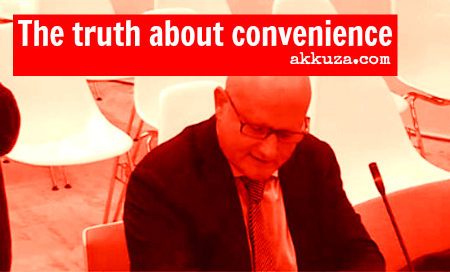
Saviour Balzan’s performance at yesterday’s Public Accounts Committee must have been a sight for sore eyes and Lord do we have sore eyes on the island. In many ways Balzan has become the champion of all the “hekk hu go fik” stalwarts who will never get enough of (as Ian Borg put it) getting an orgasm out of imagining worse places in their hell that would be reserved for what is left of GonziPN. Part of the reason may very well be that more often than not Balzan gives the impression that he operates on the very kind of substance that fuels (excuse the pun) this kind of voter.
Of course your average voter has every prerogative to elect to vote on the basis of partisan zeal, inbuilt prejudice and repressed anger. The urge to wave the flag in the face of opponents and yell about some tkaxkira is also a prerogative protected by the constitution and the right to universal suffrage. Yes, we are doomed to have the fate of our nation determined by the insufferable partisan who will go on weighing the aptitude of a party to govern not by its potential but by contrasting it to what is perceived as the virulent other.
Not Saviour though, he is a public person as in he is an editor of what for all intents and purposes is a newspaper. Yesterday Owen “the law” Bonnici kick started the waltz of connivance with this “editor” with what he called a “preambolu” (preamble). He informed all and sundry that as the editor of a paper Balzan would not be obliged to divulge his sources. True. Very true. Also redundant. It was just Bonnici’s way of tucking Balzan comfortably in his seat short of providing tea and biscuits and a nice warm cover. I switched off the radio at that point and have the various newspaper reports to go on for what happened after.
First a preamble of my own. What follows will surely provide the various sycophants of the Taghna Lkoll litter to call this blog a “nationalist blog” or a “poison pen” (though we may be older and wiser as a blog but not as important in the machinery and cogs of the system). Experience has shown that worrying about this form of accusation is like worrying that it is raining: best to put on a good waterproof jacket and not get mixed up in the mud that inevitably forms. Let the future be my judge.
Speaking of judges, that was the first impression that Balzan’s deposition seems to give: Judge Balzan was in court. Comfortably seated and welcomed by Bonnici he dispensed opinions as though they were edicts from a judicial platform. “George Farrugia should have been tried in court.” “Lawrence Gonzi lied.” “Tancred Tabone was a scapegoat.” “Tancred Tabone might have been Austin Gatt’s cousin”. In what he probably believes to have been his finest moment he spun and linked story after story, confident in the fact that “his sources are protected” to lead to the culminating “bombshell” (not my words, but one of the papers chose this term). The Shell out of court settlement with the PN government as compensation for having missed out on some tenders. The big news? Simon Busuttil was the lawyer for Shell.
Now, not having the benefit of Balzan’s disgruntled sources (I will assume you can see that for yourself – the disgruntled bit I mean) I can still try to piece together the “facts” provided by Balzan and ask a few honest questions.
There seems to be sufficient evidence pointing to a network of information that led to a skewered oil procurement policy that took place under a nationalist government watch. So far so good. We did not even need Balzan to see that far.
The conflicting evidence as to who was in it up to his teeth and who was not seems to arise from the fact that it all depends on who you accept as source. Would it be George Farrugia the whistleblower? Would it be the Farrugia brothers who according to Balzan’s song were approached as whistleblowers but later dropped in favour of their brother?
Light bulb – as Gru would say. Could it be that those who are now claiming to be victims and unwanted whistleblowers have found a place to vent their side of the story in Balzan?
Could it be that the convenience of these internecine wars and shady suspicions falls right in the lap of Bonnici’s Labour – happy enough to tag along with any mud that is thrown inter partes so long as some of it can be made to sound like it sticks to GonziPN?
And in the light of 4 above, what better manna from heaven than a non-sequitur about a retainer held by the current leader of the nationalist party for an oil company with regards to an out of court settlement related to procurement of AVIATION FUEL that has nothing to do with the procurement of Farrugia’s oil? The important thing for Bonnici and his party is that Busuttil’s name was finally dropped in the context of the Oil Procurement scandal – no matter how vaguely. For the man in the street busily “orgasming” (Ian Borg again) on the GonziPN links this must be heaven. For Muscat a welcome distraction from GaffarenaGate, ChinaGate, ChrisCardonaGate, PremierGate, ODZGate, SandroChetcutiGatesandTowers… heavens where do I stop?
Then there was that bit of magic about Gonzi lying that he did not know Farrugia’s wife – because he regularly received chain prayers from her. Which of course would make me best friends with most Nigerians who insist on trying to send me money at every opportunity they get. The Prime Minister passed on whatever information was received to the secret services but apparently, according to Judge Balzan, they went about their work maladroitly. Of course that should raise questions about the secret service, the police and more but we are not in the PAC for that are we? We need to find mud that sticks.
Finally there’s Austin Gatt. Never a beloved minister. Neither he nor his minions and now MPs were ever going to be seen in a good light of even the most moderate of PN supporters let alone the “hekk hu go fik” brigade. It gets a bit confusing because at one point Tancred Tabone is highlighted as being both the “scapegoat” of the situation as well as the (possible) cousin of the minister. Claudio Grech is guilty of arrogance – I wonder if it is of the same type that we get whenever PM Muscat gets asked an uncomfortable question.
There are worrying implications that result from the Oil Procurement Scandal. In my opinion the most worrying of all the things that Balzan implied yesterday was in fact the weather-vane approach adopted by the police depending on who is in government. That something was definitely amiss in the oil procurement methods is not hard to deduce. That it is all being lost in a desperate attempt by the government and people bearing grudges against Gonzi’s PN (and now the current PN) to change this into an anti-PN crusade is shameful to say the least.
Our class of politicians – all of it – is what we have as representatives. They are obliged to perform their representative duties in full respect of the mechanisms of democracy, particularly by ensuring that the guarantees of constitutional checks and balances are strong and fully functional. The PN’s efforts at changing and morphing into a party that has left behind the malaise of GonziPN must stick within these parameters. Labour has by now shown clearly that it has no intention to follow the rules of the accountability game.
Moments of “glory” such as these for Saviour Balzan will go down well with the Taghna Lkoll crowd. His convenient (though mostly irrelevant) name dropping will be applauded in most circles. Such moments will do close to nothing to further the cause of solving the problem of corruption that has been clawing at the heart of our system under bipartisan blessing. Worse still they will do nothing at all to open the eyes of the people to the rampant corruption that is taking place daily before their eyes.
So long as the Pied Piper can play the tune….and it seems that it’s an LP… a 10 year tune in fact.
The scandal relating to the concrete supply at Mater Dei Hospital is turning out to be a fitting metaphor to describe the fate of Maltese politics.
In the first instance we are gradually exposing an extremely deficient system that existed back in the mid-nineties that somehow or another allowed for the provision of sub-standard building materials for a hospital. Do not for one moment allow yourself to forget that it is a hospital that we are talking about. Along with schools, hospitals are probably one of the more socially sensitive infrastructures whose standard and quality mirror the heart of a nation -this is not to say that using deficient building material in order to construct any other type of building would have been a mitigation of any kind.
The formula for this horrible state of affairs is the tried and tested combination of commercial interests that work their way (either through influence or through direct involvement) into the corridors of power. The businessman and the politician will then work together to earn a quick buck on the backs of an electorate blinded by the passion for partisan flag-waving and alternation. The metaphor becomes ever more apt when one of the protagonists (shall we say suspects) turns out to be a career politician who managed to remain a sacred cow for one or other of the parties at different times in his career. No amount of irony was spared when his decade-spanning involvement in local (and now European and World) politics mean that somehow or other he was involved with the health structures of the nation under both parties in government.
But this is not about John Dalli. This is about the politics and political system of our nation. For I say that the metaphor remains apt to this day. Whether the guardians of the nation in the mid-nineties are to be found accountable for any corrupt sales of deficient construction material when building a new national hospital remains to be seen – what is sure is that someone has to pay. It will be another notch for the pro memoria of the twisted insanity of the post-Mintoffian generation of politicians.
What we have today is another government that is intent on hiding the truth or using parts of it to its gain. As of this month Muscat’s government is strongly testing the resilience of democratic sustainability and sovereignty. While the masks had fallen a long time ago, a long line of inexplicable decisions have provided clear hints that the Taghna Lkoll ideal has long been dead and buried and that Muscat has lost the plot.
It is hard to identify where it all began. Was it the full-frontal assault on the environment that did the trick? Was it the blatant lies relating to all that is Zonqor? Was it the slip relating to the Qala Yacht Marina? Muscat had tested the waters with the Hunting Referendum and wrongly gauged the slight victory obtained by those intent on preserving the status quo of wrongly appliying a European directive. Even today his appointees in the Ornis Committee defy all odds with relation to trapping. yet, Muscat’s defiant attitude on environmental issues is not a deal breaker on democratic standards. It is after all the prerogative of his party in government to espouse a suicidal destructive environmental policy.
No, the non-democratic chasm of Muscat lies away from these “minor” spites to our environmental heritage. It lies dotted within political appointments and appointees that are starting to betray their ineptness but still remain defended by the Prime Minister himself. It lies within a Cabinet Code of Ethics that has just been announced and that exposes Muscat’s money-hungry coterie for all its hypocrisy. It lies within the recent decisions relating to government property used to line the pockets of friends of friends (oh they are back but louder and clearer) from the Premier Cafe farce to the latest Gaffarena pot of gold.
It lies with the appointment of judges and magistrates in full defiance of the reforms that were being proposed by his very government. It lies with a “What’s all the fuss?” attitude combined with the “Tu Quoque” retorts that have long been dried of all significance and only serve to reinforce the strong perception of arrogance. It lies with the regular rubbing up to despots and tinpot country leaders and running around with a begging bowl while seemingly ignorant of the atrocities and democratic deficits that exist within the nations of these much adulated partners.
It lies with the belief that the national heritage and national identity is there solely for Labour’s politicians to plunder and sell to the highest bidder. With the passport scheme Muscat began to sell our mind and identity, with the lands that he has taken to expropriating, selling under cost, or plundering from their natural value he is selling our body and heritage, as for our soul, it has long been sold to the first devil to turn up at our doorstep promising Muscat a bit of money, an investment for his developer friends and a photo opportunity in which to prance around like some latter-day Mussolini on speed.
It’s a disgusting state of affairs in which nothing is sacred – not even the institutions that should stand as a guarantee. Under a nationalist government the faulty concrete foundations were laid at Mater Dei Hospital. At the same time the rotten core of all that is wrong in our political system had begun to take root. Today we find ourselves the inheritors of a hospital that is unsafe and of a government at the helm of a political system that is ready to implode any minute.
Joseph Muscat’s Labour has its hands deeply tied and entwined with the same kind of businessmen as existed in the mid-nineties and set the path for the Mater Dei disaster. It is beyond redemption. Hope, if any, lies first of all in Simon Busuttil and his managing the re-foundation of the nationalist party before going on to re-found the Maltese State. It must be patently obvious by now that the nationalist party needs a reconstruction from the roots and not simply a renewal. A new style of politics, a new style of engagement and a new style of leadership.
Speaking at Zonqor Busuttil did say that the biggest task for his party is not to be different from Muscat but also to be different from his own party in the past.
Those words should be printed out on a concrete slab at the entrance of PN HQ. Preferably on good, sound concrete… sound enough to build the basis for a brighter future ahead.
In the current whirlwind that is the Swissleaks scandal we risk missing the wood for the trees. Public opinion is easily distracted by petty insinuations and suppositions that run on the lines of taste and “intuition”. Assumptions are always preferable to sound facts and are the refuge of the lazy or the manipulating. As news broke of the names of ex-PN ministers Ninu Zammit and Michael Falzon appearing on the list of people who had funds stashed away in Switzerland we were confronted with the inevitable tsunami of disdain. This was tax avoidance of the highest order, aggravated to boot by the failed declaration of funds when performing duties as a minister of government. We were also told that both had benefited from an “amnesty” having repatriated the funds to Malta. What that really means is that they paid much less tax than they originally owed and it does nothing to clear their false declarations earlier.
In many ways an amnesty in this sense is a legal form of money laundering. Monies that had been “disapparated” into a vault at the Gringot’s Bank far from the scrutiny of the taxman are allowed back into circulation once the payment of a percentage fine is made. The real question is: how was that money made? Why was it hidden away for so long? Was tax avoidance really the only reason? That the money was legitimately acquired and not through, for example, trading in influence, is something for which we have to take the word of the honourable gentlemen who had given sworn statements of assets before parliament before and in which statements they failed to mention the existence of such funds. Forgive me if I remain skeptical.
It gets worse. The current Premier (that’s his new nick – all 4.2 million euro of it) could in all probability have been the one to have accorded the amnesty to the gentlemen in question. When questioned on the matter he took refuge in his usual “tu quoque” rubbish – coming up with a reference to Austin Gatt’s forgotten funds at UPS. The problem is that by focusing on the Where? – i.e. Swiss funds, we miss the more important questions of Why? and What? Why do ministers underdeclare their assets? What dangers lie hidden when they do so? Muscat’s cabinet and MP’s include a minister for Gozo who declared practically a minimum wage in earnings and an ex-Minister who still cannot explain having half a million euros running around the house (to mention but two).
The Cafe Premier saga only goes to worsen the situation (and not just the perception) when it comes to seeing how closely knit are the activities of our representatives to the business community. While we were all aghast at Michael Falzon’s 460k in Switzerland we could read about a 210k commission over a government deal to buy back its own property (rather than simply kicking out a tenant who was not paying). The PM was in on the deal – there are emails to prove it. Not too far away from the Premier, in the law courts, the Enemalta Scandal was still unfolding. Yet again more wheels and cogs being oiled and still no one uses the magic word in Maltese : “Tixħim” (bungs/backhanders).
In the end there is a money trail to be followed. It serves to emphasise why this government cannot keep hiding behind chinese walls when it comes to important deals such as the Transport system and the new power stations and contracts given to consultants. Transparency is only the first step to combat corruption and until now the murkiness within which our politicians function is not helping in any way. We could potentially be very close to a situation that was current in Italy in 1992 – and the danger is that, just as happened in Italy – the big fish survive the cull to the detriment of a few scapegoats.
Which is why we need real non-partisan investigative reporting and a stronger arm of the law. otherwise the wheels will just keep turning and the oil will keep flowing. The only suckers will be the people. For a change.
Opposition leader Busuttil was lambasted from some quarters for having dared suggest that the whole Enemalta procurement scandal was actually abused of as electoral fodder by Muscat and his men. What Busuttil suggested was really not too hard to understand – if the information was available long before the election loomed ominously, why was it withheld until a time when it would pay Labour in opposition as an extra baton to imply government corruption?
Busuttil was not implying that the information should have been kept quiet until after the election (who would think such a thing anyway?) but rather that it should have surfaced when it was discovered and not much later. While the PAC continues on its fishing expedition trying to pin the whole scandal onto Lawrence Gonzi Busuttil’s kind of assertion will fall on deaf ears or attract the playground type of response that the Labour machine has been honed to give.
The HSBC Swissleaks now adds to the intrigue of the Farrugia Brothers discoveries in that it provides an easier target with the cliches straight out of conspiracy theory books – which is not to say that there is nothing underhand going on in the world of procurement, government permits and the like. The problem lies elsewhere. In Malta there is no such thing as investigation beyond politically motivated with-hunts. The politically motivated is also limited in its extent since oftentimes the investigators have a huge interest in making sure that they do not in turn become investigated.
We just have to look at what happened in Italy in the early nineties to understand what I am getting at. Our political parties have developed a system of self-preservation that became ever more evident during the last election. Rules and laws of the overall system have gradually been adapted to ensure the survival of the two political parties – not just politically but also financially. Hidden behind these rules is a system of favoritisms and expectations that link the political aspect to the economy in general on the one hand (from employment to contracts to tenders to permits) and to the social on the other (medical rights, entertainment “elites” and circles).
It would not just be limited to the parties. Institutional flaws would also surface – authorities controlling pieces of the market suddenly hold strong cards for bargaining: which is where I suspect the whole Enemalta picture fits in. From the most expensive multi-million euro tender to the smallest warden with fine giving powers there is an alternate currency of favoritism and favour. Of course if you are the party in government you and your men have a stronger bargaining power. Everybody gets their unjust desserts.
Mani pulite in Italy uncovered a clear system where bungs were paid to the pentapartito (five main parties from DC to PC) whenever anybody anywhere wanted to merely conduct business. No bung (tangente), no party (tender). Does this happen in Malta? The evidence seems to be pointing to it having happened on a regular basis – not necessarily with the blessing of politicians – and that it can still be occurring to this day.
Labour seems hell-bent on institutionalizing the system further. There is no longer a need to hide the “debts” owed to supporting lobbies. It is translated immediately to enabling laws or worse still – as the forthcoming threat of an amnesty for all MEPA violations shows – an actual conspiracy to render the illegal legal. Illegal constructions will enjoy a bonifico of huge proportions and consequences – all so as to appease the debts that got Labour into power. The network between social and business interests intertwining with government is becoming more and more dangerous. We do not have a pool of inquiring magistrates as the Italians did and in some way we can consider that a blessing of sorts given how some people here tend to interpret the laws.
Simon Busuttil was right though in turning up the heat on Muscat. The whole Enemalta investigation is misguided if it turns into a fishing expedition on Lawrence Gonzi. If, rather than speculating in the style of our tabloids, proper questions were asked as to how our whole system is beginning to stink of favoritism, cronyism and party-instigated corruption then, maybe, we could be getting somewhere.