GRECO, Galdes and Non-Regression

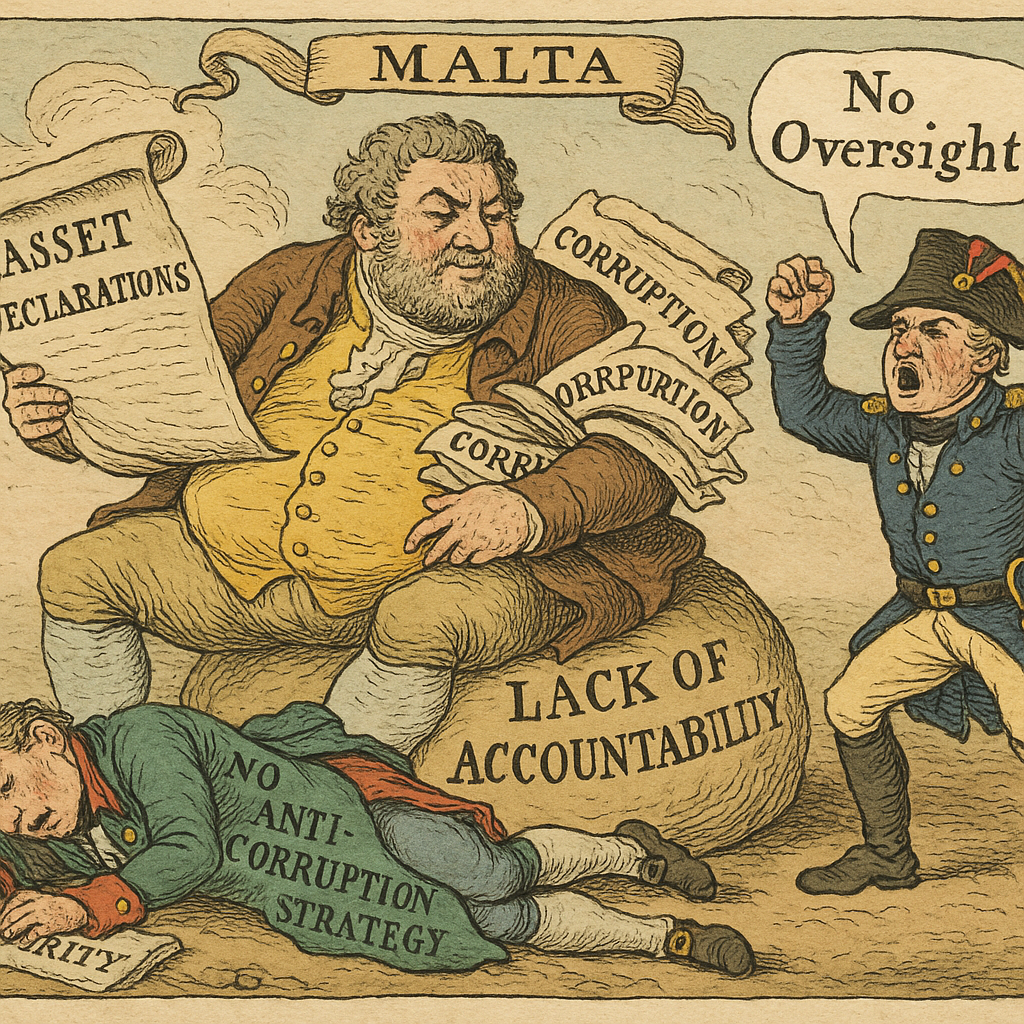
Malta’s latest GRECO compliance report again highlights systemic failures in three core areas: integrity standards for persons holding top executive functions, an effective and transparent asset-declaration regime, and the absence of a comprehensive anti-corruption strategy. GRECO’s conclusion is blunt: Malta remains in a state of insufficient compliance, with several recommendations untouched and others only partially implemented. These gaps concern the very mechanisms meant to prevent undue influence, conflicts of interest, and the misuse of public office.

The deficiencies identified by GRECO have gained renewed relevance in light of the recent scandal involving the Minister for Affordable Housing, whose unexplained personal financial arrangements and opaque dealings have raised serious questions about ethical conduct at ministerial level. In any functional integrity system, such a case would automatically trigger institutional scrutiny – but Malta’s framework remains either ineffective or deliberately under-used. This weakness is compounded by the Prime Minister’s continued refusal to publish Cabinet ministers’ asset declarations, despite years of external pressure. Without accessible declarations, there is no public or institutional ability to verify conflicts, enrichment during office, or improper benefits. GRECO has repeatedly stressed that transparency cannot exist where declarations are either incomplete, unverified, or withheld entirely. The government’s ongoing resistance transforms what should be a basic safeguard into an empty formality.

These failures collectively create an accountability vacuum. The absence of a binding anti-corruption strategy means there is no coherent framework setting out risks, sanctions, preventive measures, or oversight responsibilities. Weak or hidden asset declarations deprive journalists, civil society, and Parliament of the information necessary to detect conflicts of interest or illicit gains. The lack of integrity rules for persons at the apex of government leaves wide discretion with minimal scrutiny. The combined result is an environment where abuse is not merely possible but structurally facilitated, and where wrongdoing can remain undetected until exposed by coincidence rather than institutional design.

In the broader context of EU law, this trajectory raises serious concerns under the non-regression principle articulated by the Court of Justice in Repubblika. The Court held that Member States may not backslide on rule-of-law standards essential to maintaining judicial independence, good governance, and effective enforcement of EU law. By allowing its integrity framework to stagnate – and in key respects regress – Malta risks falling below the minimum constitutional safeguards expected of an EU Member State. The persistent refusal to strengthen transparency, regulate conflicts of interest, and implement anti-corruption structures may therefore be understood not merely as a domestic governance issue, but as a potential breach of the EU’s foundational requirements, undermining mutual trust and the proper functioning of the Union’s legal order.

This Is the Record: Malta’s Institutions Are Being Hollowed Out 

Let us begin with a truth that bears repeating: democracy does not die in one fell swoop, but by a series of quiet manipulations, each too technical to stir mass indignation, each cloaked in the language of efficiency, reform, or sovereignty. Malta is not facing an immediate coup. But what it is experiencing is something more insidious: a slow, deliberate capture of the very institutions designed to safeguard the public from arbitrary power. 

This is not a matter of partisan allegiance. It is a matter of record. And the record is clear. 

Over the last decade, Malta’s government has steadily expanded its reach over institutions that were once conceived to act as checks on executive power. The judiciary has found its independence compromised—not with tanks in the streets, but with legislation in Parliament and political appointments cloaked in the veneer of reform. 

One need not speculate. The Venice Commission, the Council of Europe, and multiple rulings from the European Court of Justice have signalled alarm. Judicial appointments were, for years, controlled by the Prime Minister’s office. Though recent changes were made following external pressure, the culture of loyalty and reward remains. Judges rise not merely by merit, but by proximity to power. And when they speak out—if they speak out—they do so at their own peril. 

This is not the natural order of things. It is a design. 

Oversight mechanisms have not been dismantled; they have been neutralised. The Planning Authority now issues permits in defiance of local plans and common sense. Its appeals tribunal, once a citizen’s last recourse, is to be stripped of real power under new legislation that proposes that courts may no longer revoke unlawful permits. Instead, they must refer the matter back to the same authority whose decision was deemed defective. This is not justice; it is theatre. 

What becomes of a nation where wrongdoers can outlast the process meant to stop them? Where court action becomes a maze designed to exhaust, confuse, and bankrupt rather than to protect? In such a nation, impunity is not an accident—it is a feature of the system. 

One may ask: where are the anti-corruption laws? Where are the safeguards? They exist, on paper. But paper burns. Legislation intended to curb corruption has been hollowed out by amendments, delayed by “consultation,” or applied selectively. The Freedom of Information Act remains more honoured in the breach than the observance. Whistleblower protections are limited in scope and rarely invoked. Asset declarations are filed but not verified. And the institutions charged with enforcement—the Commissioner for Standards, the Ombudsman, the Auditor General—are afforded just enough power to seem respectable, and just enough constraint to remain ineffective. 

This is the scaffolding of democratic decay. The façade remains intact: there are courts, there are laws, there are committees. But the substance has shifted. What was once meant to serve the public now serves power. Those who protest are smeared, sued, or ignored. Civil society is tolerated but never embraced. 

This is not a new story. Other democracies have walked this road—Hungary, Turkey, Poland. Their governments too spoke the language of reform. Their leaders too invoked the will of the people as they dismantled the machinery of accountability. 

And let us be clear: this is not about one scandal or one administration. This is about a systemic drift, a deliberate weakening of the structures that make accountability possible. It is about a state that no longer tolerates friction—be it from courts, journalists, NGOs, or ordinary citizens—and seeks instead a smooth path to its ends, unchecked and unchallenged. 

The result is a nation where corruption does not need to be concealed; it thrives in plain sight, protected not by secrecy but by inertia. It is a nation where reform is promised as a shield, and delay becomes a tactic. A nation where outrage has become routine, and resignation replaces resistance. 

But resignation is not destiny. 

Malta is still a member of the European Union. It is still bound by the Charter of Fundamental Rights. The courts in Luxembourg still have jurisdiction. Civil society still speaks, though with growing fatigue. Journalists still report, though some have paid the highest price. The fire has not gone out—but it flickers. 

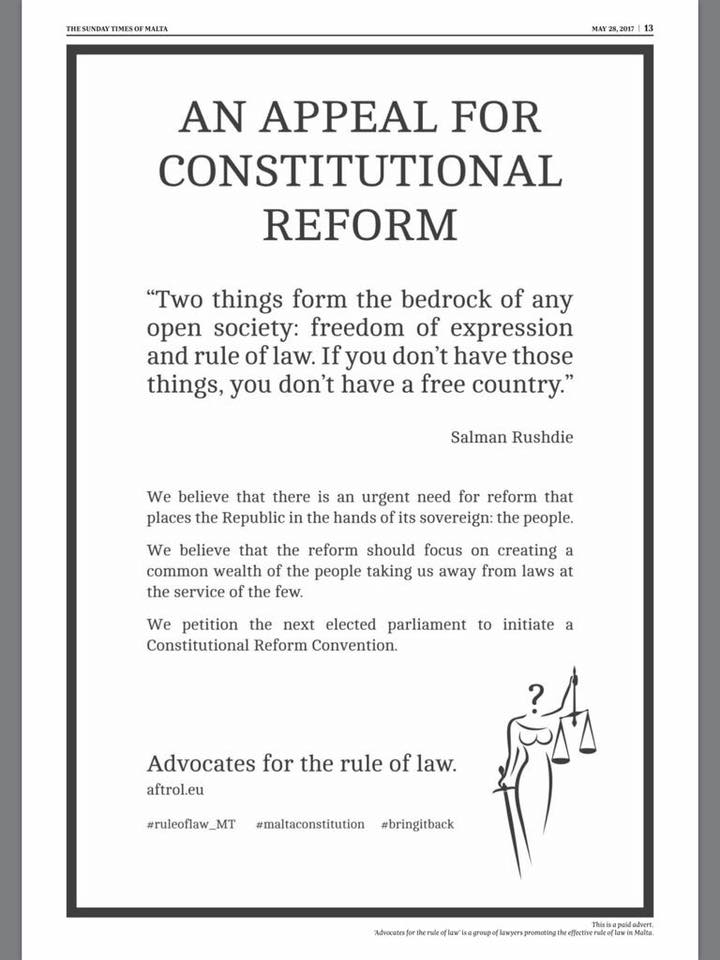
We must remind ourselves, as Edward R. Murrow once did in darker times, that “a nation of sheep will beget a government of wolves.” The purpose of institutions is not to please the powerful, but to restrain them. The rule of law does not ask whether the law was passed by a majority, but whether it serves justice. 

This is not the end, unless we accept it as such. The law can be restored. Institutions can be rebuilt. But only if we speak plainly, act firmly, and refuse to be lulled into silence by the language of procedural normalcy. 

The time for euphemism is over. 

This is the record. And it is our responsibility to change it. 

Il-bouncer ta’ Kastilja

GUEST POST: In this facebook post Christian Grima takes a good look at what it takes to get into the Auberge de Castille. The standards at the door are those set by bouncer par excellence Robert Abela. Who exactly is allowed in? (Post reproduced on akkuza.com with the author’s permission).

Jekk il-Kap tal-Opposizzjoni biex jidhol Kastilja biex ikellmek, Prim Ministru, irid jirbah l-elezzjoni generali, allura jekk nigu f’dan, inti wkoll, suppost mhux qed topera minnu, ghax sa fejn naf jien, inti ma rbaht l-ebda elezzjoni generali, ghadek. Kien rebbahhielek il-halliel, korrot tas-sena u x’aktarx qattiel jew hati li heba l-involviment tieghu jew ta’ dawk l-eqreb tieghu fl-assassinju barbaru ta’ Daphne Caruana Galizia u li llum inti writt is-siggu nkallat tieghu.Joseph Muscat, Illum injot, moralment fallut u rrapportat li nvestigat lokalment kif ukoll barra minn xtutna.

Nexia BT pero’ donnhom rebhuha l-elezzjoni generali hux? Jew qed inhawwad? Ghax dawk dehlin u hergin minn hemm kienu, tant li biex ma tiskomodawhomx u biex ma jarawkomx dehlin u hergin l-ufficini taghhom kull kwarta qiskom boloh, tajtuhom ufficcju Kastilja.Illum kellu jinghalaq dak l-ufficcju kif kellu jinghalaq kull ufficju iehor taghhom bl-assi kollha taghhom iffrizati, pendenti nvestigazzjoni ta’ hasil ta’ flus. B’inkjesta ohra fuq Schembri u Hillman li waslet biex tinghalaq u jigi pprezentat il-Proces Verbal.

Melvin Theuma jidher li rebahha l-elezzjoni generali wkoll skondtok, ghax dak ukoll diehel u hiereg ghand ic-Chief of Staff tal-predecissur tieghek f’Kastilja biex jinnegozja l-mahfra presidenzjali li tah Joseph Muscat, allegatament minn wara dahrek, wara li ftiehmu l-verzjoni maqbula bejniethom li kellu jaghti lill-pulzija u lill-Qrati taghna biex jghattilhom ghemilhom.Illum miraklu li ghadu haj Melvin wara li allegatament ipprova joqtol ruhu b’idejh b’diversi daqqiet ta’ sikkina li ta lilu nniffsu, ghax ma setghax jghix bl-inkwiet u bil-pressjoni li kien qed jaghmillu l-predecissur tieghek, siehbu Keith li skondtok hxih, u r-rimanenti nies gewwa kastilja li wasslulu r-risposti u t-theddid li kwazi gennewh.

Yorgen Fenech ukoll jidher li rebah elezzjoni generali nahseb..jew qed nerga’ nitfixkel, issa?Ghax dak ukoll diehel u hiereg Kastilja kien, qisu sejjer go latrina, kemm qabel, kif ukoll wara li nqatlet Daphne Caruana Galizia, biex jiltaqa’ ma’ Keith u ma dak li qed tpoggi fis-siggu tieghu.Joseph Muscat, illum injot u rredikolat mad-dinja kollha,L-istess Yorgen Fenech li bhalissa ghaddej kumpilazzjoni mressaq b’akkuzi fost ohrajn ta’ omicidju volontarju ta’ Daphne Caruana Galizia.Nahseb ahjar tiltaqa’ mieghu l-ufficcju tieghu il-Pieta’ lil Bernard Grech, Robert Abela. Jew il-Kwartieri l-Mile End.

L-ufficcju tieghek Kastilja, barra li skond kliemek ghadek ma kkwalifikajtx biex topera minnu, huwa ufficcju mishut u mcappas bid-demm b’riha taqsamlek qalbek li ma tissaportihiex.Riha ta’ flus jintnu jqattru d-demm. Habatlek sew li trid tilbes maskra.

Sakemm ma tizgurax li ssir gustizzja ma’ kulhadd Prim Ministru, mishut ha jibqalek l-ufficcju tieghek Kastilja u ghad trid tishet is-siegha u l-mument li ntrigajt li tnaddaf il-hmieg li halla warajh il-korrott dinji tas-sena, li fis-siggu mcappas tieghu, inti tpoggi ta’ kuljum, iggorrlu l-mantell

.Joseph Muscat. Illum injot. Illum fallut.

Corrupt Kings & Exile

In my mind, good old King Juan Carlos of Spain remains the monarch who sat through the 1982 World Cup finals as royal of the host nation. I don’t have a particular fancy for royalty so my knowledge of whatever he has been up to since stopped there. Until, that is, news of the corruption scandal linking King JC to bribes paid by Saudis in connection with some railway contract.

King JC stepped aside and let his son take the crown but the scandal was not ging away any time soon. And it shouldn’t because let’s face it justice should be the same for all, whether or not there is a real or imaginary crown on their head. Today’s news that the former King is going to self-imposed exile in the Dominican Republic still does not exonerate him from any responsibility.

In a statement, King JC’s lawyers stated that he was not escaping justice and would still be available to prosecutors.

I am not quite sure how that story will end but it jars with the story of Malta’s very own disgraced King who continues to live beyond his declared means. While he may believe that these matters are private and “none of your business” there is no doubt that many questions remain to be answered.

The rules of our democracy are flaunted daily by the members of the political parties who have had the indecency to craft the rules to their needs over the last decades. From political party financing, to personal accounts and interests of the various MPs, to the make up of the various authorities that are supposed to uphold the rule of law, all of them are guilty of taking the law for one big ride.

For there is no doubt that if Muscat’s annual declaration of assets were to be believed there is no way in hell he can be affording all this gallivanting and playing around with his imaginary jet-set. The class-obsessed couple (remember the call for a Middle Class for all) cannot resist to flaunt their extravagant lifestyle and in doing so they continue to beg questions that remain unanswered.

The disgraced ex-PM who presided over the most corrupt executive in Maltese history does not need to go into exile. The reason for that is that we still live in times of impunity, notwithstanding the cosmetic changes we have recently witnessed.

There are crooks everywhere, the situation remains as desperate as ever.

BONĠU MALTA – MEMORIAL CLEARED (AGAIN)

The situation is not desperate. Thousands flock to Spinola Bay to drink and revel. The memorial has been cleared (again) because someone somewhere has decided that we have a collective need to forget and it is his duty to help us do so. Political appointees and apparatchiks everywhere will once again deem it necessary to denigrate the acts of remembrance and will drum the following mantra into your head – this is the time to make hay, the sun is shining. All the while the law is made an ass and the safeguards of real freedom are broken down.

Remember, remember the 16th of October,
A car bomb, impunity and plot
We see no reason,
Why systemic treason,
Should ever be forgot.

#justice #daphnecrauanagalizia #impunity