The Barter Parties

It’s all happening in the PAC committee. The latest politicians to come under fire from the state’s evidence provider’s revlations are Austin Gatt and Manwel Mallia. It is good that the PAC committee is digging into the evidence in relation to “corruption scandals” but we must be forgiven if we remind all and sundry that the committee is in the end made up of members of our two political parties and that the sort of corruption that is being looked into is one that deals with dealing in influence – power broking of the kind that involves the sort of thinking that goes: “I’ll think of you today and you think of me tomorrow”.

Notwithstanding pre-electoral promises, our laws might at first glance still seem to be ill-equipped to deal with this kind of corruption. A very good reason is that the laws are drafted by our political parties who tend to create glaring exceptions whenever a law has to deal with them.

Take Manwel Mallia’s defence of “professional secrecy” – a quick look at the professional secrecy act will show that the obligation of professional secrecy can be lifted in the case of such crimes as money laundering but no such exception will apply to “corrupt practices”. In other words a lawyer who is confronted with a client who is knowingly laundering dirty money is divested of his obligation of secrecy but not one who comes to know of corrupt practices. Which does not explain whether or not Mallia used such information to his party’s advantage in any case (whether or not he was a minister does not matter).

In the run up to the last election we heard many times the party apparatchiks claim that their commercial arrangements are arranged on a barter system. Obviously columns such as this one that push the “PLPN” line of thinking are often discredited as though this were some conspiracy obsession but the fact of the matter is that this “barter” system admission was a very clear and open admission that parties are used to “trading their influence”. It is institutionalised corruption.

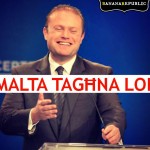
Those of a taghnalkoll persuasion might gleefully point their fingers at Austin Gatt’s reception of the €2,000 party donation but they would not do themselves any good if they ignore that such donations occur naturally across the whole party lines. The party “barter” system cannot vanish without the parties themselves vanishing along with it. That, my friends, is the unpalatable fact about the PLPN style of politics.

We saw how the loss of government influence strongly devalued PN’s “trading” power in the barter system – turning it into a bankrupt party overnight.

We also saw how the PL pie-grabbing exercises mean that the core party structure will survive another round simply by shifting its costs (and incomes) to government resources.

In the meantime the general public will act as indignant citizens and depending on which side your bread is buttered you will snort and denounce the “hnizrijiet” committed by the other side. We said it before and will say it again… you reap what you sow… and there seems to be no light at the end of this tunnel.

Below the gallery is a selection of old posts by J’accuse dealing with this barter and corruption issue.


On the Infamous JS List

Return of the JS List (August 18 2010)

(Evarist Bartolo) is insinuating that huge companies in Tokyo and Copenhagen had more than a hand in the assignation of the BWSC contract (remember that hot potatoe). The name dropping is not on the scale of ENRON style scandal but by Maltese standards it is big. There is an alleged web of intertwined interests that lead to linking the tenderor and the tenderee on the energy contract. There’s more. Bartolo does not shy back from implying that KPMG auditor to many of the parties involved served as a bridge between all the parties and government. And all this to lead to where? it’s not clear Who, What, When, Why or How but the conclusion is that:

“The PN has a system of fundraising where companies win government contracts and donate money to the PN. They are all part of the PN’s JS list,” Bartolo said, referring to the so called list named after former PN treasurer Joe Stellini.

Which is one hell of a whopper. From DimechGate to JS-Gate. Only, as I have been lamenting all the while, we need more tangible proof. We need cases before the Public Services Commission. It’s not a problem that the allegations surface on a newspaper – the newspaper is only attempting to perform its duty as part of the fourth estate – but there must be a follow up using the full strength of our democratic institutions. In a way there was never a shadow of doubt that contractors in various markets benefited from their contacts with the PN and that they performed services or investments in return. We just needed someone to get talking about them as a first step to something more direct being done about it. We do not have a magistratura in Malta as they do in Italy so do not expect a flurry of avvisi di garanzia very soon.

On Party Donations

From Business as Usual (April 25 2011)

Parties ask everyone for donations

Thus spake contractor Nazzareno Vassallo while celebrating his having survived 65 years in the dog-eat-dog world of Maltese building contractors. Were we surprised? No. Of course not. Would we wonder why his “well-known Nationalist sympathies have often worked against him when bidding for a contract.” Well yes. What does that mean exactly? Why does he bother funding both parties if his sympathies can work against him? How can he get away with frankly admitting that contracts ARE awarded on the basis of political considerations? Nazzareno is not the first to have claimed the “I oil both parties” approach. Sandro Chetcuti famously claimed it was important to have a pocket for every party (thank Mercury we only have two that count in the tendering business aye) and Vince “Holier than Thou” Farrugia has swung around the world of parties with better tempo than a grandfather clock’s pendulum.

(…)

Related:

Herrera alleges “rampant nepotism in financial sector” : one wonders if he’ll still be singing the same tune once it’s his party’s turn to milk the cow.

On Party Funding

From Funding Fundamentals (5 February 2013)

Idiots – that’s you the voters – are supposed to be carefully measuring the different proofs of liaisons that each party has with big business and throwing onto their homemade scales the various calculations as to who spent how much and where the money has come. Idiots (that’s still you) will then be expected to vote for the lesser evil. That, I guess (but I’m no idiot myself), will be the one with less ties to business and less I.O.U.’s hanging around in the pockets of various contractors and other men who can practically foot a blank cheque in times of need.

You do have to be an idiot though not to see past the protestations of both parties. On the one hand you have the ridiculous nationalist party “barter” concept. You see, the PN barters with companies like MFCC and in return for the use of their tents it gives them…. erm… See I’m stuck there. What the hell could the PN be offering to barter? It’s not like air time on its debt-ridden stations is free? Allocating a million euros of air time (in exchange for a tent) would mean perforce that that air time is lost from other who might have actually paid for the service.  Cardona also presented Beppe with a court case – Europrint vs MediaLink. Now that’s sweet. MediaLink owes Europrint half a million. Where will they get that from?

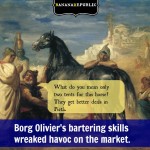
Labour on the other hand also have a hunch that we are all idiots. Their campaign CANNOT have been funded by the telethons. Igloos don’t grow on  trees Chris and you can have many many volunteers with ideas that you think are great but you cannot barter ideas for material in much the same way that Borg Olivier is not bartering ideas for tents. And while we are at it enough with this bullshit about the parties publishing their accounts. First of all Labour walked out of the committee for democratic reform (Select Committee on the Strengthening of Democracy) that not only put an end to the hope of electoral reform but also to any issue on party financing.

see also Grabbing the Iced Buns


BBC World Update on IIP

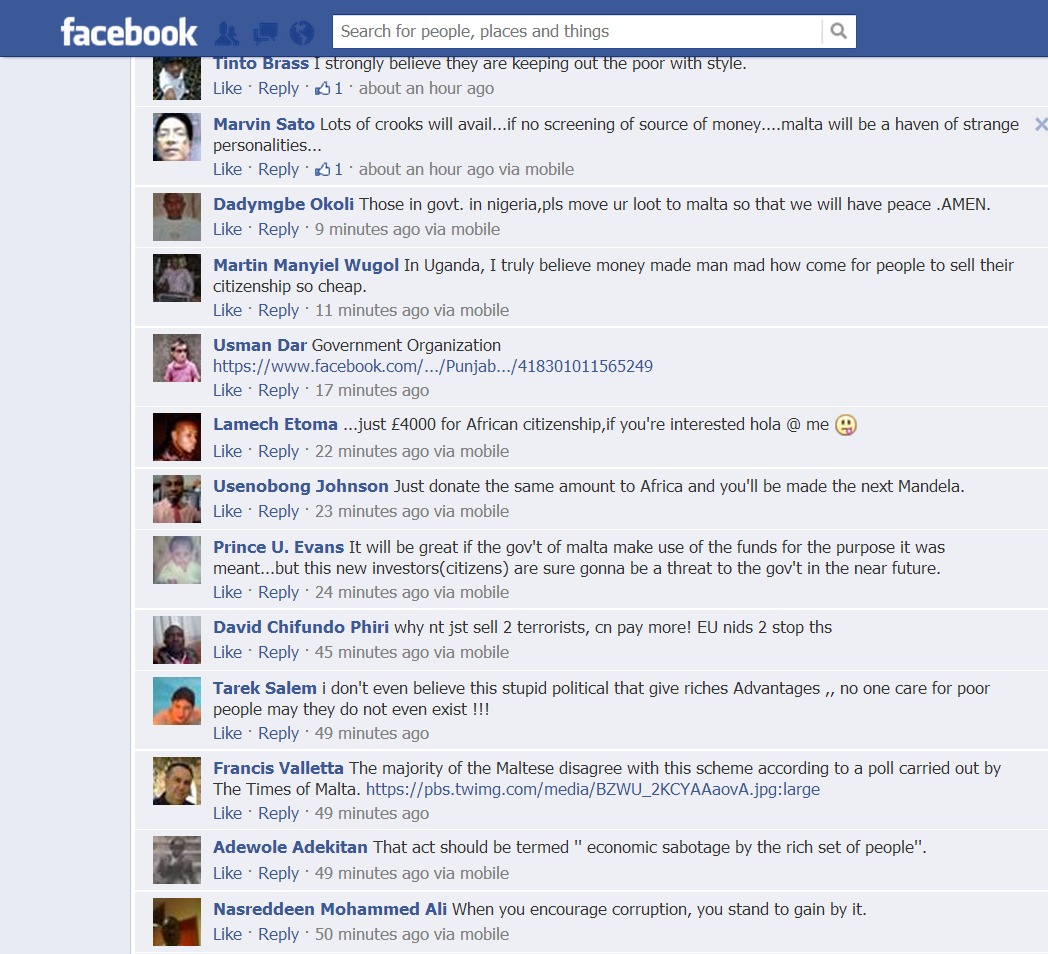
BBC’s World Update will be discussing Malta’s planned (?) IIP scheme. A post on Facebook announcing the programme has already attracted quite a long string on comments (see post here – Facebook account required). Aside from the ridiculous Labour party accusations that the whole international press attention is some kind of Opposition un-nationalistic concerted attack, this kind of debate just goes to show how global the topic of “selling citizenship” is. Unfortunately this debate will take place in a context where the final result of the IIP negotiations between government and opposition is not known. Notwithstanding the PN assurances that they will insist that “citizenship is not for sale” we have already seen some clues in the press that point to a system where the initial idea of an outright sale will be propped up with some investment criteria to make the idea “more palatable”.

Have Malta’s citizens been sufficiently consulted on this crucial issue? Should the fact that the two behemoths are “consulting” suffice – given how the issue was completely absent from their respective political manifestos? What mandate do Joseph Muscat and Simon Busuttil have from the citizens of Malta? These too are questions that need to be asked. I’m not comforted simply because Muscat or Busuttil tells me that it is OK.

worldupdate

The Hunter outside the Palace

When we decided to change the logo of SDM (the Christian Democrat Student organisation) in the mid-1990s we had decided to include a motto within a design that was meant to portray citizen participation and inclusion. The slogan, taken from Caldera’s tome describing the Christian Democrat principles translated as such “the ideal democratic palace is made up of the whole people”. We were very much into the notion of participatory democracy at the time and it was an interesting formative period of my  life.

One crucial question I have been asking myself recently, particularly after the discussions at the Vilnius closing conference of the European Year of Citizens, is “how far do citizens really want to participate”? Is not an ideal democracy one where citizens are duly represented and where such representatives go about with the business of managing the demos as entrusted unto them? Should a citizen be “active” on a daily basis or should his interventions be limited to the two instances of (1) electing those to be entrusted with the res publica and (2) intervening in moments of crises (taking to the streets)/extraordinary intervention by referendum.

The referendum – a method of public consultation is by now a familiar concept in Maltese politics. European Union membership and divorce have served to speed up the learning curve in this field and we know have a petition for a new referendum this time in the hope of abolishing Spring Hunting for good. It would seem that the representatives of our hunting community are suddenly alarmed that this petition for a referendum might be successful and they have kicked off a counter move – this time the move is a petition by the hunters to amend the very act that gives rise to Referenda. In the hunters’ opinion, such an act should never be used to stifle minorities.

It would seem therefore that the learning curve has hit a huge obstacle. The hunters’ move betrays a lack of understanding of the basic tenets of democratic action and participation. An act such as the referendum act is written in such a way so as to ensure that it does not become a tool for minorities to be ‘stifled’. Given the size of our population, it is already a gargantuan task to obtain a number of signatures that is sufficient to get a referendum going. Then, once the referendum does take place, one should also remember that it requires a majority vote – very much like a national election where similar issues are (supposedly) put on the plate in the form of electoral manifestos. That is why this blog (and a few others) have often insisted for more clarity from political parties during election time as to their commitments for their period in government.

hunter

That is also why the vague propositions found in manifestos are often more of an affront to representative democracy than the very clear aims of a referendum proposition. One should also not forget that a law that is a direct result of a referendum could also be challenged in the courts of law – especially if a citizen could claim that his fundamental rights are being infringed. I seriously doubt that a hunter’s right to shoot at will in Spring  time falls within the ambit of the fundamental rights of humankind and I only mention this check in order to paint a clear picture that goes beyond the PR-oriented assessment of rule of law and politics that is very much encouraged by our political classes today.

As it stands, the hunters are firmly entrenched outside the palace. They are not alone. Our political class have diluted all forms of accountability that would normally allow a democratic system based on rule of law, separation of powers, and checks and balances to work. When you have a government that first enacts a law, then rethinks it, then admits it was wrong, then admits it failed to consult stakeholders, then also remembers that there was no mention of this law in its political manifesto – and all the while such a government acts as though this was the most natural way of things and actually tries to get brownie points from its whole u-turn by claiming that it is “listening”… well then, something is rotten in Malta’s democratic palace.

“We are accounted poor citizens, the patricians good.
What authority surfeits on would relieve us: if they
would yield us but the superfluity, while it were
wholesome, we might guess they relieved us humanely;
but they think we are too dear: the leanness that
afflicts us, the object of our misery, is as an
inventory to particularise their abundance; our
sufferance is a gain to them Let us revenge this with
our pikes, ere we become rakes: for the gods know I
speak this in hunger for bread, not in thirst for revenge.”

(from Coriolanus, William Shakespeare).


Vitrines

My last visit to Vilnius was in 2002. I tend to remember the date of that visit mainly because of the inbuilt “football clock” – there was the Korea & Japan World Cup at the time. That last visit was also for a conference. I was a junior lawyer on the Maltese government’s team negotiating the accession chapters and this was a trip that would discuss competition.

I remember very little of Vilnius itself though since we spent most of the time closed up in the halls and the few times we gave the conference the slip it was to watch such important matches as Italy v. South Korea. I do remember remarking that the young country had not yet been fully impacted by the onslaught of capitalism since its liberation in 1990.

Walking up Gediminas Avenue in 2013 it feels like much more than 10 years have passed. The main road boasts a little of all the familiar names that are ubiquitous in the main cosmopolitan areas of the continent. My eyes shifted to the streets though (it’s actually impossible to keep your eyes off them anyway) and to the elegant passerelle of Lithuanians moving along the avenue.

Niall Ferguson cites consumption as one of the “killer apps” that allowed the West to dominate the rest. Attire and dress played an important part since the industrial revolution insofar as this killer app is concerned. I could not help but reflect on the fact that, along with the shop windows, you had the obvious consequence that a whole nation would dress smartly. Affluence begets affluence so to speak.

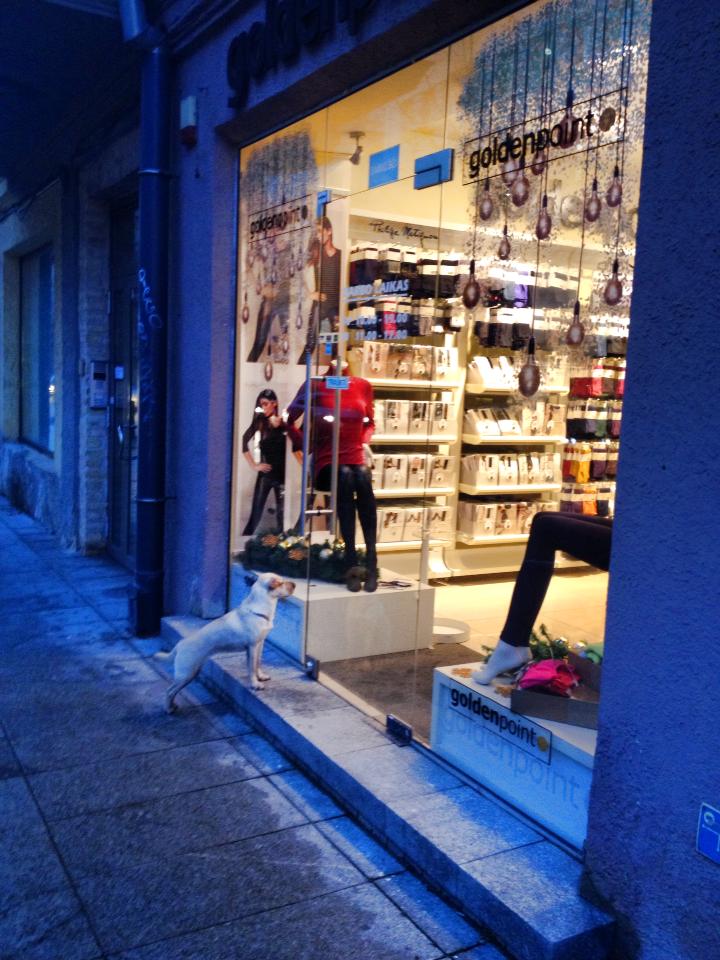
A dog’s life does not include these perks (Gediminos Avenue Vilnius)

The pan-European imprint of the shop window must say something about us, about the European citizen. This is after all the continent that perfected mercantile practices – across the seas, along the canals and on its main thoroughfares. Do our vitrines, our shop-windows, and their changing face say something about us?

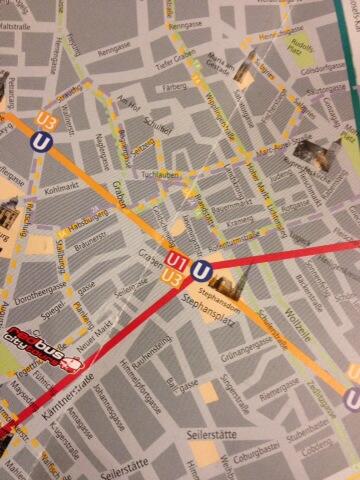
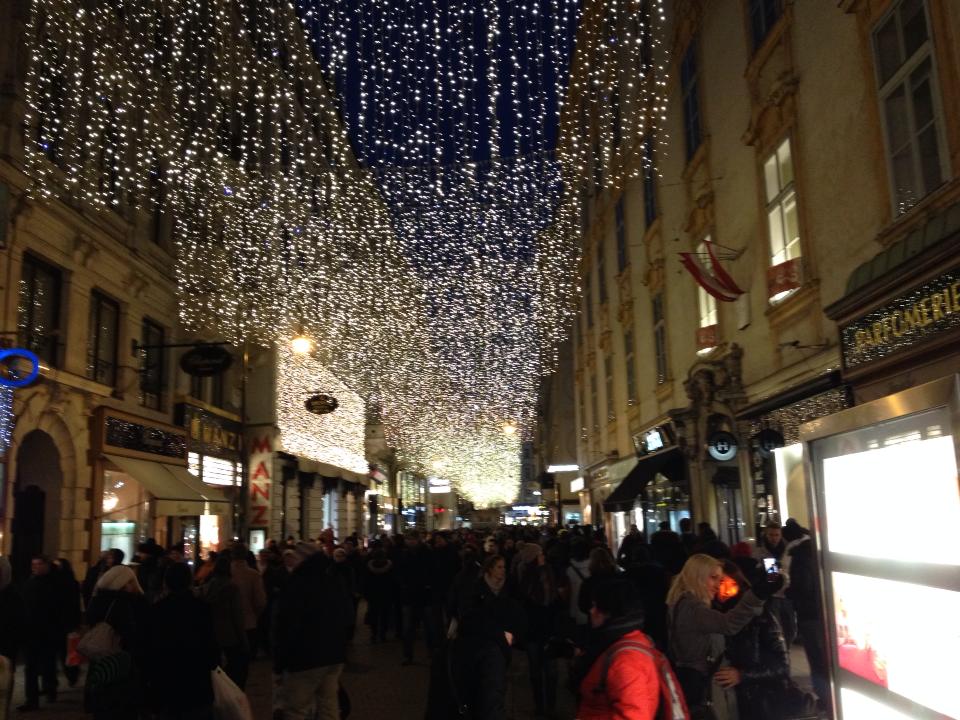
I stopped in Vienna on my way back to Luxembourg and having a long stop-over I caught a quick city train into the city. I was blown away by the huge number of Christmas shoppers that jam packed the magnificently lit thoroughfares. I did not venture much beyond St. Stephensplatz but the opulence of the Graben area with its deluxe trade names, its chocolates and sweets, its fur clad ladies marching irritable and irritating poodles … well they spoke to me immediately in the language of a society that was a step or two ahead in the affluenza tables.

map

Around Stephanplatz

Our Malls, our High-Streets, our “fashion” establishments. Do they impose an implicit harmonisation? Even before looking at this phenomenon from a global perspective, is there some conclusion that can be drawn from the European Vitrines? Do our windows have an effect on citizenship?

The window is after all often to be found at the forefront of political events. The angry citizen may vent his rage and frustration on the very shop window that would have contained his wishes just before the particular storm began to brew. Cities that expect riots (remember the G8 series?) will barricade their shop fronts and turn off the light of consumerism until the rage is over. England was once famously described as “a nation of shopkeepers”. Also, we are all too familiar with the lamentations of small shops and shopkeepers as behemoths elbow them out of the high street.

The social reaction to the evolution of shops (and their shop windows) can also probably be gauged as a sign of times. The interaction is (and will) remain mutual. As the shop and its window mutates so will the citizens and their lifestyles.

1471082_10153582240200368_1224488565_n

Crowds throng to the shops in Viennese Christmas shopping spirit

It-tiftixa tal-klassi mitlufa mill-fond ta’ pultruni sħan

Dan l-aħħar dan il-blog ġie akkużat li kien “klassist” u “elitist”. Ġie appik dak il-kumment għax kont diġa fi proċess ta’ thewdin u ħsieb dwar dan il-kunċett ta’ klassi. Fuq diskursata li kienet għaddejja fuq Facebook kont tfajt (iktar bi provokazzjoni milli b’konvinzjoni) li l-“klassi” hija mejta. Mhux għax nemmen li l-idea, il-kunċett astratt ta’ klassi, ma jeżistix imma (forsi) għax il-klassi fid-dinja postmoderna ma għadhiex daqshekk tanġibbli.

Ifhem, ġo moħħna meta nitkellmu bejnietna kullħadd għandu idea ta’ klassi / anki sens ta’ appartenenza għal klassi jew oħra. Hemm ukoll diversi klassi li jiġu definiti b’sens xjentifiku denju ta’ Linnaeus skond il-bżonn ta’ min qed jagħmel studju. Ngħidu aħna klassijiet demografiċi jew ekonomiċi. M’aħniex nieqsa minn tip ta’ “ikklassar” amatorjali illi trid jew ma tridx jaf jolqot fil-laħam il-ħaj minħabba raġunijiet storiko-soċjali.

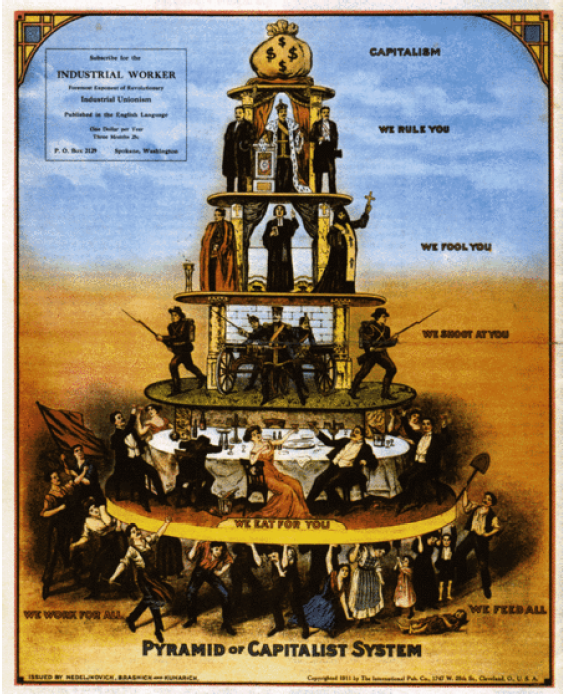
iww-class-pyramid

Ara per eżempju l-orġja ta’ sindikajr u garzellar illi isir fuq id-delinjazzjoni ħamallu-pepe li jxejjen il-linji Maginot ta’ l-ewwel gwerra dinjija.

Iżda fit-tiftixa tal-vera klassi li għandi f’moħħi kelli sensiela ta’ kriterji li xtaqt nitfa’ hekk fuq il-mejda sabiex forsi jintagħrblu mill-qarrejja.

1. L-għarfien li inti tagħmel parti minn klassi

Inqisha importanti din. Ejja nimmaġinaw li inħalltu il-kriterji ekonomiċi u dawk soċjali sabiex xufier tal-linja kolt u b’valuri konservativi u figlio di papa li jgħix ħajja ixxellerata u jiġi jaqa u jqum mill-proxxmu ma humiex faċilment garzellati. Ejja ukoll nagħmlu kriterju fejn biex wieħed jista’ jitqiegħed ġo klassi, tkun xi tkun, irid ikun (a) konxju ta’ l-eżistenza ta’ din il-klassi, (b) jaċċetta li jifforma parti minnha. F’dak il-każ kemm il-klassi ikun hawn? It-tikketti faċli jirrumblaw minn fuq ilsienna, imma jeħlu?

In-nouveau riches, il-familji landowners tal-giro del secolo fine ottocento, il-ħaddiema, it-tfal tal-ħaddiema emanċipati, il-professjonisti? Nistgħu niġbru ċetu soċjali ta’ familji illi trawwmu u draw is-sistema Mintoffjana li tiddependi fuq il-handouts? (fenomenu li żgur mhux limitat għal Malta – ara India u anki f’ċerti oqsma il-Lussemburgu). Għaldaqshekk ieħor xi ngħidu għal network ta’ familji nel giro nazzionalista illi bejn papa, ziju, u tribu elettorali ħolqu ċirku vizzjuz illi minn barra jidher ta’ “ħbieb tal-ħbieb”? Dawn iż-żewġ gruppi ta’ l-aħħar forsi ma jużawx l-istess termini biex jiddeskrivu lilhom infushom imma żgur li (a) jagħrfu li maqtugħin mill-istess pezza u (b) ikunu anki kburin li jiffurmaw parti minn dak il-grupp.

Din il-bloggata tieqaf hawn b’dan l-ewwel kriterju-provokazzjoni. Għad hemm ħafna x’nistaqsi u titkompla fi bloggati li jmiss.

Ġieħ il-Banana

Għażiża Gaia,

Din il-bloggata ma hix xi forma ta’ stmerrija jew disprezz lejn it-talenti u potenzjal tiegħek. Semgħek tkanta min kellu jisimgħek, u nies li żgur huma tal-widna iktar minni u li jifhmu fil-mużika wisq iktar minni raw fik talent mill-isbaħ li jekk indukrat tajjeb għad iferraħ widnet bosta oħrajn. Din ma hi bl-ebda mod xi attakk faħxi fuq il-persuna tiegħek u fuq kull min għandu għal qalbu “il-kompetizzjoni” tat-talenti li saret tant tħobb il-persuna mondana fis-seklu wieħed u għoxrin.

Kif issa taf sew Gaia, int ingħatajt premju (jew intqal li se tingħata dalwaqt) mingħand wieħed mill-ogħla uffiċjali fir-Repubblika tagħna. Dan l-uffiċċjal rak tirbaħ dik il-kompetizzjoni bejn ilħna żgħar għadhom mank imkissra u tant għereq f’orgażmu (tip ta’ eċċitament li titgħallem dwaru la tikber – jaf ikun eċċitament ikbar milli tirbaħ kwalunkwe premju) ta’ pjaċir u kburija illi donnu iddeċieda ħesrem, mingħajr wisq riflessjoni u ħsieb (kif wara kollox mid-dehra iħobb jagħmel) jikkonferixxi fuqek onorifiċenza ta’ importanza nazzjonali.

999207_621514967909458_179221610_nIva Gaia, se tingħata Ġieħ ir-Repubblika. Mhux int biss. Imma anki “t-tim” tiegħek. Ma setgħax jonqos li fi żmenijiet bħal dawn nippremjaw “tim ta’ suċċess” għax hekk imorru l-affarijiet. Issa ħalli li l-uffiċjal f’intervista li ta’ lill-press lanqas ma kien ċert jekk hux se tkun l-Ordni tal-Mertu jew Ġieħ ir-Repubblika imma dawk dettalji relattivament żgħar – l-aqwa li se nagħtuha xi ħaġa hux.

Issa ħa ngħidlek din Gaia. Din tal-onorifiċenzi ma hix xi ħaġa marbuta biss ma pajjiżna. Kull pajjiż għandu tiegħu tafx – lista ta’ nies li jiġu ippremjati jew b’rikonoxximent għal xi xogħol jew servizz li għamlu lejn il-pajjiż jew (ejja ngħiduha kif inhi) lista ta’ nies li ingħataw xi unur għax għaddew min hawn u ridna skuża biex ikollna riċeviment. Biex niftehmu kienu ilhom li naqqsu l-importanza ta’ dawn l-onorifiċenzi – kull ma għandek tagħmel hu li tqis li qablek kien hemm nies emeriti bħal Gaddafi (revokat) u Kim Il Sung li ingħataw l-istess unur mingħajr ma kantaw l-inqas strofa.

Li jinkwetani hu li minkejja il-merti kollha li jista’ jkollok int bħala kantanta hemm xi ħaġa li ma ddoqlix dwar il-mod kif l-uffiċjal tal-pajjiż ma jidher li għandu l-ebda stima jew rispett lejn is-simbolu tar-Repubblika u kull ma hu rappreżentat minnha. Ma kienx biżżejjed li iffissa prezz tas-suq fuq in-nazzjonalita – fuq il-fatt li wieħed ikun Malti. Ma kienx biżżejjed illi l-għażla ta-qaddejja fidili tar-Repubblika saret farsa sħiħa fejn iktar tistħajjel orġja (iva erġajna) ta’ ħbieb tal-ħbieb jiffangaw.

Ma kienx biżżejjed u issa ser inqassmu ukoll l-onorifiċenzi qishom il-pastizzi proverbjali. Li jinkwetani Gaia mhux li int, bħala Gaia, se tingħata onorifiċenza – ħalli li huwa lampanti li fil-każ tiegħek u dak li għamilt mhux talli ir-Repubblika qed tkun ġeneruża imma qed tniżżel ħafna l-istandard ta’ x’għandu jiġi ippremjat. Jinkwetani appuntu din il-moda li ma tagħrafx il-bżulija, l-għaraq ta’ min jistinka u t-talent imrawwem fuq medda ta’ żmien.

Jinkwetani li l-valur ta’ dak li aħna kburin bih bħala Maltin qiegħed kull ma jmur jitnittef fix-xejn. Tisma għajta ġdida imgeżwra fil-gidba egalitarja u meritokratika tal-Moviment Tagħna Lkoll biex kullħadd ikun jista’ jidħol l-Universita, kullħadd ikun jista’ jingħadd bħala kantant u kullħadd ikun jista’ jsir politiku. Kullħadd, jgħidulek għandu dritt għall-opinjoni u kullħadd għandu dritt għal xogħol bħala uffiċjal mal-gvern avolja ma jkunx jifhem f’kazz (skużani imma kulltant ir-rabja tagħmel bijja). Għax inkella taf int, Gaia, “mhux fjer” jew “ilhom ipappuha u issa imiss lilna lkoll”.

Allura nistaqsi Gaia, din hi il-ħolma Maltija? Dan hu “The Maltese Dream”? X’jibqalek hi u tagħlaq is-sena 2013 li tgħid li inti kburi li tgħix jew tiġi minn din il-gżira?

Għad għandek 11-il sena Gaia. Ma nafx kemm ħaqqek terfa’ responsabilta’ bħal din fuq spallejk imma inħeġġek taħseb ftit dwar pajjiżek u n-nies li jgħixu fih u forsi ġo ħsiebek tinbet idea jew riżoluzzjoni li minbarra li tipprova tgħix ħajja normali, int u l-ġenerazzjoni tiegħek tagħrfu tarmu iċ-ċuċati li bihom iżejnu u jiddandnu l-uffiċjali ta’ llum. Għallinqas hekk l-unur (forsi) ikun sewa’ għal xi ħaġa.

Mill-bqija, setgħet kienet banana.


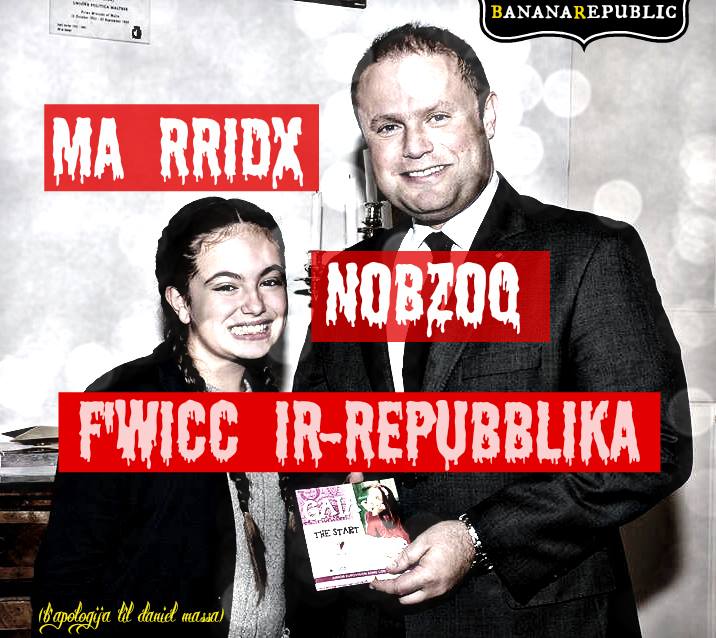
Ma rridx

nobżoq

f’wiċċ ir-repubblika.

(Daniel Massa)