The Blame Game & Simon

blame_akkuzaOpposition leader Busuttil was lambasted from some quarters for having dared suggest that the whole Enemalta procurement scandal was actually abused of as electoral fodder by Muscat and his men. What Busuttil suggested was really not too hard to understand – if the information was available long before the election loomed ominously, why was it withheld until a time when it would pay Labour in opposition as an extra baton to imply government corruption?
Busuttil was not implying that the information should have been kept quiet until after the election (who would think such a thing anyway?) but rather that it should have surfaced when it was discovered and not much later. While the PAC continues on its fishing expedition trying to pin the whole scandal onto Lawrence Gonzi Busuttil’s kind of assertion will fall on deaf ears or attract the playground type of response that the Labour machine has been honed to give.

The HSBC Swissleaks now adds to the intrigue of the Farrugia Brothers discoveries in that it provides an easier target with the cliches straight out of conspiracy theory books – which is not to say that there is nothing underhand going on in the world of procurement, government permits and the like. The problem lies elsewhere. In Malta there is no such thing as investigation beyond politically motivated with-hunts. The politically motivated is also limited in its extent since oftentimes the investigators have a huge interest in making sure that they do not in turn become investigated.

We just have to look at what happened in Italy in the early nineties to understand what I am getting at. Our political parties have developed a system of self-preservation that became ever more evident during the last election. Rules and laws of the overall system have gradually been adapted to ensure the survival of the two political parties – not just politically but also financially. Hidden behind these rules is a system of favoritisms and expectations that link the political aspect to the economy in general on the one hand (from employment to contracts to tenders to permits) and to the social on the other (medical rights, entertainment “elites” and circles).

It would not just be limited to the parties. Institutional flaws would also surface – authorities controlling pieces of the market suddenly hold strong cards for bargaining: which is where I suspect the whole Enemalta picture fits in. From the most expensive multi-million euro tender to the smallest warden with fine giving powers there is an alternate currency of favoritism and favour. Of course if you are the party in government you and your men have a stronger bargaining power. Everybody gets their unjust desserts.

Mani pulite in Italy uncovered a clear system where bungs were paid to the pentapartito (five main parties from DC to PC) whenever anybody anywhere wanted to merely conduct business. No bung (tangente), no party (tender). Does this happen in Malta? The evidence seems to be pointing to it having happened on a regular basis – not necessarily with the blessing of politicians – and that it can still be occurring to this day.

Labour seems hell-bent on institutionalizing the system further. There is no longer a need to hide the “debts” owed to supporting lobbies. It is translated immediately to enabling laws or worse still – as the forthcoming threat of an amnesty for all MEPA violations shows – an actual conspiracy to render the illegal legal. Illegal constructions will enjoy a bonifico of huge proportions and consequences – all so as to appease the debts that got Labour into power. The network between social and business interests intertwining with government is becoming more and more dangerous. We do not have a pool of inquiring magistrates as the Italians did and in some way we can consider that a blessing of sorts given how some people here tend to interpret the laws.

Simon Busuttil was right though in turning up the heat on Muscat. The whole Enemalta investigation is misguided if it turns into a fishing expedition on Lawrence Gonzi. If, rather than speculating in the style of our tabloids, proper questions were asked as to how our whole system is beginning to stink of favoritism, cronyism and party-instigated corruption then, maybe, we could be getting somewhere.


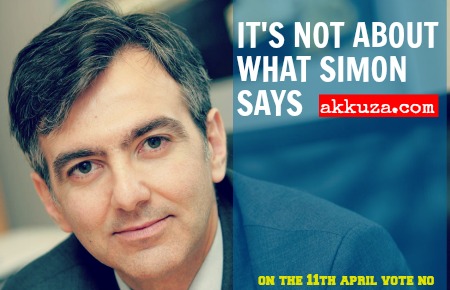
It’s not about what Simon Says

simonsays_akkuza

Diplomacy, they say, is the art of letting someone have it your way.

I rarely agree with Joseph Muscat and I don’t always agree with Simon Busuttil and when it comes to the referendum for the abrogation of the turtledove and quail hunting regulations I am in agreement with neither of them. It’s not so simple as a YES or NO vote though. The gigantic chessboard that was set in motion once the constitutional court found no objections to the petition for an abrogative referendum is full of diplomatic minefields, political manoeuvrings and vested interests. And notwithstanding the incredible murmur that hit the web once his press conference was over today it really is not at all about what Simon Says. Then what is it about?

It’s about hunting

In essence it should be. The aim of the referendum is an attempt to end spring hunting “once and for all”. That is what the NO camp hope to achieve. I have explained the technical reasons why the result of the referendum must be seen more as a political achievement than as a legally binding result. Put simply the more people vote for a ban on hunting the more the political parties who run the daily show will get a message (and a sort of protracted mandate) not to do anything to facilitate spring hunting again. At least for the time being. So what is needed is numbers. Big ones. It’s a vote with your feet moment. And that is where there might be the first problem. This is the first issue requiring a referendum about which lots and lots of people quite frankly don’t give a damn. It does not touch their pockets, there are no electricity bills to be lowered and probably they are more irritated by the whingeing of the “tree-hugging greens” than anything else. Is there a large enough section of the population who might bother to turn up at the polls simply because they hate the kind of bullies that rally behind a gun and a bullets on a protest in Valletta? Je ne suis pas convaincu.

It’s not about a derogation (really)

There is so much confusion on this point that even Simon Busuttil slipped on a nasty banana shortly after his press conference explaining his position. “I am voting for a derogation that WE negotiated” he said. No you are not Simon. Neither is Joseph for that matter. See, the “derogation we negotiated” that everyone is talking about is an altogether different derogation that was negotiated by the Fenech Adami government and concerned trapping. The derogation referred to in this referendum is the reason why we have the legal notice that some of us are now hoping to abrogate and it was not the result of negotiating skills of any pro-hunting Maltese. It is a mechanism that exists in the Birds Directive and – much to everybody’s chagrin – will continue to exist no matter how you vote and what the result is in the next referendum.  If anything I had been hoping that Simon Busuttil would say that his position was in favour of a proper use of that derogation – as against the carte blanche interpretation that has most recently been given by Joseph Muscat’s government or as against the interpretation given by the Gonzi government in 2008 when arguing before the European Court of Justice. It was a chance for Simon to show a real change in attitude by one of the parties – no lies to suck up to the hunters -the simple truth: we will work on the derogation when the conditions exist to apply it. Given that those conditions are very strict and exceptional because they are set within a framework based on real conservation it might have even made many bird lovers happy while reassuring those who are still testing Simon that their new leader does not bow to the men with guns.

But it’s not about the parties

In the end though it should not be about the parties. As I said, the PLPN had long abrogated any idea of leadership in this field. Their track record is atrocious and anyone waiting to hear what the PL or PN had to say before making his mind up about what to vote for in the referendum would be absolutely off the plot. Joseph Muscat tried every trick up his sleeve in order to appease hunters. First we had the slackening of conditions for hunting, licensing for hunting etc. Then it was obvious he tried to avoid the possibility of a referendum as much as possible. Finally when the referendum became inevitable he hoped and hoped that he could get away with an isolated referendum away from Local Council elections. When that idea caused a ruckus and backlash he succumbed and threw in the Ace up his sleeve. He backed the YES vote personally and automatically had that translated as the official Labour Party position. Labour had reneged on its promise to keep out of the campaign and had been forced to back the hunters by its scheming leader who was still underwriting the cheques he had issued before the election. Muscat now had one more wish – that Simon turn this into a PL vs PN move in the hope that he could translate this into a double trashing: a victory for the hunters and a beating of Simon by default.

Which is where you can begin to see Simon Busuttil’s position from a newer, better perspective. First of all Simon was right to first wait for the party to take a position of its own. I would have preferred it to stop at that. Probably what happened next is the result of Labour’s trying to egg Simon into an open battle and to taint the referendum with yet another partisan war. Simon would have none of that. There was the danger that he would be labelled a fence-sitter (unfairly, if we agree that waiting for the people’s decision was the right thing to do). There was the problem of consistency – given how the PN’s position had not exactly been anti-hunting in the past. So Simon has opted for the stalemate insofar as Labour is concerned. He has chosen to neutralise the Labour vs PN battle by throwing in his personal opinion on the side of the derogation (admittedly he wrongly claimed this is the negotiated derogation).

It’s a smart move really because this turns the referendum into anything but PL vs PN. Busuttil has sacrificed the possibility of measuring his popularity to the hope that the voters think with their own mind and transform this into a battle of the people or civil society vs the establishment. I would have liked a clearer position with regards to what kind of spring hunting Simon Busuttil was committing himself in favour of but given the red and blue manner of thinking for which this electorate has been groomed, Simon’s “sacrifice” for the greater good of a clear non-partisan vote turns out to be admirable. The proof of the pudding will be whether Simon’s party will act like Labour and do its utmost for the YES vote to be carried or whether the PN will limit its pronouncements to today’s leader position and allow the people to decide.

It’s about a clear statement

Which brings me back to where I started. The most important factor in this result will be the statement of the people. This is an issue upon which both parties gunning for leadership of the country (pardon the  pun) have long compromised their souls in the past. Theirs is not a position of vision. The true representative party will  be the one that takes note of a referendum result and works upon that for the future of hunting. As I said, confusingly for many people, the derogation will still remain a possibility within the Birds Directive. How and why parties in government decide to make use of it (if at all) will depend on the clarity of the vote come 11th April. Only a resounding No will tie the hands of scheming politicians like Muscat or will give a clear mandate to Simon Busuttil in the future to use the derogation wisely and within the clear and strict conditions within which it is framed.

Go out there and vote clearly. The truth is that this referendum is about what you think and what you believe.


Expression is free

expression_akkuzaOn his way to the Philippines Pope Francis conceded yet another few comments with regards to the Charlie Hebdo massacre in France. It’s the Pope speaking – don’t forget he was considered for a long time to be infallible. Bergoglio is a great communicator and has won back many sheep to the fold of Catholicism thanks to his attitude and humility. I don’t know if it is the euphoria of the moment or the relaxed atmosphere of a casual interview during a flight but Bergoglio’s qualification of the freedom of expression made me cringe.

“Imagine my assistant insulted my mother”, he said, “then he would be risking a punch.” Really Francis? Since when is that the standard Catholic answer? Whatever happened to turn the other cheek to begin with? But I am not here to tell Francis what his religion teaches as to how to react to violence or insult. What worries me is that there is little different between Bergoglio justifying a punch for an offence and an Imam in London claiming that the Charlie Hebdo journalists asked for it. It’s no different from the reaction in some quarters that called for a limit to the freedom of expression to be set at the prohibition of causing offence.

Right now it is tough for citizens of the nations that are run by the western democratic paradigm to reconcile their ideas of liberty with that of Charlie Hebdo’s freedom to insult and offend a cult. Can an opinion be damaging? Can it be allowed to be damaging? If I believe that stories like the immaculate conception and resurrection are absolute hogwash am I allowed to lampoon them in cartoon fashion? What does the freedom of expression say about that?

Well, in France the courts have already had to deal with this kind of question. There is a difference between the use of the freedom of expression to parody, mock and, yes, even offend on the one hand (which is allowed) and the use of the freedom of expression to incite hatred or call to violence. The reasoning is that nothing is sacred when it comes to the boundaries of freedom of expression. There are of course mechanisms to protect persons who feel damaged by another’s expression. You can see the right to protect against libel and calumny of course. But when it comes to mocking religious figures – there is no limit. Mock and be damned.

Why then are people arrested if they tweet or post on the internet in support of the attackers of Hebdo’s offices? Are they not expressing their opinion too? Well yes they are but they are also justifying the crimes by their acts. In France it is called “apology of terrorism”. It is seen as a step towards incitement to violence and hatred and that is why it is not allowed.

The difference is sophisticated. It requires a level of intellectual engagement that is not available to all. Living in a liberal democratic society requires that kind of sophistication. It takes a level of intellectual engagement to control the savage instinct of resorting to violence when one feels offended and instead to dismiss the efforts at lampooning as puerile schoolyard humour. Life in a western liberal democracy is not for everyone. Many would prefer to be shielded from offence by governments that censor and prevent caricature. Theirs is not the promised land of the west. They would prefer to be able to punch, flog, whip, punish a lampooner than simply look away and not take notice of anything that so deeply offends their sentiments.

They would resort to laws and bullying to silence where possible. If the law does not help them in that sense, if it is too liberal then they will exploit the weakness of the politically correct age and claim that this is about islamophobia, antisemitism, irreverent anticatholicism. “Je ne suis pas Charlie” they will tell you but they miss the point.

Because being Charlie does not mean having a predilection for infantile, sexually oriented humour and for easy (too easy) quips about prophets popes and saints. Being Charlie means having a sophisticated understanding of living in a society where others are free to express themselves in accordance to our charters and where the right kind of reaction is one of intellectual engagement not judicial or physical bullying and savagery.

Being Charlie means hearing yet another Yo Mama joke and not having the instinct to punch the joker in the face. Because being Charlie means understanding that the joke is always on you. And that’s as subjective as it can get.

Fence-sitting and Bird Hunting – all you need to know for the referendum

kakkuza

On the 11th of April 2015 the Maltese electorate will be called upon to express its opinion as to whether or not the derogation to spring hunting should continue to be applied. In short, layman’s terms the referendum will determine whether or not it will be possible to continue to hunt birds in spring. At least that is what we think is at stake. The issue is a minefield of controversies for a multiplicity of reasons. Hunting is notoriously a thorny issue, not least because of the hold that the hunting lobby has on the major political parties of the land. Also, since 2004 and full membership of the European Union, Maltese law has been complemented by the corpus of EU law, not least among which is the Birds Directive that includes what we tend to refer to as “the derogation”. Malta’s hunting practices have already been questioned under the terms of this directive and it got quite a few slaps on the wrist that time round. There is also the issue of an abrogative referendum. What is that about exactly and what effect does it have on the order of things?

As you can see it’s not that simple. As usual J’accuse is out to dispel some misunderstandings and research some truths for the benefit of the reader. Here is a list of observations on what is going on, in no particular order.

The Derogation

Let’s get this one out of the way, technical as it may be. What is this derogation and how does it fit in Malta’s hunting scene? Well it all begins with the Wild Birds Directive (the one we would label 79/409/EEC). I’ll let the Guidance Document on the directive tell you what it is about:

Council Directive 79/409/EEC on the conservation of wild birds (the so-called “Birds Directive”) provides a common framework for the conservation of naturally occurring species of wild birds and their habitats throughout the European Union. The directive owes its origin to the fact that wild birds, which are mainly migratory, represent a shared heritage of the Member States and whose  effective protection is typically a transfrontier problem entailing common responsibilities. The Birds Directive fully recognises the legitimacy of hunting of wild birds as a form of sustainable use. Hunting is an activity that provides significant social, cultural, economic and environmental benefits in different regions of the European Union. It is limited to certain species, listed in the Directive, which also provides a series of ecological principles and legal requirements relating to this activity, to be implemented through Member States legislation. This provides the framework for the management of hunting.

So that is the genesis – the why and how of the directive. You may have noticed that there is an emphasis on the idea of sustainable hunting and basic ecological principles that exist behind hunting within the framework of this directive. So, the basic rule under this directive is that killing birds is not allowed. Essentially the basic principle is the “conservation of all species of naturally occurring birds in the wild state” (article 1). Member states are not only encouraged to limit instances of hunting but also to take measures to “maintain population” of species and to encourage their preservation by, among other things creating protected areas (article 2).  [For an in depth look at the next few articles scroll down to the end of this post *].  Having described when hunting may be allowed and what species may be hunted we can now look at Article 9 which is the infamous derogation.

It’s quite straightforward really: member states may derogate (create an exception to) from the provisions of articles 5 to 8 where there is no other satisfactory solution for a number of listed reasons. The reasons are the following:

  1. In the interests of public health and safety, in the interests of air safety, to prevent serious damage to crops, livestock, forests, fisheries and water, for the protection of flora and fauna.
  2. for the purposes of research and teaching, of re-population, of re-introduction and for the breeding necessary for these purposes.
  3. to permit, under strictly supervised conditions, and on a selective basis, the capture, keeping and other judicious use of certain birds in small numbers.

So. Let’s get one thing clear. The derogation is not a bespoke derogation that Malta negotiated and “acquired” in pre-accession talks. Forget the nationalist party claims that they had managed to acquire anything special and specific to Malta. It’s all bullshit and forms part of the general PLPN approach to butter the hunting lobby the right way. The derogation exists for everybody. The crux of the matter is that certain conditions need to be satisfied. To hunt outside the accepted levels of hunting (outside article 7 conditions) you have to fulfil certain criteria. A cursory look at the above list of conditions will immediately make it obvious to any reader that the exceptions relate to emergencies where birds become pests – a necessary cull because of a disease, air safety = shooting birds that hang around airports and imperil aviation, or killing birds that are threatening livelihood. Not exactly “il-kacca namur”.

There is an important phrase in article 9: “where there is no other satisfactory solution”. A member state must prove that not only is the species in question a pest (or required for research etc) but that the only satisfactory solution would be to hunt the buggers. That is a very tough onus of proof, one that Malta failed in 2008 before the court. So there. You now know what the derogation is and (bar some more technical info on reporting) how it works.

 Applying the Derogation – the History

So the way the derogation works is the following. Member states do not need permission from the EU to apply the derogation. They may go ahead and apply it if they believe that they fulfill the conditions that allow the use of the derogation. Member states are however obliged to report to the commission every time they make use of the derogation. This allows the Commission to monitor the use of the derogation and to take action if it believes that the Member state abused of it. In 2008 the Commission felt that the measures taken by Malta fell outside the scope of the derogation because the Maltese authorities failed to show that there was no satisfactory solution other than spring hunting the species concerned. The sole purpose of Malta’s use of the derogation, according to the Commission, was to extend the hunting season for species of birds.

It must be hard for the Commission to keep a diplomatic poker face when faced with Malta’s argument – that hunting of the species concerned was possible in autumn, ok, but we did not have enough birds to hunt. We get more birds in spring so hey, we should be allowed to kill them then. In fact the stats presented by Malta for 2005 showed that in spring 15,239 quails were “taken” while “only” 5,109 were “taken” in autumn. Turtledoves? 31,493 taken in spring and only 4,990 in autumn. At no point did Malta bother to justify the use of the derogation under any of the criterion required under article 9 of the directive. At most, Malta argued, the total prohibition on spring hunting would in practice lead to the entire prohibition of the hunting of the species.

In the end the Court rapped Malta’s wrists very strongly for that period, emphasising that there must be a balance between protection of species and certain leisure activities. The derogation must be used proportionately but Malta did not prove such proportionality given that it allows the killing of 3 times more quails and 8 times more turtledoves in spring than in autumn. That, for the record, was Lawrence Gonzi’s PN government arguing before the court to justify the spring hunting season. We can only infer today that Joseph Muscat’s government would do the same – given the PM’s declaration that he would vote in favour of spring hunting. Same same, but different.

The Legal Notice and the Referendum

So if we got punished by the court why are we still talking about it? Well it’s not that easy. The issue arises every season. A Member state can declare the next hunting season open – always with the necessary conditions being fulfilled. In Malta we have Subsidiary Legislation 504.94 entitled “Framework for Allowing a Derogation Opening a Spring Hunting Season for Turtledove and Quail Regulations”. Under Section 3 of the legal notice, the Minister may decide to open the spring hunting season (a maximum of three weeks in April) by means of a notice in the Government Gazette. Since the ECJ case a proviso has been added:

 “Provided that the Minister shall not open the spring hunting season when the hunting for the two species concerned during the previous autumn hunting season may be considered as having constituted a satisfactory solution in therms of Article 9(1) of Directive 2009/147/EC f the European Parliament and of the Council of 30 November2009 on the conservation of wild birds, and taking into consideration the thresholds established in Annex I”.

See? The discretion is available for the government every year under these regulations. Every year a spring hunting season may be opened – supposedly bearing in mind the conditions of the directive. Once it is opened and the government has made use of the derogation it is obliged to report to the commission – including birds bagged.

In Malta we have the possibility of an abrogative referendum. What the referendum initiated by petition is doing is kicking off a vote as to whether or not the legal notice that empowers the minister to set up a spring hunting season should be abolished. So if the people vote NO (don’t ask why, but maybe Joseph is banking on the fact that YES has a 100% record in referenda in Malta) the Legal Notice will be abolished and the minister will have no instrument to set up a hunting season. If the people  vote YES then nothing changes.

Party Opinions and binding the future

First off the parties. Joseph Muscat has declared he will vote in favour of spring hunting. The Labour party has not got an official position although we are supposed to assume that since they are accusing the PN of dilly-dallying then they are assuming that Joseph’s position is Labour’s position. The PN has stated that it will wait for an internal debate before taking a position. Somewhere I seem to have read that Simon Busuttil is in favour of regulated spring hunting. I strongly believe that the two main parties have long abdicated any right or duty to be opinion formers and leaders on this issue. Their historical dealings with hunting lobby is such that it would be preferable if they both wait for the people to speak and then act accordingly. It’s not a question of fence-sitting but a question of  (for once) listening to the electorate they represent.

But here is my biggest question. Let us assume a victory for those who want to ban spring hunting. Legally speaking all that would have been banned is the legal notice that empowers the minister to set up a spring hunting season. For obvious reasons the Wild Birds Directive, derogation and all, will remain applicable in Malta. Even if our parliament were to vote out the Legal Notice in question there is nothing – absolutely nothing – that binds future parliaments and prevents them from re-enacting an implementing legislation of the Wild Birds Directive. This leads me to conclude that the message of the forthcoming referendum is political more than legal. A strong victory for the LE ghal Kacca would be a strong message to the parties in parliament. Sure they could in the future try to re-enact another implementing bill but they would do so in strong defiance of public opinion and would have to face the consequences.


What should have been done long ago by any party that has the environment at heart is that the Wild Birds Directive should have been implemented to the letter. Rather than promising the impossible to the hunting lobby (and conservationists), the parties in government could and should have been busy applying the directive – even if that meant an impossibility of applying the derogation and therefore no spring hunting. It would take a smatter of intellectual honesty and political accountability and responsibility.


Perhaps it might have been too much to ask.

How to vote?


I hope this blog post has helped clarify any questions you may have had. If you hold the environment to heart and want to pass on a strong message to our main representative parties then do please go out and vote LE/NO on the 11th April. This blog will be backing the No campaign wholeheartedly.


[*] The Articles in Detail


The directive contains annexes that are lists of bird species. Annex I contains the untouchables – the birds that need special conservation measures due to, for example, a danger of extinction or vulnerability (article 4). States are also urged to extend such protective measures to species not listed in Annex I but that may be regularly occurring migratory species (very crucial for Malta). Article 5 is the “thou shalt not kill” bit. You cannot kill birds, you cannot destroy their nests, their eggs, keep their empty eggs. You cannot even disturb the birds particularly during their breeding and rearing. Also, you cannot keep birds of the species the hunting and capture of which is prohibited. Clear? Article 6 prohibits the commerce in birds (dead or alive).


Which brings us to Article 7. Which is where our dear Turtledoves and Quail come in. Due to the population level, geographical distribution and reproductive rate of certain species (such as the turtledoves and quail), hunting may be allowed under national legislation. Careful though. It is not a carte blanche. Conservation standards must be respected. Turtledoves and quail fall within this category. The fact that a species is in Appendix II/2 and therefore one for which hunting is allowed does not oblige a member state to allow hunting for that species. It is an option that is left to the member state, and one that it must implement using national legislation allowing for such hunting to happen. Furthermore the directive requires that member states ensure that the practise of hunting complies with the principle of “wise use and ecologically balanced control”. While the interpretations of the latter phrase may be controversial it is definitely not an open license to kill indiscriminately.


Article 7(4) also asks of Member States that they make sure that the species to which hunting laws apply are not hunted during the rearing season or during the various stages of reproduction. This was an important point that was raised when the Commission took Malta before the European Court as it was one of the problems that arose when it comes to hunting in spring. Article 8 prohibits the use of disproportionate means of hunting in any case. you cannot use a kalashnikov, dynamite or rocket launcher, nor can you hunt from any mode of transport.

Blasphemy the redundant

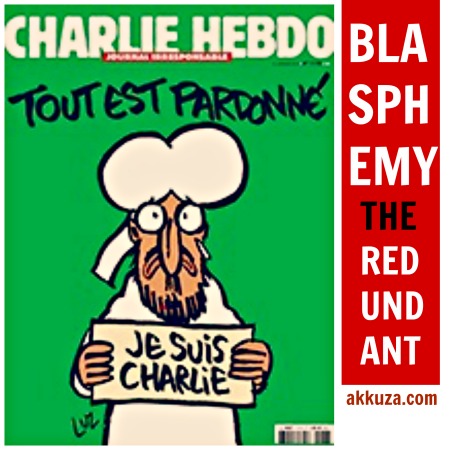
blasphemy_akkuzaThe first edition of Charlie Hebdo since the unfortunate events of last week is out tomorrow. The world has been given a preview of the front page which depicts a tearful prophet holding up a placard with the “Je suis Charlie” slogan. The background is in green – the colour of Islam – and the title is “All is forgiven”. The plan is to distribute the special 16 page edition (3 million copies are being printed) in at least 25 countries. It has been translated into four languages, including Arabic.

There is still a major problem though. To many muslims the mere depiction of the prophet is blasphemous. Charlie Hebdo’s irreverent treatment may be shielded from blasphemy laws in most of France (see next paragraph why most and not all) but when it tries to go worldwide in places such as India the issue of blasphemy might be raised all over again.

In the Alsace-Lorraine region they have a minor problem. On paper, blasphemy is still illegal under an article inherited from the German Criminal Code of 1871 when the region was transferred from Germany to France in 1918. I say on paper because when the League for the Justice defence of Muslims tried to have the law applied before a French court the court declared that the blasphemy law had become redundant due to “desuetude” which in layman terms means non-use for a very long time.

The truth is that outside the worlds where sharia or religious laws infiltrate or are one with secular laws, there is no place for a law on blasphemy. It is redundant. This applies all the more strongly in most liberal democracies where the basic charter of fundamental rights or variants thereof are applicable. Just before the attacks on Charlie Hebdo a group of representatives of the major religions (curiously the word “cultes” is used in French) had petitioned Paris to abrogate what the Archbishop of Strasbourg described as “an obsolete law”.

Blasphemy is inherently inapplicable in a secular state. The difficulties abound especially when it comes to the forces of law and order who are supposed to perform on the spot assessments of what could or could not be blasphemous in order to eventually effect an arrest. Blasphemy is in fact not restricted to one religious belief by definition (even the Maltese law on blasphemy that subsists to this day extends protection to all approved religons). So how on earth can your average policeman, called upon to intervene on a supposed commission of an act of blasphemy , assess the situation without being extremely well versed in the tenets of each and every religion which could be offended?

In truth the issue of offense  – which is the other side of the coin of the freedom of expression and which could constitute the barrier or eventual limit to such expression – is sufficiently treated and dealt with in other, wider provisions that deal with that very freedom of expression. Blasphemy is redundant, useless and archaic.

The other problem faced by  Western Liberal Democracies (my capitals) is that they must be able to explain the register of rights and duties that are expected of citizens wanting to partake of their civilisation and society. These rights and duties are codified in rules that form the backbone of society and that everyone is expected to abide by. The rules are enacted by representatives of the people with the sovereign will  entrusted unto them in open elections. They are applied by the executive branch and interpreted by the judiciary. This civic process ensures that we live in a system of rule of law with clearly defined rights and protection. Cives Europaeus Summus ut Liberi Esse Possimus – we are citizens of Europe (read Western Liberal Democracy) and thus we are free.

In a Western Liberal Democracy you do not take up arms and kill somebody who has insulted you or your beliefs. You react using the tools, rights and laws that are as accessible to you as they are to others. That is what is meant by integration too. You can be a fanatical muslim, an orthodox christian or one of those insufferable atheists pouncing on anything religious at any opportunity. You are expected to behave like a model citizen in order to integrate in the society that welcomes all and gives them a myriad of freedoms so long as they do not hurt others.

It’s simple really. A basic set of tenets that both Yeshua of Nazareth and Mohamet might have subscribed to. It is a society that allows you to be strong in your beliefs while respecting those of others – no matter how irreverent they may seem in your eyes.

Ours is a society where to resort to violence, bullying or savagery in order to impose one’s views is abhorred. In fact it is considered blasphemous.

#jesuisciveseuropaeus

Let them eat baguette

baguette_akkuzaA Happy New Year to all J’accuse readers and diehards. This blog starts its heavy trek towards celebrating ten years of blogging after an unforced hiatus. No, that is not a word stolen from Varist’s vocabulary. I return well rested from a visit to the islands that are fast becoming the second home with a wealth of newly absorbed information about the daily travails of the Maltese citizen.

The general outlook on Malta seems to be fair. My partner likes to think of Maltese as hobbits because, as she says, “You think of food first and foremost, wherever you go.” In a way it is true. Back from a trip abroad? Visiting a new city? Our first enquiries and experiments are culinary. Veni, Mangi, Judici. Our trips are coloured and defined by food. Panem et circences does take on a new meaning where the Maltese are concerened because we are a foody people.

“Kemm kilt pastizzi ja hanzir?” It is hard to speak collectively about taste in food. There is the eternal battle between quality and abundance. Somewhere along the lines there is a dividing line (or lines) that might set aside a different set of classes from Joseph’s Mittilklass. Food in all its simplicity might be venerated for the simple purpose of gratification – fenkata tajba or a simple but spot-on meal at Rita’s at Ghar Lapsi. It might take on a whole new fifty shades of implications of perceived class like when we sell a recipe book as being the one “miktub mir-ragel tal-President”.

The quest for honest to god simple good food is now complicated with the invasion of the little italians. Sicilians, Apulians, Neapolitans and Tuscans all giving a thumbs down to Renzi’s dream and scuttling their euros to Joseph’s Malta. So long as he does not get the bright idea to hike up VAT on drink as they did in the Duchy this year (up to 17% from 3% – a pint now costs 5.40 euro) they will keep coming. Is your divine tagliata di manzo con rucola parmigiano simply a culinary venture or your tiny participation in a money laundering venture set up by the sons and relatives of the camorra, mafia, ‘ndrangheta or sacra corona? Does it taste the same once you get to know that?

And what of that burgeoning empire of Hugo’s? Surely those millions cannot all come from selling a delicious platter of sushi or a well-aimed shot at making a digestible pad thai? Is it the jet-set factor? Does it pay to be seen eating at Hugo’s tapas/oriental and now middle east or burger?

Cook at home? You can shop at Lidl’s now that More has bitten the bullet of the fast money laundered buck. Nobody need know the origin of your faux foie gras once you’ve unpacked it out of the box. As for the idea of plenty I was overwhelmed when I was told that I had 24 litres of water for free since I had spent the right amount at the exquisitely stocked GS supermarket in Naxxar. Then there are charities trying to set up funds to bring fountains to remote African villages or stoves to Guatemalan denizens. It’s all so confusing.

But back to class and food. Muscat’s dream of creating a new mittilkless has hit the metaphorical brick wall when it comes to AirMalta. The people who are so used to measuring their travelling experience by the food that they eat (and the more it seems to be “free” the better) have been told that henceforth they are to be handed only baguette and water on all Air Malta flights. For baguette read a tiny bread roll that would not satisfy even the most Mittilkless of desires.

The point is not really the food on board the flights (the longest of which is around the four hour mark) but the principle of telling the people of the bountiful plate that they will have to make do with the snacklet in order to save those “ghasafar tac-comb”. There does not seem to have been a shift in ticket prices. No lower fares to reflect the lower (food) fare on board. The government obsessed with class and class aspirations, the one that makes a meal of free lunches on the taxpayers account has told the people that “they can eat baguette”.

Deep down it has little to do with the economics of saving a faltering national airline. It has much to do with the hunger of the aspirant mittelklass and their aspirations for inflight microwaved chicken or lasagne.

To some people it might have just been an amusing snack on board a quaint airline. To the emancipated wave of mittelmaltin that Joseph inspired it meant the world.