Windows of Opportunism

The good news is that it would be a “landslide defeat”. Labour would probably stroll into government with a victory by default that affords it a “stable” three-seat margin (at least). Such a majority would ensure that Labour can afford to have at least one “Franco” or “JPO” without losing its parliamentary majority. If that’s what counts as stable government these days then Muscat’s dream team would be as solid as a rock.

If the stakes were all about getting into power and staying there then Labour would be the horse to bet on. The core voters would be joined by the disgruntled, the “about time we change” (it’s only fair) and the new clan of PN-haters to form an unassailable lead at the polls and Bob’s your uncle. Or is he?

Windows

Well it’s not all roses is it? Franco Debono is promising to be the hair that broke the (fragile) camel’s back. J’accuse has chronicled how his behaviour has exposed the weakness of a machine that was assembled solely for the purpose of winning an election to the detriment of any coherent plans and values of governance. Sure, economically an argument can be made that the Par idejn sodi motley crew has contributed to the weathering of the economic storm until now. Some circles might beg to differ and will claim that our micro-economy would never have really borne the brunt of the euro maelstrom anyway – so it’s not thanks to Tonio and Lawrence that we’re quite ok.

Although budget wise we got a half-hearted OK by the Commission this week (bar some expensive tweaks to the deficit) the government remains unaccountable for a long list of grudges and defects that is only aggravated by its perverse ability to antagonise through perceived arrogance. A disjointed team was exposed in the issues of Transport Reform, Divorce Legislation and social and criminal reform laws – not to mention the honoraria fiasco. There is much revising and soul-searching to be made.

For every mea culpa on the government side there was a mini-window of opportunity for a prepared opposition to shine. Do we have a beacon prepared to step in once the current set of governors crumbles? J’accuse is painfully aware of the over-used cliché of the “unelectability of the opposition”. The fact that it is oft repeated and the fact that it was a major weapon in the armoury of GonziPN’s last election victory does not make it outdated automatically.

Muscat’s Labour seems intent on repeating GonziPN’s fatal error of 2008. They prepare for some sort of electoral victory but is this a party that is proving that it has the right credentials to govern? The smokescreen of the Franco saga might invigorate Labour hopefuls and build their hope for a change in government. The removal of the power weary Nationalists would not come a moment too soon for them. The mistake they make is that they equate the satisfaction of removing an expired government with the automatic assumption that anyone who steps in by default will be good for the job.

Who do you want to be today?

As Anglu Farrugia and Joe Mizzi table a motion for a vote of no confidence (to be held on Thursday 19th) Muscat’s Labour is counting on a snap election and a short-cut to the corridors of power. What it will do with the power when it holds it is anybody’s guess. Until now we do know that Labour is not Nationalist. We have promises of utility bill cuts without an explanation as to where the money to cover these expenses will come from. We have a farcical approach to manifesto writing (the cards to my chest approach) coordinated by an old timer and now with an arriviste error-prone wannabe as a manifesto secretary.

At the moment when it could have made its will clear and its vote count – the divorce votes in parliament- Labour wavered. This was the party in opposition mind you, not the one in government. In that instance Muscat displayed an inability to muster his men and his party behind one clear progressive cause notwithstanding the fact that it was not nuclear science. Did Labour (in opposition) manage to block vote a YES to divorce? No it didn’t. Muscat – in opposition may I remind you – conjured up the FREE VOTE. What is the free vote other than an admission that the Labour leader could not really be sure which way his member’s consciences would be playing?

On a straightforward progressive policy that should have been a piece of cake Labour faltered. It failed to take a clear party position and was unable to be clear about the way it would vote. This was the party in opposition with no governmental power to lose. Opportunism dictated that Labour gives the impression of going both ways. Thankfully in the end common sense prevailed and parliament enacted a divorce law. But not thanks to Labour. Not thanks to the PN either but still… it’s not the point here.

From the Libyan crisis to the Euro Crisis to Transport issues it has been evident that Labour is operating on the knee-jerk opportunist basis. It is a short-term policy based on populism of the basest order. The error lies in the fact that Labour has chosen to emulate the PN in its worst form – that 2008 electoral bouillabaisse that Lawrence Gonzi is ruing to this day. this kind of electoral machine gets you to cut the ribbon but leaves you reeling under your own unmerited success.

Joseph Muscat might get to sit in the driving seat at a Castille office… the real worry is whether once the persian windows are thrown open and he is blinded by the sunlight coming from across the wesgħa tal-Furjana he better have a clue about where he wants to go next… otherwise he will find that it will take much less than a Franco Debono to bring him crashing down into reality.


 

That Constitutional Question

Identifying Lou Bondi’s pitch on Tuesday’s Bondi+ was not too difficult. Franco Debono is doing a good enough job of undermining any valid points he may have with his behavioural shifting from the conspiracy theorist to the unabashedly ambitious politician. Franco seems to be unable to reconcile the values of his political mission with his unbridled hunger to slither up the greasy ladder of power as we know it. His behaviour plays into the hands of the spin-doctors of  “taste” who are prepared to highlight his faux pas until they totally eclipse any reasonable matter he may rightly wish to bring onto the forefront of the national agenda.

Bondi desperately tried to pitch the Franco vs Gonzi angle repeatedly throughout the program – infamously culminating in Franco’s refusal to “parrot” the words that the anchorman (and Nationalist quasi-candidate endorser) had desperately tried to plant in his nervous interlocutor’s mouth all evening. One aspect of this angle pitched by Bondi was his continued insistence that Franco was way out of his rights when he threatened to bring down this government by withholding his confidence vote when the time comes.

In a little “f’hiex tifhem?” (a very typical Maltese challenge of “what’s your expertise in this”) moment Bondi referred to his university lecturing credentials (“I taught politics and not just sociology – ghandek zball madornali“) presumably inspired by Franco’s earlier stunt of using his school reports. For a second I was worried that the two would pull down their pants and compare the size of their private members (sic) but a little side jab about the “Santana booing incident” (as witnessed from the I’m A VIP Quasi-Minister section of the crowd) did the trick.

Back to the constitution.

For it is a constitutional issue we are talking about. Does a lone MP from the parliamentary group of the party in government have the right to threaten to bring down the government? In bipolar (sorry, bipartisan) Malta we tend to run off with the idea that the game is one of simple mathematics – you win an election, you have the autocratic right to govern (should I say Oligarchic Franco?). Sure, what with the pilfering and tweaking of the electoral laws we have perfected the English constitutional bipartisan system to perfection and driven more than one death blow to the possibility of proportional representation.

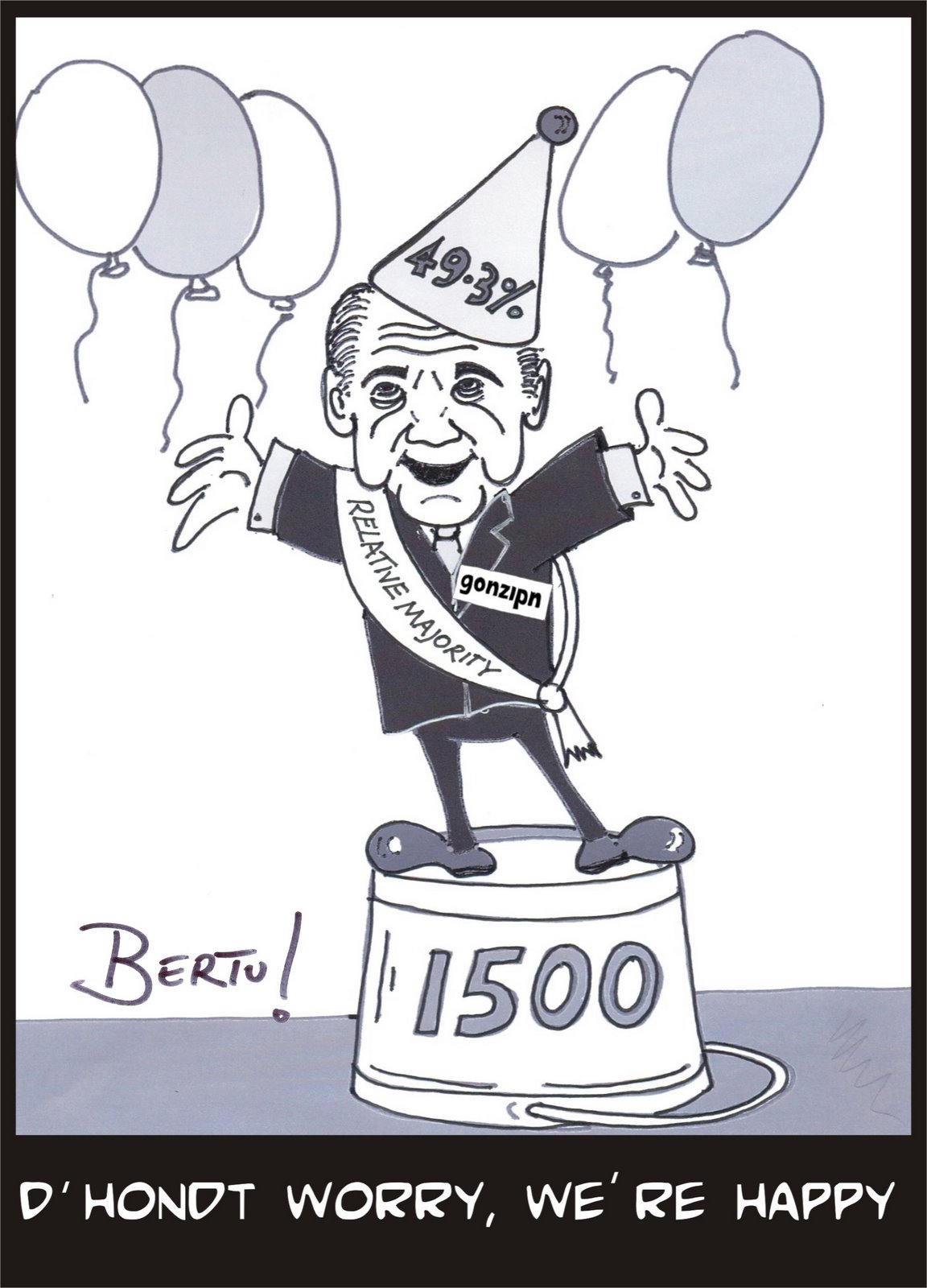
Last election’s carcades were hooting to the tune of a D’Hondt majority (see Bertoon illustration that we cooked up the next day). the D’Hondt system of voting combined with our “tweaked” constitutional provisions had led to a relative majority government – no party had obtained more than 50% of the votes but one party had 1,500 votes than the other. A constitutional clause had come into play and the way it worked was –

a) if only two parties are elected to parliament,
b) if none of the two parties obtain more than 50% of the votes,
then the party with the largest number of votes (a relative majority) will be entitled to an adjustment of seats in order to be able to enjoy a majority of seats in parliament. That’s all found in article 51(1)(ii) of the Constitution of Malta.

Interestingly (and useful for later discussion) the provisos to this article are a rare instance in which reference is made directly to “political parties”.  It’s interesting because the Constitutional structure relating to representation and government (and therefore to the management of the basic power entrusted by “the people”) centres around individual “representatives” as elected to parliament by universal suffrage. The constitutional link between elector and elected is direct – there was no original intention for the intermediaries we now call “political parties”*.

This important distinction between political parties and members can be clearly seen from the Constitutional article on the appointment of the Prime Minister – article 80:

Wherever there shall be occasion for the appointment of a Prime Minister, the President shall appoint as Prime Minister the member of the House of Representatives who, in his judgment , is best able to command the support of a majority of the members of that House (…)

Again. No parties. The President takes one good look at the House of Representatives and determines whether any member among them can count on “the support of a majority of the members” – that’s what is in play whenever a “confidence vote” comes into play. It’s an opportunity to put to test whether the PM still enjoys that  majority support. In the current context it’s what Joseph Muscat would like to table (a motion of confidence) and where Franco’s threat might come into play (by not voting for the PM and thus undermining his ability to “command the support of a majority”.

Now comes the hard part for hardcore nationalist voters to digest. Franco Debono is the latest symptom of the Coalition of the Diverse called GonziPN that oh-so-miraculously snatched victory from the jaws of defeat last election. The rainbow coalition within GonziPN was possible because of a lack of scrutiny, a loose combination of values (if any) and mainly because any candidate who could steal valuable votes that could lead to the relative majority victory (and therefore to the automatic majority in parliament) was backed to the hilt. Remember the JPO saga? Remember the spin masters backing what was very evidently a loose gun to the hilt – basta nitilghu?

So when the members of parliament finally took their place in the house of representatives Lawrence Gonzi could assume that he commands the support of the majority of members. He assumed it because any leader of a political party in Malta who has just won the election assumes that his party members will back him to govern. Easy. Alfred Sant assumed that in 1996. Lawrence Gonzi had no reason not to in 2008. The mechanism is not foolproof however. At the basis of the whole system remains the basic currency of power transfer – the representatives themselves. As Franco has reminded us more than once the “support of the representatives” cannot be taken for granted.

The mechanism of “support” or confidence is a check on the power of government. Viewed from outside the convoluted scenario that Franco has created around himself (with the help of the bloodsucking media) you will understand that the right of a member to withdraw his support is an important check in our democracy. It is just as important (if not more) as the existence of an opposition.

Even though our political parties operate on the assumption that “loyalty” is universally automatic they have now been exposed to the democratic truth that it is not. The failure is not of the system but of the arrogant assumption that the bipartisan mechanisms that the parties have written into the constitution will guarantee their permanent alternation. Franco’s methods might be obtuse and distasteful especially when they betray blatant and crude ambition but on a political level the renegade politician who disagrees with the party line was not only predictable but threatens to become a constant in the future.

The more political parties ignore the need to be coherent politically and the more they just throw anything at the electorate in the hope that something bites the more they can expect of “Franco-like” personalities. The failure to whip Franco into the party line is not a democratic failure or a constitutional flaw but a failure of the political party to operate as an effective vehicle of democratic representation.

D’hondt worry? Frankly it was only a matter of time. It’s actually a miracle it took this long for the shit to hit the fan.

* In a recent House of Commons document (Speaker’s Conference on Parliamentary Representation)  political parties were defined as “the mechanism by which people of any background can be actively involved in the tasks of shaping policy and deciding  how society should be governed. While they are not perfect organisations they are essential for the effective functioning of our democracy. Without the support of political parties it would be difficult for individual Members of Parliament, as legislators and/or as members of the Executive, to organise themselves effectively for the task of promoting the national interest—including by challenge to the Government, where that is necessary and appropriate—and ensuring that proposed new laws are proportionate, effective and accurately drafted.”

As the Mayans Logged Off

To this day, the Guatemalan Mayans remark that outsiders note down things not in order to remember them, but rather so as not to remember them. Today’s world of hyperconnectivity often leads us to wonder whether our reliance on technology for knowledge and time management is beginning to “soften” our brains and make them less sharp. The Mayans might be right after all.

Cutting off from the technology and information highway for three weeks offered a good opportunity to experience full reliance on the cerebellum. It was not just organisational zen but also a break from “information anxiety”. Information anxiety is that feeling that seems to be building up daily as we gain access to more information and begin to choke when we realise that we cannot possibly take it all in at one go.

The feeling begins with a glance at an interesting link or headline on a website. Possibly this comes certified with a hundred “likes” – the modern-day stamp of recommendation. Your mental sieve takes note and the urge to take that particular path on the ether begins to take shape. But there are other links on the page – other bits of news or information that are vying for your attention. What can you possibly do?

There’s different techniques and approaches. You could hoard links on some bookmarking website while convincing yourself that some time in the future a gap in the time-space continuum will allow you to “catch up”. Incidentally the “catch up” business is rather lame. Is it a race? Is there really somebody in the lead who has read tomes upon tomes on all kinds of subjects? Does a modern day walking, talking and web-browsing equivalent of the famed Alexandrian library exist?

You could also skim through summaries or subtitles getting the general gist of the content while being subconsciously painfully aware that you are fast becoming the internet equivalent of a jack of all trades and master of none. That would also mean learning to live with that ghost of a feeling that during your “skimming” you missed out on the really crucial, interesting part that was really worth reading. That’s information anxiety all over again.

Or you could step off the train. Step off and watch the carousel zip before your eyes as statuses are updated in your absence, news items are created, revised and rewritten while you are in a blissful corner of informational oblivion. Peeping in from time to time to assuage the withdrawal symptoms you will connect less and less with the threads and webs that have formed in your absence. You will worry less. Care less even. Anxiety what anxiety?

Before you know it, information gathering might even take its good old familiar linear form. You will have regained your sanity and your calm. It might not last very long and you might soon be wishing to be back sucking at the nipple of information overdose but trust me, the kick you get from that momentary lapse of reason might even get addictive and before you know it you could be stepping off the train.

And this time it will be for good.

Wearing Midnight

I’m supposed to have thrown the political switch for J’accuse and settled down for a little sabbatical. At most you were supposed to have heard from us with a little travel blogging – and for that purpose I have purchased a nifty little app called “Path” to chronicle our journey when we Go West. Instead, as I sit at the mac trying to put some order to my iTunes playlists and fill the ipods/ipads/iphones with enough music to kill any sense of tediousness during our flights/drives the mind wanders and there you go… I stumble on a Times article that provokes a reaction.

There they sat in the photo – Dr Michael Falzon (PL Home Affairs) and Joe Mizzi (PL Whip) under a billboard with the word “għaqal” splattered across. The article’s title “From Midnight Express, to Corradino Express – PL demands action in prisons” and it was all about how the government is getting the whole Correctional Facility business wrong although the two seem to have stopped short of calling for someone’s head (Tonio Borg’s in this case). Now those who have Labour to heart will once again call this site a PN sympathiser or what have you but yes, I still see something wrong with this picture and let me tell you what that is.

I see two Labour spokespersons capitalising on a court case (the Bickle Prison Queen) and trying to get political mileage on the strength of the “blame the government” idea. What’s wrong with that? Nothing, I agree, on the face of it. The thing is that the “demands for action” are once again rather futile pie in the sky demands. “Hemm bzonn naghmlu xi haga”. Sure we can crack jokes about Midnight Express and the obscene levels of permissiveness at Corradino but the problem – I am sure you will agree – probably does not lie with government. I am also prepared to bet that left to their own devices wardens and prisoners will still be up to no good if Michael Falzon were in Tonio Borg’s shoes.

Then there’s another thing. Our prisons are crowded with all types of offenders. Among them are people who have been sent to jail for cannabis related offences. I wonder whether Michael Falzon and Joe Mizzi joined the dots on that one. Did they have anything to say about the possible effects of decriminalisation of softer drugs?

It’s not just Labour politicians who will shy away from tackling this particular bull by the horns. Sure, every politician will nibble at some facile arguments – and condemning the state of affairs at Corradino is facile… who would not agree after all? My question is what are Labour’s policies on correction, drugs, rehabilitation, decriminalisation and similar issues that have an incidence on the current state of affairs.

Don’t hold your breath if you are waiting for an answer. They’re too busy condemning anything linkable to “il-gvern” to even bother about what they would do to solve the problem. It’s Midnight Express… another word for darkness falling at the speed of light.

In un paese pieno di coglioni, ci mancano le palle.

P.S. Even Franco Debono MP seems to have more ideas (agree with him or not) than the whole party in opposition (see here)

Not Sri Lanka

This Christmas & New Year, the wife and I were supposed to be going on a dream honeymoon to Sri Lanka and the Maldives. Were supposed. Yes that’s it. It’s not happening – at least we are not going there. I cannot really complain because we are actually off to tour the West Coast (and I plan to drive A1A Beachfront Avenue with Vanilla Ice on the stereo – how’s that for the apex of corny retro) and then drive through the desert to Vegas before hitting the beaches in Antigua. That’s what I call a cool backup plan.

If my alter ego, Gakbu Sfigho, were still active he would have chronicled how we went through a hundred different jabs (ok 2 – but one of them left me doing my own version of the Runs for a weeekend) as well as how we incurred hundreds of euros in medical expenses BEFORE we even got on the plane. Incidentally if anyone needs around 200€ worth of malaria pills (Malarone) I’m your man. I am also in possession of a one month tourist VISA to Sri Lanka that was obtained with the extra expense of DHL transmission of documents and a serendipital donation to the Maltese Association in Brussels (Fausto will correct the nomenclature).

So yes. This is a little explanation to J’accuse readers that should tell you why you will not be reading missives from the land of tea plantations and spicy food. Instead I might write you a letter from Alcatraz. One things fo shoo…. we ain’t going to Sri Lanka.

The Ferry Connection

The last few visits to Malta have included the use of the extremely convenient Sliema-Valletta ferry service. Even in the dastardly heat of August, the short trip across the harbour and (admittedly) arduous uphill walk to the Republic street is an overall pleasant affair.

When Transport Malta calls for tenders for harbour ferry services though it is not holidaymakers like myself and tourists that are the primary concern but rather the creation of a viable and practical alternative to the heavily congested road traffic. Even if we were to have had a near perfect transition to all that was promised by Emanuel Delia’s Arriva the use of water transport as an alternative was always going to be a useful complementary solution.

It’s good to see some forward thinking being applied – such as the free Valletta Lift use for all ferry ticket holders (always an added incentive). The condition of a maximum of 30 mins between each ferry trip is also important to ensure a constant flow – ferries with skeleton provision tend to be impractical for the consumer.

I’m not too sure about the “toilet facilities” requirement for what is after all less than a 15 minutes trip. Recently the Gozo Channel company that operates a 25 minute trip was quoted in the Times as saying that it did not feel the need to provide such Emergency services as defibrillators on short trips and that anyway there was no obligation. Surely available public toilets at each end of the Ferry service should suffice.

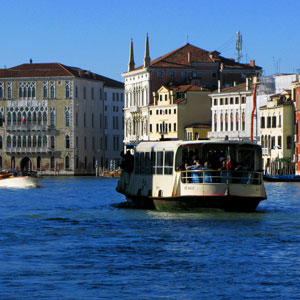
On the whole I would use the Venice Vaporettos (see picture) as a good standard reference point and would add a few suggestions of my own:

  • Sliema, Marsamxett and Inner Dockyard are a good start. A (maybe summer) route linking Portomaso – Exiles – The Tower – Tigne – Sliema Ferry might be an option.
  • Venice has many floating “ferry stops”. The Inner Harbour stops could be served by these – it might be a bit harder in the exposed areas for the summer route (see what happened to Sliema Pitch addition this year).
  • Ticketing system. Just in case the idea even floated in your mind: forget discriminating between residents and non-residents. Just use season tickets the 10€ weekly pass is a good start.
  • I am sure you thought of it but just in case, ferry users need to get to the ferry point. Is there going to be a similar deal with Arriva for a combo bus/ferry ticket? It’s evident there will be no car park + ferry ticket because Sliema parking is what it is.

What about you? Do you have any other suggestions for the new system? Do you care?