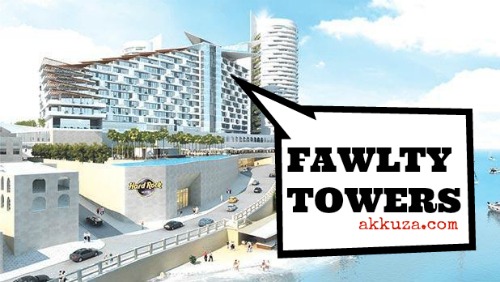
Today there are new reports on the latest crazy plan to build another tower in Malta. This time it seems that the Villa Rosa developers are intent on transforming Saint George’s Bay (bayside) into some sort of futuristic megapolis. The artist’s impressions show that most of the foreshore would be taken up by this megalith designed by recently deceased architect Zaha Hadid. Check out the link to see for yourself.
That is just Saint George’s Bay. Sliema Residents are up in arms and purportedly would love for their council to “sue the government” (sic) because of all the scarring building that is going on – towers mostly. Manoel Island is in danger of losing its status as last green patch in the harbour area and a historic house in Victoria is in danger of being pulled down to make way for a car park entrance. Architects may be putting their weight behind an appeal to conserve Maltese architecture but for very one of these there are five more who are ready to pander to the cheque-books of developers hungry for more construction.
There was an admirable action for awareness by those guys pitching tents outside Castille. It’s a sad fact though that the policy makers of this land don’t give a damn about our living environment. I don’t mean trees and plants and recycling and all that. I mean quality of living that is being put in grave danger every single day by idiotic decisions spurred on by money and greed. Is it a childish argument? Yes it is. It’s happening though and the wanton destruction of our prime living space goes on mainly because those at the top have figured that not too many people give a real toss about it.
In the end so long as the policy makers can claim that we are living an era of economic boom, high unemployment, money in the pockets of households, then they know they can get away with murder. From olive trees being brutally clipped at University to prime land being sold off at peanuts to Chinese Investors (guaranteed by Maltese investors’ money in banks) or fake university peddlers there seems to be no hope ahead.
The assault on the quality of life of the inhabitants of the islands of Gozo and Malta has long begun. I could bother you with the usual cliches such as the native American saying that goes “It is only when the last tree has been cut, the last fish caught, the last river poisoned, only then we will realise that one cannot eat money.”
I could do that but it would be useless, wouldn’t it? So long as the money keeps us happy and there’s free childcare and randomly adopted social rights… then it’s a.o.k … we could probably walk on water.
We have moved from “misrepresentation” to “outright lie”. Minister Konrad Mizzi has become a specialist in libel law. It is a standard in the Maltese game of politics and carries with it the public assumption that “since X has resorted to the courts then X must be right”. It is not how it should be, it is not what the institutes of libel and slander were set up to protect but hey, no Maltese politician in recent history has shied away from abusing of the law in this manner so why should Mr. Konrad?
“Mr. Konrad”, now there is a curious way of referring to a Minister – or anyone for that matter unless you are a slave on a cotton plantation in pre-emancipation US. Yet that is how Karl Cini of Nexia BT refers to the Unportfoglioed Minister in his correspondence to Mossack Fonseca. Cini is speaking to Mossack Fonseca about Mizzi’s PEP status and is also endeavouring to explain the “How many?” and the “Wherefrom? of the funds that will be eventually subject to movements to companies that are set up by Mossack Fonseca.
It is here that Mr. Konrad’s speech of “outright lies” finds a huge banana skin on which to slip and fall. Without playing the special investigator one can see why Konrad Mizzi finds himself in an immense schizophrenic conundrum. Why? Well over the same period of time there had to be two Konrad Mizzi’s:
The first Konrad Mizzi is the one who delegates Cini to contact Mossack Fonseca and set up a structure that requires a considerable amount of funds in order to justify its continued existence. That Konrad Mizzi has an interest to explain that he has quite a considerable amount of personal funds and also has an interest to downplay his role as a PEP. That is why Karl Cini stresses that “our legislation openly allows PEPs to hold shareholdings in other businesses”. So whether he is lying or saying the truth to Mossack Fonseca, Mizzi (through his agents at Nexia) would like the truth to seem that he is loaded with money coming from ventures that are legal notwithstanding his status as a PEP.
The second Konrad Mizzi is the one who was made Minister by Joseph Muscat. That Konrad Mizzi was at first supposed to be a wunderkind who earned loads-a-money while abroad (fuelled by the myth that “studja barra u hadem barra ergo qed jimpala l-liri“) and owned property/properties abroad and has an international family. That was the early story to explain why he needed an international structure involving a tax haven even though his overall worth amounted to a pittance (by multimillionaire tax haven standards). The second Mizzi wanted us to believe that the whole set up cost a couple of tens of euros (was it 90?) and that it was all about family planning.
You can begin to see the dilemma facing Konrad Mizzi. The documentation that is trickling out of the ICIJ Panamaleaks is slowly but surely pointing towards the Konrad Mizzi that one would expect to exist – one who either has or claims to have the kind of funds that justify such operations. The second Mizzi – Minister Mizzi – can give us as facts his Ministerial declarations of worth that obviously clash with declarations done in his own name by the first Konrad Mizzi.
So you see. Speaking about “outright lies” is dangerous in these circumstances. In the not so halcyon days of studying criminal law I still remember now Chief Justice Camilleri lecturing us about fraud and forgery. A forged document is one that “tells a lie about itself”, he would tell us. I wonder what kind of fraud or forgery would be one that yells that it’s an “outright lie”.
I re-watched “All the President’s Men” yesterday. It’s a 1976 movie featuring Robert Redford and Dustin Hoffmann and it chronicles the work of Washington Post journalists Bob Woodward and Carl Bernstein that led to the uncovering of the Watergate Scandal and the eventual resignation of President Nixon. The facts surrounding Watergate happened in the early seventies – a time without the mass means of communication and information that we know of today. Journalistic investigation was painstakingly slow and when the main whistleblower “Deep Throat” speaks in riddles there is much digging for information to be done.
Watergate was all about a money trail. Nixon and his party were using huge slush funds from the GOP campaign to finance covert operations intended to sabotage the Democrat campaign. There was no sudden discovery of all the information. It all started with what seemed to be a simple burglary at the Watergate complex and it was only thanks to the dogged work of the two journalists against all odds that the whole extent of the scandal was uncovered.
When the Post decided to run with the first big title linking big heads in government to the corruption trail, the official response was big and could be summed up in one word: denial. Nixon’s spokesperson attacked the journalists and the entity they worked for and came up with the phrase “shoddy journalism” and “shabby journalism”. Nixon’s people implied that there was a misreading of facts and that the Post had an ulterior political motive for “fabricating” such information.
All Nixon’s men did was gain some more time. They used that time to abuse their positions in power to try to harass anybody who was on their trail and close to obtaining damning information. Astonishingly Nixon won an election when the scandal had only just broke – but not so astonishingly at that point the pieces of the puzzle were far from Nixon and it was hard for the man in the street to make the connection. As more evidence was compiled – mostly by “following the money trail” – Nixon’s position became untenable.
All through the scandal that dragged on for two years, Nixon’s behaviour smacked of abuse of power and disrespect of institutional authority. At one point Nixon ordered the Attorney General (Richardson) and his deputy (Ruckelshaus) to sack special prosecutor Cox. Neither of the two accepted such a blatant abuse and both resigned in protest. Nixon only managed to get what he wanted when he found an appeasing Attorney General in Bork. Responding to members of the press for this Nixon stated emphatically “I am not a crook”.
Walking on Water
Events closer to home are uncannily similar to what happened in the Nixon days. We have a musical chairs of police commissioners who hesitate to prosecute when it is blindingly obvious that there is matter sufficient for prosecution. We have a government machinery that functions on blanket, unfounded denial and that resorts to bullying tactics when it comes to investigative journalists doing their job. Yesterday we had a Minister without portfolio mimicking Nixon’s spokesperson accusing journalists of not knowing how to read and of being “malicious”.
Every day is bringing to light more damning information linking more and more dots in a scandal that knows no equal in Maltese history. The Prime Minister and the two persons directly involved in the story choose to bury their heads in the sand and cling onto power hoping for a miracle of the walk on water kind. Apparently these scandals are not enough because some still claim that Malta is “economically strong”. I seriously believe it is only a matter of time that this fabrication of statistics falls apart – especially in the light of the fact that the greatest supposed economic injections under this government are tainted and linked with the scandalous events of Panamagate.
Muscat prefers to drag Malta through scandal after scandal rather than bear the responsibility and act in the interests of the nation. Like Nixon he believes that he will not “resign a position that he was elected to fill”. Like Nixon he prefers to use his incumbency in his favour so long as it is possible – thus protracting the agony of an electorate in need of clarity and honest politics.
One day, in the not too distant future, Muscat might face a journalist like Frost who when asked by Nixon “what would you have done” replied:
One is: there was probably more than mistakes; there was wrongdoing, whether it was a crime or not; yes it may have been a crime too. Second: I did – and I’m saying this without questioning the motives – I did abuse the power I had as president, or not fulfil the totality of the oath of office. And third: I put the American people through two years of needless agony and I apologise for that.
Watermarks is a new series on J’accuse. The idea consists in having a morning “short” taking a quick look and reflection on current events in the news – what is trending and why.
Occam’s Laser is a long-time J’Accuse reader who works in the financial services sector. In this article Occam argues that Labour is willfully muddying the waters over Panamagate, exploiting the concerns of conscientious liberals to further its own agenda.
The Labour Party is desperate. For three months it has tried to brazen out Panamagate, but despite its survival of various protests, no confidence motions and other crises, the issue simply won’t go away. Now it is hoping that by tarring the whole Maltese professional class with the same brush, it will cause enough of a distraction for people to start talking about something, anything, but Konrad Mizzi and Keith Schembri’s egregious misdemeanors.
This is clear from the recent PL attacks on Tonio Fenech and the private sector companies he works for, the attacks on the law firm EMD and its consultant Richard Cachia Caruana, and its general bewildering aggression towards any PN leaning individual somehow involved in financial services. What PL is trying to do is obvious; they want to conflate public concern about the disparate issues of global tax avoidance and its own internal governance disasters in order to dissipate public outrage. This is yet another of the PL’s dirty tricks, and the public shouldn’t allow the PL to wave this red herring in its face with impunity.
To start off with, Malta’s strategic decision to become a financial services centre is one which enjoyed (and below the surface, still enjoys) broad cross-party consensus. So PL is being maliciously disingenuous when it feigns getting its knickers in a twist over this week’s various pseudo-revelations. Secondly, while there is no denying the inherent link between a world order that allows international corporate secrecy, and the exploitation of that secrecy by persons such as Konrad Mizzi and Keith Schembri, the two problems require radically different solutions.
Regarding the problem of international tax avoidance, this is one which requires, at the international level, a global co-operation and a deep philosophical rethinking of the way the world works; and at the local level, a careful repositioning of Malta as a jurisdiction which adds value beyond its low tax base (this is already the case to some extent, but a truly well intentioned government could do much more to improve things). This is going to be a big, slow job.
The Konrad Mizzi and Keith Schembri situation, on the other hand, is a pressing governance catastrophe that requires urgent and immediate action. Every day they hold on to their position, they cause irreparable harm to our reputation, and indeed deprive us of the valuable time that we need to reposition and further diversify our economy.
Perhaps the most galling thing about this PL manouvre is the way it exploits the feelings and concerns of the country’s most conscientious individuals, those who genuinely worry about things like global inequality and corporate ethics, turning these noble concerns into tools to further its own ends. Worryingly, we’ve already seen PL try to exploit the concerns of the conscientious before, as with that other red herring about Joseph Muscat supporting gay marriage a few weeks ago. This is shockingly unscrupulous behaviour; the Maltese public deserves better, and PL shouldn’t be allowed to get away with it.
***** Zolabytes is a rubrique on J’accuse – the name is a nod to the original J’accuser (Emile Zola) and a building block of the digital age (byte). Zolabytes is intended to be a collection of guest contributions in the spirit of discussion that has been promoted by J’accuse on the online Maltese political scene for 10 years. Opinions expressed in zolabyte contributions are those of the author in question. Opinions appearing on zolabytes do not necessarily reflect the editorial line of J’accuse the blog.
***
Yesterday evening’s cabinet reshuffle came out looking like some kind of blitz. Timing is crucial in the business of politics and rest assured that the “when” of this announcement is just as important to Muscat as the “how” of the reshuffle itself. After months of prevarication on a decision that should be part of the elementary package of any politician Muscat finally seemed to be deciding. There was, by the way, no sign of the infamous “audit” that was uselessly conjured up by Muscat as the ultimate delay tactic – as it were the audit turned out to be ‘not fit for purpose’ as the cliche goes.
I was reminded of the adage that “justice must not only be done but must be seen to be done”. In this case we should switch the ‘seen’ to a ‘seem’ and drop the doing completely. There is no doubt in the mind of anyone who is not an out and out labour sympathiser that the exercise was one of political prestidigitation – and a clumsy, almost ignorant, one at that.
Mizzi – the reason behind all the change – still sits in Cabinet and therefore still enjoys the full trust (excuse the pun) of the Prime Minister. Whatever portfolio he is or is not given is irrelevant. This is not a censure, this is not an admission of mistakes, this is quite simply an escamotage (read: piece of trickery) ad maiorem publicis perturbationem. Worse still the level of accountability (if ever there was any) of Konrad Mizzi has just dropped a couple of notches. What with having no defined task it will already be much harder than it already is for the opposition or fourth estate to get him to answer for whether he is delivering and whether he is delivering rightly.
Then there is the return of Manwel “Ok Siehbi” Mallia. This continues to reinforce the tradition of Muscat’s soldiers of steel politics – no matter how bad you slip, no matter how unfit for purpose you prove that you can be we will keep you close to the fold and find you a job among the “boys” (and gals). After Mallia’s impassioned defence of old style politics it was only a matter of time before he would return to the fray.
The key here is that Muscat’s set of cards is in short supply – there are no trumps, no more magic “supercandidates” who are relatively unknown that can be foisted on a fawning electorate. Whether it is because they are close lieutenants or because Muscat cannot afford to lose them, the same entourage is “doomed” to be rotated in the corridors of power as this government shifts from scandal to scandal.
“We can’t just drop everything, sir!”
“Mister Lipwig. Is there something in the word ‘tyrant’ you do not understand?”
― Terry Pratchett, Raising Steam
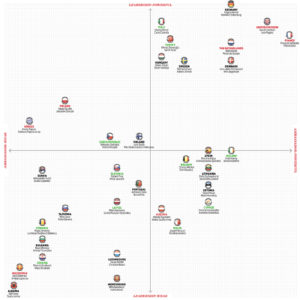
We could go on and examine how Brincat is the latest of recipient of the “kicked upstairs” mentality that has plagued Malta’s governmental policy towards the EU since the Dalli nomination. (Interestingly in that respect a recent Politico “power matrix” has shown our weak link in Europe to be Muscat the decision maker and our grace is only saved by Ambassador Marlene Bonnici’s perceived efficiency in Brussels. See the matrix here). We could also wonder out loud as to why Muscat holds the energy portfolio closer to his chest than ever before.
Politico Power Matrix in EU
We could do all of that and more but there is an underlying issue that is now blatantly obvious and that deserves our attention. At a time when the track record of Labour in government is wrought with scandals we continue to see attempts by political pundits to analyse the political aspect of this government. One recent article that caught my attention was James Debono’s “A template for social democracy, but at whose expense?”
What I find intriguing is this continuing willingness to engage Labour on political terms when I feel that the mask has long fallen. It is a bit like discussing the magical capabilities of the Wizard of Oz right after Toto’s curiosity finally unveiled him as a hypocritical charlatan who only managed to create the illusion of power through a mixture of chance and circumstance.
You know how it goes. Most analysis will start off by listing the litany of “achievements” of the Labour government (I also find it intriguing that top of that list is always inevitably Free Childcare) and we get to run through the whole gamut of “social rights” before we end up quoting the massive achievements in economic terms and employment. Marlene Farrugia has already done much to dispel this idea that economic success is something that happened only under Labour’s watch but mine here is not an exercise in partisan comparison.
What I constantly fail to see from day 1 of Muscat’s reign of manipulation is one basic currency in terms of the political market: Sincerity. Try as I may I am hard put to find a real “roadmap” as he likes to call it let alone a genuine will to change the face of the Maltese social and political landscape for the better. We may battle in a quest for the truth but underlying the truth or untruth in most matters is usually a question of sincere intentions. Sincerity is what I associate with a politician like Barak Obama or Guy Verhofstadt.
Sincerity is accompanied by passion, humility and a strong will to improve. I am not speaking of the utopic world of perfect politicians representing the will of the people (and sometimes recognising that the will of the people could actually be harmful for them) but i am talking about a genuine dedication to a set of values that are implemented in a holistic policy.
Muscat’s politics could not be further from the politics of sincerity. They are built on the dangerous precepts of populistic opportunism, built on divisiveness disguised as togetherness, built on a quest of power for the few disguised as some sort of class revolution and built on an economy with the truth that belies belief. There is no sincerity in the “social gains” under this government – only blatant opportunism to appease vociferous lobbies who would be the first to tell you that they do not care why the government supports them so long as they get what they want.
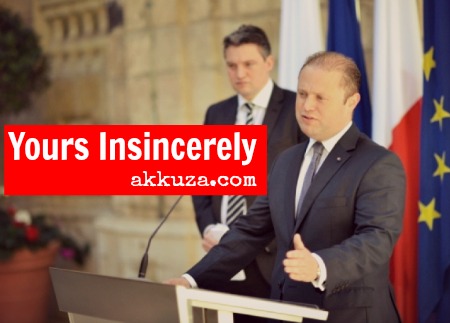
Managing the needs of different lobbies was easy in the first three years of Muscat. By opening the legislative and monetary tap he could seem to be magnanimous and caring. The lack of sincerity was of no consequence to the beneficiaries of what was very evidently from day one a free for all run for the money and a lax approach to legal consistency. The few principles touted during an election campaign were lost on the wayside on the carcade to Castille in 2013. Meritocracy? Sure, yours sincerely, Joseph (Inhobbkom).
It may sound like a cliche’ but the other adage “you may fool some of the people some of the time but you will not fool all of the people all of the time” is becoming more and more of a basic truth as time goes by. Especially though, after the denouement of Muscat’s insincerity yesterday evening at his press conference in Castille.
Muscat is still holding the fort on Panamagate. In an earlier post I had suggested that his strategy would be that of buying time and if that is still the case then we have entered the fatigue stage where, after having weathered the bulk of the storm, Muscat will be counting on the inability of the general public to keep up with the momentum of the scandal. He will, in fact, be hoping that the general sense of weariness and helplessness that our citizens have when confronted with politics will have a saving effect on himself and his government.
The latest polls do not suggest as much and the slide in trust ratings together with the fact that corruption leapt to the top of public concerns mean that the effects of Panamagate are here to stay for a while yet. The crucial bit here is that the snowball effect of Panamagate has meant that your average citizen’s distrust in politics and politicians was spread wider than the protagonists of that particular saga and that Malta finally caught up with the rest of the world when it started to question the operations of a whole class of politicians.
In fact one of the positive outcomes of Panamagate is the “coming out” of public disapproval of our political class and of the system that that very same class has created in order to survive and grow. While the party in opposition attempted to form a national rally inspired by and for the purposes of Panamagate it has become increasingly the case that the focus has shifted onto the wider issue of the rotten state of our political establishment and that includes the party in opposition itself.
Part of the reason for the aforementioned shift lies in the defensive tactics of a government under siege. The strategy of spin by Muscat required a dose of counter-accusations of supposed or alleged corruption in the rank and file of the Nationalist MPs. It was very evidently a deviation tactic aimed at distracting all and sundry from the very obvious fact that Mizzi’s and Schembri’s position were untenable without the need of further proof. What ensued was an open barrage of exchanges with no holds barred. Truth, morality, public interest, the state of the nation – they all became expendable pawns in the partisan dialogue of insults and accusations.
The No Confidence Motion
In the middle of all this the nationalist party moved a motion of no confidence in the government. We all know of the infamous 13 hour debate and what has been very aptly described as the vote that resulted in 38 likes. In the middle of this debate we had one very interesting talk delivered by former Minister Mallia. Much of what Mallia said or did not say merits analysis.
In the first place it was evident that rather than use his time to defend the government’s achievements or to defend Konrad Mizzi’s position, Mallia was intent to unleash his remaining anger leftover from Malliagate – the infamous shooting incident involving his driver that cost Mallia his cabinet position. His speech targeted those who in his words attack an honest politican who is intent on serving the country and who ends up losing his chance to serve thanks to these “attacks”.
Secondly Mallia was quick to ride his reputation of an experienced lawyer by referring to his faith in the “rule of law”. This not too subtle shifting of goalposts would have been missed by the man in the streets but was a clear attempt to alter the standards that were under scrutiny. Political responsibility is not the same as criminal or legal liability. Mallia was in a way pandering to Muscat’s idea that “proof” of illegal funds was needed in order to have to get rid of Mizzi (and Schembri) – the kind of proof one would expect in a trial in a court of law. Mallia is either naive or ignorant in that respect: it is evident to any constitutional lawyer that the very rule of law he claims to love would have Mizzi and Schembri out on their arses the moment the very set up of a company in Panama is discovered.
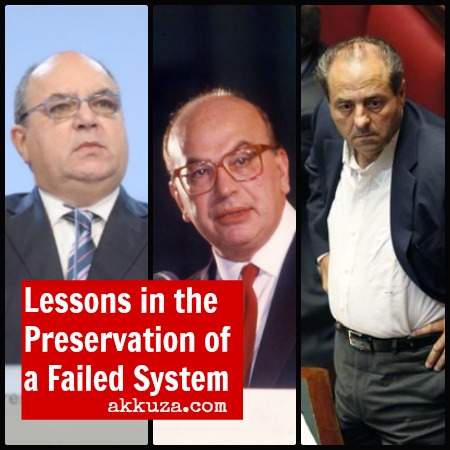
Finally, and most importantly, watching Mallia speak brought back memories of politicians from what is by now a very different era of politics. Back in 1992 a huge earthquake struck Italian politics: we all remember it as Tangentopoli (“Kick Back Gate” if you like). What began as a magisterial investigation in illegal funding of parties ended up being an expurgation of a whole political class (Operation Clean Hands).
Mallia’s speech focused very much on attacks on the truth and on the suffering of the “honest politician” who is not in politics money but to serve. In his words, “attacks” by journalists were damaging the opportunities of politicians to serve. This sounded very much like a muffled appeal to both sides of the house to moderate their terms because in the long run it is the very politicians on both sides who risk “suffering” the ignominy of an extirpation.
Back in 1992 Bettino Craxi, one of the gigantic figures of Italian politics, had stood up in the Italian Parliament shortly after the first scandals erupted and commented thus:
Su quanto sta accadendo la classe politica ha di che riflettere. (…) C’è un problema di moralizzazione della vita pubblica che deve essere affrontato con serietà e con rigore, senza infingimenti, ipocrisie, ingiustizie, processi sommari e grida spagnolesche. E’ tornato alla ribalta, in modo devastante, il problema del finanziamento dei Partiti, meglio del finanziamento del sistema politico nel suo complesso, delle sue degenerazioni, degli abusi che si compiono in suo nome, delle illegalita’ che si verificano da tempo, forse da tempo immemorabile. Bisogna innanzitutto dire la verita’ delle cose e non nascondersi dietro nobili e altisonanti parole di circostanza che molto spesso e in certi casi hanno tutto il sapore della menzogna.
Si è diffusa nel paese, nella vita delle istituzioni e della pubblica amministrazione, una rete di corruttele grandi e piccole che segnalano uno stato di crescente degrado della vita pubblica, uno stato di cose che suscita la piu’ viva indignazione, leggittimando un vero e proprio allarme sociale, ponendo l’urgenza di una rete di contrasto che riesca ad operare con rapidita’ e con efficacia.I casi sono della piu’ diversa natura, spesso confinano con il racket malavitoso, e talvolta si presentano con caratteri particolarmente odiosi di immoralita’ e di asocialita’.
E cosi’ all’ombra di un finanziamento irregolare ai Partiti e, ripeto, al sistema politico, fioriscono e si intrecciano casi di corruzione e di concussione, che come tali vanno definiti trattati provati e giudicati. E tuttavia, d’altra parte, cio’ che bisogna dire, e che tutti sanno del resto, e’ che buona parte del finanziamento politico e’ irregolare od illegale. I Partiti specie quelli che contano su apparati grandi, medi o piccoli, giornali, attivita’ propagandistiche, promozionali e associative, e con essi molte e varie strutture politiche e operative, hanno ricorso e ricorrono all’uso di risorse aggiuntive in forma irregolare od illegale.
Se gran parte di questa materia deve essere considerata materia puramente criminale allora gran parte del sistema sarebbe un sistema criminale. Non credo che ci sia nessuno in quest’aula, responsabile politico di organizzazioni importanti che possa alzarsi pronunciare un giuramento in senso contrario a quanto affermo: presto o tardi i fatti si incaricherebbero di dichiararlo spergiuro. (Bettino Craxi, June 1992).
That was at the outbreak of the scandal. The kickbacks that were investigated involved first and foremost the major political parties that had enjoyed a system of “democratic alternation” but that had developed a network of corrupt practices that later would be found to have overspilled in the business community. Political party kickbacks were parallel to grafts taken by individual politicians and the links spread straight into the arms of criminal activity. In his early defence in 1992, Craxi stressed that (I paraphrase) “the illegal funding of the political system (no matter how many negative judgements and reactions it may have generated) cannot be and cannot be used as an explosive to blow up a whole system, to delegitimize a political class, to create a climate where neither corrections nor an effective cleansing action can arise but only disintegration and adventure. For this situation we need a remedy, actually more than one remedy.”
I cannot help but noticing that Mallia’s impassioned apology for the workings of politicians in spite of what he perceives as “attacks” on their operation has inspirations that are rooted in the interventions of Craxi and politicians of his ilk back in 1992. 10 months later, in April 1993, Bettino Craxi was faced with a number of requests by the magistratura for authorisation to proceed (against him in court) and he had to make one last impassioned defence before the Camera dei Deputati. Almost 23 years ago to the day he stood up to make one of the longest speeches in defence of a failed system.
Si e’ invece fatto strada con la forza di una valanga un processo di criminalizzazione dei partiti e della classe politica. Un processo spesso generalizzato ed indiscriminato che ha investito in particolare la classe politica ed i partiti di governo anche se, per la parte che ha cominciato ad emergere, non ha risparmiato altri come era e come sara’ prima o poi inevitabile. (…) Ma di tutte l’erbe s’e’ fatto alla fine un fascio.
Tutto si è ridotto ad una unica accusa generalizzata. Le campagne propagandistiche hanno ruotato sovente solo attorno a slogans ed a brutali semplificazioni. Di questo si è incaricata infatti parte almeno della stampa e dell’informazione, andando ben al di là dei diritti e dei doveri propri dell’informazione, deformando spesso oltre misura, esaltando le ragioni dell’accusa e mettendo di canto quelle della difesa, travolgendo senza alcun rispetto diritti costituzionalmente garantiti con difese divenute praticamente impossibili, creando sovente un clima infame che ha distrutto persone, famiglie e generato tragedie.
La criminalizzazione della classe politica, giunta ormai al suo apice, si spinge verso le accuse piu’ estreme, formula accuse per i crimini piu’ gravi, piu’ infamanti e piu’ socialmente pericolosi. Un processo che quasi non sembra riguardare piu’ le singole persone, ma insieme ad esse tutto un tratto di storia, marchiato nel suo insieme. Un vero e proprio processo storico e politico ai Partiti che per lungo tempo hanno governato il Paese. (29th April 1993)
The echoes in Mallia’s speech 23 years later are incredible. It does not stop with Mallia mind you, even though Mallia’s speech was the most transparent in this respect. Politicians under attack for their unethical performances will ask you to be positive and focus on “all the good we have done” that cannot and should not be overshadowed by what they claim to be “slips of human error”. This spin is current today and it is no surprise that it was just as current in Craxi’s day.
Tutti i cicli, come è naturale passano, entrano in contraddizione, si esauriscono, degenerano. Sono cosi’ subentrati gli anni delle difficolta’ e della crisi, che stiamo ancora attraversando. Ma gli effetti e le conseguente di un periodo critico sarebbero stati ben diversi e ben piu’ onerosi se non avessimo avuto alle spalle il solido sviluppo realizzato nel corso degli anni ottanta ed un retroterra conquistato con un balzo in avanti poderoso.
It did not come without an admission though. Craxi’s line of reasoning was that parties have always been funded in a questionable manner and that this should not preclude an acknowledgement that they have functioned for the good of the state.
Cosi’ come nella vita della societa’ italiana non e’ nata negli anni ottanta la corruzione nella pubblica amministrazione e nella vita pubblica.
La vicenda dei finanziamenti alla politica, dei loro aspetti illegali, dei finanziamenti provenienti attraverso le vie piu’ disparate dell’estero, della ricerca di risorse aggiuntive rispetto poi ad una legge sul finanziamento pubblico ipocrita e ipocritamente accettata e generalmente non rispettata, accompagna la storia della societa’ politica italiana, dei suoi aspri conflitti, delle sue contraddizioni e delle sue ombre, dal dopoguerra sino ad oggi.
Non c’e’ dubbio che un troppo prolungato esercizio del potere da parte delle piu’ o meno medesime coalizioni di Partiti ha finito con il creare per loro un terreno piu’ facilmente praticabile per abusi e distorsioni che si sono verificate. Ma onestà e verità vorrebbero che in luogo di un processo falsato, forzato, ed esasperato, condotto prevalentemente in una direzione, si desse il via ad una ricostruzione per quanto possibile obiettiva ed appropriata di tutto l’insieme di cio’ che è accaduto.
Si tratta di una realta’ che non si puo’ dividere in due come una mela, tra buoni e cattivi, gli uni appena sfiorati dal sospetto, gli altri responsabili di ogni sorta di errori e nefandezze.
The appeal to morality and honesty in such times becomes almost an automatic reflex. I have already mentioned how jarring the appeal to “honest Maltese” was prior to the first rally in Valletta. This tendency to transform a political discussion into a dichotomy between “good and evil” is dangerous – dangerous both for the interlocutors who have suddenly arrogated unto themselves the questionable position of absolute purity as well as for the confused electors who are unable to detach themselves from the call of partisan loyalty when assessing such circumstances.
In this I will refer once again to Craxi’s swan song. In the heat of the affair, prior to his exposure to the courts and his subsequent self-imposed exile in Hammamet (Tunisia) he made one final appeal to a good sensed reform devoid of revolutionary lynch mobs. It sounds eerily relevant to today’s world:
Non credo del resto che la moralizzazione della vita pubblica possa esaurirsi con la denuncia ed il superamento dei sistemi di finanziamento illegale dei Partiti e delle attività politiche e con la condanna di tutte le forme degenerative che ne sono derivate. Non credo che solo in questo consista la questione della corruzione della vita pubblica. Non credo che il procedere in modo violento con l’inevitabile inasprimento dei traumi e dei conflitti che ne scaturira’ potra’ aprire un periodo ordinato e rigoglioso nella vita democratica. Non credo che per queste vie li Paese si incamminerà verso un periodo di rinascita economica,di riequilibrio sociale,di un rinnovamento politico ed istituzionale all’insegna di un grande decentramento dei poteri, nel consolidamento dell’unita’ della Nazione,e insieme di riconquista di un prestigio internazionale tanto piu’ necessario quanto piu’ aspre si vanno facendo la competizione e la conquista di aree di influenza nel mondo. C’e’ un problema democratico di rinnovamento e di ricambio della classe politica dirigente, c’è un problema di alternanza di forze nelle responsabilità di guida e di governo.
E’ un problema che deve essere risolto democraticamente, nel modo piu’ trasparente e diretto, senza provocare il soffocamento del pluralismo politico e senza fare ricorso alla barbarie della giustizia politica. Una politica che fosse intrisa di demagogia e di ipocrisia, non sarebbe destinata a fare lunga strada. Cosi’ come non e’ destinato a farla chi ancora oggi continua a non usare il linguaggio della verità, per non parlare di chi si presenta di fronte al paese con l’aria smemorata, con i tratti di chi non sapeva anche cio’ che avrebbe dovuto inevitabilmente sapere, di chi ha vissuto sino a ieri in preda a superficiali distrazioni, di chi denuncia nomenklature, ignorando la propria di cui continua a portare tutti i caratteri, e dimenticando il proprio ruolo, la propria responsabilità, di chi addirittura giudica dall’alto delle sue frequentazioni malavitose.
These quotes may be lengthy but they are necessary in order to have a look at the lessons that history provides us. It is very probable that by the time Craxi gave this speech he knew he would have little time left within the political sphere. His April 1993 speech would actually win him time as he would win that vote and stay out of the courts until December of that year when his prosecution was finally authorised. By May 1994 he was fleeing to Tunis to escape jail and where he would live till his death in 2000 under the protection of Tunisia’s leader Ben Ali (himself ousted in 2011 and charged with money laundering and drug trafficking sentenced to 35 years).
Lessons
Craxi’s story serves to remind us of how a political class will struggle and fight tooth and nail to survive. The defences it will put forward will rarely be different through the ages. In a system such as ours that has also been molded to allow for alternation between different networks of power we run the risk of seeing much of the same.
Unfortunately Malta does not have a strong judiciary or watchdogs. Konrad Mizzi and Keith Schembri have still not gotten so much as a slap on the wrist from anyone. Our tax authorities are proceeding at a slow pace but that is not even the point because tax authorities are not about political responsibility. Our Prime Minister hides behind a tax audit spirited out of one of his fantastical speeches full of management words but no political consequences. Our political parties – both of them – still inhabit a world where massive financing is taken as a basic requirement for their operation. No one questions whether paring down their size would be a good thing in itself.
We will continue to hear stories and accusations and counter-accusations of graft, politicla favours, political networks. In the meantime Malta lacks the momentum that existed in Italy under the system of aggressive togas or in Iceland with an aggregation of popular sentiment that could result in a proper change.
I will conclude by referring you once again to Mallia’s speech and his defence of the privacy of the honest politician. One of the “victims” of tangentopoli was a socialist member of the camera deputati. His name was Sergio Moroni and when faced with more avvisi di garanzia he decided to take his life, not before leaving an impassioned appeal addressed to the President of the Chamber (ex-President Giorgio Napolitano). At the risk of infuriating the readers with the length of this post I am reproducing his letter below.
Se vogliamo che tutto rimanga lo stesso, bisogna che tutto cambi.
« Egregio Signor Presidente,
ho deciso di indirizzare a Lei alcune brevi considerazioni prima di lasciare il mio seggio in Parlamento compiendo l’atto conclusivo di porre fine alla mia vita. È indubbio che stiamo vivendo mesi che segneranno un cambiamento radicale sul modo di essere nel nostro paese, della sua democrazia, delle istituzioni che ne sono l’espressione.
Al centro sta la crisi dei partiti (di tutti i partiti) che devono modificare sostanza e natura del loro ruolo. Eppure non è giusto che ciò avvenga attraverso un processo sommario e violento, per cui la ruota della fortuna assegna a singoli il compito delle “decimazioni” in uso presso alcuni eserciti, e per alcuni versi mi pare di ritrovarvi dei collegamenti. Né mi è estranea la convinzione che forze oscure coltivano disegni che nulla hanno a che fare con il rinnovamento e la “pulizia”. Un grande velo di ipocrisia (condivisa da tutti) ha coperto per lunghi anni i modi di vita dei partiti e i loro sistemi di finanziamento. C’è una cultura tutta italiana nel definire regole e leggi che si sa non potranno essere rispettate, muovendo dalla tacita intesa che insieme si definiranno solidarietà nel costruire le procedure e i comportamenti che violano queste regole.
Mi rendo conto che spesso non è facile la distinzione tra quanti hanno accettato di adeguarsi a procedure legalmente scorrette in una logica di partito e quanti invece ne hanno fatto strumento di interessi personali. Rimane comunque la necessità di distinguere, ancora prima sul piano morale che su quello legale. Né mi pare giusto che una vicenda tanto importante e delicata si consumi quotidianamente sulla base di cronache giornalistiche e televisive, a cui è consentito di distruggere immagine e dignità personale di uomini solo riportando dichiarazioni e affermazioni di altri. Mi rendo conto che esiste un diritto d’informazione, ma esistono anche i diritti delle persone e delle loro famiglie. A ciò si aggiunge la propensione allo sciacallaggio di soggetti politici che, ricercando un utile meschino, dimenticano di essere stati per molti versi protagonisti di un sistema rispetto al quale oggi si ergono a censori.
Non credo che questo nostro Paese costruirà il futuro che si merita coltivando un clima da “pogrom” nei confronti della classe politica, i cui limiti sono noti, ma che pure ha fatto dell’Italia uno dei Paesi più liberi dove i cittadini hanno potuto non solo esprimere le proprie idee, ma operare per realizzare positivamente le proprie capacità e competenze. Io ho iniziato giovanissimo, a solo 17 anni, la mia militanza politica nel Psi. Ricordo ancora con passione tante battaglie politiche e ideali, ma ho commesso un errore accettando il “sistema”, ritenendo che ricevere contributi e sostegni per il partito si giustificasse in un contesto dove questo era prassi comune, ne mi è mai accaduto di chiedere e tanto meno pretendere.
Mai e poi mai ho pattuito tangenti, né ho operato direttamente o indirettamente perché procedure amministrative seguissero percorsi impropri e scorretti, che risultassero in contraddizione con l’interesse collettivo.
Eppure oggi vengo coinvolto nel cosiddetto scandalo “tangenti”, accomunato nella definizione di “ladro” oggi così diffusa. Non lo accetto, nella serena coscienza di non aver mai personalmente approfittato di una lira. Ma quando la parola è flebile, non resta che il gesto.
Mi auguro solo che questo possa contribuire a una riflessione più seria e più giusta, a scelte e decisioni di una democrazia matura che deve tutelarsi. Mi auguro soprattutto che possa servire a evitare che altri nelle mie stesse condizioni abbiano a patire le sofferenze morali che ho vissuto in queste settimane, a evitare processi sommari (in piazza o in televisione) che trasformano un’informazione di garanzia in una preventiva sentenza di condanna. Con stima.
Sergio Moroni »