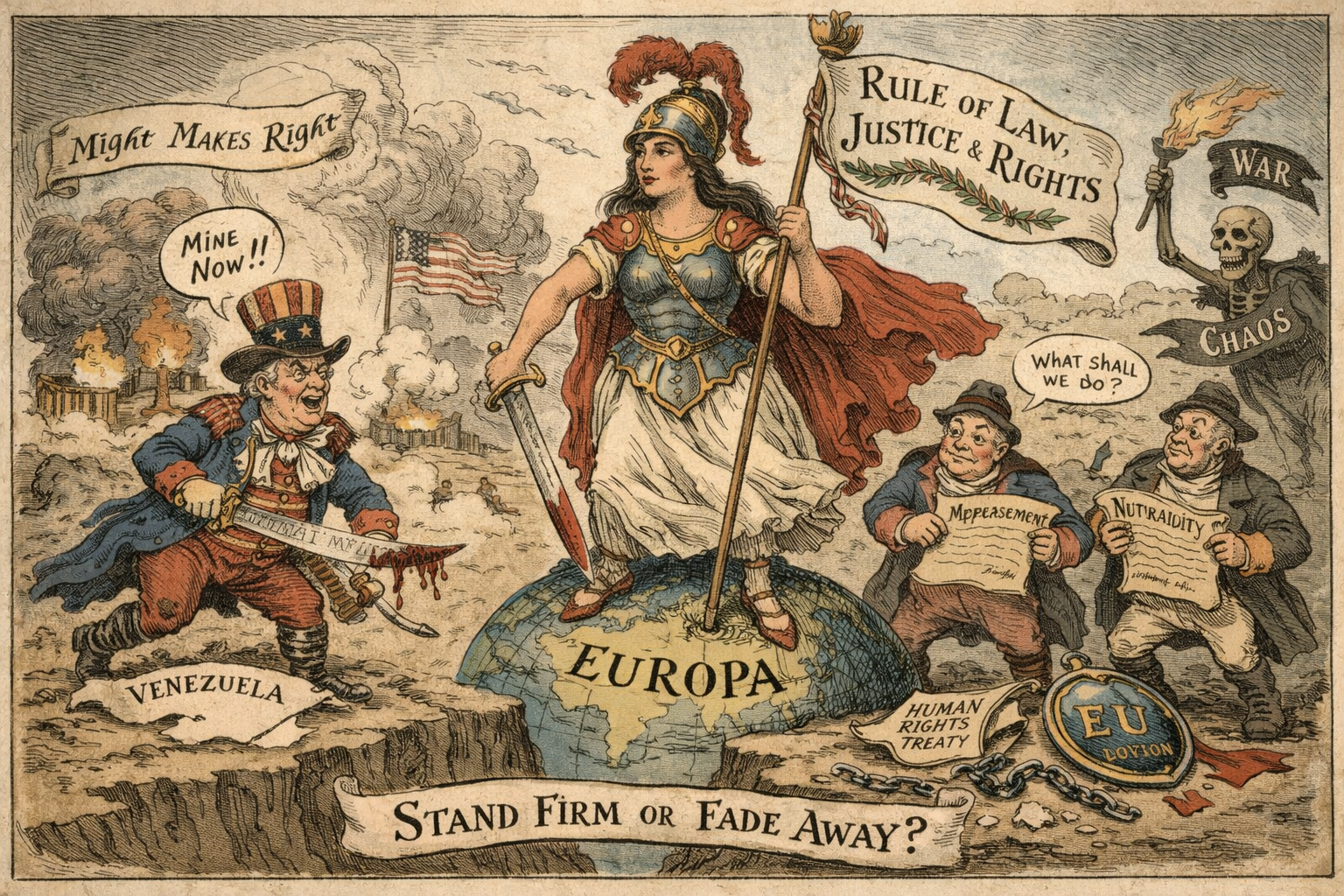
Trump’s reckless invasion of Venezuela shatters illusions about a self-sustaining rules-based order. The EU now faces a decisive choice: drift into irrelevance or unite, wielding both muscle and diplomacy, to defend postwar values of human rights, justice and law. History demands leadership; hesitation means surrender by instalments for Europe itself.
There are moments when history does not knock but barges in uninvited, kicks over the furniture and dares you to respond. The reckless invasion of Venezuela by President Trump has done exactly that. The shockwaves are not only felt in Caracas or Washington. They reverberate through Brussels, Luxembourg, Berlin and every capital that has grown accustomed to the comfortable illusion that the post-war order, once built, maintains itself. It does not. It survives only if someone is willing to defend it.
What we are witnessing is not a passing aberration. It is the naked assertion that force trumps law, that personal bravado outranks multilateral process, that sovereignty and human dignity are props in a televised spectacle. The United Nations looks on, its mechanisms sidelined. International courts issue words while tanks supply facts on the ground. The question therefore returns, unavoidable and urgent: who, if anyone, will step up for the rule of law?
Europe was born out of the smoking ruins of precisely this kind of arbitrariness. It is no coincidence that the vocabulary of the Union is studded with words like dignity, rights, justice, peace. These are not rhetorical ornaments; they are its genetic code. Yet over the past years the EU has preferred the language of caution, incrementalism, lowest common denominators. Strategic ambiguity has become strategic paralysis. All the while, the world has ceased to wait for Europe to make up its mind.
Trump’s Venezuela adventure makes the choice starker than ever. Either the European project dissolves into a genteel talking shop, destined for gradual dismantlement into insignificance, or it accepts adulthood. Adulthood means power. It means speaking with one voice, building the capacity to deter aggression, backing diplomacy with credibility and muscle, and refusing the comforting refuge of “not our problem.” It means understanding that defending human rights, international law and multilateralism today is not an academic exercise but a question of geopolitical survival.
There is no shortage of hypocrisy to overcome at home. An EU that wants to lead must first confront internal backsliding on the rule of law, the temptation to placate strongmen for short-term gains, and the ever-present fear of domestic populists who rail against imaginary Brussels overlords while depending on the stability Europe provides. Leadership will not be improvised; it must be claimed, and it will be contested.
But the alternative is worse. A world of transactional invasions and punitive raids dressed up as destiny will not leave Europe untouched. It will reach our borders, our currencies, our energy, our democracies. Retreat is not neutrality; it is surrender by instalments.
So the time for pussy-footing is over. Europe must decide whether it is merely a market with an anthem or a political community prepared to defend a civilisation of law. That means coordinated foreign policy, credible defence integration, principled diplomacy, and the moral clarity to say that invasions without legal mandate are unacceptable regardless of who orders them. The post-war values that once seemed self-evident require guardians again.
History has pushed the European Union to the front of the stage. Either it bows and exits quietly, or it stands its ground and leads. The choice will define not only the future of the Union but the fate of the rules-based order itself.
