Maduro, Gaza and Black & White Politics

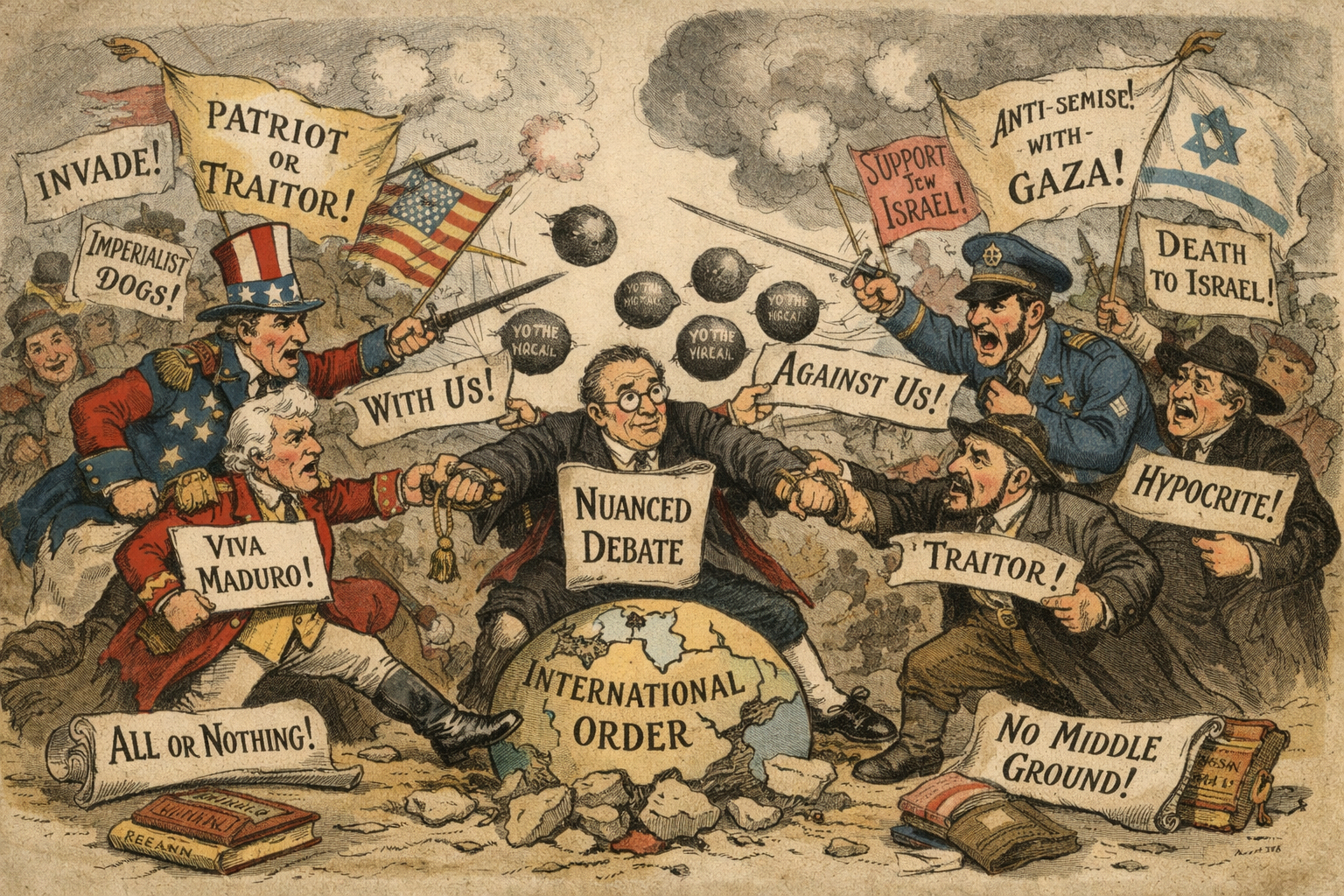
Public debate is losing its ability to handle complexity. Arguments are increasingly forced into tribal binaries: for or against, pure or condemned. The invasion of Venezuela, the Gaza tragedy, and the EU dispute over using frozen Russian assets for Ukraine all reveal the same reflex. It is now difficult to say two true things at once, to condemn authoritarianism while also condemning unlawful intervention, or to criticise a state without attacking a people. This black and white mindset weakens international norms and nourishes demagogues. Democracy requires nuance, patience and good-faith disagreement. Reality is complicated. Our thinking should be too.

There was a time when disagreement was an art. You could walk into a bar or a family lunch and discover that people could argue over politics, football and philosophy and still recognise that the world is complicated. Today that space is shrinking. The appetite for complexity has been replaced by an insistence on purity tests. You are either fully with us or fully against us. Min mhux magħna, kontra tagħna. Nuance is not only unwelcome. It is treated as betrayal.

The past months have offered an almost laboratory perfect demonstration of this drift. The reaction to the decision by Donald Trump to invade Venezuela has unfolded not as a debate about sovereignty, international law, regional stability and the Venezuelan people themselves, but as an online morality play. Choose your colours and shout. That is the extent of it.

It is apparently no longer possible to say the following simple adult sentence: Nicolás Maduro presided over an authoritarian and economically disastrous regime, and at the same time the United States is in clear violation of international norms by invading a sovereign state. The first half of that sentence will get you branded as an apologist for imperialism. The second half will earn you the label of socialist sympathiser. In some corners you will be accused of both simultaneously. The problem is not only intellectual laziness. It is a deeper abandonment of the idea that two truths can coexist, that moral judgment requires more than a team scarf.

The same flattening of thought is visible in the debate over Israel and Gaza. It should be straightforward to condemn the actions of the Israeli government and the devastation visited upon civilians in Gaza, while also rejecting any form of hatred toward Jewish people. Yet the public square rewards those who refuse this distinction. If you criticise the state of Israel you are suspected of hating Jews. If you are vigilant about antisemitism you are assumed to be endorsing every policy of the Israeli government. Whole histories, legal frameworks and human tragedies disappear into this binary grinder.

The same reflex has marked the European debate on whether to deploy frozen Russian assets to support Ukraine. What is in truth a complex web of legal constraints, property rights, market stability risks and the creation of precedents in international financial governance has been flattened into a shouting match. EU institutional leaders who counsel caution are instantly branded as timid bureaucrats indifferent to Ukrainian suffering. Those who advocate rapid and expansive use of the assets are dismissed as reckless ideologues ready to shatter the rule of law when it suits them. Member states with deep exposure to financial markets or constitutional limits on expropriation are accused of selfishness, while states urging faster action are caricatured as naïve moralists. Lost in the noise is any recognition that democratic leaders may be grappling in good faith with genuinely difficult trade offs, where support for Ukraine must be reconciled with the long term credibility of Europe’s legal order and the stability of its financial architecture.

There is a hidden cost to this constant demand for black and white answers. It corrodes the very architecture of the international order. That order is not a slogan. It is a mesh of norms, institutions, messy compromises and evolving jurisprudence that has been built to prevent precisely the rule of the strongest from becoming the only rule. When citizens lose the habit of thinking in layers, of holding tension, of accepting that rights and wrongs can intersect in uncomfortable ways, they also lose the instinct to defend that order. If every conflict is simply a clash between absolutely good and absolutely evil, then treaties, courts and multilateral processes are just inconvenient obstacles.

Social media has rewarded outrage and punished hesitation. Politicians have learned to fear the fifteen second clip more than the considered argument. Academia sometimes retreats into jargon while journalists are pushed toward headlines that perform rather than inform. Each of these trends narrows the space for complexity. The end result is a civic culture that treats reflection as weakness.

Yet reality stubbornly remains complicated. Venezuela is a country of immense suffering whose people deserve democratic dignity without foreign tanks rolling across their soil. Israel is a state with real security concerns whose government can still commit grave wrongs. The United States can speak the language of liberty and simultaneously trample the very rules it once helped to draft. These are not contradictions to be resolved by erasing half of the picture. They are the texture of the world we actually inhabit.

Recovering the capacity for nuanced judgment is a democratic necessity. Citizens who cannot think beyond binary choices are easy prey for demagogues. Institutions that depend on public understanding become brittle when that understanding collapses into slogans. International law becomes performative when publics refuse to see its value except when it flatters their tribe.

The antidote is unfashionable and slow. It requires reading rather than scrolling, listening rather than waiting to speak, arguing in good faith rather than hunting for trophies. It requires the humility to admit that one can be wrong about part of an issue and right about another, that moral clarity is not the same thing as intellectual simplicity.

We do not need a world with fewer disagreements. We need disagreements that are worthy of the complexity of the world. The alternative is already visible. It looks like foreign policy by thunderclap, public debate by accusation, and a steady erosion of the fragile agreements that keep power in check. Black and white may be easier on the eye. It is a disastrous way to see reality.

Peace for our time – the 20 year post

Today marks the twentieth anniversary for J’accuse the blog. Twenty years ago I clicked on the Post button for the first time (after 12 failed attempts) and the blog was up and running. That’s a lot of time that’s gone by and in the meantime writing does not feel the same. For years blogging came as a second nature as J’accuse elbowed its space in the national media. Writing daily was second nature, as normal as having breakfast.

What changed recently was the motivation. That feeling of overwhelming helplessness of an uphill battle against misinformation. There was a sudden void of real interlocutors as the public space became monopolized by the loud, the bullies and the manipulators. This was the time of the rapid increase in the rate of backsliding in the rule of law.

We had been the ones to issue the first warnings. I had yelled until I could yell no more that the politics of this nation was fated to recede in a downward spiral. Daphne Caruana Galizia’s assassination precipitated this state of affairs. Seven years ago I switched to writing for The Shift more often and less on this blog. However even that became frustrating. I felt like a broken record, a Cassandra on repeat doomed not to be believed and not to be heard.

And now the New World Order beckons. The world of Trumpian non-sequiturs were a spade is not a spade because Trump says it should not be. The quest for the truth has just become ever so complicated.

Which brings me to the subject of this anniversary post: Peace for our time.

Over the last few days we have heard the Trumpian pitch for “peace” in the what he calls the War in Ukraine. The mantra from the MAGA administration is now that (Ukraine President) Zelensky is only interested in prolonging the war. They say he is too arrogant to accept the terms of peace that Donald Trump has so graciously negotiated. Having humiliated Zelensky in the Oval Office Trump has turned the screw further and seems to be forcing Zelensky to the table to underwrite the “peace” only Trump can guarantee.

Some politicians, among which Malta’s Prime Minister, have no gone on record saying that “Ukraine cannot win this war”. It forms part of a wider assessment made by the PM in the context of the EU debate on rearmament following the evident signs of MAGA’s relinquishing of its defence obligations with its decades old allies. This new spin is framed in terms of peace-loving, peace-seeking propaganda with the idea being that Zelensky’s Ukraine must accept whatever deal is available so long as the guns cease to fire.

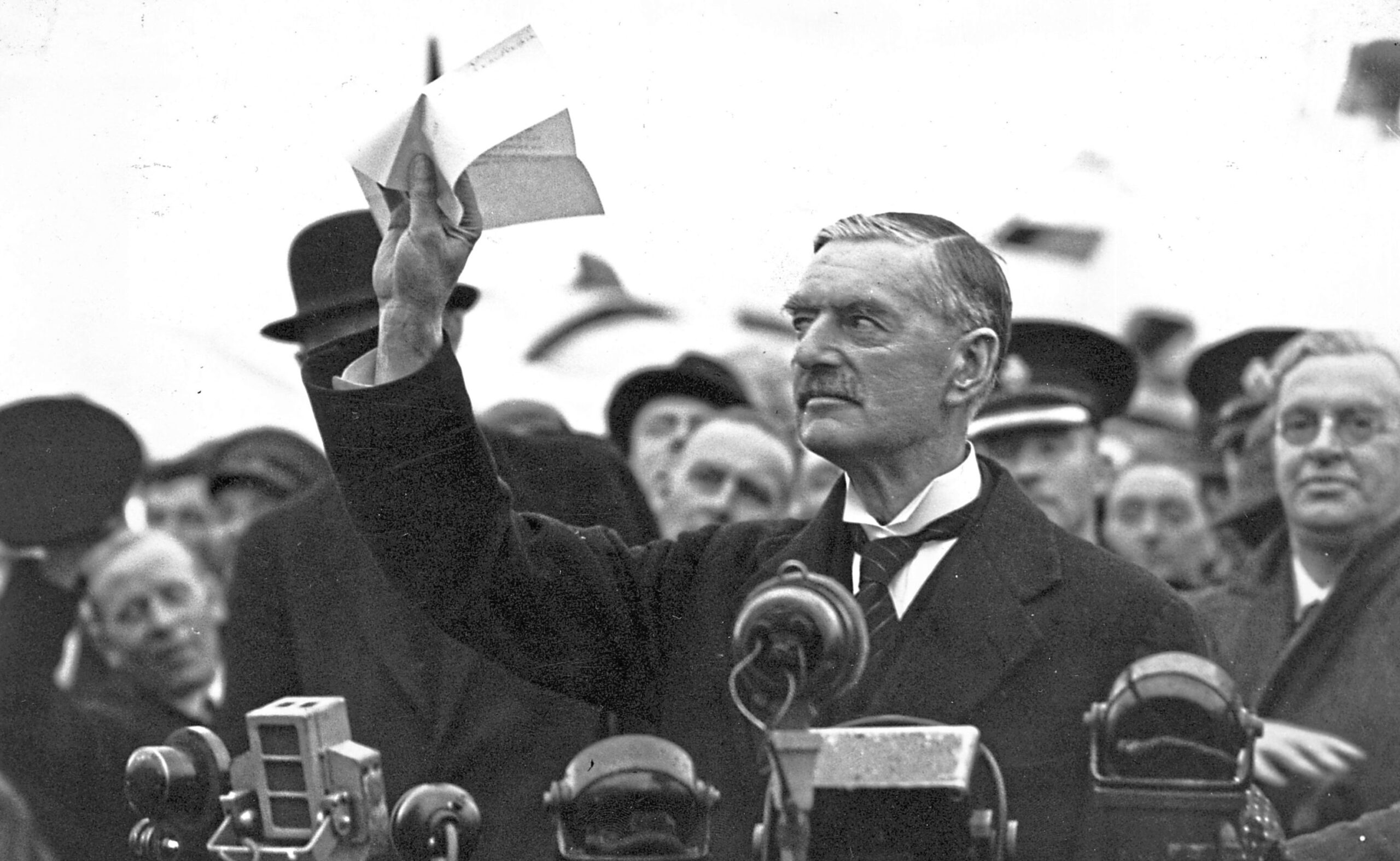
Robert Abela, Donald Trump, Viktor Orban are the modern day Neville Chamberlains desperate to sell us the idea of “Peace for our time”. Abela is keen to highglight Malta’s outdated neutrality (a Cold War concept) and his firm determination not to fork out one cent that will be spent on arming a new Europe even if that would mean that Europe is finally no longer dependent on any other force for its own security. Aside from the fact that Abela is very evidently trying to position himself against the warmonger figure of Roberta Metsola that his party has manufactured meticulously there are other issues that are being ignored.

Here are a few facts that the “Ukraine will not win this war” rabble do not want you to understand:

  1. Ukraine is not interested in “winning the war“. This is not a war in the sense that Ukraine did not choose to go to war and never intended to be struggling for survival. This was an Act of Aggression by Russia on Ukrainian soil. Worse, it is a violation of the 1994 agreement when Ukraine agreed to relenquish its share of the Soviet nuclear arsenal in return for guarantees that Russia would respect its borders – guarantees underwritten by… wait for it… the United States and the United Kingdom. The goal of Ukraine and of any self-respecting liberal democracy supporting Ukraine would not be simply to put down the guns but rather a return of the Ukraine to its borders. An unconditional return with the appropriate guarantees.
  2. Peace is not defined by Donald Trump and JD Vance. Especially the “peace” that involves arm-wrestling the victim of aggression into giving up resources to the transaction hungry wolf of a president. That is not peace. It is appeasment. Appeasment of Russia and Russia’s greed. Remember this aggression began with Russia claiming its right to safeguard its citizens who still lived in parts of the Ukraine. Could there be a more stark reminder of the situation of the Sudeten Germans at the time of Chamberlain’s peace for our time?
  3. EU security independence is no longer an option but a must. Putin’s Russia and now Trump’s America have shown that they do not care for the rules of the world order. There is no respect for the sovereignty of other nations and even less for the maintaining of alliances that have hitherto ensured security in the European region. The EU opting for rearmament is an EU that is painfully aware of Trump’s disconnection and is preparing itself to go it alone. Until Trump’s arrival Europe had lived under the safety of a shield that relied on mutual US-EU cooperation. With that shield down there is no option but to prepare for the worst. The sooner Robert Abela’s government realises that our fate is deeply intertwined with the rest of the European community the quicker will they shed the illusion that neutrality will pose a problem for the likes of Trump and Putin.

We need less Neville Chamberlains in this world. Sadly, the world of post-truth also means that there are many who are prepared to believe in “Peace for our time” promises that lead to nowhere.

That’s the truth, if I lie.

Trump u Gerusalemm: Titnehha l-maskra

Intervent li għamel Karl Schembri fil-gażżetta t-Torca. Din qiegħda tiġi riprodotta hawn bil-permess tiegħu. L-opinjoni espressa fl-artiklu hija tiegħu personali.

L-aħbar li l-Amerka tirrikonoxxi Ġerusalemm bħala l-kapitali tal-Iżrael m’għandha taħsad lil ħadd. Jekk xejn, fl-aħħar, tneħħiet il-maskra tad-dupliċita’ perversa tal-Amerikani lejn il-kwistjoni tal-Palestina. Trump, bil-vulgarita’ medjokri tiegħu, ineħħi kwalunkwe pretensjoni falza lejn l-hekk imsemmi ‘proċess ta’ paċi’. Staqsi kwalunkwe Palestinjan u jgħidlek, “xi proċess? B’min trid titnejjek?”. Trump fl-aħħar ta s-siġill tal-approvazzjoni tiegħu lejn kull illegalita’ li twettaq l-Iżrael fil-Palestina okkupata. Mit-tkeċċija tar-residenti Palestinjani f’Ġerusalemm, għat-twaqqiegħ tad-djar u l-iskejjel Palestinjani, sal-bini tal-kolonji Lhud fil-qalba tal-Palestina. Tneħħiet ukoll il-pretensjoni li l-Amerka hija l-medjatur ta’ rieda tajba bejn l-Iżrael u l-Palestina. Trump għamilha ċara iktar minn qatt qabel, imma ma ninsewx li taħt Obama nbnew l-iktar kolonji fl-Istorja u kellna l-ikbar gwerra mdemmija fuq Gaża.

Il-mistoqsija issa hi: X’se tagħmel il-bqija tad-dinja? X’se jagħmlu l-kapijiet Għarab? U x’se jagħmel Mahmoud Abbas? Diġa’ rajna ftit kliem ta’ rabja mill-kapijiet minn madwar id-dinja. X’se jagħmlu dwarha? L-Għarabja Sawdija, il-Ġordan, l-Eġittu u l-istati pupazzi kollha tar-reġjun m’huma se jagħmlu xejn. Bħalissa qed jittollerraw ftit protesti fit-toroq. Ftit ieħor jibdew jarrestaw l-imqarbin li jgħollu leħinhom.
Abbas, li kieku għandu ħabba waħda ta’ dinjita’, ixolji l-Awtorita’ Palestinjana, jagħlaq ir-rappreżentanza Palestinjana f’Washington DC, u jiddikjara darba għal dejjem li l-ftehimiet kollha, ibda minn Oslo, huma nulli u mitfugħin fil-miżbla tal-Istorja. Imma mhux se jagħmel hekk. Jiddependi mill-Amerikani biex iħallas is-salarju tiegħu stess u ta’ eluf ta’ impjegati tal-Awtorita’ Palestinjana.

Il-PLO — l-Organizazzjoni għall-Ħelsien tal-Palestina, imissha issa tagħmel dak li jgħid isimha — twassal għal-liberazzjoni tal-Palestina. Ma fadalx triq politika miftuħa. Għall-Ewropa, dan huwa ċans biex tidħol bħal qatt qabel u tiddefendi l-liġi internazzjonali. Malta għandha tgħolli leħinha fl-Ewropa u tfittex gvernijiet li huma tal-istess fehma sabiex jagħmlu pressjoni fuq l-Iżrael.

L-Iżrael issa, bis-siġill ta’ Trump, se tkompli tagħmel dak li ilha tagħmel għal deċennji. It-tindif etniku tal-Palestina. Din tħalliha b’żewġ possibiltajiet: Jew tiddikjara l-Palestinjani ċittadini tagħha u ttihom drittijiet indaqs bħal-Lhud tal-Iżrael, jew inkella taċċetta li dan huwa stat ta’ Apartheid. U lkoll nafu kif il-bqija tad-dinja trattat l-Afrika t’Isfel fis-snin tal-Apartheid.

Karl Schembri għex għal erba’ snin fil-Palestina okkupata u bħalissa jgħix fil-Ġordan fejn jaħdem bħala media adviser għal-Lvant Nofsani ma’ aġenzija umanitarja. L-opinjoni espressa f’dan l-artiklu hija biss dik personali tiegħu.

Inspiration

Asked to comment on Trump’s recent victory, comedian John Stewart made a fair point when he stated that one point that struck him during the election was that no one had asked Trump what was needed to “Make America Great” again. We don’t have the “metrics” to measure how Trump will achieve this greatness because we were never told what was missing for the “Greatness” to be there. It’s not just a question of metrics it is also a matter of not knowing what to aspire for. Make America Great sounds like a great project and to participate in that project would be an inspiration for every citizen ideally. Is it though?

Back in Malta I noticed a post on facebook by a professional graphic designer named Corinne Cutajar. Here is what she had to say about the logo adopted by Malta for its period of EU Presidency:

Waking up to this… don’t know whether to feel amused or pissed off for having my logo (right) copied. Last year I got hardly any exposure for my work and yesterday this student’s copy was blown out of proportion! #goodriddance

15095125_10154031273106129_6191463164038075204_n

Yep. It’s quite a blatant rip-off. This from the government that is supposedly all about artists and their freedoms and development. Let us not forget the high rise tax that is supposed to be channeled to a fund for artists or something of the sort. Malta’s government and its Minister of Culture who is somehow obsessed with fantasy novels are desperate to Make Artists Great again. If you want to get a finger on the pulse of what people really are bred to think about artists and compensating their efforts then look no further than this article on Illum where a hairdresser complains about the annual fee that he has to pay to the Performing Rights Society in order to play music in his salon.

The Hamilton business was also an interesting turn in the first days post-Trump’s election. By now we have all heard of the drama troupe that decided to take advantage of the presence of Trump’s VP-elect in the auditorium to read out a sort of liberal declaration reminding Pence of the diversity of the electorate and of the hope that no body will be left behind when making America great again. I must admit that I do find it ironic that the message in the theatre piece is not enough and that a troupe has to hijack the audience after the curtain falls in order to add a bit of its own drama full of bourgeois menace. At the same time the reaction by Trump and his supporters is outright ludicrous – surely VP Pence is made of sturdier stuff than one that wilts when confronted with a different message than his own.

Only this morning we got reports that Trump has backed out of an interview with the New York Times because he does not like the way they report him. Very un-presidential. Our very own Trump-at-home and his minions are making it a habit of engineering press conferences and tailor-made Q&A’s in order to be in a position of answering only the questions he/they like/s. The difference is that the veil on Making Malta Great has long fallen. We are now in the phase where the masks are thrown and the only inspiration left is the jobs for the boys, the few lies that still fall on fertile ground and the ever-widening ‘establishment’ that is none other than the circles of beneficiaries of the decisions of a government that is the antithesis of greatness, of meritocracy and of decency.

Copy that.