Praworządność : the EU and the Rule of Law

In a historic move today, the European Commission has initiated a procedure against Poland based on the clear risk of a serious breach of the rule of law. From the official press release:

Despite repeated efforts, for almost two years, to engage the Polish authorities in a constructive dialogue in the context of the Rule of Law Framework, the Commission has today concluded that there is a clear risk of a serious breach of the rule of law in Poland.

The Commission is therefore proposing to the Council to adopt a decision under Article 7(1) of the Treaty on European Union (see Annex II).

The European Commission is taking action to protect the rule of law in Europe. Judicial reforms in Poland mean that the country’s judiciary is now under the political control of the ruling majority. In the absence of judicial independence, serious questions are raised about the effective application of EU law, from the protection of investments to the mutual recognition of decisions in areas as diverse as child custody disputes or the execution of European Arrest Warrants.

This is not something that can or should be taken lightly. In a local (Maltese) context, this should put paid to the myth that the eyes of the EU institutions are only focused on Malta (vide Pana Committee and recent Rule of Law task force) and that they are focused on Malta because of the work of some “traitors”. It should also put paid to the yarn being spun in some quarters that the rule of law is some “cliche'” that only serves the ulterior hidden purposes of power-hungry groups eager to overturn the current status.

Interestingly the Commission focuses on the judicial reforms in Poland that have severely prejudiced the independence  of the judiciary – the main default in the state of the rule of law in Poland is seen to be the judicial branch. The deficiencies are in the powers of appointment and removal that have been arrogated to the executive in recent legislative changes.

Why should Malta care?

Malta’s current system of appointment, removal and scrutiny of the judiciary is already flawed as it is. All the talk about reform, even in the judicial sector, remains just that – talk. Over the years the loopholes in the system that stem from the excessive discretion of an all-powerful judiciary have only been worsened. Our Prime Minister may “take note” in some cases (in answer to the Chief Justice for example) or “be perplexed” in others (as when he feigns ignorance of the consequences of the Ombudsman’s warnings regarding the internal kangaroo courts being set up within the public service). There is only so long that these lies can hold though.

Alarm bells will continue to be rung – if not by a spineless opposition that seems to be ever more hell bent on joining the populist battle, at least by a wider civil society made up of varied exponents and NGOs that feel it is their duty to act as Malta’s last conscience. Poland had long been playing with fire and is now in direct line for losing certain rights under the EU system. Malta could very well be next.

In the eighties Malta looked closely and learnt lessons from the happenings in Warsaw and Gdansk. The solidarność (solidarity) movement was adopted as a precursor for the calls of Work, Justice and Liberty that brought about change from a tired system. This time round we might do well to take heed and see how Poland solves its problems with praworządność  (rule of law).

Now. Before it is too late.

Watching justice come undone

Magistrate Charmaine Galea has just decreed her own recusal from the compilation of evidence in the Caruana Galizia murder trial.

“Magistrate Charmaine Galea followed where magistrate Donatella Frendo Dimech left off last week and said she would not hear the compilation of evidence against the three accused, on the grounds that Ms Caruana Galizia had mentioned her in blog posts concerning Labour Party appointees to the judiciary.” (Times of Malta)

A few off the cuff facts (for which I thank some colleagues who are more familiar with the ins and outs of the courts) are warranted at this stage. Malta’s current line-up on the Magistrate’s bench has a grand total of 22 Magistrates. The standard for recusal that has just been set by the combined abstentions of Magistrates Dontella Frendo Dimech and Charmaine Galea is quite low. Magistrate Frendo Dimech’s abstention stemmed mainly from a weak level of familiarity with the victim’s sister (they shared a schoolbench) while Magistrate Galea referred to direct criticism that she received from the victim upon her appointment:

Magistrate Galea has just read out a statement saying Daphne Caruana Galizia had written about her nomination to the bench and linked it to her closeness of the government of the day.” (still the Times Court report)

Now,  that link – the one related to Daphne’s criticism of Labour’s appointment of magistrates – has delivered a severe blow to the list of 22 magistrates. Decimation does not begin to describe it. In fact, writing on the 20th of November 2016, Daphne Caruana Galizia detailed the specifics of government appointments to the Magistrates’ bench:

“This government has made 14 appointments to the bench in three years, 10 of whom are connected directly to the Labour Party. The other four are Judge Giovanni Grixti (formerly a magistrate), Judge Edwin Grima (formerly a magistrate), Magistrate Donatella Frendo Dimech (formerly at the Attorney-General’s Office), and Magistrate Aaron Bugeja (formerly in private practice).” (Running Commentary, November 20th, 2016).

The rest of the blog post in question develops an argument that implies without any doubt the ‘political’ nature of Labour government appointees through the years. In this context, Magistrate Charmaine Galea’s abstention should not come as a surprise and is actually the more ‘justified’ of the two until now seeing how Magistrate Frendo Dimech was specifically singled out by Daphne (together with another three magistrates) as not having been a political appointee. What does stand out is that by the same reckoning as applied by Magistrate Galea, 9* other appointees to the bench (10 out of the list of 22) qualify for the same reasoning, the same abstention.

We may argue at length whether or not the abstentions are sufficiently justified but that is not the point that I want to make here. The point that comes out clearly from the current debacle is that when Daphne Caruana Galizia, like many others, was pointing out the political nature of appointments to the judiciary back in 2016 (and even before that) she was actually highlighting a deficiency in the system: one that makes it weak and vulnerable. This is the tangible effect of the breaking down of the rule of law. Justice is not being seen to be done, it is being undone bit by bit.

The independence of the judiciary is a fundamental building block of a system based on the rule of law. It is a fundamental building block for any liberal democratic society. When the judiciary is treated as yet another domain wherein ‘jobs for the boys (and girls)’ are to be found, it becomes yet another dagger in the back of the proper administration of justice and consequently of the proper running of the state. The merry-go-round of recusals will necessarily go on if the roster by lot will continue to throw up names who feature on that November 20th post. It is inevitable. It is a vicious circle.

The blame is not to fall on the journalist and opinionists who pointed out the deficiencies and bad-will in the nominations. It is to fall on a government that proceeded to turn nominations to the bench into a farce. It is a government that will sit on a case of impeachment of a judge until he retires out of the grasp of justice. It is a government that will wait for the exact amount of years required by the constitution to pass for the appointment of a young, green, lawyer to the post of magistrate because rule by law trumps rule of law any day.

The not so impeached judge happened to be the father of a labour candidate, the young green lawyer happened to be the daughter of the ex-labour deputy leader and current speaker of the house. One other nominee to the bench – Ingrid Zerafa Young – withdrew her nomination after it transpired that her appointment could have breached the Constitution since she was a member of the Employment Commission. It was Dr Zerafa Young, not the government,  who withdrew her nomination.

As you follow the merry-go-round of recusals do not laugh, do not find it funny and most of all do not blame the magistrates in question. Instead remember that this is a direct consequence of the breakdown of the rule of law in this country.

We all know where the blame for that falls squarely.


*This post has been edited because the previous version wrongly implied that all the appointees mentioned in the Running Commentary’s posts were magistrates. 4 of those were in fact judges and therefore should not be considered in this particular case.

Seeing justice done

This article appeared in today’s Sunday Times of Malta

In her Republic Day address, President Coleiro Preca stated that she believes “that the rule of law is as strong as the people acknowledge it to be, as much as they believe in it, cherish it, and continue to support it.” In her reference to the concept of “belief”, the President might have unintentionally struck an important chord that plays through the ongoing debate where the “rule of law” is concerned.

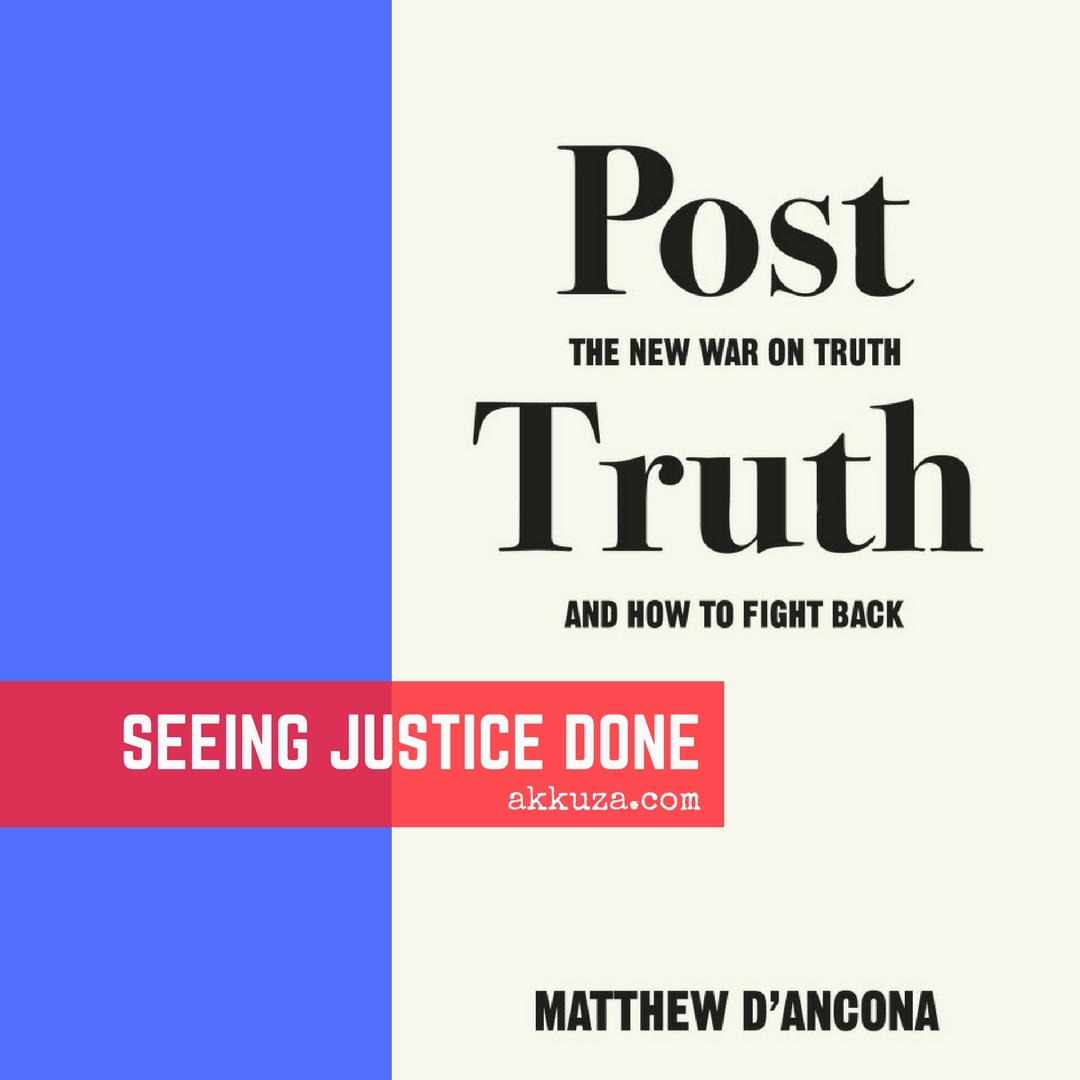
Seeing, in this period of Post-Truth Politics, is believing – even when what we see is a staged performance that is intended to reassure the emotional side of our thinking brains while at the same time numbing any rational reaction thereto. The phenomenon has been pigeonholed using various metaphors: the emperor’s clothes and Magritte’s pipe (ceci n’est pas une pipe) come to mind right now. Whole generations (particularly the baby-boomers) prize emotional sincerity over “the starchy pursuit of objective truth”.

Truth has been relegated to a relative importance in the list of priorities. It has to compete with the panoply of emotional expressions that have moved up on the popular agenda. The lack of forensic analysis, when people stop questioning the facts, has also meant that society has less time for ‘experts’. There is no trust in them. The Brexit and Trump phenomena followed on the heels of the financial crisis of 2008 when trust ratings in experts plummeted.

The collapse of trust is dangerous. As Matthew d’Ancona (who I rely upon quite liberally in this article) states “… all successful societies rely upon a relatively high degree of honesty to preserve order, uphold the law, hold the powerful to account and generate prosperity”.

Without the real value of truth our gauge of what the people appreciate shifts dramatically. Law, the rule of law, is not about faith. The very concept of a working system under the rule of law is not designed to work depending on the number of believers in the system. There is a word for a system based on belief: Religion. The rule of law is not about faith. Nor is it about hope – hope that justice is done. The danger of misinterpreting the phrase “seeing that justice is done” is based on the simple fact that it is part of a larger whole.

Fearne brought up ‘the rule of law’ often and it was like the devil quoting scriptures

The full phrase in fact is, “Not only must justice be done, it must be seen to be done”. Remove the first part – actually and linguistically – and you get an act of prestidigitation, where you are made to believe that something is there when it is not. Such a magic act requires a theatrical appeal to emotional intelligence of the highest kind: it not only requires that you believe but also that you suspend that belief and actually believe what you are being told that you should see.

“Seeing justice done” should in fact be the final act of a progression of events that include justice actually being meted out. In the past weeks we have seen the concept of the rule of law twisted and turned beyond recognition. The danger is that people begin to believe that what they see in action is the rule of law when actually it is the rule by law. In his Commentary on the Constitution Tonio Borg sets out the distinction clearly: “So the rule of law is a concept which gauges not just the number of laws enacted but their nature and direction. It is also a political concept so that something, which is clearly within the parameters of the law, may still go against the rule of law in spirit.”

Watching Chris Fearne squirm to Tim Sebastian’s questioning on the Conflict Zone (DeutscheWelle) was not pleasant. Fearne brought up “the rule of law” often and it was like the devil quoting scriptures. The Prime Minister appealing in court in order to stop inquiries, redacted contracts because commercial interests trump public interest, quoting laws in order to prevent sharing of information regarding passport buyers… that is just an aperitif.

We have naively called the new religion out as spin. It is not just spin. It is a dangerous belief system that is supplanting what should be a concrete system based on law and inspired by natural justice. Bringing three men before the courts of law for the heinious murder of a journalist can never be seen as the final curtain call that proves that all is well in the state of the Republic.

Believe me, it is not.

Jacques Zammit is a référendaire at the Court of Justice of the European Union and one of the founders of the Advocates for the Rule of Law. Opinions expressed in this article are strictly personal.

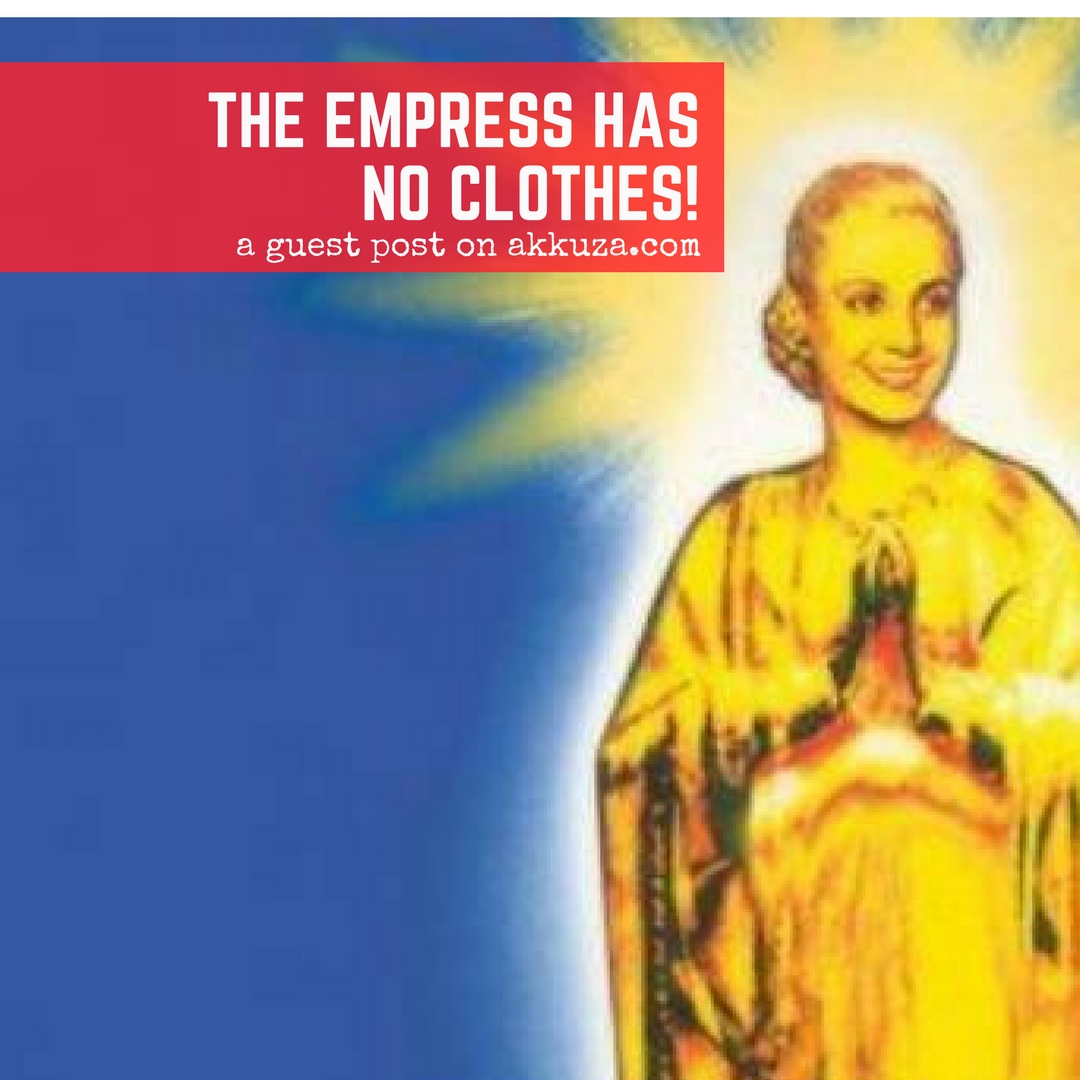
The Empress has no clothes!


Eleonora Sartori returns with a guest post concerning the concept of shame and its value in today’s society,

The Empress has no clothes! (Not that she would need much in the Bahamas).

“A sinner comes before you, Cersei of House Lannister. Mother to His Grace, King Tommen, widow of His Grace, King Robert. She has committed the acts of falsehood and fornication. She has confessed her sins, and begged for forgiveness. To demonstrate her repentance, she will cast aside all pride, all artifice, and present herself as the gods made her….

This is how George R.R. Martin describes the ritual of punishment and penance named “walk of atonement”, used to publicly shame women accused of adultery or prostitution. The confessed sinner has to walk a certain distance stripped of all clothing, exposed to the eyes and jeers of the common people.

Somehow, this brings back the image described in the Gospel of John, the Pharisees, when a woman who has committed adultery is brought unto Jesus since she is meant to be publicly shamed by being stoned. Shame is in fact a condition of humiliating disgrace or disrepute, the ignominy of being subject to a very degrading condition. However, Jesus unexpectedly answers back: “He that is without sin among you, let him first cast a stone at her.”

“He that is without sin among you”. Another aspect of shame, this time related to the self-awareness of one’s own sins. Shame caused by consciousness of guilt, shortcoming or impropriety.

Shame is indeed a manifold concept. It is also a very important pillar of humankind, as very well stressed by Professor Gardini in an article published some weeks ago on Sette – Corriere della Sera (Di cosa ti vergogni?).

But first, why am I talking about shame right now?

I felt the urge of sharing these thoughts when yesterday I read about the fact that the wife of your Prime Minister has been nominated Volunteer of the Year. As correctly put in an article published on The Shift, “The issue at stake was not the validity of Michelle Muscat’s contribution to charity which includes a 10-hour swim to raise funds for the charity she chairs, but the lack of institutional sobriety that comes across when organs of the State bestow honours on the immediate family members of high ranking officials” (It’s all about perception my dear).

The lack of institutional sobriety combines with the constant lack of transparence of appointment procedures on a worldwide scale. I’m just too tired of this ambiguous scenario we’re currently living in, where on the one hand, we have Ivanka Trump championing the cause of women empowerment by carrying out a Fashion Diplomacy strategy and on the other hand, we see Time Magazine nominating the members of the successful and long-awaited #MeToo campaign as Person of the Year.

Does no one feel ashamed for this current situation?

Then I remembered the article of Professor Gardini and I understood the core message conveyed by it. We’re no longer used to feel any shame nor to feel ashamed. Yet, I truly believe that restoring this precious feeling could only improve the democratic society in which we ought to be living in the 21st century.

Referring to Cicero in his analysis, Professor Gardini underlines that he who is capable of feeling shame presumes the existence of a superior entity, a so-called “superior thought”, that is able to assess and judge the insufficiency of one’s actions and in front of which one needs therefore to repent and rehabilitate. This superior thought is nothing but a set of values to which abides the community to whom we belong. A set of values respected by the other members of his community, who can judge and criticize you if you go off track.

Therefore, the sense of guilt is not merely private, but has a public dimension too. It’s the core expression of the principle of accountability.

But what about this principle in the digital era?

Professor Gardini correctly points out that nowadays we no longer belong to a community, but we choose virtual groups to which we want to belong. These groups do not form small societies based on confrontation and discussion, but instead exist as virtual projections of one’s imagine of one’s self. I create my group and in that group I am that particular version of myself.

Thus, in my virtual group I can always claim to be constantly right, since I have the right to reject every kind of confrontation and the arrogance not to take into account any potential different opinion. So much for the principle of accountability.

And yet, there is a very simple way to restore the role of shame in our modern society.

It’s every citizen’s duty to reintegrate into their daily routine the perception of shame and shameful actions. As well pointed out by the Background Paper published by SIDA on Accountability, Transparency and the Rule of Law within the Post-2015 Agenda, “the mere process and framework of accountability, transparency and the rule of law is not enough. What comes out of these structures and processes will, in the end, be determined by the social cohesion among people, as well as by the values and the political environment in society. Individuals have responsibilities and powers of their own to change and affect social norms and trends. Formal structures alone can never guarantee decent societies. »

It is you, the people, who have to publicly shame who you think does not abide by your set of values.

“Then the eyes of both of them were opened, and they realized they were naked; so they sewed fig leaves together and made coverings for themselves.” reads Genesis 3:7.


Majority Rules Not Ok

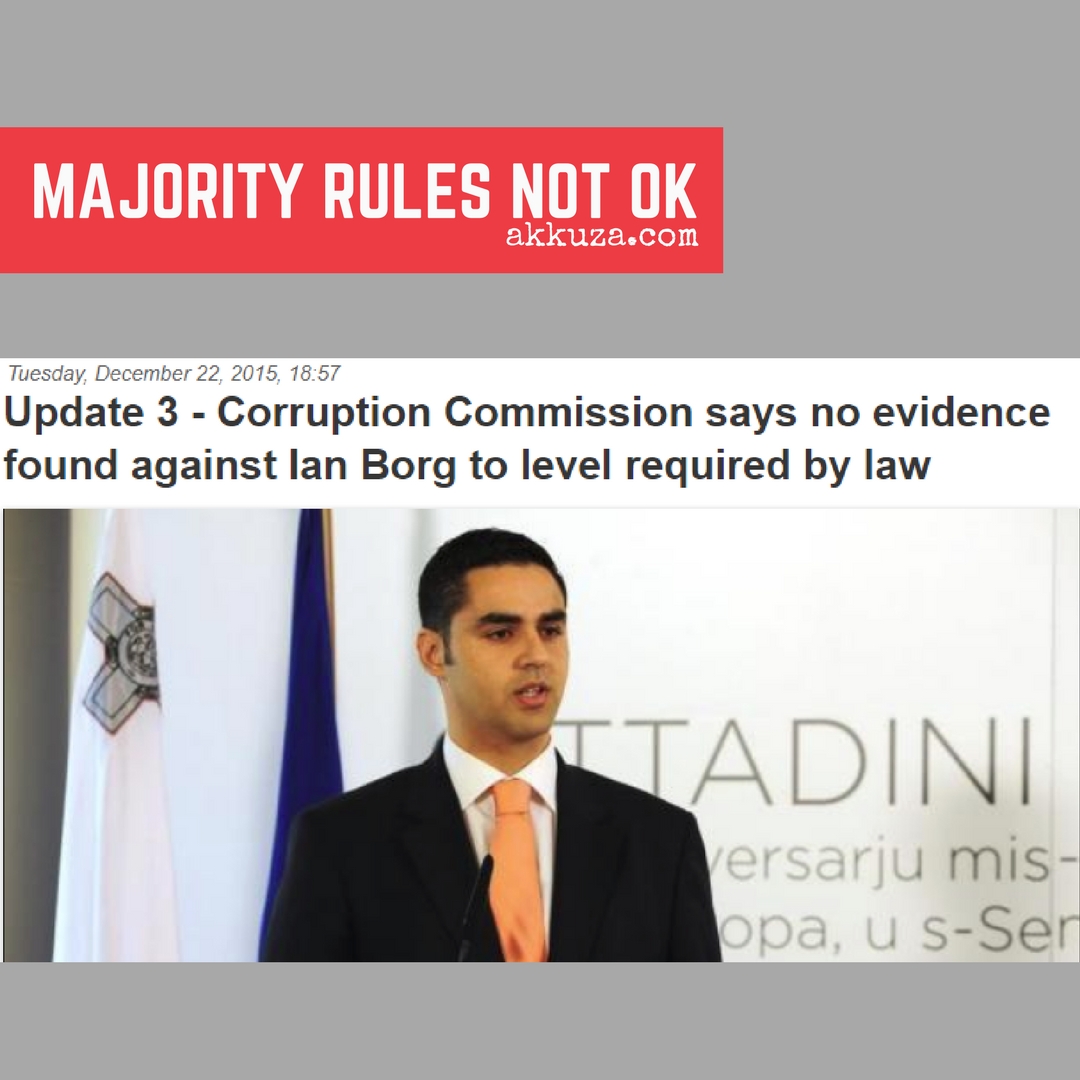
Malta’s Minister for Transport, Infrastructure & Capital Projects has gone on record saying something to the effect that “majority rule is higher than the rule of law”. One cannot stop underlining the dangers that lie behind this kind of statement. To begin with, this is a blatant show of ignorance of the laws that bind us. It flies in the face of hundreds of years of philosophical treatises on social contract, on constitutions, and on the basic principles that underlie our law-based societies.

Rousseau (The Social Contract), Locke (Second Treatise on Government), Hume (Of the Original Contract) and Madison (The Federalist Papers No. 10) – that is a tiny roll call of the kind of people who tried to get their heads around the problem of just representation in society. At the second rally organised by CSN after Daphne’s assassination I had spoken of the people as sovereign – the ultimate depositaries of the powers of the land. That was not a concept I pulled out of thin air. Our legal systems are all intended to crystallise the way that ultimate power (of the people) is lent (and we emphasise lent) to different branches of the state in order that they may govern. To govern in the name of the people, for the people, by the people. Again, not another catchphrase.

Later developments to the philosophers’ ideas came in the form of modern liberal constitutions such as those begotten by the American and French revolutions. A representative government, a separation of powers and a basic set of rights that was above the power of the legislature. From the Magna Carta onwards in fact, there was the gradual realisation that a sovereign people would still subject itself voluntarily to regulation by a set of fundamental truths that would be inalienable (could not be taken away) even by those who have been entrusted with creating laws for the day to day functioning of society.

“We hold these truths to be self-evident…” is how the second paragraph of the American Declaration of Independence begins. The colonies were protesting the abuse of the representative power by their King and in that document they justified their right to “dissolve the political bands which have connected them with another”. Among the first of the self-evident truths was The First Amendment which precluded the lawmakers from enacting laws which abridged freedom of speech, the freedom of press and the freedom of religious belief.

The basic rules would be guaranteed by other branches of the state. Alexander Hamilton outlined this in The Federalist Papers No. 78, when he spoke of the Court being the ultimate interpreter of the meaning of the Constitution. In his words, the Court would stand “between the people and the legislature, to keep the latter within the limits assigned to their authority … A constitution is in fact, and must be regarded by judges as fundamental law.. the Constitution ought to be preferred to the [legislature’s] statute, and the intention of the people to the intention of their agents.”.

Modern constitutions are replete with checks and balances of this sort. The point of the checks and balances is that tyranny is avoided. The point is that the abuse of power by a part over the whole is prevented.

The role of a ‘majority’ in our constitution starts and stops with the election of our representatives in parliament that lead to the selection of a government entrusted with executive power for a short mandate. The next day of an election the concept of ‘majority vote’ is technically redundant except when applied within the rules and regulations of parliamentary votes for the enactment of laws.

Above all, the government of the day as an executive – and every other branch of the state – have no business with using the concept of “majority rule” to trump all other concepts of legal accountability. To do so would be to usurp the very concept of control of power and representation. Ian Borg’s concept of majority rule trumping the rule of law is an abomination to the concept of democratic representation. The same can be said of Alfred Sant’s declarations in the European Parliament where the idea that “the people have voted” seems to have been bandied about as some sort of general absolution for any irregularities committed by the agents of government that was confirmed at the polls.

Whether willfully or through ignorance of the law, these statements become a declaration of war on liberal democracy. They represent a dangerous step in the current situation where the rule of law is withering before our very own eyes.

They must and shall be countered.

The people united can never be defeated.

Civil Society and its critics

A long read. This post takes a look at the actors and interests in the current debate on the rule of law in Malta. 

This afternoon the European Parliament will discuss a resolution on the Rule of Law in Malta. Point 5 of the Draft Resolution reads that “[The European Parliament] Regrets that developments in Malta in recent years have led serious concerns about the rule of law, democracy and fundamental rights including freedom of the media and independence of the police and judiciary”.  Point F of the preamble in the same draft resolution notes that “whereas this assassination led to street demonstrations and civil society protests in Malta calling for justice, accountability and respect for the rule of law”.

Our second parliament (because that is what the EP is, OUR parliament not a foreign institution) is about to discuss the state of the Maltese nation with particular attention to the legal framework that holds it together. Today’s discussion is an important milestone in our nations’ constitutional development and Civil society has been instrumental to get this discussion high on the agenda at both a Maltese and European level.

In May last year the group calling itself “Advocates for the Rule of Law” took out their first full page advert on the Sunday Times. The ad read ” Situations Vacant : Police Commissioner,  Chairman FIAU, Attorney General – needed for the proper functioning of a democratic society #ruleoflaw_MT, #maltaconstitution, #bringitback”.

I will be in Strasbourg for the commemoration of the Daphne Caruana Galizia Press Hall this evening and will also follow the debate. It’s a two hour drive from Luxembourg and it is only right to be there for this moment.  It is because I live in Luxembourg that I rely on feedback from Malta for news “on the ground”. What are the streets saying while one of our highest institutions discusses a motion that practically describes a nation in constitutional crisis? The feedback I am getting is that the effort to “return to normal’ seems to be winning. Four weeks after the assassination that supposedly shook Malta to its foundations we risk seeing Italy’s elimination from the World Cup snatching the frivolous “news cycle” baton once and for all.

So what exactly is happening? How can we have a nation that (at least in appearance) is hell bent on returning to the “u ijja mhux xorta?” normal while at the same time an important part of its institutional set up is ringing alarm bells? To understand this we have to look at the actors in this drama. What part has Civil Society played in this development – and who, above all, are its critics and detractors?

Dramatis Personae

1. The European “Partners”

The dynamic of the European institutions is such that national and supra-national interests meet in a huge chamber where ideas are bounced around. A resolution by the European parliament is not binding in the strict sense of the term for example, however one would be a fool to dismiss it as “international diplomatic spiel” that is void of substance. In the first place the EP acts within clearly defined legal parameters and on the basis of principles that are universally accepted at a European level. That is why today’s resolution begins with the consideration that the EU is founded on the values of respect for human dignity, freedom, democracy, equality, the rule of law and respect for human rights. In other words, action by the EP is grounded in principle and in law.

The major pitfall at an EU level is that the parliament resolution may be used to further competing national interests. In this particular case we may note that members from certain EU countries might use this moment of weakness in order to attack areas such as Fiscal policy and Gaming. It’s a cheap trick – one that aims to obtain what their respective countries failed to obtain during legitimate negotiations that led to Europe-wide legislation. In layman’s terms, the members of the EP who will be using this debate to put the blame on a competitive Fiscal or Gaming Policy will be deliberately obfuscating the actual matter at hand – something that was already seen in the PANA committee debates earlier on. In doing so they will provide much needed fodder to the defending government who will obviously claim that this is an assault on the country and its well-being (more about that later).

The rest of the EP – those not intent on winning brownie points for their own country’s gain – will be acting with the interest of the Union in mind. The interest that has already seen similar concerns for countries such as Poland and Hungary will now focus on Malta. It is in the interest of the citizens of Malta first and foremost, but also in the interest of the Union as a whole for the Union is only as good and great as its weakest link.

2. The Establishment in Power

By far the biggest actor with much to lose in this debate is the current custodian of government. The massive media machine has long been set in motion with a huge effort in counter-information that is supposed to negate the crisis and convince the people that all is back to normal. It is working. Only yesterday, the head of the establishment in power promised more wealth and more rights for the future. The greatest interest of power is its preservation and the key to preservation of such power is convincing the people that all is well and that the future is bright.

Millions of euros are being spent on this kind of propaganda. Every effort by civil society to call out the emperor’s nudity is countered by an army of official and unofficial counter-information. Last Sunday one of the comment articles in the Times was entitled “They doth protest too much” – it was a suavely written piece at the service of the current status quo. It was also a clear example of the direct attack on civil society based on the age old cliche’ of “divide and rule”. Doubts are sown, motivations are questioned and before you know it you are thinking: Maybe they do protest too much.

This evening government will amass its forces in order to propagate its counter-information against the “intrusion of the foreigner” – which is an old socialist trick that finds a ready acceptance among a voting populace with an insular mentality. The bottom line for today’s official Newspeak Newsletter will be: This is a traitor’s conspiracy to rally the foreigner against Malta. It will probably work.

3. The Government’s Courtesans

In the times of Le Roi Soleil being part of the King’s court meant everything. Unless you were in favour with the king your titles and nobility did not mean much. Over the years this government has built its own team of courtesans – lobby groups, interest groups, appointees, employees and other dependents – who owe the same government a regular show of fealty. Whenever trumpets need to be blown they are there: at the beck and call to do the governments’ bidding. The assault on the calls for change was boosted by the rallying of the courtesans.

Constitutional reform was brushed away as a ridiculous idea, calls for immediate change such as the resignation of a police commissioner and attorney general were once again given the “motive” treatment. Divide and rule. Assign dubious motivation. Then go for the jugular: civil society is asking for mob rule. The two-thirds majority is an absurd suggestion. Miss the wood for the trees. Nitpick their arguments into submission.

The courtesans are an important part of Muscat’s Gattopardian puzzle of maintaining the status quo. They are intent on getting a share of the illusion of wealth that is being created. As plans of neutering our center of thought unfold with a new law giving control of University to government, as our students celebrate the victory of partisanship over thinking, as our Chief Justice becomes a lone voice in an institutional desert, Muscat’s grip over the courtesans means that he can strangle a good part of civil society into submission. Without that part the dissenting voices of civil society become squeaks and squeals that cannot be heard above the Newspeak noise.

4. The Converted

Civil society in Malta had long lost a huge part of its number. The discerning, questioning, part of civil society – the one that legitimately and constantly demands and asks questions of its representatives and of the custodians of its sovereign institutions – has always been a very tiny minority. The rest of what used to be civil society have been groomed into partisan submission. The general narrative – that the nation is passing through one of its most prosperous and wealthy times ever – suits the large part of the converted perfectly. It includes of course those who have voted for and will continue to vote this government based on the promises of prosperity at all odds. It now includes a large part of those who could not bring themselves to vote this government but were also fascinated by the easily obtained prosperity – and could not bring themselves to question whether this was based on healthy foundations.

The converted have no colour. For a long time we wrongly assumed them to be two huge chunks of red or blue. There was a unifying factor of ego-litics – the politics of the self – that they held in common. The common good, the common wealth is not theirs to worry about. Their party, and through their party their aspirations for the self, is what counts most.

5. The Foot-soldiers of Old

The current constitutional crisis saw civil society (or what is left of it) attempt to reform and rally around the call for change. A weak link in this rallying call was the presence of foot-soldiers of old. These are failed politicians of the past: those who seeing the opportunity to revive a dying political career would jump on the bandwagon in one last Hail Mary attempt. There is nothing wrong in a second start mind you, however the dedication to the cause must be clear and the determination to stand by it at all costs must also be clear. If at every opportunity, the cause is hijacked in an attempt to whitewash faults of the past then the damage to civil society is clear.

Malta’s tribalistic politics is the kind of environment where a civil society that can easily be associated with the aims of one or another of our partisan elements is in danger – particularly in these times of heavy counter-information. This is not an appeal for purity, this is not a call for those who are without sin. This is a call for clear commitment.

6. The Cynics and the disparate movements

The biggest weapon available for rendering the civil society cause redundant is the descent into paranoid accusations between exponents and those who have genuine concerns regarding the finality of the cause. The critics and the cynics have their genuine concerns. The defence put up against such concerns does sometimes border on paranoia. What happens generally though is that the whole point of the need for a clear rallying point is missed.

The biggest fault to date of the current movement for change is its disparate nature. Civil Society Network remains an abstract label without a clear definition. Other efforts are working in their little corner built upon spontaneous action triggered by anger and helplessness. That much has been achieved until now is practically a miracle.

The real civil society – what is left once all the establishment, all the converted and all the courtesans and foot-soldiers are removed – still needs to rally clearly behind a definite long-term cause.The groundwork is already there: the rule of law and the return to a democratic society. What is required is a concerted effort bringing together all the elements of the real civil society who are prepared to take the struggle to the long haul.

Civil society has too many obstacles before it and cannot afford to be bogged down by incompetence and division.

The people united can never be defeated.