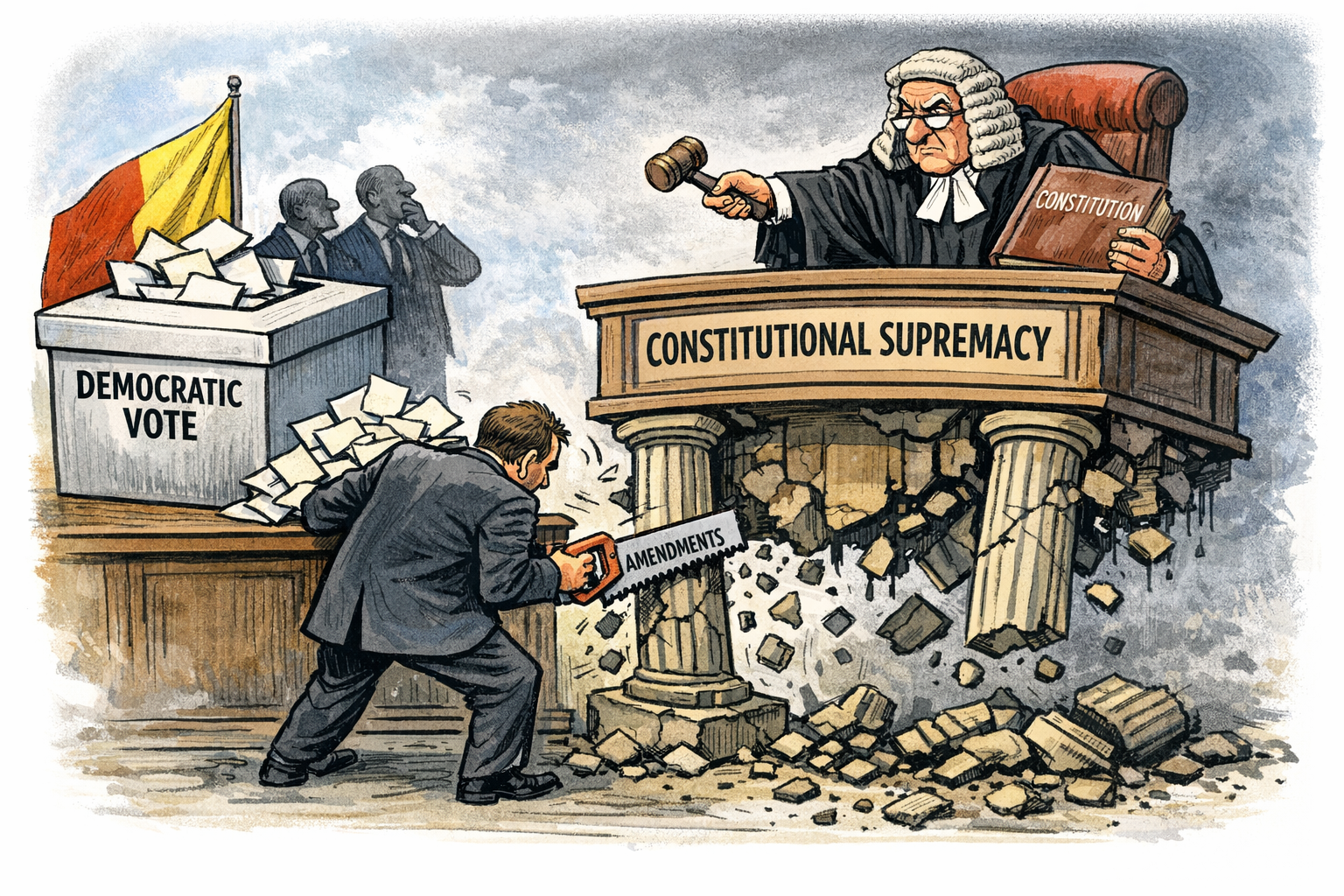
Majority Rule or Rule of Law? Neutrality, Constitutional Supremacy and the Perils of Majoritarian Logic

Robert Musumeci returns with another “constitutional article” (Malta’s Constitutional Neutrality, TOM 02.03.2026). In this analysis I challenge his treatment of constitutional neutrality and governance, exposing a recurring majoritarian logic in his writing. By conflating democratic outcomes with legal validity, his analysis risks subordinating constitutional supremacy to political arithmetic, reducing entrenched legal commitments to contingent expressions of parliamentary will.

The piece “Malta’s constitutional neutrality” asserts that Malta’s constitutional commitment to neutrality, enshrined in the 1987 amendment to the Constitution, now finds itself strained by the European Union’s evolving foreign and security policy architecture, particularly in the context of the Common Foreign and Security Policy (CFSP). Musumeci’s core claim is that while the veto in CFSP remains a bulwark preserving Malta’s constitutional neutrality, this legal safeguard is increasingly vulnerable to shifting political dynamics, particularly if habitual veto players (such as Orban’s Hungary) cease to exercise their blocking rights.

Implicit in his argument is the view that neutrality is protected less by enduring legal normativity and more by the strategic utility of unanimity in EU decision-making. This framing reflects a broader pattern in the author’s writings wherein democratic outcomes are conflated with legality, an approach most evident in his other Times of Malta article arguing that Malta’s constitutional fate is essentially entrusted to democratic procedure rather than entrenched legal restraint.

At the outset, the description of neutrality as a “domestic constitutional choice” significant in EU foreign policy politics obscures an important legal distinction. The neutrality clause is not merely a political accommodation embedded in constitutional text; it is a normative legal commitment that binds state organs and informs the interpretation of constitutional and international obligations. Article 1(3) of the Constitution explicitly states that “Malta is a neutral state actively pursuing peace…by adhering to a policy of non-alignment and refusing to participate in any military alliance,” a formulation that carries concrete legal implications, such as the prohibition of foreign military bases and the contextual limits on use of Maltese military facilities. Treating this provision as primarily a political artifact weakens its normative legal stature and reduces constitutional law to political expediency.

The focus on the CFSP veto as the principal legal safeguard of neutrality also compresses the constitutional issue into EU political mechanics. Unanimity in CFSP, as Musumeci acknowledges, means that a member state is not bound by an EU foreign policy decision unless it consents to it. However, the existence of a veto or passerelle procedures in EU law is not the same as a guarantee of compatibility with domestic constitutional commitments.

Again, Musumeci’s emphasis on the quantity of Hungarian vetoes and the potential diminution of their political cover conflates political patterns with legal safeguards. A veto is not a constitutional right conferred by domestic law, but an EU treaty mechanism whose application is inherently political rather than juridically determinate. The legal protection for neutrality rests primarily in the text of the Constitution itself and how courts interpret it, not in whether other EU states deploy their vetoes in politically convenient ways.

More fundamentally, the argument assumes that Malta’s capacity to block deeper integration in CFSP automatically protects its constitutional neutrality. This is an over-simplification. EU primary law evolves and CFSP mechanisms may increasingly interface with defence cooperation, even while excluding formal military decisions. Moreover, neutrality in constitutional doctrine is not a static concept; it is subject to legal interpretation that must account for shifting historical context.

Recent scholarly work shows that neutrality, especially in an EU member state, is often interpreted flexibly, acknowledging that neutrality does not preclude all forms of participation in collective security frameworks so long as core commitments like non-alignment in military alliances are preserved. By treating neutrality as a static artefact of Cold War language and as preserved only insofar as other states rein in EU integration, the article fails to engage with the interpretive dimension of constitutional law that recognizes the need to adapt concepts to evolving legal frameworks.

Musumeci’s previous article on constitutional governance (Honesty in constitutional governance,  (TOM, 19.01.26)) deepens this weakness by explicitly asserting that the Maltese Constitution entrusts its own fate to democratic procedure and not to “judicial virtue.” It argues that because Maltese constitutional provisions can be amended – even Article 6, the supremacy clause – the constitution does not shelter fundamental values from political winds.

This raises the spectre of majoritarian logic as a substitute for constitutional constraint, a position that undermines the very foundation of constitutional supremacy and the rule of law. It is true that the Maltese Constitution lacks unamendable “eternity clauses,” and that amendments require parliamentary supermajorities. Yet to suggest that constitutional law is subordinate to democratic choice misconstrues the nature of constitutional supremacy and legal constraint.

Constitutions worldwide entrust amendment procedures to democratic processes precisely because the constitution itself is the legal framework that governs how those democratic choices are made and limited. Democratic procedure and legal obligation are not antithetical; they operate in tandem. The notion that constitutional law can be dismissed as merely political choice obscures the fact that constitutional amendment procedures are themselves legal norms that structure democratic action.

This conflation of democratic outcomes with legal validity recurs in the latest article’s suggestion that the political cost of exercising Malta’s veto or recalibrating neutrality may prove decisive. By foregrounding the political cost of legal choice, the argument implicit in both pieces is that political feasibility is the arbiter of constitutional legality. Yet constitutional legality must be discerned through textual interpretation, doctrinal consistency, and legal reasoning independent of transient political calculus.

At a time when the international legal order itself is under strain, and when global politics increasingly rewards power over principle, it is precisely constitutional systems that must resist the reduction of law to arithmetic. If small states internalise the idea that legality bends to political convenience, they mirror a wider erosion in which might supplants right and rules become secondary to strategic leverage. If constitutional commitments are subject primarily to the vicissitudes of political costs, the concept of enforceable legal obligation is hollowed out.If constitutional commitments are subject primarily to the vicissitudes of political costs, the concept of enforceable legal obligation is hollowed out.

Yet again, Musumeci peddles majoritarian logic as a constitutional construct. His legal reasoning suffers from several interrelated weaknesses. It privileges EU political mechanics over constitutional text, collapses legal safeguards into political contingencies, and once again “sells” a constitutional theory that elevates democratic outcomes over normative constraints.

A more robust analysis would ground the discussion of neutrality in constitutional doctrine and interpretive principles, delineating the legal contours of Malta’s neutrality clause and its interaction with EU law, rather than reducing constitutional protection to the presence or absence of political shields like veto patterns. This would align the argument with core principles of constitutionalism and the rule of law, rather than subordinating constitutional rights to political calculation.

related post: Democracy is not a legal alibi

Democracy Is Not a Legal Alibi: Why Constitutional Supremacy Cannot Be Voted Away

Critical analysis of “Honesty in constitutional governance” by Robert Musumeci

In his Times article (TOM, 19.01.26) Robert Musumeci advances a central claim: that Malta’s Constitution “entrusts its own fate to democratic procedure, not to judicial virtue”, because every constitutional provision is amendable if the correct parliamentary procedure is followed.

In this brief I intend to accept the descriptive premise that Malta lacks an express eternity clause while challenging the normative and legal conclusions drawn from it. I submit that Musumeci’s assertion risks collapsing the distinction between democratic legitimacy and legal validity, and it understates how constitutional supremacy, the rule of law, and judicial independence operate as substantive constraints within a constitutional democracy even where formal amendment is possible.

Constitutional supremacy is not a slogan, but a legal architecture

Constitutional supremacy means that the Constitution is the highest norm within the domestic legal order. It is not merely a statement that courts may strike down ordinary laws. It is the structural principle that public power exists only within constitutional authorisation, and that all institutions, including Parliament, are constituted and limited by the Constitution.

Musumeci is correct to say that Article 6 renders inconsistent ordinary law void, and that courts are required to disapply unconstitutional legislation. But he then treats the existence of an amendment procedure as a “qualification” that almost empties supremacy of its protective force.

This assertion is conceptually flawed. Supremacy and the possibility of amendment are not opposites. They are complementary parts of constitutional design. Supremacy answers the question “what prevails today”. The possibility of amendment answers the question “how may tomorrow’s higher law be made”. The second does not cancel the first; it presupposes it. Indeed, the amendment procedure itself is an expression of supremacy, because it prevents constitutional change through ordinary politics and requires a legally prescribed route.

In constitutional terms, supremacy is not “eternal” in the sense of metaphysical permanence. But it remains juridically supreme at any given time. A constitution that can be amended is still supreme; it is simply not immutable.

Musumeci’s central error: democratic outcomes are not automatically “legal” in the constitutional sense

A democratic outcome is a political fact. Legality is a juridical status. The two can overlap, but they are not the same. Musumeci repeatedly implies that once an amendment procedure is followed, courts face “a constitutional fact, not an interpretative opportunity”, and that judges cannot “invent additional limits” based on “unwritten moral principles”.

This framing is misleading in two ways.

First, it assumes that constitutional adjudication becomes mechanical the moment the word “amendment” appears. That is not how constitutional law works. Courts must still determine whether the purported amendment is in truth a valid constitutional amendment, whether the correct procedure was followed, whether the amendment is coherent with the constitutional order, and whether it is a disguised attempt to do indirectly what the constitution does not permit directly. These are not “moral” questions; they are classic rule of law questions about competence, form, and constitutional identity.

Second, it insinuates that judicial review of constitutional change is necessarily illegitimate “judicial moralism”. That is an overstatement. In many constitutional systems, courts have recognised limits on amendment not because judges prefer a moral outcome, but because an amendment that destroys the constitution’s essential character is no longer an amendment. It is a constitutional replacement or rupture, requiring a different democratic mandate.

Even in the absence of an explicit eternity clause, a constitution can contain implied structural principles, such as separation of powers, judicial independence, legality, and effective protection of fundamental rights. These principles are not optional ornaments. They are constitutive of what makes a legal order a constitutional democracy rather than a majoritarian state.

Entrenchment is not merely “political cost”: it is a legal safeguard for constitutional stability

Musumeci describes entrenchment as a mechanism that raises political cost but does not create legal impossibility. That is true as far as it goes, but incomplete.

Entrenchment serves at least three legal functions that Musumeci underplays.

Firstly, it protects minorities against transient majorities by requiring cross-party agreement for foundational changes. Secondly, it protects institutional independence by making it harder for a government to rewrite the rules of accountability during a crisis or scandal. Finally, it protects constitutional continuity by reducing the risk of “constitutional capture”, meaning the use of legal forms to consolidate power and immunise the executive from scrutiny.

If entrenchment is reduced to “political accountability”, the constitution becomes little more than an instruction manual for how a parliamentary majority may legally entrench itself. That is precisely the danger constitutional supremacy is meant to prevent.

“Responsibility lies with Parliament and the electorate”: politically true, legally insufficient

Robert Musumeci argues that responsibility for “morally consequential constitutional change” cannot be displaced onto courts and lies with Parliament and the electorate. As a matter of political ethics, this is unobjectionable. But as a constitutional proposition, it is dangerously incomplete.

Courts are not only moral commentators. They are guardians of legality. Their constitutional function is not to “redeem” the political community, but to ensure that power is exercised within legal bounds, including bounds that protect the democratic process itself.

A citizen can vote out a government only if elections remain meaningfully free and fair. An electorate can judge wrongdoing only if there is access to information, investigative capacity, and independent adjudication. Parliament can be held accountable only if constitutional rights such as expression, association, and due process remain enforceable.

Therefore, the idea that “constitutional law cannot save it from itself” is rhetorically powerful but legally misleading. Constitutional law does not guarantee political virtue, but it does secure the conditions under which political responsibility can be exercised. When those conditions are undermined, “leave it to the electorate” becomes circular, because the electorate’s capacity to correct abuse is what is being damaged.

Executive interference with judicial determination: the modern route to constitutional degradation

Finally, I must address what seems to be Musumeci’s implicit comfort with the proposition that courts should not resist “politically chosen” constitutional outcomes. The core problem in contemporary constitutional breakdown is rarely an open coup. It is legalistic executive interference that preserves democratic rituals while hollowing out judicial control.

One of the most common mechanisms is court capture through appointments.

In constitutional democracies, judicial appointment is not inherently illegitimate. It becomes unconstitutional in substance when appointment power is used to predetermine outcomes, neutralise accountability, or intimidate judges into deference. The citizen may still see courts operating, judgments being issued, and constitutional language being cited, yet the adjudicative function becomes subordinated to political loyalty.

This is not hypothetical. The pattern is recognisable across jurisdictions. A government expands the size of the constitutional court or changes quorum rules so that newly appointed judges dominate panels. A government lowers retirement ages or changes tenure rules to remove existing judges and create vacancies. A government redesigns the judicial appointments process to concentrate control in the executive, replacing professional evaluation with political selection.

A government disciplines judges through administrative sanctions, budgetary pressure, or politically controlled “judicial councils”. Each step can be dressed as lawful reform. Each step can be passed by a majority. Yet the effect is executive interference with judicial determination, because the judiciary becomes unable to act as an effective constraint.

If courts then refuse to accept such changes as constitutionally destructive, Musumeci would label this “judicial moralism”. But the better legal description is that courts are defending the separation of powers and the minimum content of judicial independence without which constitutional supremacy becomes performative.

Constitutional supremacy includes supremacy over the executive, not only over ordinary legislation

Musumeci correctly emphasises that courts enforce the constitution against ordinary laws and executive action. But he understates that supremacy is most tested precisely when the executive seeks to evade adjudication.

Executive interference can take softer forms than court capture. Refusing to implement judgments or delaying implementation until the political moment passes. Issuing administrative measures designed to frustrate litigation, such as denying standing, withholding documents, or manipulating procedural timelines. Using state resources to litigate citizens into exhaustion, turning access to justice into a privilege rather than a right.

Publicly attacking judges and portraying adverse judgments as “anti-democratic”, thereby delegitimising judicial review as such. These are not questions of morality. They are questions of legality and constitutional structure. The constitution’s supremacy is hollow if the executive can systematically prevent courts from delivering effective remedies.

The EU dimension: correctly noted, but understated in legal consequence

Musumeci acknowledges that domestically valid amendments may still attract “external consequences” including political pressure and financial conditionality at EU level. This is accurate, but the framing again risks minimising legality.

For an EU Member State, rule of law commitments are not only reputational. They are embedded in binding obligations. When constitutional amendments undermine judicial independence, the issue is not merely “cost”. It is potential incompatibility with the Member State’s duties within the European legal order.

From the citizen’s perspective, this matters because EU membership creates an additional layer of constitutional constraint: national constitutional change cannot be treated as purely internal when it affects effective judicial protection, the independence of courts, and the enforcement of EU rights. Even where a domestic amendment is procedurally correct, it can generate legal consequences in EU law that materially affect the state’s position and citizens’ rights.

Conclusion: Musumeci’s theory is rhetorically honest, but constitutionally incomplete

Musumeci’s call for “honesty in constitutional governance” usefully reminds citizens that constitutional decline can be politically chosen. That is an important civic warning.

However, he commits a fundamental constitutional error by implying that democratic procedure is a sufficient condition for constitutional legality. It is not. A constitutional democracy is not defined only by who wins elections, but by the legal constraints that make elections meaningful, government accountable, and rights enforceable.

Constitutional supremacy is not a myth that evaporates because amendment exists. It is the legal hierarchy that binds all power, including power exercised through majorities. Entrenchment is not merely a political speed bump; it is a safeguard against capture. Judicial review of constitutional change is not necessarily “moralism”; it can be a rule of law necessity when the amendment is used as a vehicle to dismantle the constitution’s core structure, especially through executive interference with judicial determination via court appointments and institutional redesign.

Musumeci’s text should be read with one crucial correction in mind. Democracy matters. But legality is not whatever a majority can be made to vote for.

Legality is what the constitution, interpreted in good faith and protected by independent courts, permits the state to do without destroying the conditions of constitutional government itself.

Politics, for example

debono_akkuza

Yes, Giovanna Debono should resign. Her position in parliament as a representative of the people is untenable so long as her husband is under investigation for abuse of office. The sad truth is that the moment a minister employs his or her spouse or close relatives within their own ministry their position should no longer be tenable. Robert Musumeci, still posing as some kind of visionary for the hypothetical “movement” (that is none other than an opportunistic collection of gravy train riders) believes that we should wait for a “fair hearing”. Musumeci sat for a law degree virtually by correspondence (he will tell you presence at a lecture does not a law student make – which could be true) and regularly suffers from literal reproduction of positivist garbage you would expect from the vast majority of what is regurgitated from university today.

Fair hearing is for the criminally accused. Sure. It has absolutely nothing to do with the recognition of administrative and political responsibility. The basic manual of political representation (let alone constitutional law principles) would tell you that in order to be above reproach a person in political power should not employ close relatives. The assumption being that the mere employment of such relatives is the beginning of the path to abuse of office. It would be hard for someone in Musumeci’s movement to grasp such a concept. Impossible even. The Gozo Minister employs his spouse within his ministry. Our energy minister’s wife was “employed” by this government without so much as a justification and with a contract of employment the terms of which are shrouded in secrecy. Even the Emperor’s (sorry, PM) wife is prone to carving out for herself a role that is nowhere mentioned in the constitution. It would be ok if such a role were not costing money to the electorate. Yet it does.

Back to DebonoGate. There is no doubt in my mind that Debono will join the blacklist of ex-PN ministers tainted with a whiff of corruption – even if Anthony Debono manages to survive the trials and tribulations of a court of justice. Ninu Zammit, Michael Falzon, Giovanna Debono. The “old way” of doing politics that was allegedly swept aside two years to this day is still waiting to be judged. Simon Busuttil’s party will still be answering for this kind of sins for quite some time yet. Incidentally, the PM should take note that he risks becoming an accomplice to covering up any crimes of corruption if he chooses to sit on reports and whistleblower information until when it pays him to cause a fracas and deviate attention from the troubles within his house. Today’s Debono news paid perfectly to help people forget that we should be inaugurating the promised Power Station.

The PLPN way is still very much alive. This blog, born in 2004, has long warned that the system is one that promotes a race to mediocrity and that will constantly produce stories of corruption, nepotism, cronyism and abuse of power. The former PN government’s sins are now being brought to light – and however erred must pay. Muscat’s government has proven only that it is a case of “same, same but different”. In many cases it is even worse because this government that was supposed to herald change is only good at justifying blatant abuses by claiming it is only repeating what was done before – u hallik mill-ottimista. Simon Busuttil is discovering that change is not only about words but also about deeds and that in order to make a difference actions must follow.

It sucks being bang in the middle between two behemoths that struggle to catch up with the twenty-first century. It sucks being so right about what is so wrong with this country. What sucks most is that we seem to never learn.

Today is a three-fold anniversary. Franco Debono turns 41, the labour government turns 2 and Internazionale FC turn 106. It never rains….

In un paese pieno di coglioni ci mancano le palle.