Alex Borg’s PN: The Party as an End in Itself? 

The first days of Alex Borg’s leadership of the Partit Nazzjonalista leave me with more questions than answers. He has stepped into a role that carries the weight of history—but also of failure, stagnation, and disillusionment. The PN isn’t just in opposition; it’s in crisis. And yet, if you listened only to Borg’s early speeches, you’d think the most pressing challenge facing Malta was rebuilding the “glory” of the party itself. 

This is where the problem begins. 

Borg has so far focused heavily on “the party.” Its structure. Its morale. Its past. His language is full of admiration for the PN’s historical victories, its “heroes,” its contributions to the country. That may be comforting to some within the party. But it’s not what the country needs. Malta doesn’t need a nostalgic PN. It needs a credible alternative to the current government. Borg seems more interested in reviving a brand than offering a vision. 

It’s not wrong for a new leader to stabilise the party he inherits. That’s normal. A fractured, demoralised party is no platform for national leadership. But the problem with Borg’s early leadership is that it stops there. He’s not using the party to build a project for Malta—he’s rebuilding the party as the project itself. In that sense, it’s not clear whether he sees the PN as a vehicle or a destination. If it’s the latter, he’s missed the point of political leadership entirely. 

A party is not an end in itself. Its purpose is to offer the public a better way forward—to translate values into policy, and policy into real change. That’s especially true for a party in opposition. If the PN is to be more than a relic, it needs to be in a permanent state of readiness to govern. Not just to oppose. Not just to commemorate itself. Borg’s early rhetoric avoids hard policy choices, complex realities, or clear ideological direction. There’s no talk of climate resilience, housing, tax justice, digital infrastructure, public health reform, or how to break Malta’s addiction to corrupt planning deals. There’s no signal of how he plans to regain the public trust—especially from younger generations, many of whom have no memory of the PN’s “glory days,” only its long decay. 

That silence is loud. 

“Un programma politico non si inventa, si vive.” – Luigi Sturzo 

Is it too much to expect vision this early on? No, it isn’t. The PN has been out of power for more than a decade. Anyone taking over now should arrive prepared—not just to lead a party, but to lead a country. Vision isn’t a five-year plan or a document you publish at election time. It’s a direction, a set of priorities, a set of truths you’re willing to stand by even when they’re unpopular. Borg hasn’t even hinted at one yet. And the vacuum is glaring. 

Instead, we’ve heard what amounts to internal messaging—calls for unity, loyalty, revival. That might resonate with the grassroots, but it does little for the rest of the country. Borg may be consolidating control, but to what end? If the goal is to win power, then he’ll need more than loyalty and internal discipline. He’ll need trust, and trust is built on credibility. The PN won’t get there unless it starts talking to people outside its own echo chamber. 

Even more worrying is Borg’s silence on the rule of law. Under Labour, Malta has seen deep institutional erosion—from the collapse of regulatory oversight to the stalling of investigations into political corruption. These are not abstract issues. They affect everything from business confidence to environmental degradation to our democratic dignity. The PN under previous leadership has found it hard to keep this issue alive. Worse still, it has chosen to either engage in petty squabbles with NGOs fighting the Rule of Law battles or worse still it chose to blame its woes on the fact that such battles were ‘distracting’ or ‘unpopular’. 

Borg so far seems uninterested—or unwilling—to confront it head-on. Has he already calculated that this battle is unwinnable? Or is he too afraid of alienating potential swing voters who see such talk as polarising or elitist? 

If he drops the rule of law agenda entirely, it will be more than a tactical retreat—it will be a moral failure. Malta needs political leaders willing to do more than win elections. It needs leaders who will fight for the future of the state itself. 

It’s not enough to invoke the past. The PN was once a party that brought Malta into the EU, strengthened the economy, and helped build modern infrastructure. But that was then. A new generation wants to know what comes next. How will Malta shift away from short-term profiteering and towards long-term sustainability? How will we build a fairer economy, a less polluted environment, and a digital system that works for citizens, not just government departments? These are not romantic questions. They’re real and they demand answers. 

So far, Borg has offered none. 

If this continues, the PN under his leadership will become a sort of political heritage NGO—committed to preserving its memory, but incapable of shaping the present. And in a country that desperately needs serious alternatives, that would be a tragedy. 

Borg still has time to prove otherwise. But the clock is ticking. If he wants to lead Malta, not just the PN, he’ll need to step outside the party walls, take a stance, and speak not just to his members, but to the country. 

Otherwise, he’s not building a future. He’s curating a museum. 

CAVEAT LECTOR: Let me be clear. My critique is that of a citizen who has no direct, vested interest in the PN. My interest is in having a credible opposition that is a valid alternative for government. Beyond that I also harbour a faint hope that the next government will champion the reforms needed to revert to a state of rule of law.   

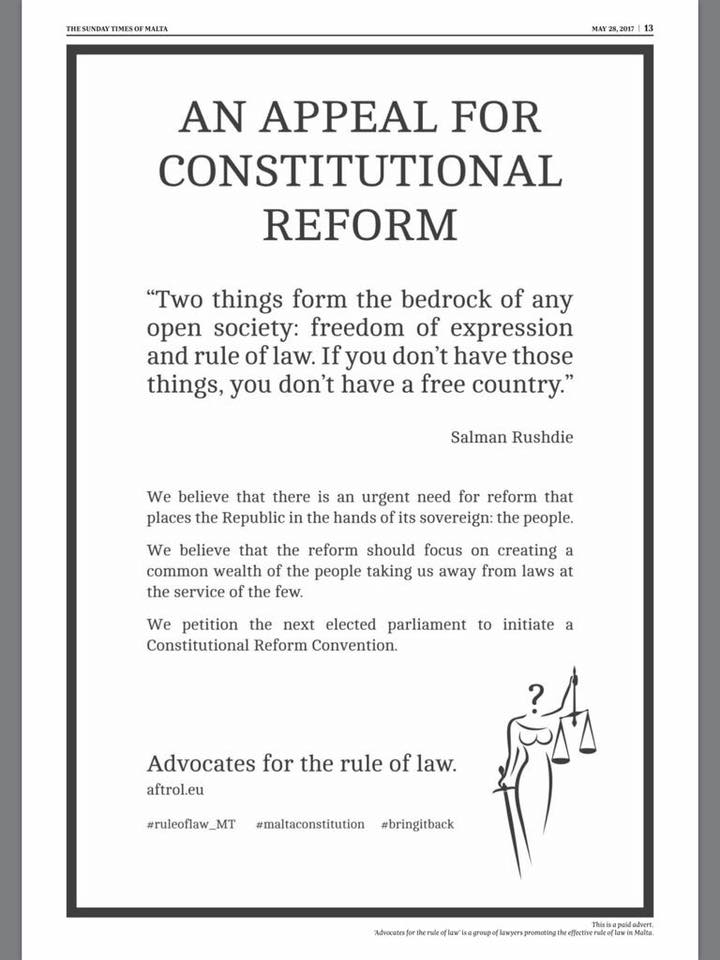
This Is the Record: Malta’s Institutions Are Being Hollowed Out 

Let us begin with a truth that bears repeating: democracy does not die in one fell swoop, but by a series of quiet manipulations, each too technical to stir mass indignation, each cloaked in the language of efficiency, reform, or sovereignty. Malta is not facing an immediate coup. But what it is experiencing is something more insidious: a slow, deliberate capture of the very institutions designed to safeguard the public from arbitrary power. 

This is not a matter of partisan allegiance. It is a matter of record. And the record is clear. 

Over the last decade, Malta’s government has steadily expanded its reach over institutions that were once conceived to act as checks on executive power. The judiciary has found its independence compromised—not with tanks in the streets, but with legislation in Parliament and political appointments cloaked in the veneer of reform. 

One need not speculate. The Venice Commission, the Council of Europe, and multiple rulings from the European Court of Justice have signalled alarm. Judicial appointments were, for years, controlled by the Prime Minister’s office. Though recent changes were made following external pressure, the culture of loyalty and reward remains. Judges rise not merely by merit, but by proximity to power. And when they speak out—if they speak out—they do so at their own peril. 

This is not the natural order of things. It is a design. 

Oversight mechanisms have not been dismantled; they have been neutralised. The Planning Authority now issues permits in defiance of local plans and common sense. Its appeals tribunal, once a citizen’s last recourse, is to be stripped of real power under new legislation that proposes that courts may no longer revoke unlawful permits. Instead, they must refer the matter back to the same authority whose decision was deemed defective. This is not justice; it is theatre. 

What becomes of a nation where wrongdoers can outlast the process meant to stop them? Where court action becomes a maze designed to exhaust, confuse, and bankrupt rather than to protect? In such a nation, impunity is not an accident—it is a feature of the system. 

One may ask: where are the anti-corruption laws? Where are the safeguards? They exist, on paper. But paper burns. Legislation intended to curb corruption has been hollowed out by amendments, delayed by “consultation,” or applied selectively. The Freedom of Information Act remains more honoured in the breach than the observance. Whistleblower protections are limited in scope and rarely invoked. Asset declarations are filed but not verified. And the institutions charged with enforcement—the Commissioner for Standards, the Ombudsman, the Auditor General—are afforded just enough power to seem respectable, and just enough constraint to remain ineffective. 

This is the scaffolding of democratic decay. The façade remains intact: there are courts, there are laws, there are committees. But the substance has shifted. What was once meant to serve the public now serves power. Those who protest are smeared, sued, or ignored. Civil society is tolerated but never embraced. 

This is not a new story. Other democracies have walked this road—Hungary, Turkey, Poland. Their governments too spoke the language of reform. Their leaders too invoked the will of the people as they dismantled the machinery of accountability. 

And let us be clear: this is not about one scandal or one administration. This is about a systemic drift, a deliberate weakening of the structures that make accountability possible. It is about a state that no longer tolerates friction—be it from courts, journalists, NGOs, or ordinary citizens—and seeks instead a smooth path to its ends, unchecked and unchallenged. 

The result is a nation where corruption does not need to be concealed; it thrives in plain sight, protected not by secrecy but by inertia. It is a nation where reform is promised as a shield, and delay becomes a tactic. A nation where outrage has become routine, and resignation replaces resistance. 

But resignation is not destiny. 

Malta is still a member of the European Union. It is still bound by the Charter of Fundamental Rights. The courts in Luxembourg still have jurisdiction. Civil society still speaks, though with growing fatigue. Journalists still report, though some have paid the highest price. The fire has not gone out—but it flickers. 

We must remind ourselves, as Edward R. Murrow once did in darker times, that “a nation of sheep will beget a government of wolves.” The purpose of institutions is not to please the powerful, but to restrain them. The rule of law does not ask whether the law was passed by a majority, but whether it serves justice. 

This is not the end, unless we accept it as such. The law can be restored. Institutions can be rebuilt. But only if we speak plainly, act firmly, and refuse to be lulled into silence by the language of procedural normalcy. 

The time for euphemism is over. 

This is the record. And it is our responsibility to change it. 

Il Triangolo No

triangolo_akkuza


I. Stability is a partisan word

Third parties, third ways. An online poll conducted by the paper Illum showed, among other things, that 14% of respondents would vote for a new party since they have no more faith in either the PN or the PL. Talk about a possible third way being a panacea for our political representation problems has belatedly gathered momentum on the island. Muscat’s government is on rapid implosion mode while the general feeling is that the PN alternative would generate more of the same style of politics – one that is deeply enmeshed in corruption and deceit to the detriment of the citizen. Marlene Farrugia’s rumblings as a dissenting politician within parliament are much stronger and coherent than those we have heard until now during the last months of the Gonzi executive. Add to that the fact that scandal after scandal the tempo of public discontent does not seem to subside and a few “public personae” are prepared to throw their weight into the ring and you have the recipe of what is being touted as the panacea for all this evil feeling: a third party.

Regular readers if this blog may well recall that the “Third Way” solution has long been advocated over the whole stretch of our blogging history. Often the election of a third party’s representatives in parliament has been described here as “driving a wedge in the bipartisan hegemony”. I still believe that a third party (and fourth and fifth) can have positive effects on our political system. The problem however lies elsewhere since the third party is not a solution in itself but it is actually a possible result of the solution that is necessary in order to definitely improve the state of our politics and consequently the health of our nation.

What do I mean? Let’s take a look at the PLPN reaction to the very public rumblings of a possible third party. Their rare chorus of unanimous disapproval was to be expected. More parties in parliament would cause “instability” they claimed. Worse still they could not envisage having to share the burden of government with some coalition party – anathema.

The PN might be investing in the concept of good governance but the philosophy behind the driving forces of this rekindling of values stops short of contemplating an utter reform of our representative system that might not be two-party-centric. Of course we can have good governance they will tell you, but applied to our system of alternation – and not beyond. In other words the current set of rules should be good enough for Busuttil’s new party philosophy – we only have to ensure that the tenets of good governance are properly applied therein and all will be fine. I beg to differ.

II. Self-preservation is a natural instinct

Let us use a coding metaphor. The structure of our constitutional system has been built using a language that reasons in bi-partisan terms. A bi-party rationale is written directly into the building blocks of our political system – both legally and politically. Since 1964 the constitutional and electoral elements of our political system have been consolidated in such a manner as to only make sense when two parties are contemplated – one as government and one as the opposition.

We are wired to think of this as being a situation of normality. The two political parties are constructed around such a system – we have repeated this over the last ten years in this blog – and this results in the infamous “race to mediocrity” because standards are progressively lowered when all you have to do is simply be more attractive than the alternative. The effect of this system is an erosion of what political parties is all about.

The political parties operating within this system are destined to become intellectually lazy and a vacuum of value. The intricate structure of networks and dependencies required to sustain the system negates any possibility of objective creation of value-driven politics with the latter being replaced by interest-driven mechanisms gravitating around the alternating power structure. Within the parties armies of clone “politicians” are generated repeating the same nonsense that originates at the party source. Meaningless drivel replaces debate and this is endorsed by party faithfuls with a superficial nod towards “issues”.

The whole structure is geared for parties to operate that way. Once in parliament the constitutional division of labour comes into play – posts are filled according to party requirements and even the most independent of authorities is tainted by this power struggle of sorts. Muscat’s team promised Meritocracy and we all saw what that resulted in once the votes were counted. In a way it was inevitable that this would happen because many promises needed to be fulfilled – promises that are a direct result of how the system works. With all the goodwill in the world Busuttil’s team promising Good Governance will be placed in the same position with the same rules as Muscat’s and Gonzi’s before them.

The point is that the system needs to be rebooted. Even a third party elected under these parameters would do little to shake the system at its foundations. What needs to be targeted are the laws and structures that have developed into an intricate network of power-mongering and twisted all sense of representative politics. A third party might be the result of that change of system but what is needed right now is that one (or both) of the two parties enjoying the uncanny and undemocratic advantages of their home-made rules is forced to accepting a program of constitutional change.

III – Restoring the supremacy of parliament

Malta’s constitution owes much to the concept of parliamentary sovereignty. Constitutionally political parties did not count for much. When forming a government the Head of State was invited to choose from among the members of parliament that member who enjoyed the support of the majority of members elected. No mention of parties. It is only through a series of shenanigans and legal changes to electoral laws that the parties became the be-all and end-all of the electoral process. Laws were changed to ensure majorities, seats in parliament and quotas – all in relation to the bi-partisan system. It led us to the infamous wasted vote.

The problem was not so much the theoretical guarantee of stability afforded by a bi-partisan system. No, the problem lay in how the guarantees afforded by alternation gradually became a threat to the “political” nature of the parties themselves. Instead they were replaced by careerist powermongers eager to climb up the ladder of our home-grown system of power-broking: from candidate to backbench MP to Secretary to Minister. Fiefdoms developed and by taking advantage of a system that guaranteed their presence on authorities, boards and watchdogs the constitution would play second-fiddle to the needs of the party in power while the opposition barked and whinged waiting their turn for a piece of the action.

How does this change? it changes by changing the whole system starting from its building blocks. Parliament has to be strengthened and revalued as the supreme guardian of constitutional representation. The new system should ensure that politicians elected to parliament fulfil their role of representatives of the people by acting as proper legislators and competent watchdogs on the operation of the executive that must remain subservient to their will. In order to obtain this we must wean parliamentarians away from the ladder of power as currently perceived while strengthening their role and function.

I have already put forward the four points that should be the groundwork for such a reform:

  1. The removal of districts from national elections.
  2. The introduction of party lists elected on the basis of proportional representation into parliament (with a minimum threshold of between 5% and 7%).
  3. The introduction of technical ministries with ministers chosen from outside parliament but accountable to parliament.
  4. (A corollary of 3) MP’s who become ministers should resign their place in parliament.

As I said in an earlier post this would remove the idea of careerist politicians. By clearly differentiating between the roles of the executive and the legislative/representative aspects we would ensure that parties are rewired to become effective in both. A technical executive with a proper plan and project will be one side of the coin while a strong representative body acting on behalf of the people monitoring and endorsing the work of the executive would be the other. Such parliaments could afford to have a hundred Marlene Farrugia’s who do not bow to a party whip for the party’s sake but use their vote in the best interests of those who elected them to parliament.

Conclusion

Electing a third party for the sake of electing a third party and simply out of spite to the two main parties is not a solution as things stand. This blog would advocate for stronger pressure on the party that is most willing to take up this programme of groundbreaking constitutional reform with the express understanding that should it get elected this would be its top priority. That mandate would end once the reform is achieved and new elections based on the new parameters would be held. What Malta needs is a Reform Movement that picks on the current momentum that is not endemic to Malta. What it certainly does not need is more parties playing from the same score as we have till now.

This honourable judge

Life on the island past the electoral truce has been anything but boring. There are times when the concept of boredom can begin to seem to be an unattainable desirable bereft of the negative connotations that normalcy and monotony might normally carry. These are the kind of times best described as “interesting” in the Chinese curse sort of way. Just as the political parties seemed to be settling into a faux festive period “truce” from the campaign that had never begun we get a wave of news items that keep tongues wagging, the media reporting and above all the parties a-busying.

Top of the list of interesting news items – beyond the extensions of Dalligate and the mafia style executions – is reserved for the judiciary and in particular for two of the members of our judicial bench who are in the eye of the storm. Judge Farrugia Sacco is in the throes of a renewed battle for his seat having had a new attack from the IOC – determined to take steps against those of its members who exposed their institution to the risk of disrepute. Another Judge, Ray Pace, is now in prison awaiting trial with the serious accusation of bribery pending above his head.

It is an ugly period for the legal branch of our separated powers and the two stories have thrust another dagger into the already weak levels of faith that the judiciary enjoyed with the general population. Trust and faith in the law is fundamental within a democracy and this kind of weakness seriously endangers the workings of our constitutional mechanisms. That is also the basic reason why the constitutional checks and balances that should come into play must work with clockwork perfection in order to ensure that the very foundations of the legal system are still intact. Public trust is the one and only priority.

Farrugia Sacco

Which brings me to the role of our political parties. We first had the Farrugia Sacco debate. In this respect the “Ceasar’s Wife” argument that I had touched upon in the Dalligate saga comes back with full force when considering how to proceed with a member of the bench who has become embroiled in such an issue. The key concept in the “Ceasar’s wife” principle is the idea of “having to be above suspicion”. This is not a question of actually being guilty but of having to appear beyond the mere suspicion. In this light, and without even making any further considerations on what actually went down in that hotel room where the Olympic tickets were held, Judge Farrugia Sacco should have long tendered his resignation in order to deal with the ghosts and suspicions peacefully and individually without carrying this baggage around in his role as a judge.

Is it so straightforward? Yes. Did we need the Ombudsman writing to the President? Not really. Even before the Commission for the Administration of Justice was involved Judge Farrugia Sacco should have done the right thing of his own accord. By refusing to do so he should have forced the hand of our politicians in parliament who are the guardians of an important constitutional mechanism with which they have been entrusted: the process of impeachment. Which is where my first beef with Joseph Muscat arises. His position on the Farrugia Sacco issue is that we must wait for the Commission for the Administration of Justice to do its work before actually impeaching the judge. Like hell we do.

Joseph Muscat’s attempt to distinguish between politics and the judiciary is an amateur approach to our constitutional politics and a dangerous situation whereby the leader of the opposition is openly reneging on his DUTY towards citizens to act as ultimate guardian of our constitutional rights. A judge in Farrugia Sacco’s situation loses his legitimacy to sit in open judgement of others in no matter what area of law. If he cannot see that of his own accord then it is up to the politicians to act as guardians of our prerogatives as citizens. Once again Muscat is doing what he does best – acting as Pilate and washing his hands of a decision that he is duty bound constitutionally to guarantee. Weak.

Pace

The Ray Pace matter seems to have brought Muscat to his senses. Suddenly the judiciary is no longer a matter for the Commission for the Administration of Justice. Admittedly the case seems to be more open and shut given the context though there is no reason to distinguish between the two when it comes to the Ceasar’s Wife test. In this case the issue of whether Ray Pace is above suspicion is more glaringly obvious – the arraignment and arrest make a decision in this respect all the more straightforward.

What did impress me was the attempts – as of early morning – by Evarist Bartolo to turn the issue into a political battlefield. He posted a link to a report of the arrest on facebook with the words “Ara f’hiex gabuh pajjiz” (Look what they have brought the country to). Incredible. To begin with it is obvious to any free thinking individual that when appointing a judge you can never foresee his turning to the dark side (to use Star Wars terms). How Ray Pace’s alleged actions are imputable to the current government and its policies beggars belief. Sure enough Evarist deleted any comments I made on the particular status – no worries I have snapshots on my iPad (once bitten, twice shy – right Jeffrey Pullicino Orlando?).

Thankfully the Labour party could not do otherwise than agree to an eventual impeachment of Ray Pace. Muscat did add that a new Labour government would review the methods of appointment of judges. No harm there right? Definitely not. Given that a rebel MP recently made it part of his personal agenda to point out inconsistencies in the field of the judiciary it should not come as too much of a surprise to any of us that sooner or later Labour would jump on that particular part of the wagon. A knee-jerk reaction it remains though and I very much suspect that we are in for a bit of patchwork and tweaks that would still accomodate the PLPN manner of appointments.

And here is another crux. I posted a status on facebook pointing out that given their record Labour would best reform the system by staying out of the appointments system. Of course the world is full of literal minded partisans who would be eager to point out that the same system that gave us Farrugia Sacco (Labour) and Pace (Labour) also gave us Arrigo (Nationalist). Which makes it allright then does it not? My point was meant to be sarcastic – Muscat’s party does not have much of a record to go on when it comes to appointments and the fact that the nationalist party too has had its fair share of nutty appointments is neither here nor there.

Judiciary

Do you remember how recently a government proposal to increase salaries for the judiciary was shot down by a labour party? The Labourites had had a sudden attack of “consistency” by arguing that if the MPs (political) could not get a raise (will we ever forget the 500€ raise?) then neither could the judges and magistrates (judiciary). Because obviously the Muscat idea that politics and judiciary should not be mixed did not apply at the time.

There seems to be a general consensus, even within the practitioners in the field, that our judicial system is due a major overhaul. The criteria for judges and magistrates appointment remain the number of years in practice. When a non-court practitioner was once proposed for the bench, court practitioners were up in arms claiming that his years of practice did not count – an odd reason if there was one. From what I can gather the conventional way to become a magistrate/judge until now has been to manifest your intention in the right circles and hopefully… if you were insistent enough and of the right hue… you would get your turn eventually.

The system has produced many a good magistrate or judge but it has flaws. It is haphazard and based on the wrong criteria. I am also told that in some cases what was needed to get onto the bench was a track record of an attempt at running of parliament. Once you got your brownie points in that field then you would have proven loyalty and a position on the bench would follow. Again. It is not the rule and is not across the board. The problem lies in the lack of clarity and in the lack of modern, clear criteria as to why a person should make it to the bench.

In other nations, like Germany, you actually study to get to the bench – not to become a lawyer first. Interpreting and applying the law requires a different set of skills than pleading before the court. Academic knowledge, logical and linguistic skills as well as good analytical methodology and organisation form part of what could be a key set of indicators in the future. A place on the bench should not be a prize for time served – let alone loyalty.

The kind of reform that is required is the real area where politics and the judiciary should definitely not merge. The legal world in Malta is not in a nice state. The kind of reform that is required is a big learning curve across the board from the courts, to the faculty of law and its product, to the support services to the long arm of the law that are the police. Education is a key factor – education to start with and education in the continuing sense.

Unfortunately I have to end this long post with the usual pinpointing of the heart of the problem. Our legal system has also been affected by the rot that is the PLPN method. Appointments and laws through the years are made with the parties and their survival in mind. It is incredible that in this day and age we can think in terms of “their” or “our” judge. It is mind boggling that judicial appointments have to be thought of in this manner and the legal community has much to feel at fault about in this respect. I am not unaware of the irony that our parliament has a heavy representation of lawyers within it and that this being the case it will be even more difficult to find people prepared to think out of the box.

When Muscat wakes up to the reality of the matter and stops thinking in populist terms, when Gonzi’s PN quit the faffing around and decide to grasp the bull by the horns I should hope that a huge debate will ensue and that within an appropriate forum, with the appropriate experts, the much needed reform of our Judicial & Legal systems is embarked upon with earnest.

Remember. We are all servants of the law, that we may be free.