The first days of Alex Borg’s leadership of the Partit Nazzjonalista leave me with more questions than answers. He has stepped into a role that carries the weight of history—but also of failure, stagnation, and disillusionment. The PN isn’t just in opposition; it’s in crisis. And yet, if you listened only to Borg’s early speeches, you’d think the most pressing challenge facing Malta was rebuilding the “glory” of the party itself.
This is where the problem begins.
Borg has so far focused heavily on “the party.” Its structure. Its morale. Its past. His language is full of admiration for the PN’s historical victories, its “heroes,” its contributions to the country. That may be comforting to some within the party. But it’s not what the country needs. Malta doesn’t need a nostalgic PN. It needs a credible alternative to the current government. Borg seems more interested in reviving a brand than offering a vision.
It’s not wrong for a new leader to stabilise the party he inherits. That’s normal. A fractured, demoralised party is no platform for national leadership. But the problem with Borg’s early leadership is that it stops there. He’s not using the party to build a project for Malta—he’s rebuilding the party as the project itself. In that sense, it’s not clear whether he sees the PN as a vehicle or a destination. If it’s the latter, he’s missed the point of political leadership entirely.
A party is not an end in itself. Its purpose is to offer the public a better way forward—to translate values into policy, and policy into real change. That’s especially true for a party in opposition. If the PN is to be more than a relic, it needs to be in a permanent state of readiness to govern. Not just to oppose. Not just to commemorate itself. Borg’s early rhetoric avoids hard policy choices, complex realities, or clear ideological direction. There’s no talk of climate resilience, housing, tax justice, digital infrastructure, public health reform, or how to break Malta’s addiction to corrupt planning deals. There’s no signal of how he plans to regain the public trust—especially from younger generations, many of whom have no memory of the PN’s “glory days,” only its long decay.
That silence is loud.
“Un programma politico non si inventa, si vive.” – Luigi Sturzo
Is it too much to expect vision this early on? No, it isn’t. The PN has been out of power for more than a decade. Anyone taking over now should arrive prepared—not just to lead a party, but to lead a country. Vision isn’t a five-year plan or a document you publish at election time. It’s a direction, a set of priorities, a set of truths you’re willing to stand by even when they’re unpopular. Borg hasn’t even hinted at one yet. And the vacuum is glaring.
Instead, we’ve heard what amounts to internal messaging—calls for unity, loyalty, revival. That might resonate with the grassroots, but it does little for the rest of the country. Borg may be consolidating control, but to what end? If the goal is to win power, then he’ll need more than loyalty and internal discipline. He’ll need trust, and trust is built on credibility. The PN won’t get there unless it starts talking to people outside its own echo chamber.
Even more worrying is Borg’s silence on the rule of law. Under Labour, Malta has seen deep institutional erosion—from the collapse of regulatory oversight to the stalling of investigations into political corruption. These are not abstract issues. They affect everything from business confidence to environmental degradation to our democratic dignity. The PN under previous leadership has found it hard to keep this issue alive. Worse still, it has chosen to either engage in petty squabbles with NGOs fighting the Rule of Law battles or worse still it chose to blame its woes on the fact that such battles were ‘distracting’ or ‘unpopular’.
Borg so far seems uninterested—or unwilling—to confront it head-on. Has he already calculated that this battle is unwinnable? Or is he too afraid of alienating potential swing voters who see such talk as polarising or elitist?
If he drops the rule of law agenda entirely, it will be more than a tactical retreat—it will be a moral failure. Malta needs political leaders willing to do more than win elections. It needs leaders who will fight for the future of the state itself.
It’s not enough to invoke the past. The PN was once a party that brought Malta into the EU, strengthened the economy, and helped build modern infrastructure. But that was then. A new generation wants to know what comes next. How will Malta shift away from short-term profiteering and towards long-term sustainability? How will we build a fairer economy, a less polluted environment, and a digital system that works for citizens, not just government departments? These are not romantic questions. They’re real and they demand answers.
So far, Borg has offered none.
If this continues, the PN under his leadership will become a sort of political heritage NGO—committed to preserving its memory, but incapable of shaping the present. And in a country that desperately needs serious alternatives, that would be a tragedy.
Borg still has time to prove otherwise. But the clock is ticking. If he wants to lead Malta, not just the PN, he’ll need to step outside the party walls, take a stance, and speak not just to his members, but to the country.
Otherwise, he’s not building a future. He’s curating a museum.
CAVEAT LECTOR: Let me be clear. My critique is that of a citizen who has no direct, vested interest in the PN. My interest is in having a credible opposition that is a valid alternative for government. Beyond that I also harbour a faint hope that the next government will champion the reforms needed to revert to a state of rule of law.
When Bernard Grech finally bowed to electoral gravity and quit as leader of the Nationalist Party (PN) this week, the predictable hunt for a saviour began. Within hours social media timelines were aflutter with pleas for European Parliament President Roberta Metsola to return home and “rescue” the party, MPs were trading endorsements, and columnists dusted off familiar laments about the PN’s existential crisis. But Malta’s oldest political movement does not, in fact, need saving. It needs reinvention.
A leadership carousel that goes nowhere
Since 2013 the PN has cycled through three leaders, each initially hailed as the figure who would close the polling gap with Labour. None succeeded. The latest Times of Malta survey in March 2025 still places the party six percentage points behind Robert Abela’s PL—roughly a 18,700 vote deficit. Worse, polls over the past three years consistently show that while Labour bleeds support, the PN fails to capture disillusioned voters . A fresh face at the helm—Metsola or anyone else—will not reverse that trend if the underlying product remains unchanged.
The fallacy of the messiah leader
Treating the leadership vacancy as a superhero casting call mistakes symptoms for causes. Charismatic leadership matters, but it cannot substitute a coherent ethos. As long as the PN defines itself primarily as “not Labour”, it will grapple for identity and bleed relevance. The politics of emergency—switching captains every electoral cycle—erodes public confidence and demoralises activists who crave purpose, not panic.
As long as it continues to think of politics, of itself, of its mission, in terms of the system that created the destructive duopoly we have today. As long as it continues to define its structural template against the background of the sick politics that have brought a nation to its knees. As long as it does this, the PN will remain the empty carcass that it has become. No matter how many ‘saviours’ are heralded into the party on the wings of partisan enthusiasm.
Rediscovering — and reimagining — values
The PN’s greatest victories were won when it offered a compelling national project: EU membership, economic liberalisation, democratic consolidation. Two decades later those milestones are baked into Malta’s status quo. The party now needs a new raison d’être anchored in 21st century challenges: a green and digital economy, affordable housing, integrity in public contracts, and an education system that prepares workers for AI driven industries.
That requires more than a policy facelift. It demands a mindset shift from siege to service, from factional arithmetic to civic partnership. The PN must speak the language of young renters priced off the property ladder, caregivers navigating inflation, and entrepreneurs stifled by red tape. It must be bolder on good governance reform than Labour, more imaginative on climate action than ADPD, and more socially compassionate than its conservative caricature suggests.
A huge caveat also against those who associate the current battle against the regression in the field of rule of law as some kind of albatross holding the PN down. Those who fall for the ‘negativity’ and ‘holier than thou’ spin as though the battle for liberal democracy is for others to make. Failure to understand the basic duty of a party to underline and subscribe to the essential core values of a democracy is another non-starter.
A blueprint for reinvention
1. Open primaries and transparent financing to detoxify internal patronage networks and give every member a stake in decision making.
2. Policy co creation labs that pair MPs with civil society experts, ensuring proposals are evidence driven and citizen tested before they hit the chamber.
3. Digital first outreach that treats TikTok and Twitch as seriously as TVMs nightly news, meeting voters where they actually spend time.
4. Talent pipelines that prioritise competence over surname, bringing technologists, climate scientists and social policy innovators onto the candidate slate.
5. A servant leader culture in which the new chief acts as convener, not proprietor, of the party’s future.
From self preservation to national service
Malta does not need another leadership beauty pageant. It needs a credible opposition capable of converting protest into progress. That mission will not be fulfilled by pleading for somebody—anybody—to “save” the PN. It will be delivered when the party itself stops asking Who will rescue us? and starts asking How can we serve?
Grech’s departure is an opportunity, not an emergency. If the PN uses this interregnum to revolutionise its purpose and methods, the polling numbers will follow. If it opts instead for another superficial reboot, the country will merely witness the latest episode in a long running tragedy—and switch the channel.
The heat is on at PN HQ. The 80 strong executive is meeting having been summoned by Adrian Delia. It’s time for a showdown with the 19 rebels showing no sign of surrendering their battle after the setback suffered by the hapless Presidential decision.
What would seem to be another long night has been kick started by another motion of confidence in Delia brought by Dr Michael Axiaq. The vicissitudes of the renewed PN leadership race is actually a tiny pixel in the much bigger landscape of the state of our political system. What interests me here is why the rebels insist on staying. Why the battle they are fighting is the battle, first and foremost, for the Nationalist Party.
Therese Comodini Cachia was quoted as saying that “it is not her intention to split the party”. Chris Said seems to be of the same opinion. And so on and so forth. Not for one second does the option of splitting from the PN and setting up a rival, larger, opposition party seem to have crossed their minds.
Make no mistake about what is happening here. Much as the rebels might be seen as voices for change away from the shady politics represented by Delia and the corrupt government, their inability to create a definite schism between themselves and the old wreck of a party they aspire to win back is telling.
The pull of the party is too great and that is the sign that the rebels, no matter how rebellious, are only willing to go so far to change the stagnant system that has a stranglehold on the nation. They are unable to cut off their dependency on a party system built to fit a constitution wrought in its image, and designed to fit a sick method of pathetic alternation like a glove.
I have written elsewhere that a new PN would have to renege everything it has been until now otherwise those who take over will only be prone to the same mistakes that have been committed in the past.
The rotten system that has taken hold of the nation is fighting back tooth and nail. Like zombies in a trance some participants in the political arena unwillingly lend themselves to the system’s fight for survival. Yesterday’s Presidential decision was such an example of the system’s desperate lurches at self-preservation.
Tonight, in the long night of knives and squaring of thoughts, another tentacle of the system attempts to survive to the detriment of a switch towards a healthier constitution.
We are a long, long way from recovery.
“If a political party does not have its foundation in the determination to advance a cause that is right and that is moral, then it is not a political party; it is merely a conspiracy to seize power.” Dwight D. Eisenhower.
“Irid ikun il-Kap tal-Partit li jrid ikun il-Kap tal-Oppozizzjoni.”
Adrian Delia, former Leader of the Opposition, Leader of the Nationalist Party
1. FACT: This is rubbish being peddled by Adrian Delia. Pure and utter bullshit. 2. FACT: Even if we consider the roundabout way George “standby” Vella will ask every single member to confirm their lack of confidence in Delia. The point still stands – Delia’s appointment by the President to Leader of opposition in the house has to be revoked. 3. FACT: Delia’s insistence that the only person to fill the new post has to be the Leader of the Party is a lie. It is based on a literal interpretation of the article relating to the appointment of the Leader of the Opposition in the House. 4. FACT: If the Leader of the Party no longer enjoys the confidence of the majority of MPs in opposition then it is clear that the other option would be triggered: the MP from the majority party in opposition who enjoys the confidence of a majority of MPs will be appointed. This is what Delia is hiding from. 5. FACT: Delia is hoping to shift battleground to the challenge for leadership of the party with his various tesserati propping him up. This should not preclude George Vella from removing him from Leader of the Opposition in the House. 6. FACT: No matter how many facebook posts or poems Delia will use to claim that he still is the Leader of the Opposition in the House, he is, by law, already out of that office. We only have to wait for the President to finish his roundabout consultation and confirm the obvious – that Delia no longer enjoys the confidence of the majority of MPs in opposition. 7. FACT: The President isn’t bound by the PN Statute and has to apply 90(4) (revocation). With Delia’s reading 90(4) would be just a decoration. 8. OPINION: Again we are witnessing a political party attempting to manipulate constitutional issues for its own needs. Again a political party and its troubled leader is trumping the highest institution of the land – The President of the Republic. George Vella must stop dragging his feet and he must revoke Delia’s appointment yesterday.
Raphael Vassallo dedicated his latest opinion column on Saviour Balzan’s portal to what purports to be an analysis of the last post on this blog – The PN must die. Preliminary remarks are in order before tackling the actual content of the column. It would seem that Raphael fell from the sky and suddenly discovered this blog and blogging for the first time. The spectre of that great risk of acknowledging another opinion and its value runs throughout the piece – typical of political engagement nowadays. J’accuse is used to that.
Ah yes, J’accuse. That’s the name of the blog Raphael. I’m sure you know that – we go far back (practically from the start), – the truth if I lie. One important part of the propaganda rule-book nowadays is of course the “shoot the messenger” chapter and nothing works more than attempting to belittle the source. Still, it’s not as though J’accuse is for your eyes only Raphael, it’s been part of the local opinion forum for quite a while now – maybe less frequently lately but still there quietly making its mark when needed.
One last thing on a formal level. It overlaps with content but it’s biggie. The “former nationalists”, “people like Jacques” boxing in. Really Raphael? I’d have hoped to never have to say never again but here we are in 2019 – fourteen years since this blog saw the (living) daylight and we are still confronted with that yawn-inducing argument of having a political party affiliation thrown at us. You almost made me think of my tiffs with Daphne there. Almost of course, because that was a wholly different league. It’s not worth a reply – just pointing out the ridiculous levels to which you descended in order to prop a weak argument.
J’accuse the “former nationalist” will be added to the long line of other masks attributed to me over the years including “the labourite”, the “AD activist” the “liberal” and the “Luxembourger who smells of Gozo cheese” (that was another Vassallo). Lastly, I do no think I should bother with whatever Daily Mail inspired trash led Raphael to play the “cushy Euro jobs” card. We are not here on His Majesty the Kink’s Service but there are probably other cushy jobs that deserve investigative journalists’ attention – much closer to home.
Allow me to start with the end. Raphael got the gist of the argument wrong. His assessment is quite alright insofar as it looks into the issue of the “PN dying”. We may agree or disagree whether it will be a natural death or a euthanasia sped up by circumstances. Whether the PN will die today or another day is an issue and conundrum that forms part of the disquisitions tied directly to playing the game as it stands – within the confines of the rules and expectations of these times.
My argument is completely extricable from the current operating system and as such does not and will not take into consideration the existence and aim of current factions within the PN insofar as their ultimate concern is gaining control of the party as is and resetting it to function within the current system. Therein lies the huge difference.
This was an article about the PN but could have very well been (and there will definitely one day be one) an article about how the PL must die. “The PN’ and “The PL” are much more than the physical parties and institutions that occasionally face internal struggles that cause them to slightly reset. As I have already tried to explain they are also the two parties around which the Constitution and our whole institutional, political and social mindset have been set.
The PN that must die is that PN that is still willing to own and participate in this systemic set-up. That PN is dangerous just as much as the current PL is dangerous. They are both machines created to feed on and abuse the system. Unless that point is grasped then all other parts of the assumptions made by Raphael are useless or, if useful, then they are useful only to prop up a part in the struggle that accepts the constitutional status quo.
Outside the PLPN there is a civil society that is slowly but surely growing stronger. In spite of attempts at denigration (“dwindle to roughly the size of those monthly gatherings at the Great Siege Monument in Valletta”) that are to be expected from those who defend the status quo, civil society is increasingly becoming aware of the importance of systemic change.
It is a slow transformation. The calls for focusing on the Rule of Law found a tough soil to land on and grow. That was because the problem was technical to explain and had no immediate tangible effects for the man in the street. What happened later down the line though is the real eye opener. The sudden construction crisis led to another growing section of civil society becoming more and more vociferous and demanding accountability. Tangibility of the problems led to more direct action.
The environment, the socio-economic gaps and health issues coupled with disastrous urban planning might soon overtake the purely financial corruption problems which are less easily identified by citizens. The Applegren Effect works wonders because it is immediate, tangible and begins to rock the waters. Moviment Graffitti have brought feet to the ground and given shape to citizen discontent. Meanwhile the heritage from the assassination of Daphne Caruana Galizia is also making headway in the form of different organisations, such as Occupy Justice.
In all of this, the PN is in its death throes. Talk of refounding and rebuilding is good. It is better if it challenges the main problem head on: that the PN must denounce its current shape and form as main participant and cause of the denaturation of our Constitution. That is why a new PN must be very very new. Away from the mindset that seeks to preserve the old.
Is it about destruction? Raphael imputes the destructive wishes to a faction of the PN. Destruction though is happening at a higher level. The backsliding of the rule of law is a sign of systemic implosion. You either don’t see it because you don’t understand or you don’t see it because you don’t want to believe it’s there.
Ah, you may leave here, for four days in space, But when your return, it’s the same old place, The poundin’ of the drums, the pride and disgrace, You can bury your dead, but don’t leave a trace, Hate your next door neighbor, but don’t forget to say grace, And you tell me over and over and over and over again my friend, You don’t believe we’re on the eve of destruction.
(Eve of Destruction, Barry McGuire)
Raphael speaks of Shiva, Brahma and Vishnu and he could very well have quoted the Beastie Boys (it takes a second to wreck it). I am very aware that a destroyed PN leaves a vacuum that needs to be filled. Even from my cushy seat in the EU (I wonder whether Raphael ever asked himself why I need bother about Malta if my seat is so cushy – he might find an answer there) I know that this is the case.
Malta is in need of a huge constitutional change. The deaths of the PLPN behemoths would only be a prelude for that. We are in dire need of a reform of parliament, executive, judiciary and of the constituted bodies. Muscat’s government is edging its way to a one-sided reform that will be the King fashioning a nation in his image. That is where the danger lies. The current PN leadership is in danger of becoming a prop to this governments machinations – just see the latest land deals that zipped through parliament without a whimper from the PN.
As a political observer my instinct would tell me that a vacuum left by the PN could be filled by a movement. A movement of and for change. Experience has shown us that the current political scenario has led to a situation where few are reluctant to lead that movement. Internal mistrust and imputation of agendas among civil society does the rest to kill off any impetus.
The movement of change should be one above factions and above the current system and its workings. Unfortunately, as we have seen, unless this change is provoked by an even worse crisis we will remain in the vicious circle of PLPN alternation. The outcome of the factional disputes within the PN (and within the PL but that seems to have been postponed for a while thanks to Muscat’s failure in Europe) will be simply a resetting within the system that is pushing us all on the brink of destruction.
Predicting that the PN will die is easy, advocating for the change that counts is not. Raphael is right on one point: the potential leaders for change out there should be making their voice heard not working in the background.
The weeks of long knives at the PN HQ have just been put in temporary suspension as an apparent reprieve has been found. ‘Party stalwart’ Louis Galea described as the man who transformed the PN into a ‘slick political machine’ between 1977 and 1987 has been appointed as AZAD Head and given the mission to reform the PN. Here is how the Times of Malta reports the former member of the European Court of Auditors when explaining his mission :
La Cavalleria Rusticana
Dr Galea said he had several meetings with Dr Delia before Thursday’s meeting of the executive and had discussed various ideas. He would now lead a reform process which would include all those within the party and the country who wished to help so that the PN could stand on its own feet. This, he said, was in the interests not just of supporters, but the country as a whole.
Times of Malta, Louis Galea appointed head of PN Think-Tank, 5th July 2019
The reform is apparently motivated by the needs of the party to “stand on its own feet“. What comes next will blow your mind (as the click-bait peddlers are wont to proclaim nowadays): The PN needs to stand on its own feet in the interests of its supporters and of the country. Which is the kind of reasoning that normally precedes the launching of a floating device up a narrow sheltered waterway filled with excretion while inconveniently forgetting to equip said device with any means of propulsion.
Once again half of the PLPN hegemony will go through a process of renewal, regeneration and redesign much in the vein of what Inħobbkom Joseph had done with the Malta Labour Party in order to turn it into a ‘slick political machine’ (see what I did there?) that churns out the kind of electoral victories that are sure to cure any kind of “uġiegh” that any die-hard “partitarju” may have felt. And therein (among a myriad other considerations) lies the crunch… (Qui sta il busillis)
(Not) A man for all seasons
Louis Galea means well. I am sure he does. This is definitely not an attack on Louis Galea. Nor is it intended to be an attack on the current leadership (for want of a better word) of the Nationalist party. This post, like many posts before it on this blog, is an attempt to point out the real needs of the country, its residents and its political parties (strictly in that order). In order to do that we must focus on the current dramatis personae but we must also step outside the political machine that takes many givens for granted and patiently point out the emperor’s nudity for the umpteenth time.
Louis Galea was anointed by Adrian Delia in these times of trouble and overt rebellion in order to quell the forces of evil and convert them to striving for the party’s cause because unity in the party, with the party, for the party is presupposed to be the overriding panacea. We could waste time looking into the factions, the dissent, the anger, the hurt and the damaged pride of what appears to be a party on its last throes. We could. But it is beside the point.
Let us just state the obvious that this transfer of responsibility from Delia to Galea is clear evidence of the failure of the Delia mandate. Leaders are appointed to give vision. A change of leader inevitably implies a change of style and direction with the imprint he or she will give to the party as a whole. It is not just Delia that is being held to such standards… here is what we had to say on Simon Busuttil’s performance as deputy leader (and Muscat). In handing over to Galea on of the most basic of tasks he should be fulfilling as leader Delia has openly admitted his lack of grip over the party.
Galea will do what he has always done. There is no way that the veteran politician who has served the party will change his ways and adapt them to 2019 and the future. His successes in party management occurred in an era when the cold war was in full swing, the end of history had not yet begun and coincided with the period of constitutional tinkering at a national level that set the way for the PLPN Constitution – an adaptation of liberal democracy centred around the pathetic alternation in power of THE parties.
Nostalgics will look back tearfully at the age of Xogħol, Ġustizzja, Liberta’ and wish against wish that Galea will manage to bring back that golden period. What Galea brings to the table though is the iron-clad determination to restore a party to its former slick perfection. What he does not bring is the content, the values, that were advocated by that slick machine in that period of time. Sure enough the good old Fehmiet Bażiċi will be bandied around at some point but they will do so in the same manner as has been done in recent years – one that weighs the importance of policy choices on the shameful scale of positivity and popularity.
Galea’s eighties PN differed from today’s PN in one important aspect. An era kicked off in the late seventies and reached all the way to 2004 and petered out as PM Gonzi soldiered through the economic crisis. That era was one where the PN was driven by consecutive “causes” that allowed an alienation from the mantra that is “in the party, with the party, for the party”. The PN was a party with a national interest acting for the national interest. Which is what a party should always be.
A nation that was born out of constitutional struggles with its colonial masters had seen first independence and then a republican constitution in its first steps on the world stage. The Mintoffian interlude and experimentation with ad hoc socialism had led the country to a developmental stagnation. Fenech Adami’s PN took up the challenge with vigour and the steps that followed involved a transformation into a liberal democracy, an infrastructural boost coupled with the path to membership of the European Union.
Nationalist party electoral victories (and losses) in this period cannot be seen separately from the underlying causes that were being fought. No matter how slick the party machine was, the real reason for the (at times disappointingly marginal) victories was that a sufficient majority of the nation could identify with cause after cause behind which the nationalist party had thrown its weight. At the time, the early signs of backsliding of the rule of law that resulted from party abuse of the law could be sidestepped for the greater cause.
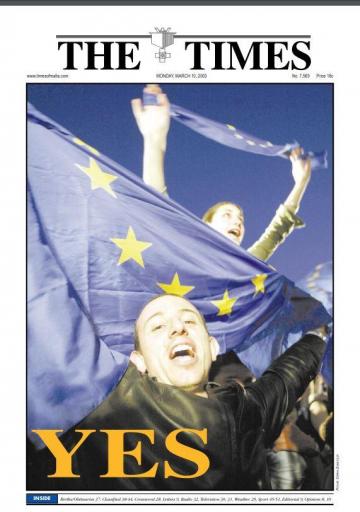
There is no denying that by the time the people voted in the EU referendum, many pro-EU votes were also a vote for change – one that would allow for the raising of standards beyond the grasp of the petty partisan politics. The EU Acquis should have done the rest. Still. The PN had served its purpose for two decades. The last few years of the Gonzi government were concentrated on steadying the ship through the economic crisis but the PN had already begun to lose its hold on the pulse of the people.
A party for all reasons
Any reform of the PN must therefore also be seen in this light. As has always been the case a party must have a reason to exist. Aside from the minutiae of everyday policy development one must also be able to identify a party with an overarching cause – of the type that marked the PN’s double-decade of success at leading the country. Call it ideology if you will, though that gets complicated in this day and age what with the modus operandi of the current political arena.
The party’s mission with such a cause would be to convince first of all the people that they must espouse it and this for their own sake. That, in itself, is not the easiest of tasks. Just consider for a moment that the ground-breaking election of 1987 that launched the era of change was won by… wait for it… a margin of 4,785 votes. The cause must transcend the party. There is no other way of going about this for real effectiveness.
As things stand the reasoning that underlies ideas of reform is pinned strongly in the heart of the current system. Here is how I described it in 2016 in a blog post entitled Il Triangolo No:
The structure of our constitutional system has been built using a language that reasons in bi-partisan terms. A bi-party rationale is written directly into the building blocks of our political system – both legally and politically. Since 1964 the constitutional and electoral elements of our political system have been consolidated in such a manner as to only make sense when two parties are contemplated – one as government and one as the opposition.
We are wired to think of this as being a situation of normality. The two political parties are constructed around such a system – we have repeated this over the last ten years in this blog – and this results in the infamous “race to mediocrity” because standards are progressively lowered when all you have to do is simply be more attractive than the alternative. The effect of this system is an erosion of what political parties is all about.
The political parties operating within this system are destined to become intellectually lazy and a vacuum of value. The intricate structure of networks and dependencies required to sustain the system negates any possibility of objective creation of value-driven politics with the latter being replaced by interest-driven mechanisms gravitating around the alternating power structure. Within the parties armies of clone “politicians” are generated repeating the same nonsense that originates at the party source. Meaningless drivel replaces debate and this is endorsed by party faithfuls with a superficial nod towards “issues”.
The whole structure is geared for parties to operate that way. Once in parliament the constitutional division of labour comes into play – posts are filled according to party requirements and even the most independent of authorities is tainted by this power struggle of sorts. Muscat’s team promised Meritocracy and we all saw what that resulted in once the votes were counted. In a way it was inevitable that this would happen because many promises needed to be fulfilled – promises that are a direct result of how the system works.
The “intellectually lazy and value vacuum” parties are what needs to be reformed. This requires a rebooting of the system. What needs to be targeted are the laws and structures that have developed into an intricate network of power-mongering and twisted all sense of representative politics. Reform of this kind goes a much longer way than merely rebooting the party and putting it back in the same fray.
Forza Nazzjonali was a last-minute attempt to mobilise the forces of opposition to corruption in this country. It is telling that the part of the PN that viewed the coalition as anathema would justify their aversion to the idea with the fact that this damaged the “party”. It is the same part of the PN that is unable to see the greater picture regarding the backsliding of the rule of law in the country. In their eyes the difference between them and Muscat is that Muscat has hit on a winning formula and has raised his party to new heights of glory. You can bet your last euro cent that had Muscat been PN they would be applauding him till the cows come home.
As things stand though, the reform of the PN does not seem to be pointed in the direction of greater causes. The reform will in all probability get mired in the usual bull concerning street leaders, committees, local councils, regional structures, partition of party fiefdoms, “listening” mechanisms and such. Nahsbu fin-nies taghna. Nisimghu il-wegghat. Partit miftuh u lest ghal bidla. Yada yada yada.
That kind of reform deserves only a slow death. It would just be a tinkering of the ladders of power that are built within our parties with the hope of getting a chance of replicating them on a national scale once in “the power” (For more on how this works see yesterday’s fresh report from the Commissioner on Standards – or if you’re lazy just watch the Yes Minister episode called Jobs for the Boys). It is the kind of reform that assumes all is ok with the laws of the land and how they are applied. Again. That reform deserves a slow and painful death.
Death becomes them
I have absolutely no doubt in my mind that calling for the death of the party will attract all sorts of opprobrium from the party core. That should not matter. What matters is that the message gets across. The PN must die is really a call to rebuild from scratch. Thinking within the confines of an age-old mentality of parties wired to mirror and milk the state machine can only cause further damage. Instead the PN must rebuild as a party that owns the biggest cause at the moment : the need for a radical constitutional change that inoculates the nation against state capture.
After his failed mission at the last EU #topjobs summit Joseph Muscat flew to the Czech Republic and met PM Babis. The squares of the Czech republic have been filled with protesting citizens unhappy with Babis who is under investigation for fraud. Muscat could give a lesson or two to Babis on how to convert the baying crowds into comfortable electoral margin wins. That’s the Muscat who was not considered for an EU Top job because of his governmental track record.
The new PN should be out there leading the battle against corruption on all fronts. It should be reminding the people that this battle is for their best because the backsliding of the rule of law will ultimately have one big victim: the very people who currently blindly follow Muscat’s every turn. That new PN can only exist if the current format and mindset are ditched. This is the chance to take the lead in a wide coalition of opposition for real change. In 2020 the seeds for a new forward looking movement could be sown. The odds are stacked against that though – the system is a survivor, the system feeds on the core nostalgics and will show a strong will of self-preservation.
Never forget, and beware, that old Mediterranean adage: “if we want everything to stay the same, then everything must change”.