Alarm Bells in Caracas – a wake up call for the EU

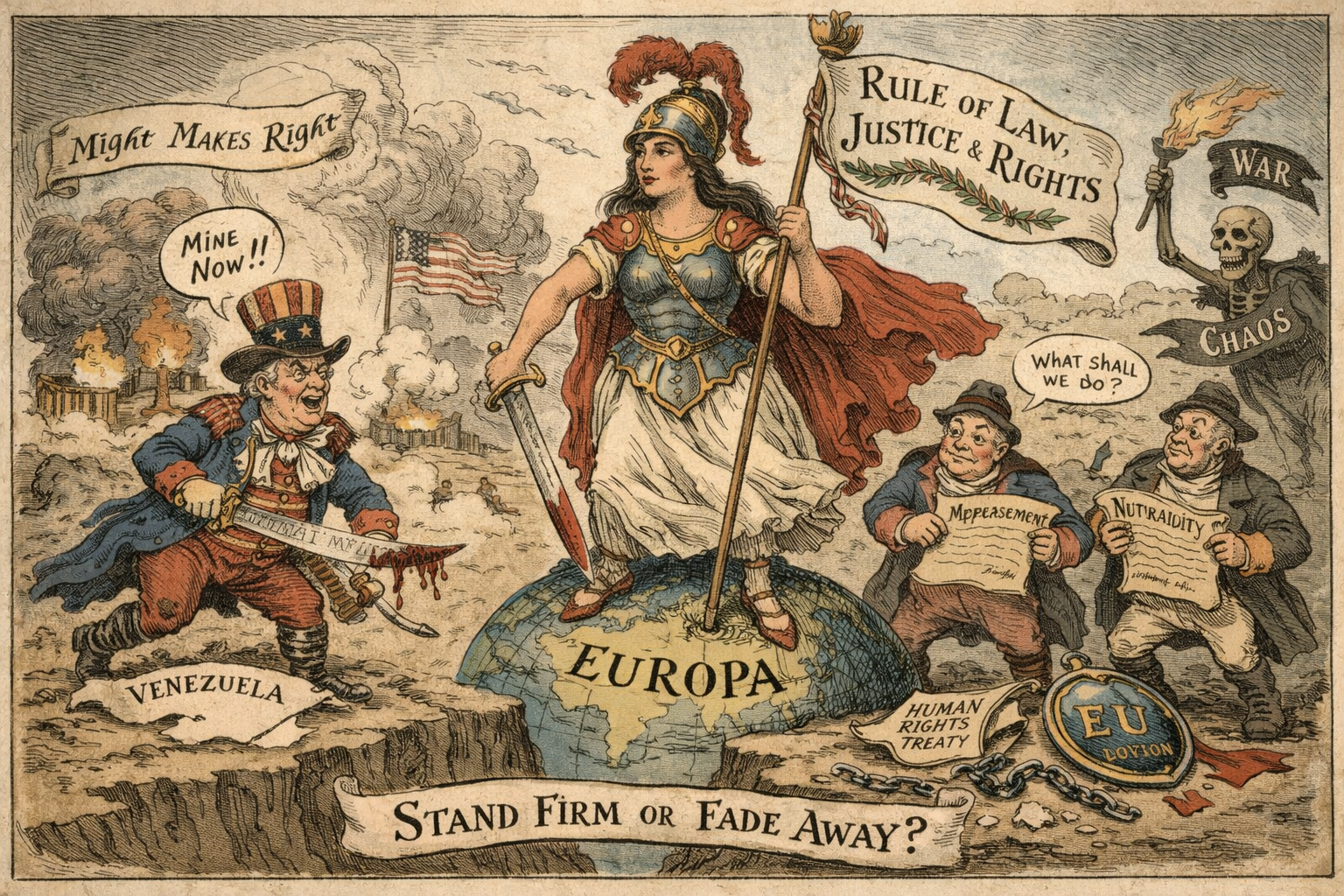
Trump’s reckless invasion of Venezuela shatters illusions about a self-sustaining rules-based order. The EU now faces a decisive choice: drift into irrelevance or unite, wielding both muscle and diplomacy, to defend postwar values of human rights, justice and law. History demands leadership; hesitation means surrender by instalments for Europe itself.

There are moments when history does not knock but barges in uninvited, kicks over the furniture and dares you to respond. The reckless invasion of Venezuela by President Trump has done exactly that. The shockwaves are not only felt in Caracas or Washington. They reverberate through Brussels, Luxembourg, Berlin and every capital that has grown accustomed to the comfortable illusion that the post-war order, once built, maintains itself. It does not. It survives only if someone is willing to defend it.

What we are witnessing is not a passing aberration. It is the naked assertion that force trumps law, that personal bravado outranks multilateral process, that sovereignty and human dignity are props in a televised spectacle. The United Nations looks on, its mechanisms sidelined. International courts issue words while tanks supply facts on the ground. The question therefore returns, unavoidable and urgent: who, if anyone, will step up for the rule of law?

Europe was born out of the smoking ruins of precisely this kind of arbitrariness. It is no coincidence that the vocabulary of the Union is studded with words like dignity, rights, justice, peace. These are not rhetorical ornaments; they are its genetic code. Yet over the past years the EU has preferred the language of caution, incrementalism, lowest common denominators. Strategic ambiguity has become strategic paralysis. All the while, the world has ceased to wait for Europe to make up its mind.

Trump’s Venezuela adventure makes the choice starker than ever. Either the European project dissolves into a genteel talking shop, destined for gradual dismantlement into insignificance, or it accepts adulthood. Adulthood means power. It means speaking with one voice, building the capacity to deter aggression, backing diplomacy with credibility and muscle, and refusing the comforting refuge of “not our problem.” It means understanding that defending human rights, international law and multilateralism today is not an academic exercise but a question of geopolitical survival.

There is no shortage of hypocrisy to overcome at home. An EU that wants to lead must first confront internal backsliding on the rule of law, the temptation to placate strongmen for short-term gains, and the ever-present fear of domestic populists who rail against imaginary Brussels overlords while depending on the stability Europe provides. Leadership will not be improvised; it must be claimed, and it will be contested.

But the alternative is worse. A world of transactional invasions and punitive raids dressed up as destiny will not leave Europe untouched. It will reach our borders, our currencies, our energy, our democracies. Retreat is not neutrality; it is surrender by instalments.

So the time for pussy-footing is over. Europe must decide whether it is merely a market with an anthem or a political community prepared to defend a civilisation of law. That means coordinated foreign policy, credible defence integration, principled diplomacy, and the moral clarity to say that invasions without legal mandate are unacceptable regardless of who orders them. The post-war values that once seemed self-evident require guardians again.

History has pushed the European Union to the front of the stage. Either it bows and exits quietly, or it stands its ground and leads. The choice will define not only the future of the Union but the fate of the rules-based order itself.


The politics behind Snowden

Edward Snowden is on the run. The US government is attempting to get the former CIA employee and contractor for the NSA  extradited after he shared classified material with the international press – namely with the UK’s Guardian. Snowden’s first leak activity took place in Hong Kong, safely wrapped in a series of laws and rules that govern the former UK colony. Even had the Hong Kong courts reached a decision to extradite Snowden (which they did not), the final say would still have lain with the Chinese authorities who have the prerogative of a veto on such decisions.

Snowden has apparently “left the building” this morning and has been tracked on an Aeroflot flight – direction Moscow. The Russian authorities claim to be unaware of the hot potato that is passing through their space but it is rumoured that Snowden has another final destination in mind. In fact Snowden has already mentioned Iceland as the best place to end up given the high level of personal protection that is afforded to individuals in Icelandic law.

Iceland is an interesting choice and model  not just within the context of this case but in a wider political and economic context. The island nation has just come out of its own financial crisis. Although it suffered a severe blow between 2008 and 2012 it seems to have weathered the worst part of the storm and steadied its ship back on a better course. The crisis forced a blanket institutional reform and resulted ironically in a final rebuff of the EU membership that had previously been top of the agenda. In fact elected on the wind of debt disputes with the UK and the Netherlands as well as continuing tension on environmental matters (particularly fishing policy), the newl conservative government of 2013 has opted to freeze the EU membership application.

Why would Snowden go to Iceland then? This Guardian article provides much of the answers to that question. The country’s efforts for protecting freedom of expression and whistleblowers are not token gestures to appease the population in bandwagon riding politics. The Icelandic Pirate Party has lobbied for strengthening of the rights including the protection of asylum seekers. Birgitta Jónsdóttir is chairman of the Icelandic Modern Media Institute and an Icelandic MP for the Pirate Party. The Institute is currently examining the options for Edward Snowden while actively working on multiple fronts to strengthen his right to diplomatic protection.

The politics behind Snowden are the politics of individual freedom and liberty. They are the politics of direct representation and accountability and transparency. They are the politics of the 21st century that may seem to originate in the unfamiliar world of global communication and knowledge management but are just as crucial to social development and constitutional integrity as the period of revolutionary idealism that brought about the birth of consitutional liberal democracies. Parties such as the international phenomenon that is the Pirate Party are a new tool in modern democracies that operates with clear values, clear direction and that do not compromise their values for the sake of power itself.

Think about that.

Guernica revisited

The other day I was browsing the news on my phone when I came across an item about a series of bombings around Irak and Afghanistan. I remember thinking how this kind of news has become so frequent as to become almost unnoticeable. My first idea of news is in the early eighties when the bulletins would be dotted with IRA bombings, kidnappings and hijacks. Post 9/11 terrorism had not come into being yet and you still had the tangible feeling of people losing their lives – of humans engaged in suffering and misery inflicted upon them by lesser beings – but by humans nonetheless. The Habibiya bombings were just a flicker on the news ticker. By the time the full information was gathered thirty-one people had lost their lives in a series of bombings in the Middle East and many more were injured.

Sports bulletins were not stopped, nation’s leaders were not rushing to express their condolences with the victims of these attacks or solidarity with a nation that was once again pregnant with mourning relatives. Most of all, the item barely made it to the top of news bulletins or front pages across the world.

Then came Boston.

Comparisons are odious and this is not intended to compare for there is no comparison that holds ground with the suffering and misery inflicted by loss of life or grievous injury. An injured human is an injured human – whether he is running a marathon, watching a marathon, on a boat in the middle of the Mediterranean or shopping in a market near Tikrit. A dead human is a dead human – whatever the cause of death may be and no matter if the death was caused in the name of some ‘greater cause’ or due to mere madness.

But the Boston marathon lies in the heart of a United States that still tries to be a melting pot of sorts. People from all over the world aggregated to the town of freedom and tea parties to celebrate life in a sporting fashion. Some twisted minds who deserve the worst of Dante’s circles in hell planned and plotted for bombs to explode at the moment when the largest number of runners are crossing the line. It’s ugly. It’s vile. And the world yelled “Enough” in angry indignation. Which is all good for the par. Every one of these dead runners or spectators (three at the moment of typing) and every one of the persons who had to have their limb amputated, must be mourned and showered with all the compassion and help they may need.

They must be helped because we are human and because we like to believe that our kind is capable of thinking as a society that cares. In equal measure must the perpetrators be found and eradicated. Yes. Eradicated.

But Boston also showed the two-faced approach to emotions. Almost daily the world observes tragedies such as what happened in that fair American city. Yet while Boston will enjoy more than its fair share of attention, events such as the bombings in Irak get relegated to second, third or even nth place. This is not a competition mind you, nobody would vie for top billing on the tragedy headlines. It does say much about our perception of the world. For much as I would like to give the news conglomerates and journalists (as well as their customers and clients – the reader, viewer and listener) the benefit of the doubt you do get a nagging feeling that some lives are more important than others.

If not more important, then more relevant to others. The onlooker at a marathon is not as distant as the “oriental” at a souk who gets blown to smithereens while buying her vegetables for the daily pot. The message that this sends out is that these people are “different”. That very message of difference that we had all nixed when Huntington came around with his clash of civilisations business. It could not happen we thought. We are all human and humans and their rights are universal.

The irony of the Boston attacks was that they occurred during a marathon. The concept of a marathon began after the battle of Marathon in 490 BC after the united city states on the peninsula beat the invading Persians at Marathon (with Pheidippides running the distance to Athens to announce victory). The battle itself would have been seen as a clash between two great civilisations – the lords of the earth versus an association of free states. The temptation to succumb to this kind of rhetoric might be great but in the end it is humankind that suffers – not democracies or authoritarian regimes – but the man in the street… jogging, shopping or simply minding his own business.

Every so often we get a new version of Guernica painted directly onto the canvas of our collective memories. We are reminded once again of the pain and suffering that a human can and will inflict on another human. We are reminded of the ugliness of our nature and of the fine line that divides this exalted race of ours from animal-like behaviour and of what a struggle it is to be and remain “civilised”.

May their souls rest in peace and may the victims of humankind everywhere be vindicated by what will hopefully be an increased awareness about ourselves and who we really are.