Across Europe, the protection of cultural traditions and pastimes sits at the crossroads between constitutional identity and legislative policy. While all Member States acknowledge culture as a public good, few have given it explicit constitutional status. Italy stands out as a state where culture is embedded in the constitutional text as a foundational value. Malta, by contrast, protects its traditions through statute and policy rather than constitutional law. A comparison between these small Mediterranean states reveals how constitutional design shapes the strength and enforceability of cultural protection — and how both models interact with broader principles of European law.
In Italy, Article 9 of the Constitution occupies a central symbolic and practical role. It declares that “the Republic promotes the development of culture and scientific and technical research” and “safeguards natural landscape and the historical and artistic heritage of the Nation.” This brief clause has evolved into one of the pillars of Italian constitutional identity, second only to the protection of human dignity and democracy. The Constitutional Court has interpreted Article 9 expansively, seeing it not merely as a programmatic statement but as a binding constitutional duty on public authorities. The protection of culture, landscape, and heritage has thus become an enforceable constitutional good, capable of limiting legislative and administrative action.
The 2022 constitutional reform further strengthened this framework, explicitly adding the protection of the environment, biodiversity, and ecosystems “also in the interest of future generations” to Article 9. The reform linked environmental and cultural heritage under a single constitutional ethos — the idea that Italy’s identity rests on the continuity of its landscape, arts, and traditions.
This constitutional culture is reflected in a dense network of legislation, most notably the Codice dei beni culturali e del paesaggio (Legislative Decree 42/2004). The Code translates Article 9 into practice by defining, classifying, and regulating cultural assets, landscapes, and intangible heritage. Interestingly, the Italian model is not purely centralised. The Constitution assigns significant powers to the Regions and local authorities under Title V (Articles 117–118), which divide legislative competences between the State and the Regions. Culture and tourism fall within the category of “concurrent competences”, meaning that while the State lays down the fundamental principles, the Regions enjoy the power to legislate in detail and to promote regional traditions and local cultural practices.
This regional autonomy is vital for Italy’s cultural richness. Local authorities support and regulate traditional events such as the sagre popolari — village fairs celebrating local produce, crafts, or patron saints — as well as historical pageants, dialect preservation initiatives, and folk music festivals. Each Region has its own cultural statutes: for instance, Tuscany and Emilia-Romagna provide funding and legal recognition for traditional community events, while Sicily and Sardinia operate under special statutes granting even broader cultural powers. The sagra popolare thus becomes not only a communal celebration but also an expression of constitutional pluralism — the coexistence of local traditions within a shared national framework. Through Article 9 and regional competences, Italy has constitutionally integrated its living traditions into the structure of the Republic itself.
Malta’s situation is markedly different. The Constitution of Malta (1964) contains no article equivalent to Italy’s Article 9. Cultural protection is mentioned only indirectly in the Preamble, which commits the nation to safeguard “the heritage of the past.” There is no recognised fundamental right to culture, no constitutional duty upon the State to promote or preserve heritage, and no judicial doctrine elevating culture to constitutional rank. Instead, the Maltese system relies on ordinary legislation and policy measures.
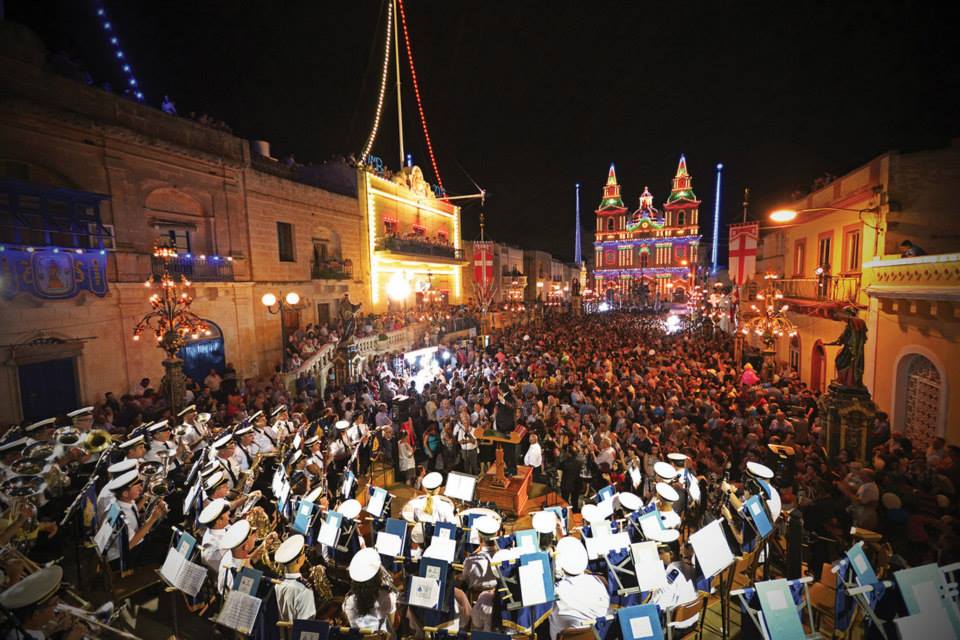
The Cultural Heritage Act (Cap. 445 of the Laws of Malta), enacted in 2002, provides the legal foundation for the protection and management of both tangible and intangible heritage. It establishes Heritage Malta and the Superintendence of Cultural Heritage, the principal institutions responsible for preservation and registration. Under this Act, traditional practices — such as village festas, għana (folk singing), carnival, the regatta, or traditional crafts — can be recognised as part of the national heritage inventory. Complementary legislation, including the Environment Protection Act (Cap. 549), covers aspects of landscape and environmental heritage. Malta’s National Cultural Policy (2015, revised 2021) serves as a guiding framework, but it remains a policy document without constitutional force.
This statutory model has important consequences. Cultural protection in Malta depends largely on executive discretion and funding priorities, rather than on judicially enforceable duties. Courts rarely invoke cultural considerations as constitutional values when adjudicating conflicts between development and heritage. The constitutional silence on culture also limits the use of cultural arguments in administrative or constitutional litigation. Where Italy’s Article 9 allows judges to weigh culture and heritage against economic or infrastructural interests, Maltese law offers no equivalent balancing principle at constitutional level.
At the European Union level, the two models interact differently with supranational norms. The EU’s legal framework recognises culture as an area of supporting competence. Article 167 of the Treaty on the Functioning of the European Union (TFEU) requires the Union to contribute to “the flowering of the cultures of the Member States,” while Article 22 of the EU Charter of Fundamental Rights obliges respect for cultural, religious, and linguistic diversity. These provisions, though not directly enforceable, shape EU policy and interpretive practice. They give Member States space to justify national cultural measures — for instance, subsidies, preservation laws, or regional protections — as expressions of their national identity, which the EU must respect under Article 4(2) of the Treaty on European Union (TEU).
Italy’s constitutional framework aligns naturally with this European approach: its Article 9 and regional competences provide concrete expression to the Union’s abstract respect for diversity. The Italian model shows how national constitutions can transform cultural policy into a constitutional commitment compatible with EU law. Malta, on the other hand, exemplifies a system where EU-level cultural principles reinforce policy rather than constitutional obligation. The EU supports Maltese initiatives through programmes such as Creative Europe and through recognition of heritage sites and intangible practices, but these remain dependent on political choice rather than constitutional mandate.
Ultimately, the contrast between Italy and Malta illustrates two distinct ways of embedding culture within law. Italy’s constitutionalisation of heritage and regional traditions transforms culture into a legal value of the Republic, linking identity, landscape, and citizenship. Malta’s statutory model reflects a policy-based conception, where culture thrives through institutional commitment and community participation rather than constitutional adjudication. Both approaches, however, belong to a broader European story — one in which traditions, pastimes, and collective memories form part of a shared commitment to identity, continuity, and the democratic value of cultural diversity.
