Judicial independence in the EU: structural pressures beyond formal Rule of Law monitoring

Questions about judicial independence within the EU are rising, with Malta, Spain, and Italy exemplifying systemic pressures affecting national judiciaries. Incremental reforms and political contestation challenge autonomy despite formal structures. The EU’s legal responses may lag behind emerging risks, highlighting the need for robust institutional practices and public trust to ensure effective judicial independence.

Across the European Union, questions concerning the organisation, functioning and perceived independence of national judiciaries increasingly arise not only in infringement proceedings or preliminary references, but also in domestic constitutional debates and legislative reform processes. While the Union’s annual rule-of-law reporting mechanism provides a structured overview of institutional safeguards, recent developments in several Member States suggest that the principal challenges to judicial independence now manifest less through abrupt institutional rupture and more through sustained political contestation surrounding appointments, governance structures and prosecutorial organisation. The emerging pattern is therefore one of systemic pressure exercised within formally lawful constitutional frameworks, rather than overt breaches capable of immediate judicial sanction at Union level.

In Malta, successive controversies concerning judicial appointments, disciplinary oversight and the broader relationship between the judiciary and executive authorities illustrate the vulnerability of small legal systems to concentrated institutional influence. Even where constitutional reforms have introduced formal checks or enhanced procedural transparency, public debate continues to focus on whether appointment mechanisms and political signalling risk undermining public confidence in the effective separation of powers. The Maltese situation demonstrates that, from the perspective of Union law, compliance with formal structural guarantees does not automatically resolve concerns regarding functional independence, particularly where institutional culture, administrative resources or political polarisation affect the practical perception of judicial autonomy.

Spain presents a distinct but related institutional dynamic. The prolonged inability of political actors to renew the governing council of the judiciary has generated a structural backlog in senior judicial appointments and contributed to operational constraints within the court system. From a constitutional standpoint, this situation illustrates that judicial independence may be weakened not only by executive intervention but also by sustained political deadlock which effectively immobilises self-governing judicial bodies. Such paralysis does not necessarily constitute a clear infringement of Union law; however, it may indirectly affect the effective judicial protection required under Article 19 TEU and the principle of the rule of law as interpreted in the Court’s case-law.

In Italy, the forthcoming referendum on restructuring the judiciary, including proposals affecting the institutional separation between judges and prosecutors and the composition of governing bodies, highlights a further dimension of the European debate. Judicial organisation is primarily a matter of national constitutional competence; nevertheless, where structural reforms alter disciplinary regimes, appointment procedures or institutional accountability mechanisms, they may fall within the scope of Union scrutiny insofar as they bear upon the guarantees of independence required for courts applying Union law. The Italian process therefore illustrates how large-scale constitutional redesign of judicial systems can occur through democratic procedures while simultaneously raising questions concerning long-term institutional balance and prosecutorial autonomy.

Taken together, these national situations suggest that contemporary risks to judicial independence within the Union increasingly arise through incremental institutional adjustments, political bargaining over appointments, or structural reforms justified by administrative efficiency or accountability objectives. Such developments typically unfold gradually and within the bounds of constitutional legality, thereby limiting the capacity of Union enforcement tools—which are primarily reactive and litigation-driven—to intervene at an early stage.

The Union acquis on judicial independence, developed extensively in the Court’s jurisprudence concerning effective judicial protection, remains a powerful corrective instrument where concrete measures demonstrably undermine independence. However, its operational logic presupposes identifiable legal acts producing measurable effects, whereas systemic political pressure or institutional stagnation may evolve without generating a single reviewable measure capable of immediate judicial assessment.

From the perspective of Union constitutional architecture, this creates a structural asymmetry. The legal framework is highly effective in addressing explicit disciplinary regimes, forced retirements, or direct governmental control over courts, but comparatively slower in responding to cumulative institutional developments that alter the practical equilibrium between judicial and political authorities over time. The central issue for the future of the European rule of law system is therefore less the absence of legal standards than the temporal gap between emerging structural risks and the moment at which those risks crystallise into legally actionable violations.

In that sense, current debates in Malta, Spain and Italy may be understood not as isolated national controversies but as indicators of a broader European transition in which the safeguarding of judicial independence increasingly depends not only on formal constitutional guarantees, but also on the resilience of institutional practice, political restraint and public trust in the judiciary as an autonomous constitutional actor.

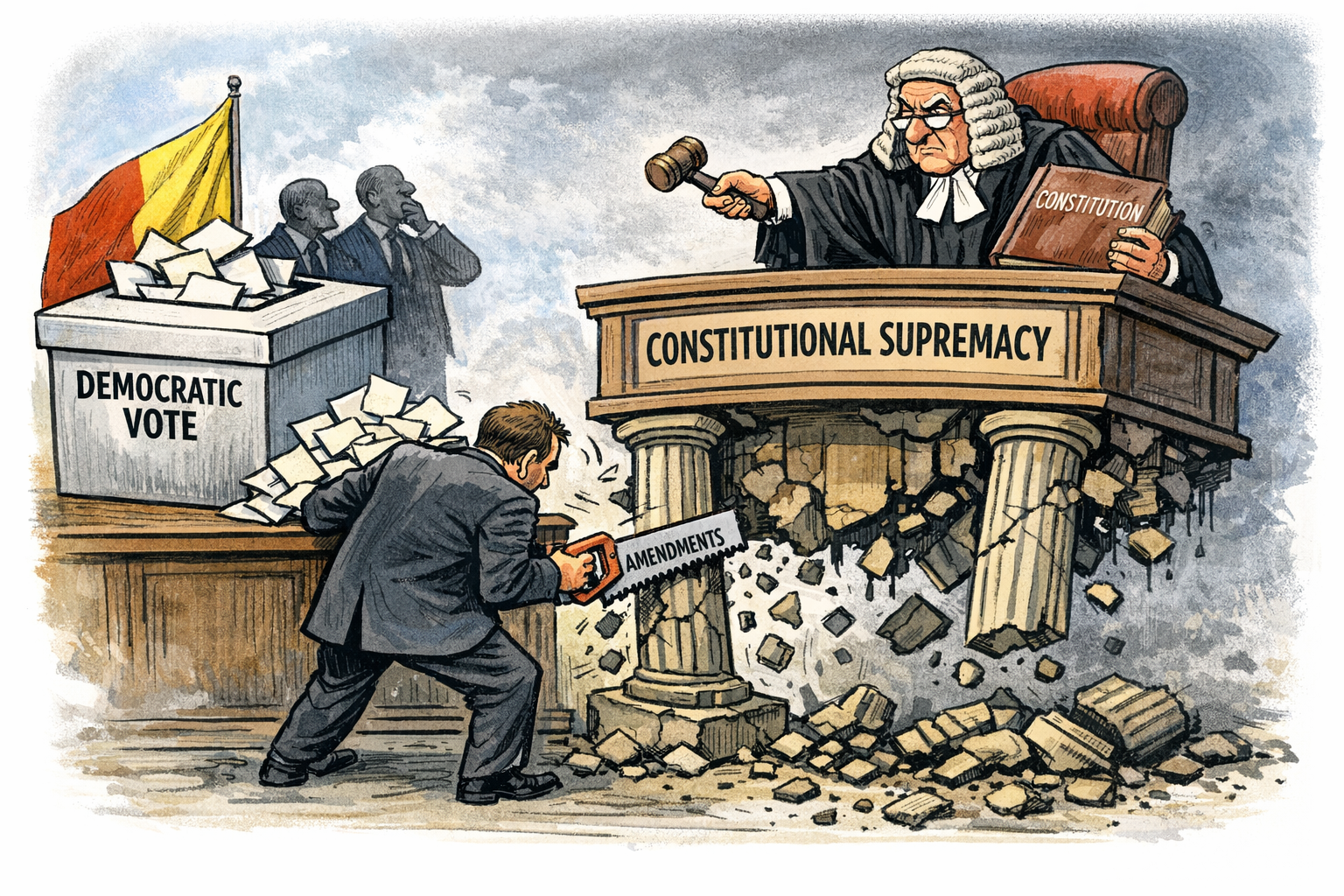
Democracy Is Not a Legal Alibi: Why Constitutional Supremacy Cannot Be Voted Away

Critical analysis of “Honesty in constitutional governance” by Robert Musumeci

In his Times article (TOM, 19.01.26) Robert Musumeci advances a central claim: that Malta’s Constitution “entrusts its own fate to democratic procedure, not to judicial virtue”, because every constitutional provision is amendable if the correct parliamentary procedure is followed.

In this brief I intend to accept the descriptive premise that Malta lacks an express eternity clause while challenging the normative and legal conclusions drawn from it. I submit that Musumeci’s assertion risks collapsing the distinction between democratic legitimacy and legal validity, and it understates how constitutional supremacy, the rule of law, and judicial independence operate as substantive constraints within a constitutional democracy even where formal amendment is possible.

Constitutional supremacy is not a slogan, but a legal architecture

Constitutional supremacy means that the Constitution is the highest norm within the domestic legal order. It is not merely a statement that courts may strike down ordinary laws. It is the structural principle that public power exists only within constitutional authorisation, and that all institutions, including Parliament, are constituted and limited by the Constitution.

Musumeci is correct to say that Article 6 renders inconsistent ordinary law void, and that courts are required to disapply unconstitutional legislation. But he then treats the existence of an amendment procedure as a “qualification” that almost empties supremacy of its protective force.

This assertion is conceptually flawed. Supremacy and the possibility of amendment are not opposites. They are complementary parts of constitutional design. Supremacy answers the question “what prevails today”. The possibility of amendment answers the question “how may tomorrow’s higher law be made”. The second does not cancel the first; it presupposes it. Indeed, the amendment procedure itself is an expression of supremacy, because it prevents constitutional change through ordinary politics and requires a legally prescribed route.

In constitutional terms, supremacy is not “eternal” in the sense of metaphysical permanence. But it remains juridically supreme at any given time. A constitution that can be amended is still supreme; it is simply not immutable.

Musumeci’s central error: democratic outcomes are not automatically “legal” in the constitutional sense

A democratic outcome is a political fact. Legality is a juridical status. The two can overlap, but they are not the same. Musumeci repeatedly implies that once an amendment procedure is followed, courts face “a constitutional fact, not an interpretative opportunity”, and that judges cannot “invent additional limits” based on “unwritten moral principles”.

This framing is misleading in two ways.

First, it assumes that constitutional adjudication becomes mechanical the moment the word “amendment” appears. That is not how constitutional law works. Courts must still determine whether the purported amendment is in truth a valid constitutional amendment, whether the correct procedure was followed, whether the amendment is coherent with the constitutional order, and whether it is a disguised attempt to do indirectly what the constitution does not permit directly. These are not “moral” questions; they are classic rule of law questions about competence, form, and constitutional identity.

Second, it insinuates that judicial review of constitutional change is necessarily illegitimate “judicial moralism”. That is an overstatement. In many constitutional systems, courts have recognised limits on amendment not because judges prefer a moral outcome, but because an amendment that destroys the constitution’s essential character is no longer an amendment. It is a constitutional replacement or rupture, requiring a different democratic mandate.

Even in the absence of an explicit eternity clause, a constitution can contain implied structural principles, such as separation of powers, judicial independence, legality, and effective protection of fundamental rights. These principles are not optional ornaments. They are constitutive of what makes a legal order a constitutional democracy rather than a majoritarian state.

Entrenchment is not merely “political cost”: it is a legal safeguard for constitutional stability

Musumeci describes entrenchment as a mechanism that raises political cost but does not create legal impossibility. That is true as far as it goes, but incomplete.

Entrenchment serves at least three legal functions that Musumeci underplays.

Firstly, it protects minorities against transient majorities by requiring cross-party agreement for foundational changes. Secondly, it protects institutional independence by making it harder for a government to rewrite the rules of accountability during a crisis or scandal. Finally, it protects constitutional continuity by reducing the risk of “constitutional capture”, meaning the use of legal forms to consolidate power and immunise the executive from scrutiny.

If entrenchment is reduced to “political accountability”, the constitution becomes little more than an instruction manual for how a parliamentary majority may legally entrench itself. That is precisely the danger constitutional supremacy is meant to prevent.

“Responsibility lies with Parliament and the electorate”: politically true, legally insufficient

Robert Musumeci argues that responsibility for “morally consequential constitutional change” cannot be displaced onto courts and lies with Parliament and the electorate. As a matter of political ethics, this is unobjectionable. But as a constitutional proposition, it is dangerously incomplete.

Courts are not only moral commentators. They are guardians of legality. Their constitutional function is not to “redeem” the political community, but to ensure that power is exercised within legal bounds, including bounds that protect the democratic process itself.

A citizen can vote out a government only if elections remain meaningfully free and fair. An electorate can judge wrongdoing only if there is access to information, investigative capacity, and independent adjudication. Parliament can be held accountable only if constitutional rights such as expression, association, and due process remain enforceable.

Therefore, the idea that “constitutional law cannot save it from itself” is rhetorically powerful but legally misleading. Constitutional law does not guarantee political virtue, but it does secure the conditions under which political responsibility can be exercised. When those conditions are undermined, “leave it to the electorate” becomes circular, because the electorate’s capacity to correct abuse is what is being damaged.

Executive interference with judicial determination: the modern route to constitutional degradation

Finally, I must address what seems to be Musumeci’s implicit comfort with the proposition that courts should not resist “politically chosen” constitutional outcomes. The core problem in contemporary constitutional breakdown is rarely an open coup. It is legalistic executive interference that preserves democratic rituals while hollowing out judicial control.

One of the most common mechanisms is court capture through appointments.

In constitutional democracies, judicial appointment is not inherently illegitimate. It becomes unconstitutional in substance when appointment power is used to predetermine outcomes, neutralise accountability, or intimidate judges into deference. The citizen may still see courts operating, judgments being issued, and constitutional language being cited, yet the adjudicative function becomes subordinated to political loyalty.

This is not hypothetical. The pattern is recognisable across jurisdictions. A government expands the size of the constitutional court or changes quorum rules so that newly appointed judges dominate panels. A government lowers retirement ages or changes tenure rules to remove existing judges and create vacancies. A government redesigns the judicial appointments process to concentrate control in the executive, replacing professional evaluation with political selection.

A government disciplines judges through administrative sanctions, budgetary pressure, or politically controlled “judicial councils”. Each step can be dressed as lawful reform. Each step can be passed by a majority. Yet the effect is executive interference with judicial determination, because the judiciary becomes unable to act as an effective constraint.

If courts then refuse to accept such changes as constitutionally destructive, Musumeci would label this “judicial moralism”. But the better legal description is that courts are defending the separation of powers and the minimum content of judicial independence without which constitutional supremacy becomes performative.

Constitutional supremacy includes supremacy over the executive, not only over ordinary legislation

Musumeci correctly emphasises that courts enforce the constitution against ordinary laws and executive action. But he understates that supremacy is most tested precisely when the executive seeks to evade adjudication.

Executive interference can take softer forms than court capture. Refusing to implement judgments or delaying implementation until the political moment passes. Issuing administrative measures designed to frustrate litigation, such as denying standing, withholding documents, or manipulating procedural timelines. Using state resources to litigate citizens into exhaustion, turning access to justice into a privilege rather than a right.

Publicly attacking judges and portraying adverse judgments as “anti-democratic”, thereby delegitimising judicial review as such. These are not questions of morality. They are questions of legality and constitutional structure. The constitution’s supremacy is hollow if the executive can systematically prevent courts from delivering effective remedies.

The EU dimension: correctly noted, but understated in legal consequence

Musumeci acknowledges that domestically valid amendments may still attract “external consequences” including political pressure and financial conditionality at EU level. This is accurate, but the framing again risks minimising legality.

For an EU Member State, rule of law commitments are not only reputational. They are embedded in binding obligations. When constitutional amendments undermine judicial independence, the issue is not merely “cost”. It is potential incompatibility with the Member State’s duties within the European legal order.

From the citizen’s perspective, this matters because EU membership creates an additional layer of constitutional constraint: national constitutional change cannot be treated as purely internal when it affects effective judicial protection, the independence of courts, and the enforcement of EU rights. Even where a domestic amendment is procedurally correct, it can generate legal consequences in EU law that materially affect the state’s position and citizens’ rights.

Conclusion: Musumeci’s theory is rhetorically honest, but constitutionally incomplete

Musumeci’s call for “honesty in constitutional governance” usefully reminds citizens that constitutional decline can be politically chosen. That is an important civic warning.

However, he commits a fundamental constitutional error by implying that democratic procedure is a sufficient condition for constitutional legality. It is not. A constitutional democracy is not defined only by who wins elections, but by the legal constraints that make elections meaningful, government accountable, and rights enforceable.

Constitutional supremacy is not a myth that evaporates because amendment exists. It is the legal hierarchy that binds all power, including power exercised through majorities. Entrenchment is not merely a political speed bump; it is a safeguard against capture. Judicial review of constitutional change is not necessarily “moralism”; it can be a rule of law necessity when the amendment is used as a vehicle to dismantle the constitution’s core structure, especially through executive interference with judicial determination via court appointments and institutional redesign.

Musumeci’s text should be read with one crucial correction in mind. Democracy matters. But legality is not whatever a majority can be made to vote for.

Legality is what the constitution, interpreted in good faith and protected by independent courts, permits the state to do without destroying the conditions of constitutional government itself.

Finch Trapping: A meeting is not an endorsement

The Times of Malta recently reported that Minister Clint Camilleri met the European Environment Commissioner to discuss Malta’s latest “finch research” season. The article’s headline — “All above board for finch research season” — suggests that Brussels has given Malta’s new trapping rules a clean bill of health. Yet on closer reading, there is no indication that the European Commission confirmed any such thing.

The piece simply recounts the Minister’s visit and his own assertions that Malta’s revised framework now complies with EU law and with last year’s Court of Justice judgment that struck down the previous derogation. Nowhere does it cite a statement from the Commissioner or the Commission affirming that the new rules are indeed in line with EU requirements. The most that can be said is that the Commissioner “welcomed dialogue” — a standard diplomatic courtesy that should not be mistaken for approval.

This matters. Malta’s record in the field of hunting and trapping is one of chronic friction with the EU’s environmental acquis. For years, governments have skirted or stretched the limits of the Birds Directive, invoking “research” or “tradition” to justify practices the Court has repeatedly condemned. Each time, reassurances are offered that “Brussels understands” or “the Commission agrees,” and each time the facts tell a different story once legal scrutiny sets in.

Until the Commission itself publicly confirms that Malta’s new system satisfies the Court’s judgment and the Directive’s strict conditions, it is premature — and misleading — to claim compliance. A meeting in Brussels does not change legal reality; it changes optics. The real test will come when the Commission assesses Malta’s measures on their merits, not on the strength of a press release or a photo opportunity.

Malta’s relationship with EU environmental rules has long been erratic. One can only hope that this time, conformity will be measured by law and science, not by wishful interpretation.

The Times of Malta article would have served the public better by highlighting the gap between ministerial assertions and legally binding validation, rather than implicitly treating the meeting as de facto endorsement.

The Passport Judgment Aftermath (II)

Facts and Explainers

Part of the reaction, or backlash, to today´s judgment includes the incredible assertion that the fact that the solution in the judgment was diametrically opposed to the Advocate General´s Opinion somehow diminished the quality of the judgment.

Such a position displays an ignorance of procedure before the EU Court. The Opinion given by an AG is normally requested by the Court itself and is an opportunity to obtain a detailed analysis of one or more possible solutions to the issue before the Court. It is by its very nature non-binding.

The Advocate General’s Opinion at the Court of Justice of the European Union is followed in about 75–80% of cases. However, the judges are not bound by it, and they diverge in roughly 20–25% of instances. While the Advocate General provides a detailed and independent legal analysis, the final judgment rests solely with the Court, which may adopt, modify, or completely depart from the Opinion depending on its own deliberations.

There have been several high-profile cases where the Court did not follow the Advocate General’s Opinion. In **Google Spain (C-131/12)**, AG Jääskinen opposed a broad “right to be forgotten,” yet the Court recognized it, requiring Google to delist links on request. In **Schrems I (C-362/14)**, AG Bot found flaws in the Safe Harbor agreement but suggested nuanced remedies; the Court instead invalidated Safe Harbor outright.

In **Wightman (C-621/18)**, AG Campos Sánchez-Bordona concluded that the UK could unilaterally revoke Article 50 TEU, and while the Court agreed, it gave more precise conditions for such a revocation. In **Coman (C-673/16)**, AG Wathelet advocated strong residence rights for same-sex spouses across the EU; the Court upheld the outcome but based its judgment narrowly on free movement law rather than broader marriage recognition.

These examples illustrate that while the Advocate General’s Opinions are highly influential, they serve ultimately as a guide rather than a command. The Court of Justice carefully considers them but reaches its own conclusions based on legal interpretation, judicial consensus, and the wider context of European Union law.

New Rules on Travelling to Malta – Is a fantasy 14-day rule unjustly ruining travel plans?

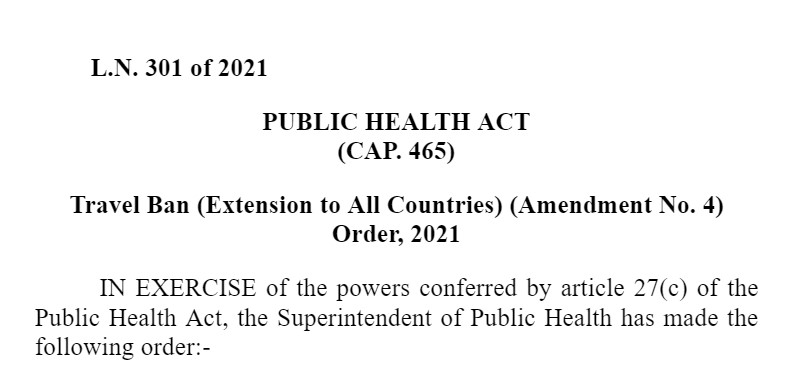
Most of yesterday’s post was based on public declarations of what the new measures for the 14th July would be as well as on the preliminary reactions by the Commission. The Legal Notice “Travel Ban (Extension to all Countries) (Amendment Number 4)” was published yesterday. As expected, the L.N. “fixes” the terms that had been declared in order to avoid the discriminatory practices mentioned by the Commission. Travel to Malta is extended beyond the possession of a vaccination certificate for certain cases (medical reasons, children aged 5 to 11) while Maltese residents who were expected to return to Malta could do so based on a PCR test.

It is comforting that the L.N. took into consideration these aspects though it is clear that not all persons hoping to travel to Malta will be covered by these changes. One example would be the diaspora of Maltese working abroad who had been hoping to join their family for summer but who have not yet made it for the vaccination.

One particular obstacle to travel for such workers was the extra condition being imposed on holders of vaccination certificates. In fact, according to the guidelines for entry, it was not sufficient to be in possession of a vaccination certificate but there was an additional requirement that the certificate would have to have been issued “at least fourteen days from the administration of the vaccine”. This means that if you obtained the vaccination certificate less than 14 days before your travel date then it was useless and you could not travel to Malta.

Now countries like Luxembourg issue a fully operational EU COVID19 Vaccination Certificate on the day you receive the final dose. As an example I could cite my own family where my wife was due a second dose on the 26th and we are meant to travel on the 31st. IN our case we are lucky we could count on the Luxembourg system and managed to move the date of the second dose to an earlier date to be safe for travel by fulfilling the 14-day condition.

The problem I have though is that the 14-day condition does not result from any part of the legislation in question. The Legal Notice limits itself to the phrase: “persons may travel from Malta to the countries listed in this proviso and from the countries listed in this proviso to Malta as long as, upon their arrival in Malta, they are in possession of a vaccination certificate“. No 14 day moratorium.

As you can see in the screenshot from the Malta International Airport website the 14-day condition has been maintained without any legal basis:

MIA Notice
from MIA Website

This lack of clarity is not helpful especially since this type of problems normally are “discovered” at the point of entry when faced with an employee sticking religiously to the rules and there is no time for an “appeal” to the law. I might stand to be corrected and would be happy for any enlightenment on the matter but in my mind the 14-day rule has no legal basis and might be unjustly depriving travellers to Malta of their right to move.