
The part I don’t take

The list of speakers for tomorrow’s Civil Society Demonstration has been published and readers by now will have noticed that I am one of them. I have seen comments directed at me both on the Times and Independent articles on the event. According to one commentator I was an obvious choice because I wrote “against the PL” prior to 2013. Another commentator was convinced that my time served as president of the university student’s union was served in the capacity of a PN representative.

To be fair, that was just about it. Not much fodder it seems. Which probably means that I am sufficiently of an unknown factor to pass the grade of most suspicious observers. I could answer both the comments stating firstly that I have written “against the PL” both before and after 2013. My track record is such that my writings took me “against the PN” often too – especially when the PN deserved more scrutiny as the party in government. Luckily I have 12 years of blogging to back my claims.

As for my time in KSU – the allegation is risible to say the least. My time spent both in SDM and in KSU was at the service of students and the student community. I proudly state that together with my colleagues of the time I was responsible for a (albeit temporary) rift between the SDM and the Nationalist Party. The reason is simple – I did not take kindly to being dictated how to do politics for a party’s sake.

This is not an apologia for my past or for my credentials to address tomorrow’s crowd. This is more of a look at why I believe that the kind of activism that is developing in and around the current crisis is perforce a non-partisan one. The wider aims and goals of the civil society that has begun to stir go beyond the immediate demands made by the Civil Society Network. The fundamental aim is constitutional reform. Constitutional reform that is radical and has to be so.

Such Constitutional Reform must be party-free. Understand this. Party-free not party neutral. The thinking outside the box begins at that point. We have had a constitutional system that developed around and at the service of two parties. I have repeated this notion ad nauseam. The reason for the institutional rot is also because there is a limit to how much you can bend and twist the rules to serve two masters. The reason for institutional rot is not to be placed at the foot of one party or another. There is no measure that can blame one party more than the other. The reason must be placed squarely at the feet of both parties. Yes. The PLPN.

So think outside the box we must. The movement must become a constitutional movement. The proposals of what a new Malta should look like will be manifold. Already there are disagreements among proponents as to which system will be better however there is one crucial matter that must be remembered: the discourse has been brought to the forefront of the national agenda.

Before the election I founded the Advocates for the Rule of Law together with some colleagues of mine. Our aim was to highlight the deficit of rule of law that was becoming increasingly obvious. Yes, it became increasingly obvious under Labour’s watch but be careful, the problem was rooted much much earlier. Here is a snippet from a blog post (and from my Independent on Sunday column at the time) in March 2010: what many would call less suspicious times:

“All three branches of the state are currently under heavy attack and the levels of trust that “the people” seem to have in the administrative, executive and the judiciary appear to be alarmingly low. This is not healthy for our democracy – it’s a rot that is setting in. The rot must be exposed, not in a partisan, self-interested kind of way but rather in an objective attempt at rediscovering what we want for the future of our nation.”

I reread my posts over the years since 2005 and to me it sounds like a broken record. Not – as an observer on Daphne’s blog observed tauntingly very recently – the broken clock that is right twice a day. No, this was a constant consistent message. Over the years I and other like-minded individuals explored possibilities for constitutional change. We believed that the change should start from the house of representatives. Transforming it into a truly representative institution would mean proportional representation and having a clear cut separation from the executive. It did not make sense to have a third of parliament sitting in the cabinet.

The discourse of reform needed a crisis to be kicked off. Sadly the crisis took the ugliest form that one would never have wished for – the death of a vociferous journalist. The agenda of reform that had been hinted at mildly during Panamagate and its aftermath was now catapulted to the forefront. The Advocates for the Rule of Law (AFTROL) had managed to put the words on the nations mouth: Rule of Law. The discussion had remained at a technical level and the election had pummelled a people into silence.

The new crisis has brought the discussion back with a vengeance. What needs to be understood is that this is not about asking Joseph Muscat to resign. It is not about advocating or pushing for the usual alternation. It is much deeper than that. The nation desperately needs the reform for its own good. Citizens need to understand that so long as they pin their hopes on the partisan assessment of politics then all hope is lost. The two political parties will always be in survival mode. It is parallel to their need to be in power to make the system work to their advantage. The rules  must stay the same – even if they will pay lip service to constitutional reform.

Now more than ever it is imperative that we are not partisan. The part I don’t take is the part in part-isan. It is imperative that we begin to understand that the Civil Society Movement must establish itself with even higher standards than the temporary ones that are being  asked for right now. Constitutional reform must come from the heart of the nation. From its sovereign. We the people.

I am not partisan. I don’t need to be and cannot be. My duty as a civil activist is to fight for constitutional change that brings about the proper reforms. That brings about the rule of law.

We are servants of the law so that we may be free.

 

Leader of the Opposition

Adrian Delia is frantically fighting a race against time. It has become increasingly evident that his gamble for leadership of the nationalist party did not include the foresight or plan that would account for the fact that he needs to find a way to get into parliament. This lack of foresight does not bode well for the nationalist party – that it is lead by someone unable to make the most simple of calculations is not exactly a bright light for the future. If my sources are right, plan B for Delia and his entourage seems to be the harassing of a number of MPs that are judged as most likely to want (or to be forced) to give up their seat and make way for the half-heartedly anointed one. It is a clumsy and roundabout way of doing things that jars conspicuously with the declared marketing of TeamDelia of wanting to unite the party behind Adrian as quickly as possible.

Unwitting supporters have even been asked to turn their guns onto the PD as though the damned coalition meant that the Democratic Party owed the Nationalist Party anything other than collaboration in parliament against the forces of corruption. Kudos to Marlene Farrugia who has strongly retorted that she will not be turned in this respect and that the PD will jump at any chance to take the place of any MP who chooses to call it quits and force a by-election. Of course Delia and his team will choose to take this opportunity to ride roughshod over the concept of coalition and collaboration – hatred of anything the coalition was about is after all one of the hallmarks of Delia’s New Way. So much for a deeper understanding of the changes that are necessary in the way politics is made.

But what about the Holy Grail position of the Leader of the Opposition? Well, constitutionally we are in a bit of a conundrum. First of all, none of the conditions that create a vacancy of the position of Leader of Opposition (Article 90(3) of the Constitution) has been fulfilled so technically since Simon Busuttil is still a member of the House of Representatives and consequently has not vacated the position. Let us assume that by informing the President of his intention to no longer lead the nationalist party, Simon Busuttil has de facto given up his place as Leader of the Opposition that he occupied under the terms of 90(2)(a) of the Constitution. In that case, until Delia manages to find a way into Parliament we can try to see who can legitimately fill that constitutional role come the 1st of October. Whichever scenario you take, whether it is under article 90(2)(a) (the MP who leads the opposition party with the largest number of members) or under article 90(4) (If, in the judgment of the President, a member of the House of Representatives other than the Leader of the Opposition, has become the Leader in the House of the opposition party having the greatest numerical strength in the House) – in both cases the Leader of the Opposition is (a) a member of the house and (b) commands/leads the largest number of opposition members. In the absence of the party leader (Adrian Delia) the obvious constitutional choice until the dilemma is solved is to nominate the Deputy Leader for Parliamentary matters (Mario DeMarco) as the Leader of the Opposition.

Sure, it can be a strange situation where the Leader of the Party is not the same person as the Leader of the Opposition but this does not mean that it cannot and will not work. As I said, Delia should have foreseen this situation before he decided to throw in his name as a leadership candidate. It’s not like he was not asked the question as from the start of his campaign. Even a minimum of constitutional knowledge would have told him that no MP on any side of the house owes any party anything. The seats are not theirs to give – they have been elected by their constituents and owe them the duty of representation. Giving up that seat for a man who only three months ago was unwilling to represent any part of the nation would be a betrayal of their constituents of the highest order.

I am quite sure that in the end one MP will be found who will give in to the heavy handed tactics of TeamDelia. It does not bode well at all though. It is one thing to elbow your way into the leadership of a party, it is another altogether to bulldoze your way into a constitutional position without the least bit of deference to the constitutional principles that underlie a constitutional democracy.


Il Triangolo No

triangolo_akkuza


I. Stability is a partisan word

Third parties, third ways. An online poll conducted by the paper Illum showed, among other things, that 14% of respondents would vote for a new party since they have no more faith in either the PN or the PL. Talk about a possible third way being a panacea for our political representation problems has belatedly gathered momentum on the island. Muscat’s government is on rapid implosion mode while the general feeling is that the PN alternative would generate more of the same style of politics – one that is deeply enmeshed in corruption and deceit to the detriment of the citizen. Marlene Farrugia’s rumblings as a dissenting politician within parliament are much stronger and coherent than those we have heard until now during the last months of the Gonzi executive. Add to that the fact that scandal after scandal the tempo of public discontent does not seem to subside and a few “public personae” are prepared to throw their weight into the ring and you have the recipe of what is being touted as the panacea for all this evil feeling: a third party.

Regular readers if this blog may well recall that the “Third Way” solution has long been advocated over the whole stretch of our blogging history. Often the election of a third party’s representatives in parliament has been described here as “driving a wedge in the bipartisan hegemony”. I still believe that a third party (and fourth and fifth) can have positive effects on our political system. The problem however lies elsewhere since the third party is not a solution in itself but it is actually a possible result of the solution that is necessary in order to definitely improve the state of our politics and consequently the health of our nation.

What do I mean? Let’s take a look at the PLPN reaction to the very public rumblings of a possible third party. Their rare chorus of unanimous disapproval was to be expected. More parties in parliament would cause “instability” they claimed. Worse still they could not envisage having to share the burden of government with some coalition party – anathema.

The PN might be investing in the concept of good governance but the philosophy behind the driving forces of this rekindling of values stops short of contemplating an utter reform of our representative system that might not be two-party-centric. Of course we can have good governance they will tell you, but applied to our system of alternation – and not beyond. In other words the current set of rules should be good enough for Busuttil’s new party philosophy – we only have to ensure that the tenets of good governance are properly applied therein and all will be fine. I beg to differ.

II. Self-preservation is a natural instinct

Let us use a coding metaphor. The structure of our constitutional system has been built using a language that reasons in bi-partisan terms. A bi-party rationale is written directly into the building blocks of our political system – both legally and politically. Since 1964 the constitutional and electoral elements of our political system have been consolidated in such a manner as to only make sense when two parties are contemplated – one as government and one as the opposition.

We are wired to think of this as being a situation of normality. The two political parties are constructed around such a system – we have repeated this over the last ten years in this blog – and this results in the infamous “race to mediocrity” because standards are progressively lowered when all you have to do is simply be more attractive than the alternative. The effect of this system is an erosion of what political parties is all about.

The political parties operating within this system are destined to become intellectually lazy and a vacuum of value. The intricate structure of networks and dependencies required to sustain the system negates any possibility of objective creation of value-driven politics with the latter being replaced by interest-driven mechanisms gravitating around the alternating power structure. Within the parties armies of clone “politicians” are generated repeating the same nonsense that originates at the party source. Meaningless drivel replaces debate and this is endorsed by party faithfuls with a superficial nod towards “issues”.

The whole structure is geared for parties to operate that way. Once in parliament the constitutional division of labour comes into play – posts are filled according to party requirements and even the most independent of authorities is tainted by this power struggle of sorts. Muscat’s team promised Meritocracy and we all saw what that resulted in once the votes were counted. In a way it was inevitable that this would happen because many promises needed to be fulfilled – promises that are a direct result of how the system works. With all the goodwill in the world Busuttil’s team promising Good Governance will be placed in the same position with the same rules as Muscat’s and Gonzi’s before them.

The point is that the system needs to be rebooted. Even a third party elected under these parameters would do little to shake the system at its foundations. What needs to be targeted are the laws and structures that have developed into an intricate network of power-mongering and twisted all sense of representative politics. A third party might be the result of that change of system but what is needed right now is that one (or both) of the two parties enjoying the uncanny and undemocratic advantages of their home-made rules is forced to accepting a program of constitutional change.

III – Restoring the supremacy of parliament

Malta’s constitution owes much to the concept of parliamentary sovereignty. Constitutionally political parties did not count for much. When forming a government the Head of State was invited to choose from among the members of parliament that member who enjoyed the support of the majority of members elected. No mention of parties. It is only through a series of shenanigans and legal changes to electoral laws that the parties became the be-all and end-all of the electoral process. Laws were changed to ensure majorities, seats in parliament and quotas – all in relation to the bi-partisan system. It led us to the infamous wasted vote.

The problem was not so much the theoretical guarantee of stability afforded by a bi-partisan system. No, the problem lay in how the guarantees afforded by alternation gradually became a threat to the “political” nature of the parties themselves. Instead they were replaced by careerist powermongers eager to climb up the ladder of our home-grown system of power-broking: from candidate to backbench MP to Secretary to Minister. Fiefdoms developed and by taking advantage of a system that guaranteed their presence on authorities, boards and watchdogs the constitution would play second-fiddle to the needs of the party in power while the opposition barked and whinged waiting their turn for a piece of the action.

How does this change? it changes by changing the whole system starting from its building blocks. Parliament has to be strengthened and revalued as the supreme guardian of constitutional representation. The new system should ensure that politicians elected to parliament fulfil their role of representatives of the people by acting as proper legislators and competent watchdogs on the operation of the executive that must remain subservient to their will. In order to obtain this we must wean parliamentarians away from the ladder of power as currently perceived while strengthening their role and function.

I have already put forward the four points that should be the groundwork for such a reform:

  1. The removal of districts from national elections.
  2. The introduction of party lists elected on the basis of proportional representation into parliament (with a minimum threshold of between 5% and 7%).
  3. The introduction of technical ministries with ministers chosen from outside parliament but accountable to parliament.
  4. (A corollary of 3) MP’s who become ministers should resign their place in parliament.

As I said in an earlier post this would remove the idea of careerist politicians. By clearly differentiating between the roles of the executive and the legislative/representative aspects we would ensure that parties are rewired to become effective in both. A technical executive with a proper plan and project will be one side of the coin while a strong representative body acting on behalf of the people monitoring and endorsing the work of the executive would be the other. Such parliaments could afford to have a hundred Marlene Farrugia’s who do not bow to a party whip for the party’s sake but use their vote in the best interests of those who elected them to parliament.

Conclusion

Electing a third party for the sake of electing a third party and simply out of spite to the two main parties is not a solution as things stand. This blog would advocate for stronger pressure on the party that is most willing to take up this programme of groundbreaking constitutional reform with the express understanding that should it get elected this would be its top priority. That mandate would end once the reform is achieved and new elections based on the new parameters would be held. What Malta needs is a Reform Movement that picks on the current momentum that is not endemic to Malta. What it certainly does not need is more parties playing from the same score as we have till now.

I.M. Jack – the pauline edition

imjack

Gone fishing or the Public Accounts Committee

I caught a glimpse of the proceedings at the Public Accounts Committee sessions. Inelegant and clumsy are the first words that come to mind. It was never meant to be a fashion statement or synchronised swimming, sure, but the overall impression before getting down to the nitty gritty is that of yet another debasement of institutional tradition.

Sitting in the metaphorical witness dock former PM Lawrence Gonzi had his patience tried by repeat questioning that seemed to be going nowhere. There was a moment of dramatic irony when Gonzi accused the Committee of not following the procedure it should (that of the COCP) when the Committee was actually chaired by (and therefore under the responsibility of) Jason Azzopardi of team PN.

Still, the line of questioning taken up by Justice Minister seems to be one of spurious fabrication very much in line with the journalistic style at MaltaToday (which revels in the idea of having kicked off this fracas in the first place) rather than the quest for some truth or other (in a land of multiple truths the first to the media machine is King). What exactly is the PAC after? What is this Enemalta business proving in the end?

In all probability this business, like surely many others to come, will prove that businesses, businessmen and corrupt persons in power (and by this I mean persons appointed to manage/run/sit on parastatal entities) will constantly try to find a convergence point in the shadows and suck from the public funds so long as they are not caught.

Amnesties and amnesia

It was also very interesting to watch the Justice Minister justify the line of questioning by claiming that the amnesty (proklama really) requires constant checking since one of the conditions it contains is that it can be withdrawn if the person enjoying its benefits is found to have hidden the truth.

So we have a “businessman” who is benefiting from an amnesty in order to assist the authorities in uncovering illicit activity by other “businessmen”. The current government’s line seems to be to question this amnesty (with the concurrent risk that many other people might end up not being brought to justice).

While all this is happening we have another sector (construction and development) in which the government seems to be adamant to offer a blanket amnesty to all those who have abused of the law (broken it) and partaken in the rape of the nation (metaphorically speaking). The Taghna Lkoll government has made no effort to hide its tight links to the Malta Developer’s Association and it’s erstwhile Chairman (or is he President?) Sandro Chetcuti.

There is no whistleblowing reason for an amnesty here. The feeble excuse that Taghna Lkoll philosophy can throw up (yes, like vomit) is that those paying for the amnesty will generate lots of money for the coffers. A blanket amnesty that allows people to buy scars on the face of the nation. Brilliant. So long as Sandro tells us that everything is just fine for the developers we must all be grateful.

Kulcha and Karnival

It may seem too facile an argument but the priorities of Taghna Lkoll in the field of culture are so obviously linked to core voting interests that you cannot but argue on the lines that sound both snobbish and classist. As the effort to denigrate the City Gate project continues to gather momentum we are told of the Great Carnival and Music set of stalls that will offset the great vacuum that exists. Minister Bonnici (him again) told the gathered press that we cannot continue with this “silo mentality” – I must confess I had to look it up since I am not a FEMA graduate and find marketing catchphrases particularly undigestible.

It turns out that fighting the “silo mentality” means copying the design of garages and stalls that some Taghna Lkoll-ing carnival float enthusiast (and ONE employee) had visited on a trip abroad and spending some 6 million euros to build a sort of samba-drone that doubles up as a garage band gig place much to the chagrin of William Mangion.

Is it facile to argue that the ditched plans for the ditch/moat are crying for re-instatement and could well have done with some of those millions? Is it too easy to argue that while we appreciate that the carnival custom in Malta does deserve an investment of sorts (inclusive of a papier-mache’ museum) this should not come as an easy-fix solution that is obviously lacking in global planning?

Personally I love the idea of a regenerated part of Marsa hosting a carnival drove complete with museums and apprentice schools. It is the way these ideas suddenly pop up and are so very evidently the result of “lapazzar” planning simply to shut the mouths of another cohort of voters that is absolutely obnoxious. Stilll. It’s better than those bastard nationalists who never listened eh?

They’re drowning again

Far from the offices of wake up and smell the coffee. Far from the populistic approaches and ISIS scaremongering. There, in the deep blue tempest toss’d seas, more and more of them are dying. On the eve of the day when Malta celebrates the feast of Saint Paul’s Shipwreck, tens of immigrants who had left Tripoli in the hope of a better future lost their lives to the sea and the cold. What value those lives to the thousands who will throng the streets of the city of gentlemen adulating the Magnus who like the immigrants had been toss’d by the same sea?

Lawyers and Lawyers

Two issues. First the hunting then the constitutional case where the PN seems to have regained two seats. We had a parade of practising and retired lawyers stating the obvious (and then even complicating matters in interviews by not getting it quite right) when it came to referenda and their consequences. Did we need that charade? It reminded me of that farce re-enacted by Alfred Sant pre-1996 when he sat down with the an accommodating notary to sign a “contract with the people” – blissfully ignorant that the whole business of election, swearing-in and governing already covered the job.

As for the constitutional case. There is a glaring silence on the PN side when it comes to arguing which seats should be compensated and why. I watched a lawyer called Adrian Delia perform logical summersaults on an interview with newsbook.com.mt. He was clearly confused by the question as to whether or not Labour should have lost two seats in the process. Let us set aside the absolute hypocrisy of a PN representative talking about proportional representation in parliament – the proportionality has nothing to do with it.

The two candidates Buttigieg and Azzopardi were deprived of their seats because of an error by the Electoral Commission when the original set of parliamentary seats was being distributed. Thus Azzopardi lost out to Justyne Caruana for the fifth seat in the 13th district. If the error is admitted and the proper count repristinated then it should automatically follow that Caruana would lose her seat and Azzopardi would take it up (ths giving a 3-2 result for PN in Gozo). Same applies for the Edward Scicluna – Claudette Buttigieg situation.

The compensation of seats for proportional purposes takes place AFTER the original election of 5 candidates from each district. It has nothing to do with the error that took place BEFORE the proportional attribution. The PN request before the Civil Court should technically have included the request to have the Labour candidates erroneously elected replaced with the nationalist candidates who had been “cheated” by the error.

Happy Saint Paul’s feast to all J’accuse readers. We are one month away from our 10th anniversary of this blog. Thank you for your custom.

A second republic on transfiguration avenue

Joseph Muscat is doing his damned best to impart a sense of history and gravitas to whatever grandiose plans he wants to unveil to the public. We are half way through the official election campaign (not to mention the fact that we have been in election mode for over 12 months) and the Labour party is calmly approving its election manifesto this evening. Idiots (that’s you the voters) have been told that the reason for this delay is that they could never cope with understanding all the proposals at once. As the idiots grovel at the pedestal of Muscat’s porta-podium he continues to shower a concoction of non-sequiturs replete with the ingredients of flimsy business jargon, spurious historical references (and misinterpretations such as the homosexual liberation of the 70’s) and sweeping populist statements.

104039.strip

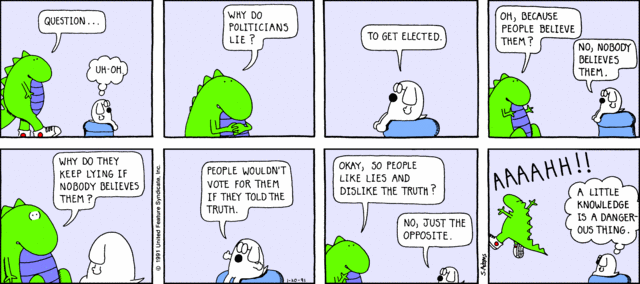
It works. God how it works. The idiots at large (please don’t be offended, I use idiots in the same way Dilbert would) just love it. Now they also have a mantra to repeat while Joseph shoots tautologies at them like there’s no tomorrow. “Uliedna …. Taghna Lkoll”, “Il-Bzulija… Taghna Lkoll”, “Il-Haddiema… Taghna Lkoll”. You’d only wish you had the time and the sort of financing parties get and you could attend one of these meetings with a huge sign – and just when Joseph is getting all het up again in his ill-fitting suit standing on the podium you could lift a board of your own… with just three letters: WTF.

1844.strip

He’s gone to Lija this morning. At Transfiguration Avenue (how apt) or Belvedere (how not) he linked his next step to the 1919 assemblies of those audacious forefathers of ours busy fighting for self-government and a constitution. You see he had the setting in mind and he needed a grand achievement of the past as a background to make whatever he wanted to say sound as pompously grand. Then he let loose. He spoke of a Second Republic (given this was Transfiguration Avenue it’s a surprise it was not a second coming). He was giving us his own idea of a metamorphosis. He’s obliterated Labour and it’s history (which was not a bad idea if you needed to change it) but has given us this new “movement” that is all emptiness and nothing. It’s only redeeming factor for most idiots (that’s us again) is that by voting for this mess we will get rid of the other mess that has been in government “too long” as they say.

What was this second republic? He wants a Convention so that people other than politicians could take part in drafting what will probably be a Kostituzzjoni Taghna Lkoll. Given his party’s track record on piecing together a recognisable plan or document I should be forgiven if I don’t hold my breath. Joseph must have been inspired by the EU’s Constitutional Convention which met around the time he was rabidly and vociferously explaining to all why the EU was nothing less than the result of an infelix coniunctio of the spawn of satan. Now he claims that he wants a Convention to make the Constitution a European (not post-colonial) constitution.

The pillars of the second republic? Electoral reform – this from the party that has contrived (together with the bunch of macchiavellian populists across the parliament floor)  to engage in all forms of filibustering techniques à-la-maltaise to block any form of sensible change: from electoral reform to party financing. And if you believe the electoral calls for this kind of laws then I’m sorry you qualify for Prime Idiot (that’s a new award here at J’accuse).

Next pillar: neutrality. Labour is still struggling with this one. It’s all the heritage of Mintoff’s dearest insistence. We have found ways to go around it though there would be no harm in redefining this obsolete clause – not exactly Second Republic groundbreaking material.

Then Joseph went all Orwellian. He probably sat up watching the sad show that was Bondi+ yesterday and when for the umpteenth time Lou could not hide his blatant partiality Joseph must have done what he always does: Spontaneous Bullshit Idea Generation. I know what we’ll do…. we’ll push for more regulation and entrench it in the constitution. The new constitution will strengthen the Broadcasting Authority by making it responsible for ALL media. We’ll then get the phenomenal rules inspired by idiot numbing exercises applied across the board.

That’s his Second Republic then. Cosmetic touch ups of electoral reform, a little tweaking of the neutrality clause and of course back to an Orwellian nightmare tightening controls  on freedom of expression. But so long as it is government by the idiot-elected, for the idiot-electors then it should be ok.

What Joseph Muscat’s sad intervention on Transfiguration Avenue ignored is that in order for our nation to really enter a Second Republic what is really needed is a tabula rasa – the stranglehold of the PL and PN on politics and how we do it must be broken. The prelude to a second republic would be the dismantling of the two parties or the breaking of the bipartisan mold with the election of a more representative democracy.

In our dreams. Il-Holma Taghna Lkoll.

30525.strip.sunday

Ex post – Elephants and the constitution

A couple of days back (28th November) I had uploaded a post discussing “the elephant in the room” that would be so conspicuous during the budget debate. The elephant in question is of course Franco Debono’s not too veiled threat to vote against the budget and thus bring about the end of GonziPN’s term in office. Having seen his last hopes of reconciliation fritter away with Simon Busuttil’s volte face on the matter Franco has been in Armageddon mode ever since.

One of the arguments I made in that post referred to the position(s) taken by Joseph Muscat – and this was before his jaw-dropping post-budget assertion that Labour is the best party to put Tonio Fenech’s budget into practice. Muscat’s appropriation of the PN government’s financial plans was to me the final straw that definitely ruled out any vote for Labour (not that there was much hope there but I had left an open door waiting for a very, very convincing argument in that respect – needless to say that argument never turned up). Muscat’s actual position on the budget notwithstanding I had stated:

If Muscat were half the statesman he wishes to be then he would be operating differently. The interest of governance and governability would trump his greed for getting into government. He should not be reinforcing Franco Debono and that parliamentarian’s hara-kiri. At the end of the day the election is months away in any case – budget or no budget. Muscat could use this opportunity to pull the carpet from under Franco’s legs and be in command of his own party’s destiny. His best move would be to instruct two or more of his MPs (how many are necessary) to abstain in the budget vote. The budget would pass, without the vote of labour who would go on record as having voted against.

As far as I know (and I’m not particularly keen on this calling dibs business) this was the first time that this theoretical approach was mentioned in the media (printed or otherwise). Last night though a “Guest Post” was up on the Runs discussing the very idea though it was presented as “A rather bizarre rumour is doing the rounds.” The abstention, according to the rumour, would no longer be from one or two of Muscat’s MPs but Joseph Muscat himself. Guestposterontheruns proceeded to rubbish the idea:

Should this scenario come to pass, Labour would once again show that it has turned inconsistency and lack of principle into an art. How can a prospective prime minister and party leader vote one way while his entire party vote for its antithesis on what is essentially a vote of confidence in this government? How can the entire Opposition vote to bring down the government while its leader votes to keep it in place? How can the party leader himself vote against the party whip?

The anonymous writer – presumably fearful of showing her name lest she loses her day job for having an opinion (you know given these oppressive times we live in) – goes on to explain that “Unlike the case of divorce, a budgetary vote is not, and cannot be, a matter of conscience. There is no free vote on the matter and there cannot be, under any circumstance.” Which might make for quite a convincing argument. In a vacuum. All other things being equal (as Labourites apparently tend to think).

What guestposterontheruns fails to notice is the constitutional underpinning of the original theoretical scenario. While it may be argued that the value of the budgetary vote is a political vote that is not tied to conscience or free votes, its value is grounded in the fact that a budgetary vote is also an implied vote of confidence in government. A budgetary vote therefore is all about the stability of government and governance.

Should Joseph Muscat take up the J’accuse suggestion and use his vote in order to undermine Franco Debono’s efforts to vote against the budget irrespective of its content then Muscat would be acting in order to guarantee the very principle of governmental stability that underpins our constitutional provisions. The message and precedent set would be of extreme importance, not just for the government of the day (whose days are counted anyway) but also for future governments and their MPs. A renegade MP linking a budgetary vote to a personal issue (Austin Gatt) will not be seconded in his actions by the opposition.

This point is valid irrespectively of the inherent contradiction of the Labour party’s political position on the budget itself (we like it, we adopt it but we will vote against it). The arguments made by guestposterontheruns are short-sighted in that they tackle Muscat as the Labour leader within the current electoral campaign and scenario. The theoretical scenario I originally posted is neutral of current events and could be applied to any future scenario where a renegade MP abuses of his position.

That is what the “statesman” business is all about. Constitutionally, the need to establish a clear precedent for our two-party system and that states that renegade MP shenanigans will not be seconded in order to cause unnecessary instability, trumps by far the usual customary rules with regard to budgetary votes (whip, free vote etc).

The “rumour” might after all not turn out to be true (or simply sourced from a careful reader of this blog). I also have my doubts about how much Muscat and his team would understand the true value of the strategy I outlined. Even in short-term political terms it would be quite a winner for Labour. To be seen as not wanting power at all costs, to pull the carpet from under Franco’s feet and to simply wait a few more months (two?) for the government to run its natural course would be a boost for a party still reeling from its mishandling of the early post-budget.

I suspect that the very fact of the danger that Muscat might actually contemplate such a scenario that runs havoc with the PNs electoral plans is what must have prompted guestposterontheruns  to write about the “rumour” in the first place. Always if the rumour turns out to be true, that is.