OLAF & Caesar’s Wife

I’ll try to to be brief on this one and avoid excessive legalisms. Yesterday, the European Anti-Fraud Office (affectionately known as OLAF) deemed it necessary to issue “a statement in order to clarify comments contained in media reports”. Allowing sufficient leeway for the dangers of inevitable multi-lingual approaches in European matters, the press statement of an “independent wing” of the Commission probably raises more questions than provides answers.

In the first instance it is interesting to see a prosecution unit that remains so pro-active within the media spheres. In a way we can understand the concern since more often than not nowadays a large part of justice matters are dealt with in the public communication spheres long before the real questions are decided in the courts of law. There was however more than a hint of anxiety and patching up in this (I presume) carefully worded missive and maybe, just maybe, we can identify the reasons for the caution.

For the first time we have a clearer indication of what the OLAF report contains with regard to both Silvio Zammit (OLAF still insists on calling him a Maltese entrepreneur) and to Commissioner Dalli. Let’s take a look at the first paragraphs of the release:

The Evidence

The OLAF investigation found evidence that a Maltese entrepreneur, who had organised meetings between Commissioner DALLI and representatives and lobbyists of snus producers, repeatedly requested a considerable sum of money from the snus industry in exchange for the adoption of a proposal for the lifting of the ban on snus, trading on the name of the Commissioner. This request was declined by the snus industry and no payment or financial transactions have taken place.

The OLAF investigation found no conclusive evidence of the direct participation of Commissioner DALLI in the operation for requesting money. In line with Regulation 1073/99, OLAF has referred the case to the competent Maltese judicial authorities, for their consideration of the criminal aspects of the actions of the persons involved.

So we have here a clear delineation of the proof that OLAF has managed to unearth. We now know for certain that Silvio Zammit’s involvement was clear and proven. The involvement includes “repeated requests for a considerable sum of money”, a clear indication that Zammit promised in exchange that their proposal for lifting the ban would be adopted and that Zammit did so in the name of the Commissioner. We also know that Swedish Match declined the request and never transferred any money.

We also know that OLAF found NO CONCLUSIVE EVIDENCE of the direct participation of Dalli in the operation for requesting money. Significantly, quite significantly I would add, OLAF’s statement then states that this case was referred to the Attorney General “for consideration of the criminal aspects of the actions of the persons involved”.

Do note that the bit relating to the “circumstantial pieces of evidence” comes later. Unless this is a result of a bad case of press release drafting by OLAF’s PR people then we have something to dwell upon. More importantly AG Peter Grech has something less to dwell upon. The provisions of our law relating to Dalligate would be the Criminal Code chapters on Abuse of Public Authority (112 et seq. with particular consideration of 115, 121(4)(c), and 121A as well as Cap 326 – the Permanent Commission against corruption act. It would also seem that Silvio Zammit’s activities as described would be sanctionable under the relevant provisions. It remains to be seen how much the proof that is now in the AG’s possession can be used to inculpate John Dalli criminally.

Parallels may be drawn to the Arrigo/Vella cases of late and in particular to the notion of knowledge of corrupt offers. At this stage our assessment cannot be more than presumptive given the lack of information about what links John Dalli damningly to Zammit’s activities. So while we can safely say that on the basis of OLAF’s declarations a strong case has been built against Zammit (and I would  add that on the basis of certain emails even Swedish Match might be liable to at least some investigation so long as it could have gone along with the auction), we have little or no certainty about Dalli’s criminal involvement.

This makes even more sense when we look at the next paragraph in OLAF’s statement:

OLAF has also concluded that there are a number of unambiguous circumstantial pieces of evidence gathered in the course of the investigation, indicating that Commissioner DALLI was aware of the activities of the Maltese entrepreneur and of the fact that this person was using the Commissioner’s name and position to gain financial advantages. OLAF found that Commissioner DALLI had taken no action to prevent or dissociate himself from the facts or to report the circumstances. In line with Regulation 1073/99, OLAF referred the case to the President of the Commission, for his consideration in light of the provisions laid down by the“Code of Conduct for the Commissioners”, C (2011) 2094.

What stuck out for me is the fact that after outlining this next set of facts OLAF explains how it referred them to someone distinct from the person who was at the receiving end of the first set of facts. In the case of the circumstantial evidence showing that Dalli was aware of Zammit’s activities OLAF specifies that these were referred to the President of the Commission for his consideration in the light of the provisions of the Code of Conduct for the Commissioners. I find this disconcerting to say the least. On the one hand I can understand that circumstantial evidence might be sufficient to prove a violation of a code of conduct but irrelevant in criminal proceedings but would that not be a call for Malta’s AG to make?

On the other hand it would explain Barroso’s swift action to oblige Dalli to relinquish his post. If Dalli will forgive me the female reference “Caesar’s wife must be above suspicion” and that means that Barroso might not require anything more than circumstantial evidence in order to rid himself of an uncomfortable commissioner. OLAF might have realised that this circumstantial evidence would not hold water other than within the confines of a strictly applied code of conduct – and opted to separate the two issues.

Repercussions

It is important to stress that my above analysis is based on a press release and just a press release. Be that as it may and given the original enigmatic responses of Mr Kessler this might be a good reading of the modus operandi in OLAF’s case.

On an EU level the level of evidence required to prove that a Commissioner is blemished  is low. That may be because the Commission cannot afford to make mistakes. Before we heard of the amounts involved (€60m) a large number of journalists were still wondering what Dalli did wrong. Dalli might have had a chinese wall between himself and Zammit but the circumstantial evidence was enough for him to be considered to have stepped on the wrong side of the Commission Code of Conduct.

There is however a remote possibility (but still a possibility) that the AG’s conclusions might turn out to be surprising. Zammit seems to have no hope in hell of getting out of this. He’ll probably get the book thrown at him and more. His actions (if proven as OLAF seems to have proven them) make him fall foul of most of the provisions in the Criminal Code. Dalli? Now that all depends on the links that the AG can create based on the evidence before him. Will the proof that he was aware of Zammit’s activities be substantial? Will it suffice? The Arrigo/Vella cases might have some answers already but there might be more than that required here. It’s an open question but it might also be time for us to consider the scenario where John Dalli is not found to have committed any crime under Maltese law. The faeces might still be about to hit the rotating cooling device.

It may be far fetched but it is, as I say, a remote possibility.


Dalligate avec du recul – (Part II – Regrets they have a few)

The day Dalli resigned from the Commission (or was forced to resign if you prefer) I got a call from Malta. “They’ve just mentioned his resignation on RTK. Is he preparing for the election too?” You couldn’t fault this way of thinking if you wanted to. A man had just resigned from probably one of the highest posts within the European Union and the first thought that probably sprung to the mind of many Maltese was in relation to the forthcoming national elections. Will Dalli be back like a latter-day Schwarzenegger? Slowly, as events unfolded it became more and more clear that Dalli was out through no choice of his own but this did not assuage the thirst for Melito-centric interpretations of the goings-on.

Again, we were still in “hazy-fact” land when the tribal delineations began to take shape. It wasn’t hard to second-guess really though in some cases the conclusions drawn could be surprising. Dalli was the man kicked upstairs by the nationalist party to what he seemed to uncannily consider his “Siberia”. His rather frequent raids into the Maltese political scene were at best described as indecorous (for a Commissioner) and at worst clumsy. Three issues stick out like an ugly wart on a halloween mask: (1) first there was the questionable business in relation to energy and SARGAS (in apparent partnership with a future labour government), (2) then there was his intervention as a witness for Jeffrey Pullicino Orlando in the little farce court held at Dar Centrali, and finally, on a rather different (and perhaps more crucial level) was (3) his baffling intervention during the Libyan Spring that had Barroso fuming at the collar.

Dalli had definitely positioned himself firmly away from the “ungrateful” (in Franco Debono terminology) PN constellation and was busy cosying up to the rebels on the one hand and the opposition on the other. He could have let this all go by and concentrated on fulfilling a prosperous term as Commissioner. This would have done his CV a load of good, even in Melito-centric Malta, and who knows whether by the end of his term he would not have preferred pastures new far away from whatever counts for politics on the island these days. We won’t know though, and never will, and one of the reasons is that John Dalli has Silvio Zammit as an acquaintance, probably has him down as a business partner, more probably still as some form of confidant. I insist on the probably at this stage because I prefer to wait for the concrete proof to come out (as always).

So yes. We were saying. Dalli resigned and next thing we knew it was connected to charges of fraud and trading in influence. What happened next was very telling. I’ll try to summarise a few of the positions:

The Greater PN Benefit

I couldn’t really fathom this one, but that’s probably because I try to think in logical order and not through conspiracy theory smoke. Essentially there were varying degrees within this faction but the underlying theme seemed to be one: Dalli’s disgrace is PN’s gain. Funny that. No matter how much acrimony Dalli had shown to the PN in the past months, he remained a Commissioner nominated by the present Prime Minister. A disgraced commissioner is a disgraced nominee for the country. I had immediately blogged on that point  (The Surreal Case of (ex) Commissioner Dalli) and pointed out what seemed to be the obvious, namely that not only was PN’s nominee disgraced but this was compounded by the fact that it was evident to many that this nomination was the result of the party putting its interests before the nation’s.

The We Told You So Brigade

Which brings me to the “we told you so” brigade that numbers among its ranks the heavyweight blogger on the Runs. Daphne was in a way proved right to have pointed out that Dalli was a problem that should never have been exported. With hindsight the nomination of a volatile figure such as Dalli seems counter-productive. The underlying reason for the nomination was very evidently the exportation of an inconvenience (best encapsulated in the phrase “kicked upstairs”) than the result of a search of the most suitable person for the Commission post. In macchiavellian, “The Thick of It” terms, Dalli had already turned into a sort of untouchable outcast politically speaking and by nominating him to the Commissioner’s post this problem would not simply vanish.

The Conspiracy Theory

Inevitably you had the usual suspects hanging on to John Dalli and praying and hoping that this was some weird conspiracy theory by those evil schemers at PN HQ who needed to rid themselves of this evil economist before the actual election run up. Needless to say that if the people in Pietà are really that stupid to hoist a petard under Malta’s reputation abroad simply to get John and his retinue out of the national election equation then really this country is in the pits. You did have what would become the MaltaToday line of journalism (coupled with ONE News and its corollaries) trying hard on the “entrapment” line – nothing to do with Paul Borg Olivier slyly laying an email trap on Silvio but rather the “Evil Tobacco Industry” pulling a smart one like, you know, they do in Hollywood movies. That case remains a weak case – two days on and is fast running dry of ideas. I still have one question in this respect though: What is John Dalli’s level of interest in MaltaToday? I’m not holding my breath for any answers.

So those were the main battle lines. Poor Dalli was doomed in most cases as a nation of sleuths set to work trying to delve deeper into Dalligate. Interestingly the Dalli bomb relegated many many issue to a secondary level. Parliament and its convoluted agenda were momentarily forgotten, no “iggranfat mas-siggu tal-poter” and no calls for early election. Even Joseph Muscat learnt his lesson and announced a “cautious approach” to the matter.

The first indication of the transmogrification of Dalligate into electoral spin came, unsurprisingly from the nationalist corner of the ring. It was inevitable because Labour were still reeling from the obvious problem of guilt by association. For too long now had they courted the disgruntled Dalli and, worse still, they had often hinted that part of their energy plan involved Mr Dalli and his Nordic contacts (oh sweet irony of ironies). The Nationalist party should have been reeling too. As I explained earlier they were the nominating party for BOTH persons involved in the scandal. A Nationalist Commissioner and a Nationalist Deputy Mayor hailing from that great college of upright councillors that is Sliema. So in the first place we got silence. A whole bloody wall of it.

Which left space for the usual noisy bunch. The first indication of a plan, a suggestion, for making use of Dalligate to PN’s advantage came from Daphne Caruana Galizia on her Thursday column. The plan was the tried and tested “guilt by association” and was built very much on what Labour probably feared the moment Dalli’s resignation came out. It was simple really – Dalli, thanks to his recent dealings and appearances was not really a nationalist Commissioner. No siree, Dalli was to be slammed with the worst label in the nationalist political book: he was “Labour”. It’s just like the Franco treatment of late. You know “he deserves to be with Joseph’s skip, dak Mintoffjan”. The equation worked out the logical leaps for you. Dalli is Labour. Dalli worked with Labour. Dalli’s plans for a future Labour government make him even more Labour. So Dalli’s resignation is tantamount to a full blown Labour loss.

Which is in part true and reasonable. From a Maltese point of view and if you were to ignore all the happenings at Commission level (and the fact that the offer, the bribe and the report relate to many things but to nothing Labour) the recent appearances by Commissioner Dalli made him in the least a “non-nationalist” and at the most someone who comfortably beds with Labour. The script was there for all to see and the Runs made sure that regular postings reminding us of Dalli’s recent supposed ills reinforced this theory. Little surprise therefore that after a trip to Brussels for the latest information Malta’s avant-garde investigative journalist returned to produce a programme sans-guests that seemed to have been ghost written by Daphne Caruana Galizia. I needed more than one ‘kerchief to stop the tears from flowing when Lou spoke of his “witnesses” who could place Dalli and Silvio at Peppis between March and May. Really Lou? Your “eyewitnesses”? Pity Daffers blogged about them first.

Slamming Dalli and slamming Labour might be convenient but it misses one major participant. It depends on Lawrence Gonzi admitting that his nominating John Dalli as Commissioner was with hindsight an error of judgement. You see, no matter how pro-Labour Dalli’s slant had begun there is no denying that he was in Brussels (with Silvio) thanks to the kicking upstairs by our PM. It would seem that the pitch by the DCG-Bondi duo was not to be taken up by Lawrence Gonzi:

Prime Minister Lawrence Gonzi vehemently refused to pass any comments on Commissioner John Dalli’s resignation but said he is not sorry he took the decision to appoint him Commissioner instead of Joe Borg in 2010. Asked to give his reaction on the negative impact on Malta’s image due to Mr Dalli’s resignation, the Prime Minister only said that he did not want to pass judgement. (…) Asked whether, with hindsight, it was a mistake to appoint John Dalli  Commissioner, Dr Gonzi defended his decision and said he was not sorry for his decision. (Times)

There you go. No regrets. Which means that the prodigal son was not refuted. Once again I agree with Daphne and believe that this is a statement that Dr Gonzi might come to regret – even on a purely political level. Our Prime Minister has other pressing issues in mind though – first among which is the nomination of a new commissioner.

The New Commissioner

First of all let us simply agree that Labour’s calls for a “consensus commissioner” are ridiculous at this stage. They come from the same school of constitutional law as Franco Debono’s or Robert Musumeci’s. The interesting bit is that notwithstanding the fact that the PN might have learnt its lesson about putting the party’s interests before the nation it might find itself in the unenviable position of being unable to do otherwise.

Why? Simple. Whoever gets sent to Brussels is almost definitely out of the running for next election. Not to mention that whoever goes to Brussels is also out of campaign planning. The most suitable candidate has been tainted by the kangaroo court parliament show. Yes, I’m speaking of Ambassador (emeritus) Richard Cachia Caruana. Should Lawrence Gonzi nominate him as Commissioner (a post he is undoubtedly suited to perform) this would be the end of the nationalist campaign and the opening of an unassailable gap in the polls. Worse still, Cachia Caruana is a crucial behind the scenes participant in PN electoral planning and it would be hard to replace such a player at this stage.

Other suitable candidates from among the party giants could also be considered a “waste” in party terms. A Chris Said or a De Marco for example would be an unhappy wastage for the PN. You could consider an outgoing politician but do you really imagine Austin Gatt in Brussels? The good thing is that he would take Delia with him. Or maybe not. Michael Frendo? Tonio Borg? Possibly. Definitely not Simon Busuttil – too many votes to be lost with him away though again his would be a perfect fit. Which leaves us with the least controversial option. Louis Galea, currently sitting at the Court of Auditors, would slide into the job without so much as a whimper. He’s already been assessed for the suitability of holding a high profile EU post, is already up to date with EU institutional workings and hey, he’s a smart politician, which is not so common these days. In a way Galea’s nomination would lessen the impact of what would otherwise be a case of PN priorities trumping national priorities.

Preliminary Conclusions

It’s a tough call and there’s much more to write but this post is already too long for my liking. (A call back to the days of my Indy columns). There’s much more to mull about but one thing is for certain… Dalligate is not short of repercussions on the Maltese side of the scandal.


Dalligate avec du recul (Intermezzo – European Update)

What was the nickname that Labour had for (then) Minister Dalli a while back? Johnny Cash no? This was back in the time when Dalli was a successful nationalist party heavyweight who imported the much maligned Value Added Tax and bulldozed budget after budget until Sant’s government and CET came along. That was a good 17 years ago. My oh my does time fly when you’re having fun and people do change. Dalli is far from being a nationalist party heavyweight now and this latest fall from grace will seriously test his quality as a political cat of nine lives.

Part one of this post looked at the European dimension of Dalligate – particularly the effect it has on the lobby industry and on the institutional set-up of the EU. Today’s developments deserve a little addendum before turning to the other side of the Dalligate equation that deals with matters closer to Qormi. So here is our intermezzo before part two.

An Intermezzo European Update

The Swedish paper Aftonbladet seems to have reliable information that Silvio Zammit’s price tag in order to influence new tobacco legislation in favour of “snus” was €60 million. That’s right, go make some tea… I’m here waiting with the rest of the story.

Does this change much of what we already had from the OLAF briefings and Dalli press statements? Well, yes and no. We somehow already had the feeling that Silvio Zammit was the one who initiated the contact with ESTOC (remember the RE: business in the email – the one you read here first and then read elsewhere a day later?). We now have a figure to go along with the proposal. Silvio Zammit, purportedly acting for and on behalf of Commissioner Dalli asked for 60€ in order to influence EU legislation.

Now here’s the thing. I have no problem in believing the Swedes on this – they are after all Lutherans and Lutherans never lie. They would have no interest in lying because the documents to corroborate this are in the hands of Malta’s AG and in the hands of Mr Kessler (OLAF Chief). One fact does not everything prove though. You see the problem is that Silvio Zammit emerges from this story as a cowboy  amateur lobbyist (see Noel Grima on how Silvio is nowhere to be seen in the official lobby list). What he is offering is for one Commissioner – Mr Dalli – to actually influence a huge package of EU legislation.

Liars they are not (the Swedes) but stupid? Did they really believe that this vendor of fried date pastries could actually deliver the goods he was promising? It’s not like the Commissioner sits in a tiny room at the Berlaymont and cuts and pastes directives to his (or his lobbyists’ liking). Even if Zammit had obtained the go-ahead (and if Dalli were in on it) it would have been a Herculean task for the duo to convince a long line of obstacles: their own Directorate-General, other Directorate Generals during inter-service consultation for starters and later on down the line the European Parliament and the European Council when voting on the final format.

So if Zammit DID make the offer (and it is looking increasingly likely that he did) then it makes him a very, very naive go-between (I hestitate to call him a lobbyist). You never make a deal that you cannot deliver. We still have no conclusive proof that John Dalli sanctioned the offer (or even that he was aware of it) beyond OLAF’s claims of circumstantial evidence. So much for fools rushing in.

On a European level an offer such as Zammit’s would be manna for a company like Swedish Match that was at the wrong end of Tobacco consultations. Prospects did not seem to be too bright for any pro-snus legislation so their coming into possession of this bungling offer from what turns out to be a naive go-between was a blessing. This is what I meant when I wrote that the Zammit-Dalli tandem (if and when the lien is proven) could have inadvertently left too wide a door open for a lobby group to take advantage. Anybody in Swedish Match’s position would have done the same.

They did not just have one reason to do so… Zammit gave them sixty million.


Dalligate… avec du recul – part I (European Lobbying)

I did say yesterday that the (ex) Commissioner Dalli case smacks of the surreal. With a little less than twenty-four hours time for reflection and with a flurry of statements and press conferences to look at (not to mention the early-worm analysis) we can safely conclude that the case is less surreal and more multi-dimensional.

Strange as it was seeing Lou Bondi among the legion of journalists querying the Commission’s move following the OLAF report, it was a fitting reminder of the (at least) dual dimension of this case. Bondi’s questions (and those of a few other journalists who bothered to research the Malta dimension) represented the Maltese interest in the affair. The TVM talk-show host is undeniably partisan (a “renown fact” some would say) in his approach and this element of partisanship was present in the Brussels Q&A. Even from our point of view, watching the events unfold yesterday we could not resist wearing Maltese partisan glasses – whether you formed part of the “we want Dalli to fail (see we told you so)” brigade or the conspiracy theorist “the evil clique has hit him hard” clan. It is inevitable in our Melito-centric way of thinking: this was happening in Brussels because someone in Malta needed it to happen.

But that is not necessarily the case is it? Here’s why.

European Lobbying after Dalligate

I spoke to a few colleagues who have worked closely within and around the lobbying industry in Brussels. Tucked away as I am in the Grand Duchy of Luxembourg I cannot claim to have first hand experience of lobbying (and thank heavens for that since my work depends on not being influenced by outside lobbying  – it IS a court of law you know). Insider information has therefore been crucial to better understand the works.

First there is the business of lobbying. Commissioners meet companies, associations and lobby groups regularly. It is not a hidden fact. You can actually check out a Commissioner’s agenda for such meetings -they are public knowledge. John Dalli has himself shown that he met most of the Tobacco Industry groups in preparation for his next Tobacco Directive in which he has invested much of his time. The trick here is to try to understand and find out exactly how far the Dalli-Zammit connection took this particular type of contact and lobbying. What the journalists were legitimately querying yesterday (particularly to the enigmatic OLAF chief Kessler) was “where is the wrongdoing”?

Industry experts will tell you that lobbying to meet a Commissioner is legit. That a go-between asks for money to set up a meeting “is neither here nor there”. The no-no bit comes when you “trade in influence”. If I understand this correctly it means that the Commissioner and his entourage don’t only deal with access to the Commissioner but also put a price on “changing legislation itself”. Which is where the whole business of proof remains hazy. Kessler told us that the proof was circumstantial and the OLAF report actually concludes that no legislation was influenced while adding that Dalli was aware of the dealings. The emails – the few that have surfaced (one actually) are neither here nor there. What is holding Dalli/Zammit back from publishing all the correspondence with Swedish Match?

An ex-colleague of mine at the Court, now busy on the lecture circuit blogged about Dalligate and its repercussions. Here is what he has to say about Dalli’s position:

These findings of the OLAF do not seem to prima facie warrant Mr Dalli’s resignation and contribute to make its sudden move appear as an overreaction to the questionable behavior of an individual foreign to his office. However, the language chosen by the Commission to convey the findings of the OLAF report is quite ambiguous and opens to speculation: to what extent Mr Dalli knew that he was the object of lobbying by a member of his Maltese entourage? OLAF seems to suggest that he was actually fully aware of this fact. Did he take any action to limit these lobbying efforts? And more importantly: to what extent Dalli’s behavior, even though a inert one, has been such as to breach the duty of integrity to which he was bound under Article 245 TFEU?

These questions cannot be answered easily and without the appropriate proof. In order to build a case for his defence, John Dalli would have to probably do the following:

  • prove that the draft Directive was not influenced by the smokeless tobacco clan (no legislation effected)
  • publish the full exchange of correspondence with any lobby teams (correspondence made in his name and to which he had access)
  • procure a list of witnesses to any meetings that occured
  • show a list of other companies/associations that he met
  • possibly provide a timeline that could show that Swedish Match’s dealings turned sour after a possible rejection.
Until that happens we must bear in mind that lobby relations in Brussels have now shifted to a new paradigm. Dalligate  will have endless repercussions on the lobbying industry in Brussels, because it will mean that a company/association really has to watch out how to approach any Commissioner, how to word emails and more. Meanwhile, the Commissioners and their staff (thousands of them) will have to revise the conditions for meeting industry reps, something which until now has been done, according to industry practitioners with ease and without any stains.Comparisons are being drawn to the “Cash for Access/Lobbygate” scandal in the UK in 1998. (Incidentally it takes quite a desperate bit of research to rely on the impressions of a Daily Mail blogger to gauge impressions abroad on Dalligate -baksheesh? really? Is 1998 really that far back Synon? Rule Brittania fejn jaqbillhom dawn l-iStricklandjani).
On the face of the information that has been made available until now – and barring any prova regina that might still be hiding in the OLAF report – the Commission (and Dalli) seems to have been an easy target for entrapment by an angry lobbyist combined with the presence of an OLAF that is enthusiastic to prove its worth. Dalli and Zammit might be eventually found to be guilty of over-enthusiastically engaging in “cash for access” dealings (not exactly baksheesh Synon) and thus leaving the door wide open for an industry specialist to work it to its advantage. Alberto Alemanno asks a few questions in this respect:
In these circumstances, the sudden resignation of Mr Dalli is somewhat surprising as it is likely to weaken not only his personal position but also that of the EU Commission. While the EU Commission emerges as the looser of this ‘situation’, the prima facie winner seems instead Swedish Match, one of the leader producer of smokefree tobacco products. One may legitimately wonder what has been the exact role played by the company in the birth of the professional relationship between the Maltese entrepreneur and the company. Was Swedish Match a victim or the creator of such a relationship?

Should it turned out that it has been the latter, the trap that Swedish Match seem to have successfully tended to Mr Dalli could turned out to be counterproductive: the benefit it could gain in messing delaying the preparation of the revised directive might be offset by the negative image it gained in originating this scandal. Should instead turned out that Swedish Match was the innocent victim of a fraud (read its yesterday’s press release), nobody will feel very sorry for a company selling tobacco products and willing to hire somebody who was ready to leverage on his personal relationship to steer the outcome of the policy process.

In any event, this episode, although unfortunate for everyone, has the merit to bring to public attention the limits of today’s tobacco control efforts : the lack of an open, evidence-based and non-ideological debate upon the future of tobacco (including snus). My claim is that should such a debate exist neither Swedish Match nor Commissioner Dalli would have fallen victim of the snus’ trap.

 So to conclude part one. Dalligate issue goes far beyond the preoccupations of our navel-gazing island. An important European institution has been rocked by the scandal – the practices of the lobbying industry are bound to be revised and many questions have cropped up that remain as ye unanswered. Prominent among which is the distinct possibility that a lobby group that is sufficiently motivated and irked by a current Commissioner might find a way to use the EU’s own mechanisms to rid itself of an uncomfortable interlocutor.
If this is the case there is much reviewing left to be done.
* J’accuse would like to thanks the persons who under the veil of anonymity provided relevant insight into the world and workings of lobby-groups in Brussels. The next post will focus on the Malta repercussions of Dalligate – from nominating a new Commissioner, to the effect on an electoral campaign to the suspension of Dalli’s “interference” in local politics.


Emails in context (Snuff)

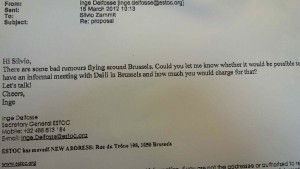
MaltaToday have published a loose email that is obviously part of a wider correspondence between ESTOC (European Smokeless Tobacco Council) and Silvio Zammit. This email would appear to vindicate the assertion that Silvio Zammit was offered money to set up a meeting between ESTOC and John Dalli. the words “would appear” are important here.

The email (see pic below – click to enlarge) is obviously not the first contact between ESTOC and Zammit. Aside from the fact that the ESTOC contact refers to Mr Zammit by name – implying a high level of familiarity, the subject of the email clearly demonstrates that this is a reply in a chain of mails. The subject tag is “Re: Proposal”. So the last email before this was from Silvio Zammit to ESTOC and is called “Proposal”. It is highly unlikely that the subject matter was added in this email since the “re:proposal” bit clashes with the context of the current text. it is more probable that the ESTOC contact (Inge) was using the shorter method of “Reply” in the email.

We do not know what was the content of the previous email (and neither – apparently – do MaltaToday).

There are a few considerations to be made here with regards to the lobby groups and Commissioners. The Belgian channel RTBF described this case as one of “trafic d’influence‘ and it is important to bear in mind that this is the nature of the fraud involved. It is not uncommon for go-betweens to liaise for meetings with Commissioners but it is illegal for Commissioners to sell their powers and discretion to bidders.

The issue at stake here is twofold. Firstly there is the issue of the relationship between Silvio Zammit and a lobby group. What was the offer? Who made it? Who established contact? What was being sold/offered? How much of the Commissioner’s ultimate discretion was being put on the table for “sale”?

The second issue is whether John Dalli knew of these transactions and whether there was an actual possibility that the Commissioner’s discretion be tied/influenced by these monetary offers.

I can see no reason why, if this email is intended to prove that Silvio Zammit was the subject of “baiting” by the Smokeless Tobacco lobby, then the whole correspondence is not being shown. The only plausible answer I have to that is that the original contact was made by Silvio Zammit and that the earlier emails would only show that it was his contact that got the ball rolling. Needless to say, ESTOC might have pounced on the opportunity of throwing a bad light on a Commissioner whose legislative activity and programmes were not very helpful to their cause however they were could have been helped by Zammit’s availability and familiarity.

Gays and bendy buses

Magistrate Peralta’s decision this morning seems to have caused quite a ripple effect in the ether and beyond. What seems to have irked most people is the assertion that the accused in the case in question was justified in feeling provoked by an Australian (drunk) man’s implication that he (the man) was gay. Prominent among the court’s considerations was the fact that the events took place in the village of Mellieha and that it appeared to be “part of the mentality of society there” to feel offended by the insinuation that one was homosexual.

Conclusions are drawn quickly by the public jury but we might be missing the wood for the trees. Magistrate Peralta’s assessment is not that it is ok for people to be provoked whenever there was an insinuation that they were gay. What the Magistrate was bound to do is to assess whether any man in the same circumstances and context was justified in claiming that he felt provoked. It is a sort of “when in Rome standard”. Unfortunately, in such situations, the court is called upon to take a snapshot of our society as it is and work with the tools at hand.

I find it hard to believe that anyone can seriously think that in our country (and not just in Mellieha) the general feeling when someone implies that you are gay is not one of contentment and pride. Last I checked the term “pufta” was not exactly used within the context of lauds and accolades. Which is not to say that I agree with the judgement handed down – I have an absolute aversion for people who hide behind the “I saw red” theory – whatever the provocation they might feel to have suffered. All the derision of Mellieha and its residents can only be extended to all of this sad country of ours that seems to be genuinely shocked whenever one of its warts props up in the mirror.

Speaking of warts, Minister Austin Gatt surely has better things to do than to attempt (feebly) to reply to Boris Johnson (not Johnston) and his bendy bus statements at the Tory conference. To begin with I do not feel that Malta was given pride of place in that comment and was only a postilla to the primary idea that Boris’ mayorship had actually gotten rid of the bendy bus affliction that had littered the London streets like a latter day pestilence. To follow, Gatt and his minions best keep their mouths shut when it comes to anything Arriva, let alone the bendy buses. For heaven’s sake what’s all this nonsense about “mathematical calculations” when we all know of the bendy buses stuck in Mrabat and Mater Dei roundabout?

So what? Johnson’s joke about getting rid of bendy buses was at Malta’s expense. So what, Emmanuel Delia cannot take a jibe lying down so he gets his master’s ministry to type what he must have felt believed to be a witty retort (hoho the Labourites are agreeing with the Tories) and doesn’t even manage to get the Mayor’s surname right. Once again we demonstrate an incapacity to stare the truth of our warts in the face (or warts on our face). Bendy buses suck, Austin (and Manuel) and no amount of attempts at replying to the magnificent stage master that is the Mop of London will change that.

Next time, Austin (or Manuel), if you want to really get the feel of your average Maltese reaction in such situations just write a short telegram to Boris. One word would suffice…

“Pufta”.