The PN does not need saving II

Turning a refusal into an opportunity

Roberta Metsola’s decision not to contest the leadership of the Nationalist Party will disappoint many — and understandably so. Her popularity, international standing, and gravitas would have made her a formidable candidate at a time when the PN is desperate for a resurgence. But sometimes, strength lies not in stepping forward, but in stepping aside.

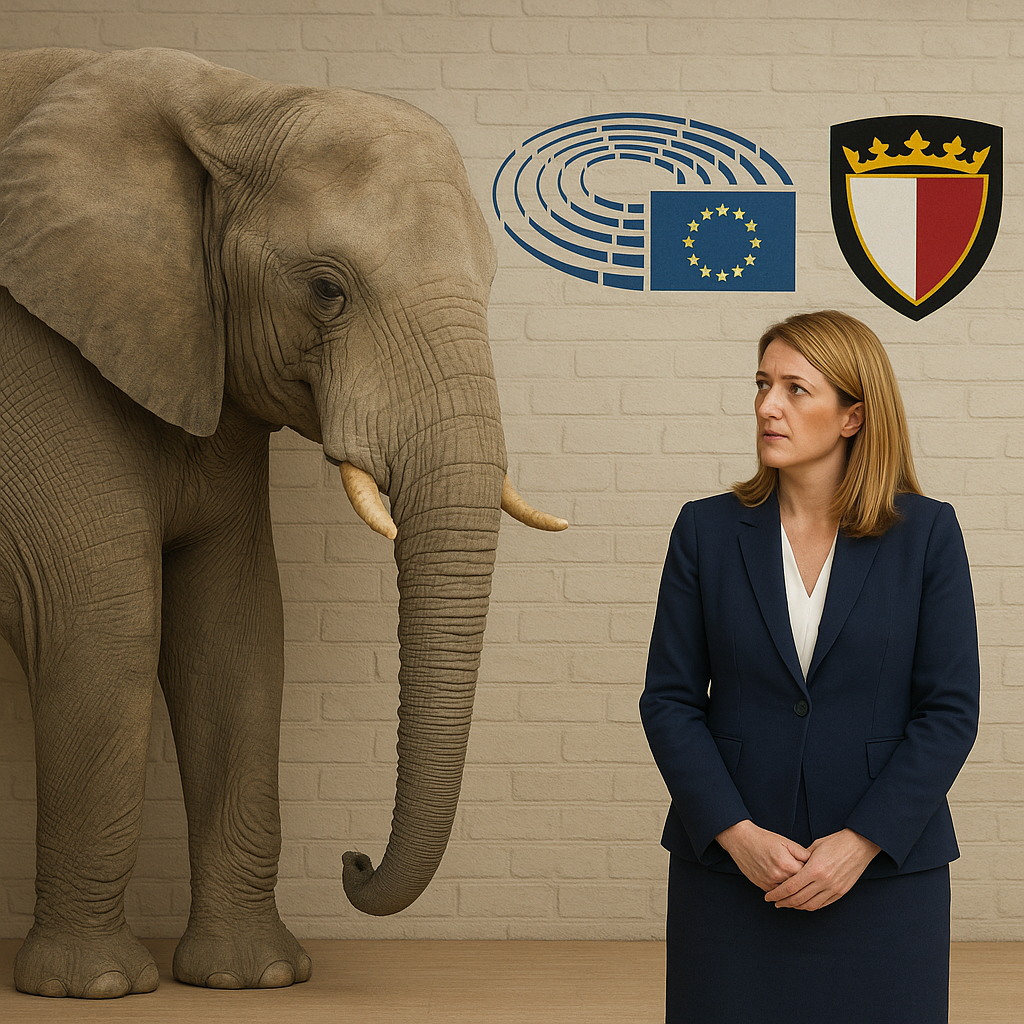
This refusal is no retreat. It is a recalibration. Metsola’s decision clears the air and clarifies the path ahead. The elephant that loomed large in every speculative conversation is no longer in the room. And with that, the PN stands at a true crossroads — finally unshackled from distractions, free to look inward and chart a path forward.

The party’s woes are deep-rooted, but so too is its potential. What it needs now is not a saviour but a leader. Someone who is willing to do the difficult work of reimagining what the PN stands for — and for whom. Metsola’s step back offers this incoming leader something invaluable: a clean slate. There are no albatrosses hanging from their neck, no power struggles in the wings. Just an open field and a nation that is quietly yearning for a real alternative.

Just like Bernard Grech’s resignation, Metsola’s decision strengthens, rather than weakens, the next PN leader. She remains a loyal ally — a Maltese figure at the helm of one of Europe’s most important institutions, whose voice still carries weight both at home and abroad. The next leader of the PN can move forward knowing they have her support, but not her shadow.

Reinvention will not come easy. It will require political courage, humility, and a genuine connection with the people. But more than anything, it will require freedom — freedom from the ghosts of the past, from the paralysis of nostalgia, and from the illusion that electoral success lies in more of the same.

If properly dealt with, Roberta Metsola’s refusal to run is not the closing of a chapter. It is the turning of a page.

The PN does not need saving

When Bernard Grech finally bowed to electoral gravity and quit as leader of the Nationalist Party (PN) this week, the predictable hunt for a saviour began. Within hours social media timelines were aflutter with pleas for European Parliament President Roberta Metsola to return home and “rescue” the party, MPs were trading endorsements, and columnists dusted off familiar laments about the PN’s existential crisis. But Malta’s oldest political movement does not, in fact, need saving. It needs reinvention.

A leadership carousel that goes nowhere

Since 2013 the PN has cycled through three leaders, each initially hailed as the figure who would close the polling gap with Labour. None succeeded. The latest Times of Malta survey in March 2025 still places the party six percentage points behind Robert Abela’s PL—roughly a 18,700 vote deficit. Worse, polls over the past three years consistently show that while Labour bleeds support, the PN fails to capture disillusioned voters . A fresh face at the helm—Metsola or anyone else—will not reverse that trend if the underlying product remains unchanged.

The fallacy of the messiah leader

Treating the leadership vacancy as a superhero casting call mistakes symptoms for causes. Charismatic leadership matters, but it cannot substitute a coherent ethos. As long as the PN defines itself primarily as “not Labour”, it will grapple for identity and bleed relevance. The politics of emergency—switching captains every electoral cycle—erodes public confidence and demoralises activists who crave purpose, not panic.

As long as it continues to think of politics, of itself, of its mission, in terms of the system that created the destructive duopoly we have today. As long as it continues to define its structural template against the background of the sick politics that have brought a nation to its knees. As long as it does this, the PN will remain the empty carcass that it has become. No matter how many ‘saviours’ are heralded into the party on the wings of partisan enthusiasm.

Rediscovering — and reimagining — values

The PN’s greatest victories were won when it offered a compelling national project: EU membership, economic liberalisation, democratic consolidation. Two decades later those milestones are baked into Malta’s status quo. The party now needs a new raison d’être anchored in 21st century challenges: a green and digital economy, affordable housing, integrity in public contracts, and an education system that prepares workers for AI driven industries.

That requires more than a policy facelift. It demands a mindset shift from siege to service, from factional arithmetic to civic partnership. The PN must speak the language of young renters priced off the property ladder, caregivers navigating inflation, and entrepreneurs stifled by red tape. It must be bolder on good governance reform than Labour, more imaginative on climate action than ADPD, and more socially compassionate than its conservative caricature suggests.

A huge caveat also against those who associate the current battle against the regression in the field of rule of law as some kind of albatross holding the PN down. Those who fall for the ‘negativity’ and ‘holier than thou’ spin as though the battle for liberal democracy is for others to make. Failure to understand the basic duty of a party to underline and subscribe to the essential core values of a democracy is another non-starter.

A blueprint for reinvention

1. Open primaries and transparent financing to detoxify internal patronage networks and give every member a stake in decision making.

2. Policy co creation labs that pair MPs with civil society experts, ensuring proposals are evidence driven and citizen tested before they hit the chamber.

3. Digital first outreach that treats TikTok and Twitch as seriously as TVMs nightly news, meeting voters where they actually spend time.

4. Talent pipelines that prioritise competence over surname, bringing technologists, climate scientists and social policy innovators onto the candidate slate.

5. A servant leader culture in which the new chief acts as convener, not proprietor, of the party’s future.

From self preservation to national service

Malta does not need another leadership beauty pageant. It needs a credible opposition capable of converting protest into progress. That mission will not be fulfilled by pleading for somebody—anybody—to “save” the PN. It will be delivered when the party itself stops asking Who will rescue us? and starts asking How can we serve?

Grech’s departure is an opportunity, not an emergency. If the PN uses this interregnum to revolutionise its purpose and methods, the polling numbers will follow. If it opts instead for another superficial reboot, the country will merely witness the latest episode in a long running tragedy—and switch the channel.

Freedom of Expression and Counter Protests

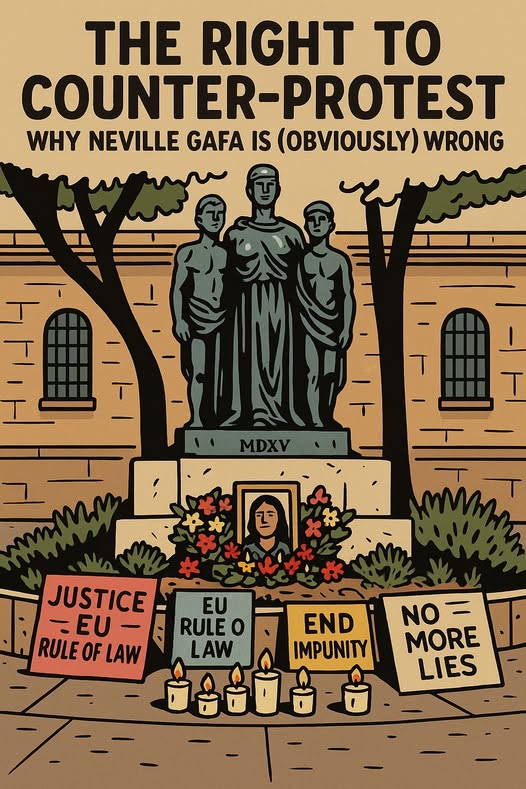
« On day 18 of the trial of those charged with supplying the bomb that killed Daphne Caruana Galizia, as her family sit in court listening to every unbearable detail of the plot, out here in Great Siege Square, lowlife cowards continue to try to destroy Daphne’s memory and our protest for justice. » – Occupy Justice on Facebook

Government stooge Neville Gafa continues his sorry attempt at vilification under the guise of exercising his right to freedom of expression. In his mind, he has every right to clear the Great Siege Monument and add his vilification posters in the stead of the Daphne Memorial. He also has ignored a Court judgment that guaranteed the right of Occupy Justice to have the memorial in its place in the first place.

Is Neville Gafa right though? Does his freedom of expression extend to the right to destroy the memorial ? Does his right to counter-protest trump the original protest? Does it give him a right to destroy the Daphne Memorial on a daily basis?

Short answer. Like f**k it does.

Long answer:

In European democracies, the right to counter-protest is a vital expression of freedom of speech and assembly, protected under Articles 10 and 11 of the European Convention on Human Rights. While much attention is often placed on the rights of those organising a protest, it is equally established in law that individuals and groups have the right to demonstrate in opposition to such gatherings, provided their actions remain peaceful.

This principle has been confirmed in several landmark judgments by the European Court of Human Rights.

A key case in this area is Plattform “Ärzte für das Leben” v Austria, where the Court held that states are not obliged to guarantee protest immunity from all disruption, but must take reasonable steps to ensure peaceful assemblies can take place even in the face of opposition. The Court reaffirmed this in Faber v Hungary, where a man was arrested for holding a flag near a demonstration with opposing views. The Court ruled that the arrest was unjustified, finding that the mere potential for provocation does not justify restricting counter-demonstration rights.

National courts in the UK and across Europe have echoed this approach. In the UK, the Public Order Act allows authorities to impose restrictions on protests, but these must be proportionate and not used to suppress expression simply because it is unpopular or contentious. In Redmond-Bate v DPP, the English courts clarified that the state’s duty is to manage hostile audiences, not silence speakers due to crowd reaction.

The European Court has repeatedly stressed that states must not permit what is known as a “heckler’s veto,” whereby the threat of disruption by counter-protesters becomes a justification for curbing the original protest.

Instead, both sides must be granted space to express their views, and it is the role of the authorities to ensure that pluralism is preserved, not stifled. In polarised societies, this balancing act is challenging but essential. Counter-protests are a legitimate part of public debate, and their protection is fundamental to a democratic order.

So, you can counter-protest. Sure. BUT – And this is a huge but – you CANNOT in any way engage in violent acts on the protest that you are counter-protesting.

Now the removal of the Daphne Memorial is equivalent to an act of physical violence that does not respect the original freedom of expression. Neville Gafa has absolutely no right to do so.

Furthermore it is the duty of the executive authorities to protect the original protest – not just in the light of Judge Zammit McKeon’s judgment but also in the light of basic fundamental rights law as explained above.

The Passport Judgment Aftermath (III)

Facts and Explainers – The Mexit Fantasy

Another reaction popular on social media is the one that advocates showing the middle finger to the meddling EU and actually leaving it. How dare the Europeans dictate citizenship terms to our sovereign nation?

Where to start? A list maybe…

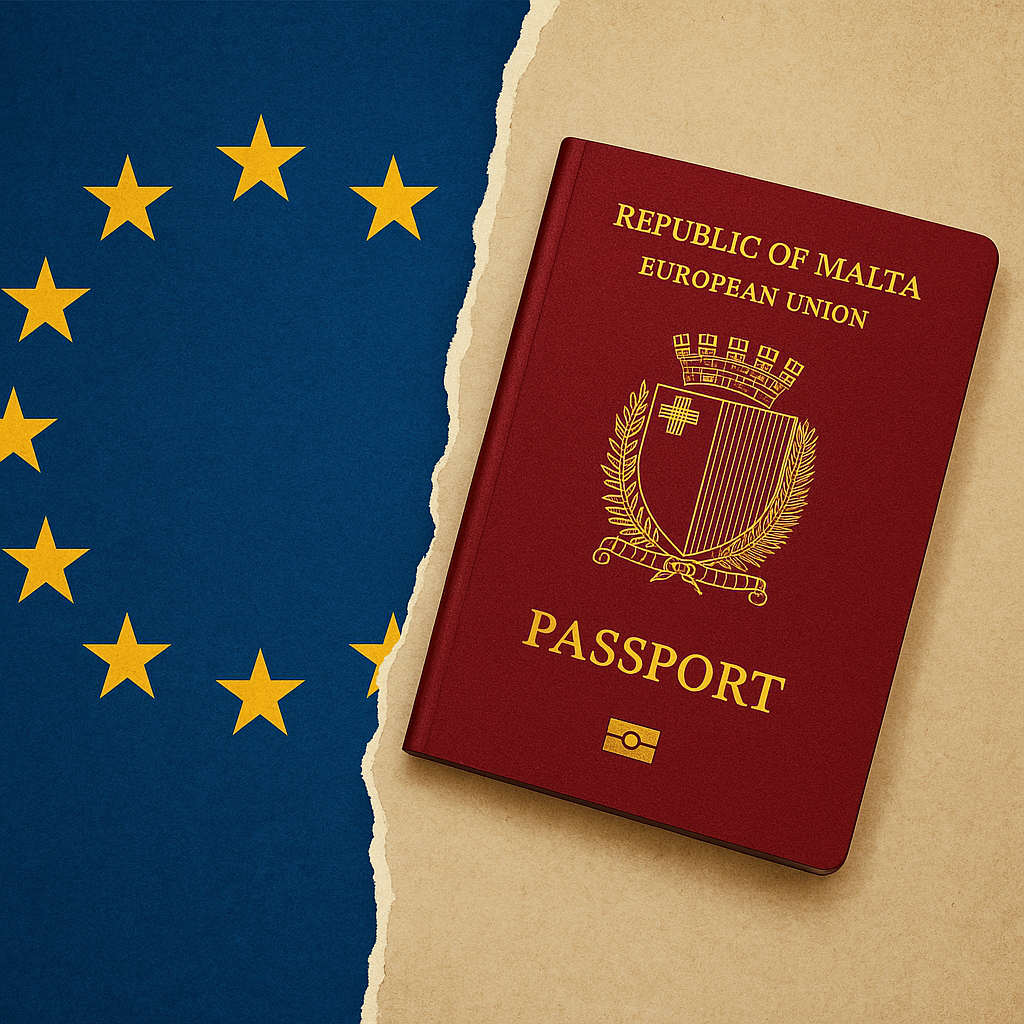
1. The success of the citizenship by investment scheme that generated 1.4 billion euros for Malta depended heavily on the fact that a) Malta was part of the European Union and b) the scheme practically sold (a more coveted) EU citizenship over and above (the Trojan horse) Maltese citizenship. As the Court itself noted in the judgment, agents were actively promoting the scheme as an opportunity to buy your way into the EU and not Malta. Add that to the scarce checks on the creation of any lien to Malta itself other than coughing up the cash and you may begin to understand how an EU-less Malta would not have such a successful scheme. In other words… it worked because of the EU element not in spite of it. Leave the EU and see how many citizens will comply.

2. Ironically, Malta was involved in another landmark case that has much wider implications than just in Malta. In Repubblika, the Court looked into the exercise of another sovereign competence of member states i.e. judicial reform. Repubblika was not the first case in which the Court did so. Article 19 TUE, and more specifically the obligation on Member States to maintain an efficient judicial system guaranteeing access to the EU acquis had allowed the Court to set an EU standard for judicial reforms. Again in layman´s terms: you fiddle around with your judiciary as much as you like BUT the EU will lways make sure that your new set up is not worse than the certified set-up of that was in place when you joined (non-regression principle). Same thing happened this time round with the citizenship scheme. The EU still allows Member States to determine who can become their citizen BUT given the implications on EU Citizenship the conditions for granting such citizenship may be scrutinised.

3. And this is the hardest one to get for the sceptics. It is basically summarised as you cannot have the cake and eat it (or the more expressive maltese “tridha hobbla u tredda”). Membership of the EU brings benefits. Huge benefits for both citizens and the country as a whole. These benefits come with obligations of loyalty to the system. Member States cannot expect to undermine the system while continuing to enjoy the benefits. It is really that simple. It is useless crying wolf every time you are found to have fallen foul of the common rules.

Leave the EU? Mexit? Possibly… consider it but only after you have really weighed the overall losses that will inevitably be incurred. I am quite sure you will think twice before thinking of leaving the EU again.

The Passport Judgment Aftermath (II)

Facts and Explainers

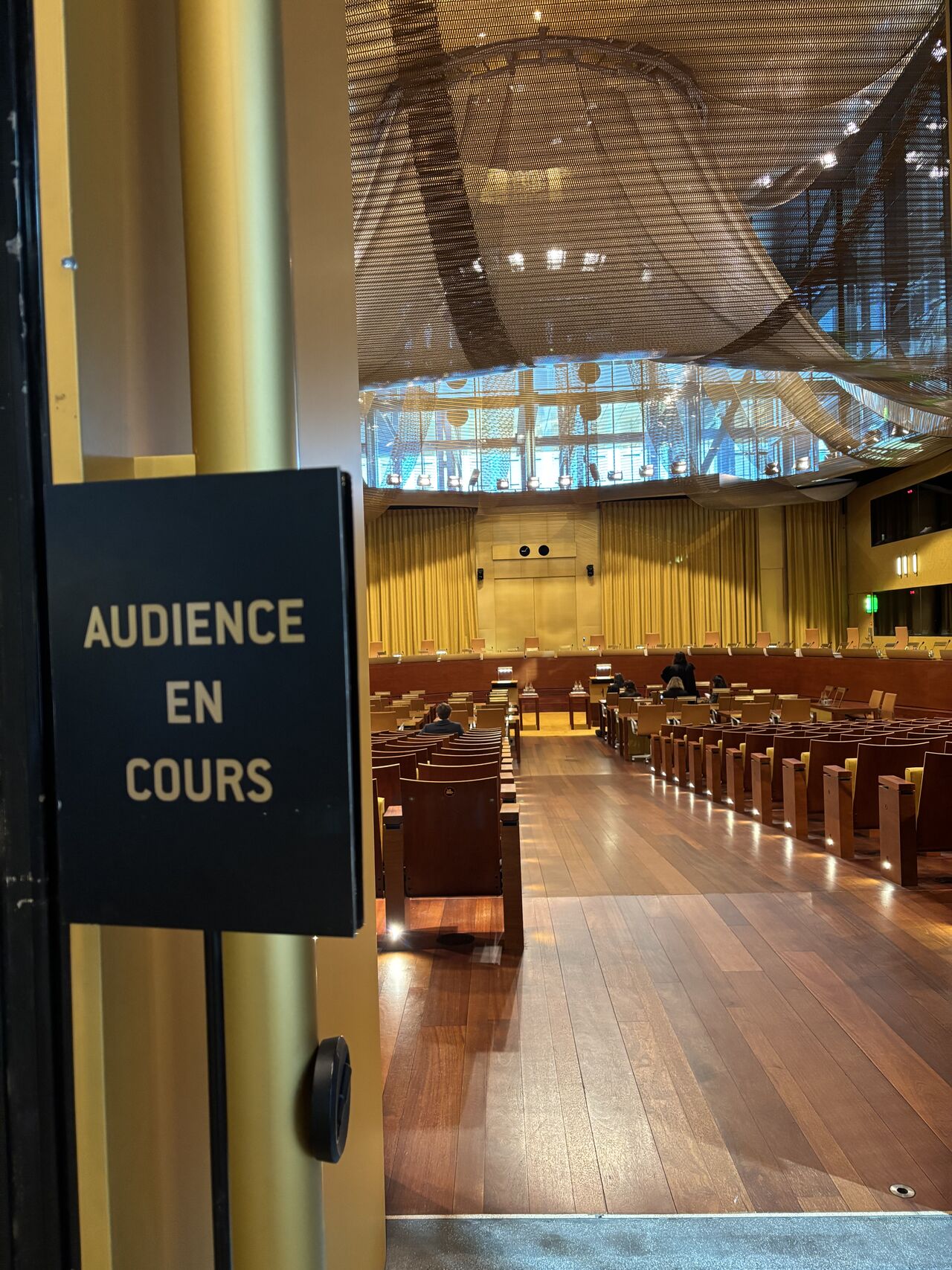
Part of the reaction, or backlash, to today´s judgment includes the incredible assertion that the fact that the solution in the judgment was diametrically opposed to the Advocate General´s Opinion somehow diminished the quality of the judgment.

Such a position displays an ignorance of procedure before the EU Court. The Opinion given by an AG is normally requested by the Court itself and is an opportunity to obtain a detailed analysis of one or more possible solutions to the issue before the Court. It is by its very nature non-binding.

The Advocate General’s Opinion at the Court of Justice of the European Union is followed in about 75–80% of cases. However, the judges are not bound by it, and they diverge in roughly 20–25% of instances. While the Advocate General provides a detailed and independent legal analysis, the final judgment rests solely with the Court, which may adopt, modify, or completely depart from the Opinion depending on its own deliberations.

There have been several high-profile cases where the Court did not follow the Advocate General’s Opinion. In **Google Spain (C-131/12)**, AG Jääskinen opposed a broad “right to be forgotten,” yet the Court recognized it, requiring Google to delist links on request. In **Schrems I (C-362/14)**, AG Bot found flaws in the Safe Harbor agreement but suggested nuanced remedies; the Court instead invalidated Safe Harbor outright.

In **Wightman (C-621/18)**, AG Campos Sánchez-Bordona concluded that the UK could unilaterally revoke Article 50 TEU, and while the Court agreed, it gave more precise conditions for such a revocation. In **Coman (C-673/16)**, AG Wathelet advocated strong residence rights for same-sex spouses across the EU; the Court upheld the outcome but based its judgment narrowly on free movement law rather than broader marriage recognition.

These examples illustrate that while the Advocate General’s Opinions are highly influential, they serve ultimately as a guide rather than a command. The Court of Justice carefully considers them but reaches its own conclusions based on legal interpretation, judicial consensus, and the wider context of European Union law.

The Passport Judgment Aftermath (1)

Facts and Explainers

Here´s an exercise for all the whataboutists active on social media defending Malta´s passport scheme. One of the arguments being bandied around is in fact that other countries still have such schemes. I knew this was not true and that Malta´s was the last one standing till today; but do not take it from me. I asked ChatGPT instead and here is the result….

How many countries in the EU currently have a citizenship by investment scheme?

As of April 2025, no European Union (EU) member state offers a citizenship by investment (CBI) scheme—that is, a program granting immediate citizenship in exchange for a financial investment without substantial residency requirements.​

Malta was the last EU country to operate such a scheme. However, on April 29, 2025, the European Court of Justice ruled that Malta’s “golden passport” program violated EU law by commodifying citizenship and undermining the principles of solidarity and mutual trust among member states. The Court emphasized that granting EU citizenship in exchange for payment undermines the integrity of citizenship, national bonds, and mutual trust among EU member states. Prior to this, Cyprus and Bulgaria had already terminated their CBI schemes following pressure from the European Commission over similar concerns.​

While direct citizenship by investment programs have been discontinued, several EU countries continue to offer residence by investment (RBI) schemes, commonly known as “golden visas.” These programs grant residency rights to investors, which may eventually lead to citizenship through naturalization, subject to residency duration, language proficiency, and integration requirements. Countries such as Portugal, Greece, Spain, and Hungary maintain such RBI programs, though they are under increasing scrutiny and regulatory tightening.