Dalligate avec du recul (Intermezzo – European Update)

What was the nickname that Labour had for (then) Minister Dalli a while back? Johnny Cash no? This was back in the time when Dalli was a successful nationalist party heavyweight who imported the much maligned Value Added Tax and bulldozed budget after budget until Sant’s government and CET came along. That was a good 17 years ago. My oh my does time fly when you’re having fun and people do change. Dalli is far from being a nationalist party heavyweight now and this latest fall from grace will seriously test his quality as a political cat of nine lives.

Part one of this post looked at the European dimension of Dalligate – particularly the effect it has on the lobby industry and on the institutional set-up of the EU. Today’s developments deserve a little addendum before turning to the other side of the Dalligate equation that deals with matters closer to Qormi. So here is our intermezzo before part two.

An Intermezzo European Update

The Swedish paper Aftonbladet seems to have reliable information that Silvio Zammit’s price tag in order to influence new tobacco legislation in favour of “snus” was €60 million. That’s right, go make some tea… I’m here waiting with the rest of the story.

Does this change much of what we already had from the OLAF briefings and Dalli press statements? Well, yes and no. We somehow already had the feeling that Silvio Zammit was the one who initiated the contact with ESTOC (remember the RE: business in the email – the one you read here first and then read elsewhere a day later?). We now have a figure to go along with the proposal. Silvio Zammit, purportedly acting for and on behalf of Commissioner Dalli asked for 60€ in order to influence EU legislation.

Now here’s the thing. I have no problem in believing the Swedes on this – they are after all Lutherans and Lutherans never lie. They would have no interest in lying because the documents to corroborate this are in the hands of Malta’s AG and in the hands of Mr Kessler (OLAF Chief). One fact does not everything prove though. You see the problem is that Silvio Zammit emerges from this story as a cowboy  amateur lobbyist (see Noel Grima on how Silvio is nowhere to be seen in the official lobby list). What he is offering is for one Commissioner – Mr Dalli – to actually influence a huge package of EU legislation.

Liars they are not (the Swedes) but stupid? Did they really believe that this vendor of fried date pastries could actually deliver the goods he was promising? It’s not like the Commissioner sits in a tiny room at the Berlaymont and cuts and pastes directives to his (or his lobbyists’ liking). Even if Zammit had obtained the go-ahead (and if Dalli were in on it) it would have been a Herculean task for the duo to convince a long line of obstacles: their own Directorate-General, other Directorate Generals during inter-service consultation for starters and later on down the line the European Parliament and the European Council when voting on the final format.

So if Zammit DID make the offer (and it is looking increasingly likely that he did) then it makes him a very, very naive go-between (I hestitate to call him a lobbyist). You never make a deal that you cannot deliver. We still have no conclusive proof that John Dalli sanctioned the offer (or even that he was aware of it) beyond OLAF’s claims of circumstantial evidence. So much for fools rushing in.

On a European level an offer such as Zammit’s would be manna for a company like Swedish Match that was at the wrong end of Tobacco consultations. Prospects did not seem to be too bright for any pro-snus legislation so their coming into possession of this bungling offer from what turns out to be a naive go-between was a blessing. This is what I meant when I wrote that the Zammit-Dalli tandem (if and when the lien is proven) could have inadvertently left too wide a door open for a lobby group to take advantage. Anybody in Swedish Match’s position would have done the same.

They did not just have one reason to do so… Zammit gave them sixty million.


Facebook Comments Box

Dalligate… avec du recul – part I (European Lobbying)

I did say yesterday that the (ex) Commissioner Dalli case smacks of the surreal. With a little less than twenty-four hours time for reflection and with a flurry of statements and press conferences to look at (not to mention the early-worm analysis) we can safely conclude that the case is less surreal and more multi-dimensional.

Strange as it was seeing Lou Bondi among the legion of journalists querying the Commission’s move following the OLAF report, it was a fitting reminder of the (at least) dual dimension of this case. Bondi’s questions (and those of a few other journalists who bothered to research the Malta dimension) represented the Maltese interest in the affair. The TVM talk-show host is undeniably partisan (a “renown fact” some would say) in his approach and this element of partisanship was present in the Brussels Q&A. Even from our point of view, watching the events unfold yesterday we could not resist wearing Maltese partisan glasses – whether you formed part of the “we want Dalli to fail (see we told you so)” brigade or the conspiracy theorist “the evil clique has hit him hard” clan. It is inevitable in our Melito-centric way of thinking: this was happening in Brussels because someone in Malta needed it to happen.

But that is not necessarily the case is it? Here’s why.

European Lobbying after Dalligate

I spoke to a few colleagues who have worked closely within and around the lobbying industry in Brussels. Tucked away as I am in the Grand Duchy of Luxembourg I cannot claim to have first hand experience of lobbying (and thank heavens for that since my work depends on not being influenced by outside lobbying  – it IS a court of law you know). Insider information has therefore been crucial to better understand the works.

First there is the business of lobbying. Commissioners meet companies, associations and lobby groups regularly. It is not a hidden fact. You can actually check out a Commissioner’s agenda for such meetings -they are public knowledge. John Dalli has himself shown that he met most of the Tobacco Industry groups in preparation for his next Tobacco Directive in which he has invested much of his time. The trick here is to try to understand and find out exactly how far the Dalli-Zammit connection took this particular type of contact and lobbying. What the journalists were legitimately querying yesterday (particularly to the enigmatic OLAF chief Kessler) was “where is the wrongdoing”?

Industry experts will tell you that lobbying to meet a Commissioner is legit. That a go-between asks for money to set up a meeting “is neither here nor there”. The no-no bit comes when you “trade in influence”. If I understand this correctly it means that the Commissioner and his entourage don’t only deal with access to the Commissioner but also put a price on “changing legislation itself”. Which is where the whole business of proof remains hazy. Kessler told us that the proof was circumstantial and the OLAF report actually concludes that no legislation was influenced while adding that Dalli was aware of the dealings. The emails – the few that have surfaced (one actually) are neither here nor there. What is holding Dalli/Zammit back from publishing all the correspondence with Swedish Match?

An ex-colleague of mine at the Court, now busy on the lecture circuit blogged about Dalligate and its repercussions. Here is what he has to say about Dalli’s position:

These findings of the OLAF do not seem to prima facie warrant Mr Dalli’s resignation and contribute to make its sudden move appear as an overreaction to the questionable behavior of an individual foreign to his office. However, the language chosen by the Commission to convey the findings of the OLAF report is quite ambiguous and opens to speculation: to what extent Mr Dalli knew that he was the object of lobbying by a member of his Maltese entourage? OLAF seems to suggest that he was actually fully aware of this fact. Did he take any action to limit these lobbying efforts? And more importantly: to what extent Dalli’s behavior, even though a inert one, has been such as to breach the duty of integrity to which he was bound under Article 245 TFEU?

These questions cannot be answered easily and without the appropriate proof. In order to build a case for his defence, John Dalli would have to probably do the following:

  • prove that the draft Directive was not influenced by the smokeless tobacco clan (no legislation effected)
  • publish the full exchange of correspondence with any lobby teams (correspondence made in his name and to which he had access)
  • procure a list of witnesses to any meetings that occured
  • show a list of other companies/associations that he met
  • possibly provide a timeline that could show that Swedish Match’s dealings turned sour after a possible rejection.
Until that happens we must bear in mind that lobby relations in Brussels have now shifted to a new paradigm. Dalligate  will have endless repercussions on the lobbying industry in Brussels, because it will mean that a company/association really has to watch out how to approach any Commissioner, how to word emails and more. Meanwhile, the Commissioners and their staff (thousands of them) will have to revise the conditions for meeting industry reps, something which until now has been done, according to industry practitioners with ease and without any stains.Comparisons are being drawn to the “Cash for Access/Lobbygate” scandal in the UK in 1998. (Incidentally it takes quite a desperate bit of research to rely on the impressions of a Daily Mail blogger to gauge impressions abroad on Dalligate -baksheesh? really? Is 1998 really that far back Synon? Rule Brittania fejn jaqbillhom dawn l-iStricklandjani).
On the face of the information that has been made available until now – and barring any prova regina that might still be hiding in the OLAF report – the Commission (and Dalli) seems to have been an easy target for entrapment by an angry lobbyist combined with the presence of an OLAF that is enthusiastic to prove its worth. Dalli and Zammit might be eventually found to be guilty of over-enthusiastically engaging in “cash for access” dealings (not exactly baksheesh Synon) and thus leaving the door wide open for an industry specialist to work it to its advantage. Alberto Alemanno asks a few questions in this respect:
In these circumstances, the sudden resignation of Mr Dalli is somewhat surprising as it is likely to weaken not only his personal position but also that of the EU Commission. While the EU Commission emerges as the looser of this ‘situation’, the prima facie winner seems instead Swedish Match, one of the leader producer of smokefree tobacco products. One may legitimately wonder what has been the exact role played by the company in the birth of the professional relationship between the Maltese entrepreneur and the company. Was Swedish Match a victim or the creator of such a relationship?

Should it turned out that it has been the latter, the trap that Swedish Match seem to have successfully tended to Mr Dalli could turned out to be counterproductive: the benefit it could gain in messing delaying the preparation of the revised directive might be offset by the negative image it gained in originating this scandal. Should instead turned out that Swedish Match was the innocent victim of a fraud (read its yesterday’s press release), nobody will feel very sorry for a company selling tobacco products and willing to hire somebody who was ready to leverage on his personal relationship to steer the outcome of the policy process.

In any event, this episode, although unfortunate for everyone, has the merit to bring to public attention the limits of today’s tobacco control efforts : the lack of an open, evidence-based and non-ideological debate upon the future of tobacco (including snus). My claim is that should such a debate exist neither Swedish Match nor Commissioner Dalli would have fallen victim of the snus’ trap.

 So to conclude part one. Dalligate issue goes far beyond the preoccupations of our navel-gazing island. An important European institution has been rocked by the scandal – the practices of the lobbying industry are bound to be revised and many questions have cropped up that remain as ye unanswered. Prominent among which is the distinct possibility that a lobby group that is sufficiently motivated and irked by a current Commissioner might find a way to use the EU’s own mechanisms to rid itself of an uncomfortable interlocutor.
If this is the case there is much reviewing left to be done.
* J’accuse would like to thanks the persons who under the veil of anonymity provided relevant insight into the world and workings of lobby-groups in Brussels. The next post will focus on the Malta repercussions of Dalligate – from nominating a new Commissioner, to the effect on an electoral campaign to the suspension of Dalli’s “interference” in local politics.


Facebook Comments Box

Emails in context (Snuff)

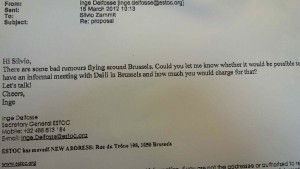
MaltaToday have published a loose email that is obviously part of a wider correspondence between ESTOC (European Smokeless Tobacco Council) and Silvio Zammit. This email would appear to vindicate the assertion that Silvio Zammit was offered money to set up a meeting between ESTOC and John Dalli. the words “would appear” are important here.

The email (see pic below – click to enlarge) is obviously not the first contact between ESTOC and Zammit. Aside from the fact that the ESTOC contact refers to Mr Zammit by name – implying a high level of familiarity, the subject of the email clearly demonstrates that this is a reply in a chain of mails. The subject tag is “Re: Proposal”. So the last email before this was from Silvio Zammit to ESTOC and is called “Proposal”. It is highly unlikely that the subject matter was added in this email since the “re:proposal” bit clashes with the context of the current text. it is more probable that the ESTOC contact (Inge) was using the shorter method of “Reply” in the email.

We do not know what was the content of the previous email (and neither – apparently – do MaltaToday).

There are a few considerations to be made here with regards to the lobby groups and Commissioners. The Belgian channel RTBF described this case as one of “trafic d’influence‘ and it is important to bear in mind that this is the nature of the fraud involved. It is not uncommon for go-betweens to liaise for meetings with Commissioners but it is illegal for Commissioners to sell their powers and discretion to bidders.

The issue at stake here is twofold. Firstly there is the issue of the relationship between Silvio Zammit and a lobby group. What was the offer? Who made it? Who established contact? What was being sold/offered? How much of the Commissioner’s ultimate discretion was being put on the table for “sale”?

The second issue is whether John Dalli knew of these transactions and whether there was an actual possibility that the Commissioner’s discretion be tied/influenced by these monetary offers.

I can see no reason why, if this email is intended to prove that Silvio Zammit was the subject of “baiting” by the Smokeless Tobacco lobby, then the whole correspondence is not being shown. The only plausible answer I have to that is that the original contact was made by Silvio Zammit and that the earlier emails would only show that it was his contact that got the ball rolling. Needless to say, ESTOC might have pounced on the opportunity of throwing a bad light on a Commissioner whose legislative activity and programmes were not very helpful to their cause however they were could have been helped by Zammit’s availability and familiarity.

Facebook Comments Box

The surreal case of (ex) Commissioner Dalli

The next time there is an election for Sliema’s local council don’t expect a long list of potential candidates queueing outside Paul Borg Olivier’s door.  Silvio Zammit (no relation) is the latest PN councillor (and deputy mayor) to resign from his post citing “personal reasons”. Of course, the fact that he is embroiled in the scandal that has rocked the European Commission might be much more than a personal reason but hey… who’s nitpicking here? At the time of writing this post we do not have much to rely upon other than a statement by John Dalli (no surprise there – denial of involvement) and press statements by the Commission shedding light on the results of an OLAF (anti-Fraud office) report into the matter.

The unavailability of any further facts precludes anyone from acting as judge and jury on John Dalli, Silvio Zammit or the OLAF office for all that matters – without facts it is all based on speculation. This does not mean however that the goings-on over the last 24 hours do not merit more than a passing observation since a number of conclusions can be drawn – irrespective of the where the final proof will ultimately take us. Here goes:

1. Malta’s shame – PN’s dishonour

There’s a scandal in the Commission and it involves a Maltese nominated Commissioner. No amount of “boo-ya I told you so” celebrations on the part of some anti-Dalli factions within the PN will compensate for that one. If, as seems to be the general theory, the post of Commissioner was used as a sort of “kicking upstairs” of an inconvenient politician (a policy that seems to make party priorities trump national interest) then it is clear where the responsibility lies. If a one-man show blog could come up with this kind of CV for Dalli we can really see the nomination for Commissioner in perspective.

In comparison to the pie-on-the-face that comes along with a disgraced Commissioner, the  Silvio Zammit bit of the scandal is tantamount to a few crumbs on one’s beard. Be that as it may, it is no insignificant fact that Silvio Zammit was until a few hours ago a PN councillor who ran for elections in a locality on a PN ticket. The mere existence of the emails linking him with the Swedish company suffice to demonstrate that Silvio Zammit is used to an unorthodox way of approaching politics and that is a euphemism. His antics have contributed to adding him to an increasingly long list of ex-PN councillors who fail to understand the basic concept of proper political behaviour. This is a massive fail for the nationalist party – a huge glitch in the system that can only be exacerbated if the right scrutiny is not exercised on future candidates: at both local and national level.

2. Media wars

There was a banal exercise of mental masturbation yesterday as different “media companies” battled for the unenviable prize of having “broken the news” of Dalli’s resignation. I first heard of it via a phone call of a relative of mine who told me that RTK had just included a flash news in the bulletin. I am no authority on “who came first” in this instance though and quite frankly being first to get the news is nowadays much less important since the “scoop” is liable to lose its unique value in minutes if not seconds. What is more important is getting the right news and the right information. Not giving the news a particular slant at an early stage is important (as Natalino Fenech rightly could teach a few elements within the Labour party) .

So what did we know and what did the media tell us? Here’s a list of statements lifted from different media sources with a CONFIRMED OR UNVERIFIED quotient:

  1. 1. John Dalli has resigned from his post of Commissioner – (CONFIRMED) – (ALL NEWS)
  2. His resignation follows an OLAF investigation into alleged fraudulent activities – (CONFIRMED) – (ALL NEWS)
  3. The alleged activities involve contacts between a businessman and acquaintance of John Dalli & a Swedish Tobacco company (CONFIRMED) – (CM RELEASE)
  4. OLAF found conclusive proof of exchanges between this businessman and the Swedish Company. (CONFIRMED) – (REPORTS OF EMAILS & CM RELEASE)
  5. The OLAF report did not find any conclusive evidence of the direct participation of Mr Dalli but did consider that he was aware of these events (CONFIRMED) – (CM RELEASE)
  6. John Dalli categorically denies being aware of these events (CONFIRMED) – (PBS TVHEMM interview)
  7. The OLAF report showed clearly that the European Commission’s decision-making process and the position of the services concerned has not been affected at all by the matters under investigation. (CONFIRMED) – (CM RELEASE)
  8. The corrupt activity involved a Maltese businessman named as Silvio Zammit (TIMES, MALTATODAY, DI-VE – no explanation of how his name is out).
  9. The corrupt activity involved a Maltese entrepreneur who had approached the company using his contacts with Mr Dalli and sought to gain financial advantages in exchange for influence over a possible future legislative proposal on snus. (CONFIRMED – CM RELEASE, OLAF REPORT)

At this point we have to look at an article by MaltaToday that stands out for a particular slant that it gives to the correspondence between Zammit and Swedish Match. All the information gleaned from most sources (and in particular the Commission’s press statement) indicated that Zammit had contacted Swedish Match and that he “sought to gain financial advantages in exchange for influence over a possible future legislative proposal”. Whatever way that is read you get the idea that Zammit contacted Swedish Match and offered to use his confidence with John Dalli in order to influence future Tobacco law. The phrase “sought to gain financial advantage” clearly implies that Zammit offered his services for a fee.

Yet. And this is a bit yet. Maltatoday, having claimed to have seen part or all of the email exchange, titles its article “Silvio Zammit was offered fee to set up meeting with John Dalli – email“. In the article in question we find the following paragraphs:

MaltaToday is informed that Zammit was in contact with Swedish Match over the possibility of influencing John Dalli ahead of a major revision of the Tobacco Products Directive that would have further regulated the access of tobacco to minors and other non-tobacco products like Swedish Match’s snus.

Swedish Match told MaltaToday that had they received an “indecent proposal that was a real and credible offer” by a Maltese businessman who claimed he could influence Dalli on his anti-tobacco legislation.

According to the email between Zammit and Swedish Match, the Nationalist councillor was offered a fee to broker a meeting between the company and John Dalli.

This information does not result from any other publicly available piece of news. MaltaToday is giving a diametrically opposite twist to the events by implying that “according to the email between Zammit and Swedish match”, Silvio Zammit was offered a fee to broker a meeting between the company and John Dalli. So it would seem that rather than sending an email to the Swedish company in which he offered his services in exchange for a fee, Zammit – once contact was established – actually received an offer of a fee to broker the meeting. Which would be rather strange since the Swedish company then proceeded to report the facts to the Commission/OLAF for investigation.

It is in John Dalli’s interests to first and foremost prove that he had no knowledge of the going-on. Insofar as the current situation is concerned that would exclude him from the corrupt activities that allegedly involve the former Sliema PN Councillor. Whether or not the Swedish company or Silvio Zammit was doing the “offering” is irrelevant to John Dalli once he manages to prove that he was extraneous to the whole events.

Meanwhile, MaltaToday would do well to either publish the emails in its possession or rewrite the article in question in order to eliminate any ambiguity. Unless of course ambiguity was the original intention of the article (not that the headline leaves much space to imagination).

3. Conclusions

In this pre-election run up Dalli finds himself once again out of the game. New scandals, new allegations mean that any aspirations he had to join the dagger-fest that is brewing in Pietà must perforce be put on hold. The nationalist party does not come out of this series of events any stronger. Pie on Dalli’s face is pie on Lawrence Gonzi’s nomination for commissioner – a serious post that commands respect (which also puts a huge petard on the ridiculous conspiracy theories involving a nationalist plot to rid themselves of Dalli).

For starters the PN government has to nominate a new commissioner – and if this is to be a valid, face-saving politician it means disqualifying one of the big guns from the forthcoming national election. Tonio Borg is being mentioned and I would not be surprised if Simon Busuttil get a few virtual votes either. Everybody seems to be forgetting about our Ambassador Emeritus at this point – who better to sit wisely on a Commission seat? Labour exponents seem to be fantasticating about “Labour’s right” to nominate the commissioner. Nothing would be more ridiculous. That bright europarliamentarian Joseph Cuschieri has even suggested Alfred Sant – of course, Alfred “Switzerland in the Mediterranean” Sant. As they like to say with so much tongue in cheek in their parts… bir-rispett kollu!

As for Silvio Zammit. Well, he is definitely not the last of the PN circus act (pardon the pun) to have hit a brick wall when it comes to politics. Unless something is done about having a proper school of politicians – not the yes men kind who dwell on the mistaken idea that it is all about power and networking – then we surely have more surprises in the waiting from the nationalist party stables.


******

CM RELEASE – PRESS STATEMENT OF THE EUROPEAN COMMISSION – 16 OCTOBER 2012

Press statement on behalf of the European Commission

Commissioner John Dalli has today announced his resignation as a member of the Commission, with immediate effect.

Mr Dalli informed the President of the European Commission Jose Manuel Barroso of his decision following an investigation by OLAF, the EU’s antifraud office, into a complaint made in May 2012 by the tobacco producer, Swedish Match. The company alleged that a Maltese entrepreneur had used his contacts with Mr Dalli to try to gain financial advantages from the company in return for seeking to influence a possible future legislative proposal on tobacco products, in particular on the EU export ban on snus . As soon as the Commission received the complaint it immediately requested OLAF to investigate.

The OLAF final report was sent to the Commission on 15 October. It found that the Maltese entrepreneur had approached the company using his contacts with Mr Dalli and sought to gain financial advantages in exchange for influence over a possible future legislative proposal on snus. No transaction was concluded between the company and the entrepreneur and no payment was made. The OLAF report did not find any conclusive evidence of the direct participation of Mr Dalli but did consider that he was aware of these events.

The OLAF report showed clearly that the European Commission’s decision making process and the position of the services concerned has not been affected at all by the matters under investigation.

The final OLAF report and its recommendations are being sent by OLAF to the Attorney General of Malta. It will now be for the Maltese judiciary to decide how to follow up.

After the President informed Mr Dalli about the report received from OLAF, Mr Dalli decided to resign in order to be able to defend his reputation and that of the Commission. Mr Dalli categorically rejects these findings.

Mr Barroso has decided that Vice President Maros Sefcovic will take over the portfolio of Mr Dalli on an interim basis until a new Commissioner of Maltese nationality is appointed in accordance with article 246 (2) of the Treaty on the functioning of the European Union.

Mr Giovanni Kessler, Director-General of OLAF will be available in the press room after the midday briefing tomorrow.

Facebook Comments Box

Future views

Until I find time to post about “the issues that aren’t” I’d like to take a quick look (and provocation) at the idea of “the future” that has slipped in among the top hit concepts in Maltese political discourse.

“The future” and its natural antithesis “the past” feature prominently both as the centre-stage of marketing spin as well as the obvious underpinning building blocks behind most arguments. It is of course inevitable that if you are plugging change from a situation of quasi-inertia you will be pushing an agenda that automatically projects you to a future that is (another catch-word) different. This is a key question at this point in time since change and difference are strong selling points once you accept that the current situation just won’t do.

On a superficial level – one that is easily pricked into reaction by billboards that provoke and appeal to the instant idea – being associated with the past is supposed to be an immediate point-killer. You’re stuck in the middle ages, you’re backward or you’ve failed to shed some heavy luggage. Unless of course you manage to retaliate that too much talk of the past implies a misplaced nostalgia or, worse still, a deceptive lie. The bad thing about the past – in marketing terms – is that it lies there like a giant wart for all to see. It has happened. It is a fact. Indisputably so. You can hardly contradict it without engaging on a principled level – without talking politics.

The future? Now that’s something else. Campaigns built on the future appeal on a number of levels. Look at Obama’s hope-filled “Yes we can” campaign. It’s all about what could be done in the future. It builds on aspirations and desire for change. Look closer to home. Sarkozy’s “Ensemble tout est possible” cloned to the PN’s “Flimkien kollox possibli” relied on a promise that working together could make everything possible. That was when the promise was still a future possibility. We’ve seen how that “together” quickly crumbled to an impossibility – that future is now another past, another wart crying out to be analysed.

Joseph Muscat and Labour are trying hard to portray the image of having a project for the future. Their language is replete with concepts such as the famous “road-map“. The Labour party relies heavily on the sale of dreams – a future that is not only unquantifiable but also one that cannot be assessed. The selling of a dream involves simply being careful enough not to step on anyone’s dislikes. It is a combination of band-wagon politics and fence-sitting. The final key to this strategy is the reliance on the electorate’s general disgruntlement with the current band and their apparent inertia. In order to promise everything to everyone Joseph Muscat simply has to sit back and promise nothing. At least not tangibly.

The moment there is the danger of being associated with a fixed idea Muscat will shy away into the clouds of non-commitment or denial. He will return with words about road-maps and consultation. It’s less of a case of leadership with direction and more of a case of blind man’s bluff. The excuse of not being in election campaign is wearing thin. Especially when Muscat’s party has long delivered the judgement that (a) PN is no longer fit to govern and (b) Labour is.

Nationalist futures are worse than bleak at the moment. With a 12 point gap in the polls and a seeming inability to take control of the pre-electoral agenda setting it will take a miracle to get back into a fighting chance at this stage. Much will depend on the PN machine’s ability to bring Labour down to discussing the real and now. If the language of politics is shifted into the present temporal dimension – ignoring the histrionics of back-benchers on the way out and the media circus – then the tired party of government might (might) be back with a fighting chance. This will require stronger displays of clarity of vision, brutally honest introspectives that reflect upon past mistakes and a strong sense of determination that would finally eradicate the deep-seated doubt that has entrenched itself in the popular mindset.

The intangible politics of the future might only be eclipsed with a presentation of the very tangible politics of the present. It’ll be a hard trek but given the alternative scenarios and possibilities it is not only worth a try… it is their duty to do so.

Facebook Comments Box

Election fever

Recent events in the holy of holies that is parliament are beginning to make the Council of Trent seem like a walk in the park. I have already registered my consternation at what seems to have been a missed opportunity by the PN to take the initiative following the summer recess and to finally call the damn election. My observations seem to have found an echo in (of all places) Franco Debono’s latest rant (Gonzi had planned an October election) – and I am not sure whether this is a good thing. It would seem that the initiative was not taken because of a +12% gap at the polls that did not augur well or a snap October/November scrutiny.

Whatever the case may be and no matter how much of my guesswork was actually right I would like to look at another element in this pre-election frenzy and that is the magic BUDGET. I do not have the powers of foresight that the late Spiridione Sant proclaimed to have with much rasputinian fervour and cannot claim to be privy to the content of the forthcoming budget. What I can do is ask a few questions with regard to the budget and how it places itself in an eventual election run.

Some pundits are assuming that a PN budget is planned as some sort of “show and tell” exercise with the electorate. In this scenario, Gonzi and Fenech would present a budget that clearly shows the direction that the PN is taking with the management of the country. Bar any contradictory hiccups (St. Philip’s being the prime candidate for contradictory hiccup material) we would have a budget that doubles as a practical electoral manifesto that would presumably contrast greatly with Muscat’s pie in the sky lists of “ma nindaħlux lill-business” style.

The grand underpinning point in this plan is that Gonzi’s PN knows full well that Franco Debono is bound to hijack the budget and will be lying around in wait like a taliban strapped to his panties with dynamite, semtex and more ready to blow the project to smithereens with his (now openly declared) vote against the budget. The idea here is simple (pace the spinmeisters at Pieta)… a lovely budget that will most likely be endorsed by Brussels (we have to get a nod of sorts because of the concerted austerity plan – there IS a world beyond Joseph and Lawrence) that might even tickle the fancy of the doubters but that gets shot down by the new villain in the story – Master Debono of Għaxaq. Q.E.D.

Now I am no master of the polls and statistics but I do have a legitimate question to ask. What weight are we supposed to give a budget that is very evidently being presented with the extreme likelihood that it will not be adopted or accepted? I mean, in the long run it’s a case of “You know that I know that you know” and Fenech & Gonzi’s hopes about the Franco party-pooper business are not exactly secret. So with that perspective don’t you think that this budget would be a budget lite?

We might not get to answer the question should Franco and Labour continue with the barrage of motions trying desperately to alter the orders of the house. On the other hand it is beginning to seem extremely likely that the current interpretation of the house rules will lead us to a November Budget as the first real vote that would make the PN’s plans re Franco and his sabotage come true.

Whatever the case don’t forget to ask yourself – is it a budget or the modern PN equivalent of a trojan horse?


Beware of the nationalist finance minister bearing budgets.

Facebook Comments Box