Know your enemy

know your enemy _ akkuza

The language of war has returned ever since the Paris Attacks. The French PM has not held back the ballistic rhetoric and insists on qualifying this as a war between France and Da’esh (they hate that name). In doing so, Hollande steps into the shoes of George W. Bush who similarly had declared war on Bin Laden and Al Qaeda shortly after the sad events of 9/11. Ever since 13/11 (European calendar) Hollande has upped the tempo and has even resorted to invoking international clauses before the UN in order to intensify the attacks on Da’esh.

One thing that has really been getting at me ever since this war discourse has begun is the frequent reference to the facts of the Paris Attacks as though they are the first time ever that a European nation is facing terror and terrorist attacks. The modern generation of politicians seem to have a faint, or non-existent, grasp of the recent history of their continent. It would appear that it is the first time that a group of men opened fire on innocent civilians, the first time that bombs went off in a major European city, the first time that a sporting event was directly in the line of fire and – to add the events of the Russian events on the Sinai – the first time that a plane was bombed or hijacked by terrorists.

As if this historical distortion is not enough we have to also add the fact that the context of all this terror-talk is a Europe that is already submerged in fear-mongering in relation to the “threat” of immigration. The Paris Attacks occurred within the context of a major continental upheaval with regards to immigrants and refugees and we had no time to factor in the issue of continental values that was still very much unresolved at the time.

What do I mean by historical distortion? This is a generation of politicians that are used to selling their wares through very efficient marketing and rhetoric. They are used to manipulating facts and figures in order to infuse feel good factors. Just take a look at “Our economy is booming” Renzi and Muscat for a clear example of what is meant. These politicians are now faced with a concrete problem and have to seem as efficient as when they are trumping up figures to make their economy sound beautiful. So they tell us that this is a danger such as we have never seen before. In one fell swoop the deeds of the IRA, ETA, Baader-Meinhoff, Brigade Rosse and the PLO (and PLF) are vanished away.  According to the new rhetoric the bombings at Liverpool Street Station, Bologna or the shootings at Munich are just fiction.

Muhammad Zaidan (Abu Abbas for enemies) never existed. The governments of Thatcher and Craxi never had to deal with terrorist cells. No. Only now are we at WAR. The enemy is everywhere. That is what they want you to believe.

Does this mean that a terrorist threat from Da’esh should be ignored or is not so bad as they make it sound? Nonsense. What I mean is that this sudden linking of terrorist attack to acts of war has consequences that go far beyond dealing with them as the type of security threat that they really are. With the death of Abdelhamid Abaaoud, the mastermind behind the Paris attacks, we were told that he was very probably the mastermind behind most of the other attacks that occurred recently – or that were foiled. from the shootout in Verviers to the foiled Thalys aggression  – it was Abaaoud. When you read the facts that are available in terms of 70s and 80s terrorism it begins to look very likely that we are dealing with a cell of extreme terrorists.

This kind of cell is a bunch of individuals disgruntled with society in very much the same vein as a Breivik or your average US High School Shooter in the US. It is now also clear that they are raised and bred in Europe only to abscond to war zones like Syria to get “training” in much the same way as the Che Guevara’s of other decades rushed to zones of popular revolution. The “ideology” is an excuse or pressure valve justification to unleash pent up anger at a society that they claim misunderstands them. When they do manage to succeed with one of their plans to explode or kill that is when Da’esh steps in to claim ownership. Which is fortunate for Da’esh because, as they themselves claim in their newsletters, any action that is successful and perpetrated by anyone can be claimed as originating from them no matter how spurious the link is. This makes Da’esh look much larger and organised on the European mainland than it really is.

The flaws in European security relate to the inability to flag disillusioned individuals, the facility with which they can obtain weapons in a society that does not treat guns and bombs as liberally as the US and finally, the biggest flaw is looking for a massive organisation where there most probably is none. Da’esh’s hand in all this is ‘limited’ so to speak in obtaining a monopoly on fear. The ultimate aim for Da’esh is to provoke the “Us and Them” mentality – and they hope to recruit more than just a handful of misplaced youths with suicidal tendencies. That is why the war language serves Da’esh more than it serves your average European state.

It may sound crazy at this moment in time but I strongly believe that Europe – particularly the Union – has much bigger problems than the terrorism threat. The main issue here is the search for a Europe of Values with common intent. It is that Europe that failed to take shape when Giscard d’Estaing’s constitutional convention failed to deliver a clear definition of the Europe that we all want. It is only by defining what it is and what its values are that Europe can finally stand up and be clear about its position vis-a-vis the immigrants that are looking to it as a place of refuge or economic improvement. When we can tell refugees and immigrants who we are and what standards they must conform to then we can really wage the real war that counts. The war on ignorance and intolerance.

Before you face your enemy it is important to know thyself. Nosce te ipsum.

Facebook Comments Box

Microexpressions

Nigi ghalik u nifqghek YouTube

Hollywood at times can give new insights. From Lie to Me – a series featuring Tim Roth – an exercise in the study of microexpressions.

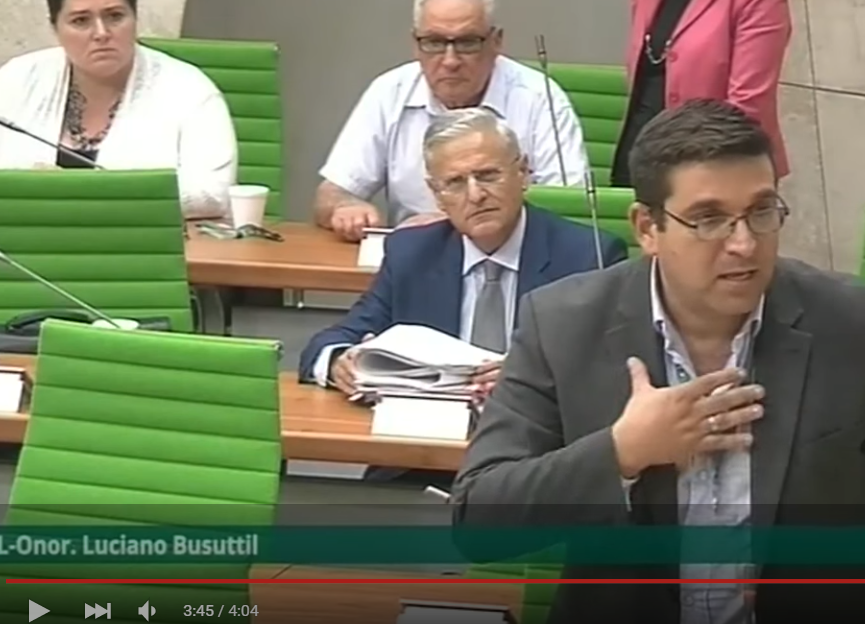
Interestingly, at the point where Luciano Busuttil is giving his version of events in the Nifqghek Incident we can see both Deborah Schembri and Leo Brincat with expressions of sadness, the hardest microexpression to fake:

-Inner corners of the eyebrows are drawn in and then up
-Skin below eyebrow triangulated, with inner corner up
-Corner of the lips are drawn down
-Jaw comes up
-Lower lip pouts out

Debono Grech on the other hand is clearly still agitated and his microexpression is clearly and unequivocally concentrated around an expression of anger.

-The brows are lowered and drawn together
-Vertical lines appear between the brows
-Lower lid is tensed
-Eyes hard stare or bulging
-Lips can be pressed firmly together with corners down or square shape as if shouting
-Nostrils may be dilated
-The lower jaw juts out

As for whether MP Busuttil was telling the truth as to whether or not he heard Debono Grech’s words, well that is where Hollywood ends. The truth is that there is no clear way to tell if someone is deceiving by using microexpression detection: “For as Ekman, Frank, DePaulo, Burgoon, and Vrij have repeatedly told us, there is no single behavior indicative of deception. There are indicators of stress, psychological discomfort, anxiety, dislike, issues, or tension, but not deception.”

Still. Sadness and Anger. Clearly perceptible in this screenshot.

Facebook Comments Box

Article 42, ISIS and neutrality

article42_akkuza

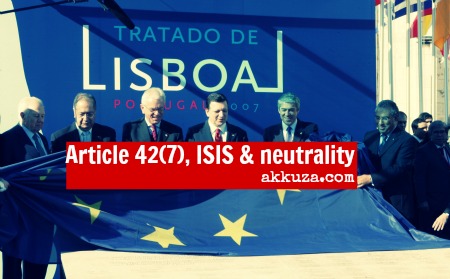
There has been quite a flutter in Malta since Francois Hollande decided to invoke article 42(7)  of the Lisbon Treaty. Even without the eccentric shenanigans of former PM Karmenu Mifsud Bonnici, questions were being raised as to how and to what extent Malta would be committed thanks to this invocation. I thought of providing a little Q&A, just like in parliament, but without the nigi hemm u nifqghek bits.

1. First of all, what does Article 42(7) state?

Article 42 (7) TEU states:

If a Member State is the victim of armed aggression on its territory, the other Member States shall have towards it an obligation of aid and assistance by all the means in their power, in accordance with Article 51 of the United Nations Charter. This shall not prejudice the specific character of the security and defence policy of certain Member States.

Commitments and cooperation in this area shall be consistent with commitments under the North Atlantic Treaty Organisation, which, for those States which are members of it, remains the foundation of their collective defence and the forum for its implementation.

2. So. This means war right?

No it does not. At least not in the sense that the army blessed and formed in the image of Manuel Mallia will be sent to the front to stand shoulder to shoulder with peshmergas. Nor does it mean that we will have AFM troops patrolling the Champs Elysees any time soon. The emphasis in article 42(7) is on aid and assistance and, more specifically, on the fact that the “security and defence policy” of certain Member States should not be prejudiced. This means two things:

a) Firstly, it means that any state invoking article 42(7) can negotiate individually with any other Member State (and crucially without the need to use any of the EU institutions) any temporary form of aid and assistance.  Each Member State is responsible for determining its contribution on the basis of what they deem to be necessary, which does not necessarily mean the deployment of military assets.

b) Secondly, and more importantly in the eyes of many in Malta, the fact that the security and defence policy of certain Member States is clearly invoked is a direct reference to the ‘neutral’ status of states such as Ireland, Austria and Finland – to give an example of some others. What that means is that notwithstanding any interpretation of military intervention that might be given by states dealing under this article, this obligation stops when the security and defence policy of certain States does not allow it. The second paragraph referring to NATO commitments is a further reinforcement of this distinction.

3. Oh so we are not at war then.

That’s a nice one. Modern politicians of the Hollande mould have a tendency to slip quickly into the language of war once a terrorist attack takes place. This “tradition” is new to this century ever since Commander in Chief Bush declared war on Al-Qaeda. Unlike the 70s and 80s when a terrorist bomb attack or shooting never really translated to a casus belli the political psyche of the post 9/11 words seems to require such heavy handed references and we are living in an age where France will now even try to provoke the UN to declare a war on a state whose existence nobody beyond the self-declared caliphate acknowledges.

Still. In the microcosm of Muscat’s land,  we will first engage in a debate of “neutrality” clauses in our constitution. The significance of such clauses dwindles into nothing when one considers that they were intended to deal with a specific battle between superpowers (a battle that no longer exists) and that in any case they would be invoked in case of a war between states – and not neutrality in the face of the war on terrorism. Another thing, Muscat’s government spent most of its legislature whingeing about the fact that immigration problems are a common problem that should be faced and borne equally by all EU states.

Calling oneself out of the fight on terrorism by relying on an outdated and practically inapplicable neutrality clause is hypocritical to say the least. By saying this I am not advocating participation by Malta on military activity but rather that Malta’s attitude towards security and its contribution to ensuring that the borders of the European Unoion are impervious to terrorists leaves much to be desired. From the Algeria VISA scandal, laughed off by our Chief Salesman to the thousands of Libyan Residencies to the continued insistence of this government to transform Malta into one big trojan horse for entry into the EU… these are ample examples as to how Malta’s contribution to the war on terror could be vastly improved.

4. Where does that leave us?

Well it leaves us with an EU that is gearing up to battle the amorphic monster that is “terrorism” with a series of knee-jerk reactions. It leaves us with a government in Malta that ironically needs to wake up and smell the coffee for the reasons outlined above.

Most of the time, it seems, it leaves us reverting to the centuries old adage: si vis pacem, para bellum.

Facebook Comments Box

Sales Report

salesreport

Chief Salesman Muscat was reporting from his business visit in Algeria. He told journalists that the Algerian authorities had laughed off any suggestion that something was amiss with the abnormal number of visas being issued by the consulate run by Muscat’s father’s cousin. Obviously the matter of visas being issued lightly and allegedly on the basis of a network of bribes is of no security consequence to Algeria. Why should it be? It is probably a laughing matter indeed. The arabs have a curious habit of referring to someone as “oncle” or “cousin” out of respect – much in the same way as some Maltese use the phrase “my friend” even if you do not know them from Adam. Muscat was reported to have replied sarcastically about his familiarity with the man running the Algeria consulate. “He’s my father’s cousin, that’s a very strong relationship,” Dr Muscat said sarcastically. Again, he seems to find these things funny. Brushing it all off as being a bit too much brouhaha.

Meanwhile. Malta’s Chief Salesman seemed positively surprised that the Algerian counterparts are eager to use Malta as a window to Europe’s pharmaceutical market. What stands out as strange is that given the linguistic and historical partnership with France, the Algerians would still need to use Malta to hitch a ride into Europe. The question really is all about standards. Is Malta becoming one of the weaker links of the European Union? Is this government once again peddling the rights and obligations that were hard earned in order to make a quick sale? We can only wait. Do not expect truthful answers from salesmen though, Their business is not governance but profit.

Facebook Comments Box

Sales Alert

salesalgeria_BR

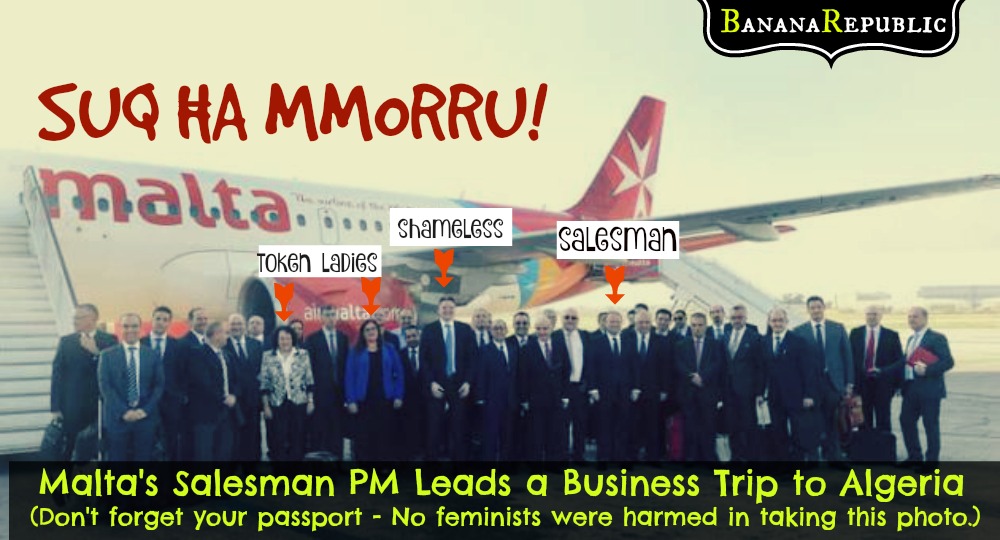
In between world changing summits our PM is off on a business mission to Algeria. The press photo shows a corny group pic of the delegation standing at the foot of the stairs of an AirMalta plane. The delegation is testosterone heavy with two (visible) token women thrown into the fray. Energy and Health Minister is also on board, presumably to cook up another top secret arrangement the details of which can never be announced because of their economic sensitivity. Meanwhile our PM still cannot explain how his relative issued 7,000 visas for Europe in Algeria. The Algerian government should of course be worried since wherever Konrad Mizzi seems to go for his wheeling and dealing there seems to be a tendency of the government collapsing soon after. One, two, three… Viva l’Algerie!

Facebook Comments Box

The truth, if he lies

turhtjospeh_akkuza

La vérité, si je mens (The truth if I lie). We’ve carried that movie motto on this blog as from the start back in 2005.  I was reminded of this motto when I read Dr Muscat’s interview on the Times today. It’s the truth, if I lie – it’s a nonsensical phrase actually that can be substituted by “I promise” or as we were used to hearing on the streets of Malta when we were young “Promise to Jesus”. Whatever your choice of phrase is, Muscat’s assertion really needed this kind of appendage at the end. Here’s what he was reported to have said:

“As for the dwindling number of arrivals to Malta, Dr Muscat denied suggestions made by his predecessor, Lawrence Gonzi, that this was the result of some form of agreement with Italy, insisting this was only due to better collaboration with the neighbouring country.”

We can safely assume that Muscat was already squirming uncomfortably at this point since he had already had to pull out an enormous amount of somersault arguments to deal with the Michael Falzon hot potato. I’m sure in the back of his mind he was blaming the failure of Saviour Balzan and his name dropping stunt to distract attention from the myriad scandals that the Labour government is brooding upon.

But back to his statement. Muscat gave us a clear example of his Magritte Policy – the “what you see is not what you get” statement. In the very same sentence he tells us that there is no form of agreement with Italy but that ther is better collaboration with the neighbouring country. Come again? In what universe of CHOGM flop organising and nation paralysing nincompoops with a degree in management and economics is an agreement not a form of collaboration?

We are not talking about two friends meeting in a pjazza and deciding who will pay for the pastizzi and coffee at is-Serkin. Nor is this a “gentlemen’s agreement” to rent a flat that will only be put to paper should circumstances require and should pressure be too much. No. These are two sovereign nations dealing with each other at diplomatic level and reaching agreements that has repercussions on the operation of their administrative and military forces. Orders will be given as a result. Priorities will be set in an IF/THEN format such as: If migrants are rescued at sea THEN do not take them to Malta BUT proceed to ITALY no matter where they are found.

That sort of thing requires formulation, confirmation and agreement in the form of positive action usually in the form of signatories scribbling their names on very formal paper. More importantly, an agreement normally involves obligations on both sides. Now we can all see for ourselves that Italy is taking on the bulk of migrants (erm ALL recently found migrants) – Muscat himself has never denied this and we have questions being asked in Italy and the EP about it too. So we know what Italy’s side of the obligation consists of. What then is Malta giving back?

Muscat wants you and the kool-aid drinkers to believe strongly that this is the result of “better collaboration with the neighbouring country“. If this vague meaningless phrase can be put quickly in succession after a denial of anything the dastardly Gonzi said then it will add muchly to its level of credibility. What Muscat does not and will not answer is what Italy are getting in return.

Maybe Dr Gonzi is right, maybe he is wrong. That is not the point. The point is that Muscat will only say the truth if he lies. He will not tell you what he promised Renzi and Italy because, as we know by now, he is above accountability.

And for the next two weeks he will be more than that. He will be busy having tea with what he sees as the selfie-imposing VIP while you are confined to your house and (if you are a businessman) losing money due to the national paralyis that is needed by the party that couldn’t be trusted to organise a piss-up in a brewery.

The truth, if I lie.


Facebook Comments Box