A Study in Outcomes

outcomes_akkuza

The public verdict on the thirteen hour debate on the confidence motion in government was already out before the debate actually started. To many this had been a complete waste of time. To many more this was once again a descent into partisan pique, mudslinging and tomfoolery – a sentiment that would turn out to be fodder to the Labour side that claimed to be over and above the divisiveness that was still being sown by what in its words was a “negative” Opposition. That much time was dedicated to explain why and how a no-confidence motion had been moved is understandable. As is the marathon efforts of the Labour side of the house to turn this into a game of deviation.

In many ways Labour succeeded into getting everyone to believe that this was a motion of no-confidence in all its work and not in a very particular set of circumstances that threaten to damage any such good that has been done. We’ll have more time to delve into the lessons to be learnt from the marathon debate – lessons, I hasten to add, for all sides. What I would like to start with is the end: more specifically the tone of triumphalism set by Labour who claim to have “won the vote of confidence” and seem to believe to have weathered the storm. Politically it is true that the government survived the confidence motion and managed to turn it into a confirmation of what the countermotion deemed to be sterling work.

There’s another interesting angle to this chess game though. Admittedly it is an angle that can only be seen once you wear the dumbed down spectacles of partisan illusion but it is an angle that is worth exploring just the same.

At 9 am on Monday morning we knew already the numbers of the vote. The Nationalist side had 29 votes that would go to the no confidence side. Add to them the two independent MPs – that’s 31. Labour had it’s record majority of 38 MPs ready to shoot down any proposal that would shed a bad light on government. As partisan things go the numbers ran 38 against 31. So basically in order for the PN to claim even a slight form of victory one would expect that the number on the side of the No confidence motion would be anything above 31. Even if in the end it would lose the vote, any number of shifts from the preordained position would surely have been a victory of sorts to work upon.

Now the same goes for Labour though. It is useless to gloat on getting ones own votes that are after all only a reflection of the public state of mind in 2013. For Labour to “win” anything out of the vote you’d expect them to win over at least one vote from the other side. Anything less would not be a vote of confidence but merely a retrenchment of a party hanging on to power.

As it turns out there were no surprises. Indeed, no victors were to be registered in the House. The numbers at 9am remained the same numbers at 10pm. This may all sound like crazy reasoning but it is not all that fanciful as your average partisan voter may hope. There is truth also in these numbers. There is truth in the inflexibility of a popularly mandated majority that prefers to stick to power rather than take action on the rot that has begun to set. There is also truth in another not insignificant detail. The numbers do not really reflect the numbers at the start of this parliament in 2013. Seen from that perspective there is already one Labour MP who has shifted her allegiance to the side that has no confidence in this government.

In many ways she reflects the voice of the shifting mood outside of the house where seats are no longer so certain. This has to be the first lesson from the 13 hour marathon on Monday. Nobody won the vote that day – the only victor was a general retrenching. There was one ray of hope though, one MP sitting on the independent benches was doing her homework and had an ear and her heart outside the house. She was listening to the real numbers that underlie the house of representatives. And they were not smiling.

Facebook Comments Box

Sobering thoughts at a rally

sobering_akkuza

The Panama Papers affair is bigger than Malta. Much much bigger. The data leaked from the offices of Mossack Fonseca covers decades of information and has an effect on people worldwide. Rich people worldwide. The social and political effects are only just beginning to snowball and the high profile case of the Icelandic Prime Minister will surely not be the last by far. There is much that is surreal about this business including the fact that many seem to be surprised about the goings on in a tax haven state like Panama (and not just Panama). The informed citizen of today still has the capability of striking you as being somewhat naive about the truths of the world. It’s OK to watch your James Bond and Mission Impossible movies or read international espionage novels were money is ‘wired’ away at the touch of a button into secret impregnable accounts on the other side of the world but then it is suddenly surprising to find out that fiction has been mirroring reality all along and that foremost among the crooks are a band of money-crazy politicians.

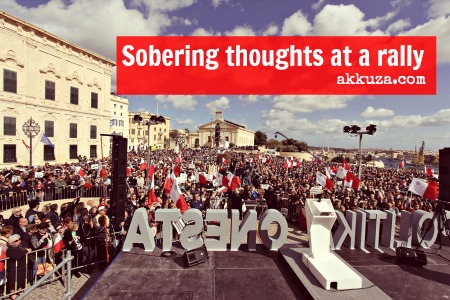
The world wakes up once again (for the nth time) to the reality that the real conmen are those who are creaming off the luxurious part of our collective earnings while the normal citizen is being right royally rogered. It would seem that the banking and property bubbles were not enough and that just as we were beginning to understand the nuances of Hollywood’s The Wolf of Wall Street and The Big Short we were supplied with enough new stories to merit a marathon of docu-flicks. It’s a world-wide issue – from Brasil to New Zealand to Panama to Malta questions are being asked of a political class that has been caught short one time too many. Which brings me to Sunday’s national(ist) protest. I’d like to share some notes and thoughts that were inspired by the rally – before, during and after it happened. Here goes:

  • Panamagate has brought Malta to yet another important cross-roads of its political history. These litmus tests have been scattered over our relatively short life-span as a sovereign nature. to Once the consequences of certain decisions are calculated, once the effects are factored in and once a new beginning has been undertaken, history will show that there was a “right” and “wrong” side to the current events (with all the concessions that we can make to the subjective nature of such interpretations). There was an appeal to that feeling mostly by Marlene Farrugia with her battle cry (or shriek) of “Hawn jien” (Here I am) – emphasising that this moment is one of those times that people stand up and be counted. (Also emphasising rather ironically the obsession with “Fejn kont?” (Where were you?) that afflicts political debates that put much value into unswerving loyalty to beliefs – also known as the tal-Barrani Syndrome). Citizens have begun to understand the consequences of a lax polity that has no sense of merit, no intention of accountability and no respect for the common good. Those citizens are being called in action to halt the slide to mediocrity of politics. If for nothing else, Panamagate is serving as a huge eye opener.
  • Maltin Onesti. Maltin li jhallsu t-taxxi. The rally was inevitably tinged with a partisan flavour. The call of the party is difficult to suppress and Carmelo Mifsud Bonnici’s words flow through the veins of many who were eager to rekindle an enthusiasm that had for so long been dormant if not absent. Ejjew nazzjonalisti, ejjew bil-bnadar taghkom, ejjew bl-eluf minn taghkom, f’dis-siegha tat-taqbid. To be fair the effort to de-party the event was all there. The only flags to be seen were the red and white of Malta and the only hymn to be heard other than that posion for the ears that goes “We the people” was the national anthem right before the Leader of the Opposition spoke. So far so good. What jarred ever so slightly were those calls for honest tax-paying Maltese that seemed to be an appeal to create a dichotomy between good and evil that is ever so present in our political discourse. The greatest risk was that this self-arrogation of purity and righteousness would distract from the real message. After all there was no need to set such a high standard for the crowd – it is not the moral and righteous standard of individual citizens that is being questioned here but the dealings of a minister of government, the PM’s chief of staff and the PM himself by vicarious responsibility (until now). It is not the case of “he who is pure throw the first stone” – that is the wrong lesson to impart to the crowd. This is all about accountability in a normal liberal democracy where the people, taxpayers and all, have the right to call for the dismissal of a Minister caught in circumstances such as Mizzi’s.
  • That is really the point of it all isn’t it? There is a sense of inevitability about the fact that Mizzi and Schembri will eventually resign. That sense of inevitability is inspired by the simple reason that their position became untenable from the moment that they chose to set up a financial structure as has been discovered. There is no need to find money or treasures, no need for tax audits, no need for declarations, no need for any of all this. The mere fact that they thought of using a structure that can only exist to keep something hidden (whether in the past or in the future) is enough to make them unfit for any purpose that requires public trust. Our Prime Minister knows that his position only gets worse every day that he does not take action on the matter – and when I say worse I do not only mean among those who attended the national protest but also, as is becoming increasingly obvious, among his own supporters.
  • There is a reflection that is hard for the nationalist party to swallow. It must be made. We did not get to the national protest on April 10th thanks to anything that the nationalist party has done. The huge mass of people calling for the ousting of Mizzi and Schembri (and Muscat) were there because of a much bigger series of events that began when somebody signing off as John Doe offered to pass on a huge amount of sensitive information to a journalist working for the Süddeutsche Zeitung. The Panama Papers have exposed the inadequacy of key members of our government and to this day threaten the very existence of the government itself. What about the PN? The PN was already on the road to recovery – its proposals on Good Governance in less suspicious times were a good start. It could not but try to take the lead on this matter and as a responsible opposition it is pressing for immediate action. In doing so it must be wary of sensationalism and of the trap of falling into the old political game. The people are fed up with politicians trying to take them for a ride. In 2013 the people handed Muscat an incredible majority exactly because they felt they could no longer take the arrogance of the nationalist government of the time. Questioning their choice today becomes a futile exercise if what is offered as an alternative to the current mess is more of the same.
  • The main lesson to be drawn here is that the nationalist party must brush up its act if it is preparing to lead with New Politics. New Politics means not being drawn into the partisan mud-slinging game by Labour’s diversion tactics. It also means building up on ideas and strengthening the values it represents by showing that it is a party with a national interest at heart and not a self-serving machine of the kind that is now anathema to most voters. To prepare for this it must already think beyond Panamagate because if the events ahead are truly inevitable and foreseeable then the PN must be prepared with a project of its own and also be prepared to listen to those who for too long have been sent to the margins of politics and who have ideas of real reform that could revolutionise the landscape. Yes, the PN might have to be prepared to become a smaller but stronger part of a renewed political landscape.
  • As for Labour. Labour was not present at the national protest. We were regaled with a national conference brimming with Soviet Style optimism and standing ovations. Konrad Mizzi was one step short from being awarded the Soldier of Steel Medal (but that is usually awarded AFTER you lose your place) and his failure to bear responsibility angered quite a few of the Labour delegates and MPs. This turmoil is just the beginning for the labour party. The Taghna Lkoll philosophy has failed and not just because of Panamagate. Panamagate served as an eye opener to uncover the many things that Labour has been allowed to get away with until now. Ahead lie battles for the soul of the party and do not expect the current power circle to let go lightly – there are too many interests involved. There will be blood – of the political kind as Chris Cardona would say.
  • One last word on the media. The nationalist party committed a horrible faux pas by conflating the Jason Azzopardi libel case. The crowd outside the law courts was a throwback to the medieval era, that same medieval era where Chris Cardona’s rhetoric belongs. Doorstepping irritating journalists aside there is something extremely worrying about the state TV’s reluctance to properly report the daily changes in Panamagate. Also worrying where the calls from the Labour corner of the crowd to somehow stifle any international coverage or reporting of the situation. It would seem that there are still exponents who rue the absence of a law on foreign interference – even Chris Scicluna was targeted for sending a factual report to Reuters about the national protest.

I’ll stop here for now. We’ve got weeks ahead of more exchanges and more information to discover. We are definitely living in interesting times.

Facebook Comments Box

Here come the doorsteppers (I)

unnamed

Politics has reached a shallow point in Malta. We’ve all heard that phrase by now. Trust in politicians on the island has gravitated towards the same low point as has been shared for a long time and for different reasons on the rest of the continent. We’re slightly delayed – it has only just begun to dawn on a large part of the population that “the Game” has nothing to do with power and that the alternating race to mediocrity is only destined to produce more of the same, but different. At the same time as this great realisation is happening – within the confines of cliche’ ridden appraisals that your average citizen is capable of – there is still a strong pull towards the partisan DNA that is, much to the chagrin of Andrew Borg Cardona and Charles Mangion, programmed into the vast majority of the voting population.

It’s not just Konrad Mizzi who is afflicted by the mysterious “internal conflict”, it’s all bona fide “partitarji” on both sides of the political chasm. Labourites cannot believe that their government is coming so close to repeating the short stunt under Sant… one mega-crisis and it’s all over. Deep down they all see the horrible error in Mizzi’s ways, even they understand that the Energy Minister’s position is untenable but they are loath to admit it. The pull of the party is too huge and trumps all. The Nationalist party card bearers also have a dilemma of their own. They’d love to see the back of this government but they are still not 100% convinced that their own party is good enough to lead and many have still not understood the modus operandi of Simon’s politics.

The time would have been ripe for reasoned debate centred around reform and improvement. Politics, particularly party politics, is in the doldrums. Anyone with a brain between their ears could tell that the sell-by date of mediocre politics is long past. Reasoned debate and rational argument are what the doctor ordered – it’s the right medicine for both parties internally as well as for our institutional set-up. Rational and reasoned debate requires information and an exchange of ideas and programmes with the best for the country being the ultimate goal.

What we have got instead is the return of the non-political exchange. Politics with a big P has been thrown out of the window and the machines of spin are out all over again because as soon as a moment of crisis brings the faint glimmer of a possible election round the corner our parties do what they do best – entrench and send out the soldiers: in this case one important element are the “doorsteppers”.

It’s not a new breed of political animal. The latest morph on both sides are Mario Frendo and Nicole Buttigieg. They are sent to the enemy lines in search of the soundbite that can be processed and fed into the propaganda machine. They form part of a wider circle and game played by the politicians themselves who hide behind feeble excuses, half-truths and word games to destroy any possibility of debate. We’ve seen them before. Joseph Muscat was one of them himself. Ministers and shadow ministers on both sides of parliament began their career as doorstepping journalists of sorts, as did some of our MEPs. I remember one of the earlier morphs of these doorsteppers in the form of Simone Cini who shadowed Eddie Fenech Adami all the way to PN mass meetings provoking the worst out of the worst.

It’s weird. Even the language of the two parties switches away from real meaningful essence and we now hear of accusations of “fascism”, “return to the eighties”, “stifling of speech” and more. The nationalist party brouhaha about the use of criminal libel was surreal for example for it really begged the question “What did you think of criminal libel in the 25 years that you were in government?”. Someone from the Independent did bother asking Marthese Portelli only to get some long-winded non-reply based on “just look at the good things we have done in those years so please just ignore the way we looked away from any possible reform”.

“Concentrating on the good we did” seems to be the new karma. Konrad Mizzi is magically oblivious to his textbook case of “things not to do unless you want to lose your position as minister”. He still thinks that it’s a conspiracy by the PN to remove what he believes is the best performing Labour cabinet member and nothing more. Aside from the fact that his own admission of naivety should suffice to make him lose any possibility of sitting in ANY position of public responsibility, his excuse seems to have gone down as sufficiently plausible with the rest of the PL crowd. Now he’s probably on his way to being anointed as a soldier of steel.

So we are down to looking at the doorsteppers. Planted in the middle of crowds who have the collective political nous of a football hooligan they will “interview” and provoke for the sake of getting a snapshot of the worst of the worst of the opposite party’s supporters – oblivious all the while to the fact that they could very well have sampled someone from their own inner circles with very much the same results.

… to be continued

Facebook Comments Box

The Price of Time

the price of time _ akkuza

Take a step back. Try to disentangle your brain from the bombshell of Panamagate as it unfolded in Malta. Now take a look at Prime Minister Muscat and his reaction to the whole business over the last seven weeks. In Malta Panamagate came early, probably prematurely. Konrad Mizzi got an early warning of the dangers to come when Caruana Galizia dropped some hints about the information that had come to her possession. “The lamb for Easter would come from New Zealand” was the coded message that set alarm bells ringing in Mizzi’s head. Mizzi had been handed an unexpected advantage – unlike the bigger heads that were to be shaken on the night of Sunday 3rd April he had been handed a lifeline from the quarters he’d least expect. Mizzi and Muscat had been gifted a precious amount of time to work on a defence.

Time. That’s the point here. Timing was crucial and every minute gained to work on the alibi was worth a mountain of gold. Nexia BT, Brian Tonna, Keith Schembri, Kasco, Panama, New Zealand, Adrian Hillman, more Konrad Mizzi. The news trickled out slowly as Caruana Galizi’s blog turned gatekeeper of the leaked information for a period of time – at least until the international bomb would explode thanks to Süddeutsche Zeitung and ICIJ.

This gift was a godsend for Muscat and Mizzi. We were regaled with the “declaration of assets”, the “family planning” and the “full collaboration” stories. Muscat could sit and watch and do what he does best: gauge public opinion. Better still he could shift the goalposts of assessment. It would no longer be about the existence of a structure using jurisdictions that have a notorious and shady reputation. It would become a case of whether money would be found in Panama or New Zealand. Muscat would skilfully manipulate the discussion until the question of Mizzi’s suitability as minister (and Schembri’s as Chief Advisor) would hinge only on whether any corruption could be proven.

It’s not the point really. Put simply both the Minister and the Chief of Staff should have resigned the moment it is was clear that they set up companies in dubious and shady jurisdictions. Whether there is any money to be found (and so much time lapsed till the international machine would actually be set in motion that it is doubtful whether any money would have stayed put so long) is irrelevant. The Panama Papers have shown that. Once the news was out, politicians the world over were slammed with big question marks on their head. The responsible politicians among them have already borne the consequences. And Konrad and Keith?

Konrad and Keith had the benefit of time on their side. The parameters of the discussion had already been shifted with the artful use of propaganda and party machinery. The question had already become whether or not any money would be found. Muscat had managed to shift it all to the far-fetched finding of a smoking gun. One wonders whether Konrad and Keith would have survived the onslaught had their names figured for the first time along with the rest of the ICIJ releases and not a good seven weeks before.

Which is not to say that both Konrad Mizzi and Keith Schembri are out of trouble. In any decent democracy they would already have been long gone. A decent Prime Minister would have distanced himself from members of his entourage who opt to create such structures in dubious jurisdiction for whatever reason and with whatever intent. He’d do it for his sake and for the sake of his party in government.

Muscat still needs to buy time. The rumblings within his own party must not be comforting. The Süddeutsche Zeitung journalists claim to have “several weeks” of news to release so the Panama Papers are not going to vanish overnight. The more politicians abroad fall thanks to these Papers the more pressure there is on Muscat and Mizzi’s “alibi” regarding the mythological hidden millions that are supposed to be hidden or absent.

Muscat needs to continue to buy time as he has done in previous scandals – notably the Manuel Mallia issue – the bonus time that he was graced with thanks to the early release of the information in Malta has run out. Now that the Panama Papers scandal is an international hot potato Muscat might find that buying time will become more costly. Distraction tactics, mud slinging on the opposition and fact twisting all have an expiration date.

He probably knows that when that time runs out he might find that the writing has been on the wall all along… that Mizzi and Schembri’s position is untenable and delaying the inevitable is disrespectful to the electorate that put Muscat into power, including those who tried their luck for the first time.

Next time they might not be too audacious.

Facebook Comments Box

Il Triangolo No

triangolo_akkuza


I. Stability is a partisan word

Third parties, third ways. An online poll conducted by the paper Illum showed, among other things, that 14% of respondents would vote for a new party since they have no more faith in either the PN or the PL. Talk about a possible third way being a panacea for our political representation problems has belatedly gathered momentum on the island. Muscat’s government is on rapid implosion mode while the general feeling is that the PN alternative would generate more of the same style of politics – one that is deeply enmeshed in corruption and deceit to the detriment of the citizen. Marlene Farrugia’s rumblings as a dissenting politician within parliament are much stronger and coherent than those we have heard until now during the last months of the Gonzi executive. Add to that the fact that scandal after scandal the tempo of public discontent does not seem to subside and a few “public personae” are prepared to throw their weight into the ring and you have the recipe of what is being touted as the panacea for all this evil feeling: a third party.

Regular readers if this blog may well recall that the “Third Way” solution has long been advocated over the whole stretch of our blogging history. Often the election of a third party’s representatives in parliament has been described here as “driving a wedge in the bipartisan hegemony”. I still believe that a third party (and fourth and fifth) can have positive effects on our political system. The problem however lies elsewhere since the third party is not a solution in itself but it is actually a possible result of the solution that is necessary in order to definitely improve the state of our politics and consequently the health of our nation.

What do I mean? Let’s take a look at the PLPN reaction to the very public rumblings of a possible third party. Their rare chorus of unanimous disapproval was to be expected. More parties in parliament would cause “instability” they claimed. Worse still they could not envisage having to share the burden of government with some coalition party – anathema.

The PN might be investing in the concept of good governance but the philosophy behind the driving forces of this rekindling of values stops short of contemplating an utter reform of our representative system that might not be two-party-centric. Of course we can have good governance they will tell you, but applied to our system of alternation – and not beyond. In other words the current set of rules should be good enough for Busuttil’s new party philosophy – we only have to ensure that the tenets of good governance are properly applied therein and all will be fine. I beg to differ.

II. Self-preservation is a natural instinct

Let us use a coding metaphor. The structure of our constitutional system has been built using a language that reasons in bi-partisan terms. A bi-party rationale is written directly into the building blocks of our political system – both legally and politically. Since 1964 the constitutional and electoral elements of our political system have been consolidated in such a manner as to only make sense when two parties are contemplated – one as government and one as the opposition.

We are wired to think of this as being a situation of normality. The two political parties are constructed around such a system – we have repeated this over the last ten years in this blog – and this results in the infamous “race to mediocrity” because standards are progressively lowered when all you have to do is simply be more attractive than the alternative. The effect of this system is an erosion of what political parties is all about.

The political parties operating within this system are destined to become intellectually lazy and a vacuum of value. The intricate structure of networks and dependencies required to sustain the system negates any possibility of objective creation of value-driven politics with the latter being replaced by interest-driven mechanisms gravitating around the alternating power structure. Within the parties armies of clone “politicians” are generated repeating the same nonsense that originates at the party source. Meaningless drivel replaces debate and this is endorsed by party faithfuls with a superficial nod towards “issues”.

The whole structure is geared for parties to operate that way. Once in parliament the constitutional division of labour comes into play – posts are filled according to party requirements and even the most independent of authorities is tainted by this power struggle of sorts. Muscat’s team promised Meritocracy and we all saw what that resulted in once the votes were counted. In a way it was inevitable that this would happen because many promises needed to be fulfilled – promises that are a direct result of how the system works. With all the goodwill in the world Busuttil’s team promising Good Governance will be placed in the same position with the same rules as Muscat’s and Gonzi’s before them.

The point is that the system needs to be rebooted. Even a third party elected under these parameters would do little to shake the system at its foundations. What needs to be targeted are the laws and structures that have developed into an intricate network of power-mongering and twisted all sense of representative politics. A third party might be the result of that change of system but what is needed right now is that one (or both) of the two parties enjoying the uncanny and undemocratic advantages of their home-made rules is forced to accepting a program of constitutional change.

III – Restoring the supremacy of parliament

Malta’s constitution owes much to the concept of parliamentary sovereignty. Constitutionally political parties did not count for much. When forming a government the Head of State was invited to choose from among the members of parliament that member who enjoyed the support of the majority of members elected. No mention of parties. It is only through a series of shenanigans and legal changes to electoral laws that the parties became the be-all and end-all of the electoral process. Laws were changed to ensure majorities, seats in parliament and quotas – all in relation to the bi-partisan system. It led us to the infamous wasted vote.

The problem was not so much the theoretical guarantee of stability afforded by a bi-partisan system. No, the problem lay in how the guarantees afforded by alternation gradually became a threat to the “political” nature of the parties themselves. Instead they were replaced by careerist powermongers eager to climb up the ladder of our home-grown system of power-broking: from candidate to backbench MP to Secretary to Minister. Fiefdoms developed and by taking advantage of a system that guaranteed their presence on authorities, boards and watchdogs the constitution would play second-fiddle to the needs of the party in power while the opposition barked and whinged waiting their turn for a piece of the action.

How does this change? it changes by changing the whole system starting from its building blocks. Parliament has to be strengthened and revalued as the supreme guardian of constitutional representation. The new system should ensure that politicians elected to parliament fulfil their role of representatives of the people by acting as proper legislators and competent watchdogs on the operation of the executive that must remain subservient to their will. In order to obtain this we must wean parliamentarians away from the ladder of power as currently perceived while strengthening their role and function.

I have already put forward the four points that should be the groundwork for such a reform:

  1. The removal of districts from national elections.
  2. The introduction of party lists elected on the basis of proportional representation into parliament (with a minimum threshold of between 5% and 7%).
  3. The introduction of technical ministries with ministers chosen from outside parliament but accountable to parliament.
  4. (A corollary of 3) MP’s who become ministers should resign their place in parliament.

As I said in an earlier post this would remove the idea of careerist politicians. By clearly differentiating between the roles of the executive and the legislative/representative aspects we would ensure that parties are rewired to become effective in both. A technical executive with a proper plan and project will be one side of the coin while a strong representative body acting on behalf of the people monitoring and endorsing the work of the executive would be the other. Such parliaments could afford to have a hundred Marlene Farrugia’s who do not bow to a party whip for the party’s sake but use their vote in the best interests of those who elected them to parliament.

Conclusion

Electing a third party for the sake of electing a third party and simply out of spite to the two main parties is not a solution as things stand. This blog would advocate for stronger pressure on the party that is most willing to take up this programme of groundbreaking constitutional reform with the express understanding that should it get elected this would be its top priority. That mandate would end once the reform is achieved and new elections based on the new parameters would be held. What Malta needs is a Reform Movement that picks on the current momentum that is not endemic to Malta. What it certainly does not need is more parties playing from the same score as we have till now.

Facebook Comments Box

A call for Union

brussels_akkuza

It’s been a long break. I had planned to post earlier but the events in Brussels have been at the back of my mind for some time now and had sapped at the will to write and make whatever little difference another opinion could make – especially in this world that gives the impression of getting more cynicial by the minute.

Last week saw confessors of the world’s largest religion prepare for the most intense period of meditation and contemplation. Believer or unbeliever you could still listen to the words of Yeshua from Nazareth – a simple maxim – thta could have been revolutionary for mankind. Sat at a table of equals he would reportedly tell us that all humans had to do was to love others as they do themselves and do to others what they would do themselves. Simple really.

In Palmyra the Syrian forces advanced and freed the ancient city forcing ISIS forces back to stronger holds like Raqqa and Homs. They left behind them a trail of destruction – around these supposed “religious fanatics” hangs a stench of death, misery and desolation. Reports in the media informed the gawking world that a kidnapped priest had been crucified by ISIS over Easter. Humanity? Not much. Religion and faith? Another excuse to justify psychopathic actions, nothing more. Not in my name shouted millions of muslims worldwide.

As I am sure there are muslims in Pakistan who condemned the atrocious attacks in Lahore where over 60 christians died in an attack. Same goes for Iraq where an innocuous soccer event was cut short with an explosion causing over 30 deaths. Not in their name.

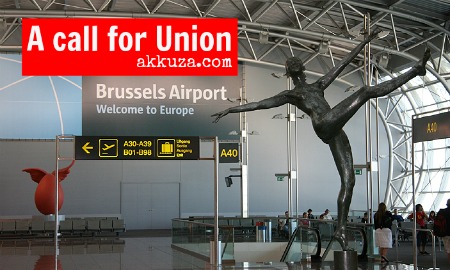
Which brings me to Brussels and Zaventem. ISIS have claimed authorship of the vile attack that took place at the airport and metro. For many Maltese this is even more familiar territory than Paris and New York were after previous criminal attacks. Around 36 hours before the blasts ripped through the departure lounges I was travelling home exceptionally via Brussels. Our check in row was row 8 – apparently only two rows away from the site of the main explosion. As the news pored out familiar marks of the airport were mentioned – the Starbucks in the main gallery where I had sat with my dad for a long, long coffee a couple of months ago stuck out.

It’s more personal for us now but it does not change the way we are all handling the matter. We still speak of “terrorism” and we are quick to link the issue to the wave of immigrants that has become a constant in Europe. The failure of integration is proclaimed. The EU’s nations retrench to their nationalistic stances and the biggest menace now is to one of the fundamental and most obvious pillars and advantages of EU membership – Schengen and free movement.

There are a few reflections to be made:

1. Terrorism as a label

It is worth noting that the way the media report the issue is facilitating ISIS’ business. A brilliant article in the Guardian noted that the media are acting as a lunga manu PR for the IS by attributing a larger sense of organisation where there is none. We are quick to rush to the label of “Terrorism” combined with “Islamic Fanatics”. In reality, and viewed with a cooler mind, these are cells of instability in our own society that are the result of multiple causes – and not just a religious orientation gone awry.

Europe has a long, recent history of terrorist cells of political, religious or sectarian and independentist inspiration. “Terrorism” is a label we use for a sophisticated type of crime against the general public – car bombs, explosions, gun attacks and now even a belt full explosives for a kamikaze ending. These perpetrators need to be treated as criminals first and terrorists later. By exalting their actions as being the result of some kind of intricate organised network and hidden army we are falling in the hands of ISIS and its supporters.

Finally these are mostly home-grown citizens who have a bone to pick with society in general. ISIS offers them a great means of escape and an excuse to unleash their anger with such devastating consequences. They must be treated as criminals – home-grown criminals – and the punishment must be exemplary of a society that deals strongly with these problems. Deportation to some trumped up “country of origin is an escapist solution. It is a solution adopted by nations that are in denial that social and economic problems within their borders lie at the real base of what is going on.

2. Crime exists and it is Europe-wide

Having said that the “terrorist” label is not helping the cause does not mean a denial of the existence of criminal elements that use the religious angle as an excuse for their psychopathic actions. What Brussels (and even Paris) taught us is that there is a systemic problem of lack of coordination in the EU. Too many hands, too many seperate limbs of enforcement that fail to communicate with each other and too much ambiguity about our common border.

The calls are out to suspend Schengen and for a retrenching to nationalist lines of control. The calls are wrong. The problems with which the member states of the European Union are faced today are in need of exactly the opposite remedy. The Union was built on the pooling of sovereignty in areas where the whole is better than the parts. We’ve all heard how the Common Market became the driving force of an Economic Community that strengthened its connections.

Now, more than ever the areas of Security and Justice require a stringer pooling – not a breaking down. A Union Police that acts across borders and on all borders is required. It cannot have the face and interest of the few states that are facing the problem of the moment – in other words it cannot be a Frontex that begs for the attention of states that are far from the action. This Union Police should have Union-wide powers of monitoring entry, exit, and also internal activity within the Union. Intelligence would be pooled and enabled by all parties, a budget would ensure it has the resources possible to combat crime and a clear delineation of its competences would enure it can work within its own range as well as collaborate with national forces.

Schengen is the target of the bomb touting criminals. Suspending Schengen, restricting the fundamental freedom that European Union citizens have so proudly achieved is not a solution. It is a dangerous step towards submission.

3. Integration

Finally, one last point about integration. As I said earlier the existence of such criminals cannot be linked to problems of integration. The religious angle is an excuse to unleash destructive wills – an excuse that could very well have been found elsewhere. Having said that a Union that is teetering on establishing its own ideals needs to take up this challenge and face up to it. Rather than speaking of integration we should be looking at the common values that the European Union member states hold dear and ensuring that anybody who is born or enters into their territories understands that these are the rules by which civil society lives.

Once again in the name of humanity the Union should be working to strengthen the commitment to the universal values of human rights and anybody wanting to live within its confines should be prepared to live along and not against such precepts.

Facebook Comments Box