Praworządność : the EU and the Rule of Law

In a historic move today, the European Commission has initiated a procedure against Poland based on the clear risk of a serious breach of the rule of law. From the official press release:

Despite repeated efforts, for almost two years, to engage the Polish authorities in a constructive dialogue in the context of the Rule of Law Framework, the Commission has today concluded that there is a clear risk of a serious breach of the rule of law in Poland.

The Commission is therefore proposing to the Council to adopt a decision under Article 7(1) of the Treaty on European Union (see Annex II).

The European Commission is taking action to protect the rule of law in Europe. Judicial reforms in Poland mean that the country’s judiciary is now under the political control of the ruling majority. In the absence of judicial independence, serious questions are raised about the effective application of EU law, from the protection of investments to the mutual recognition of decisions in areas as diverse as child custody disputes or the execution of European Arrest Warrants.

This is not something that can or should be taken lightly. In a local (Maltese) context, this should put paid to the myth that the eyes of the EU institutions are only focused on Malta (vide Pana Committee and recent Rule of Law task force) and that they are focused on Malta because of the work of some “traitors”. It should also put paid to the yarn being spun in some quarters that the rule of law is some “cliche'” that only serves the ulterior hidden purposes of power-hungry groups eager to overturn the current status.

Interestingly the Commission focuses on the judicial reforms in Poland that have severely prejudiced the independence  of the judiciary – the main default in the state of the rule of law in Poland is seen to be the judicial branch. The deficiencies are in the powers of appointment and removal that have been arrogated to the executive in recent legislative changes.

Why should Malta care?

Malta’s current system of appointment, removal and scrutiny of the judiciary is already flawed as it is. All the talk about reform, even in the judicial sector, remains just that – talk. Over the years the loopholes in the system that stem from the excessive discretion of an all-powerful judiciary have only been worsened. Our Prime Minister may “take note” in some cases (in answer to the Chief Justice for example) or “be perplexed” in others (as when he feigns ignorance of the consequences of the Ombudsman’s warnings regarding the internal kangaroo courts being set up within the public service). There is only so long that these lies can hold though.

Alarm bells will continue to be rung – if not by a spineless opposition that seems to be ever more hell bent on joining the populist battle, at least by a wider civil society made up of varied exponents and NGOs that feel it is their duty to act as Malta’s last conscience. Poland had long been playing with fire and is now in direct line for losing certain rights under the EU system. Malta could very well be next.

In the eighties Malta looked closely and learnt lessons from the happenings in Warsaw and Gdansk. The solidarność (solidarity) movement was adopted as a precursor for the calls of Work, Justice and Liberty that brought about change from a tired system. This time round we might do well to take heed and see how Poland solves its problems with praworządność  (rule of law).

Now. Before it is too late.

Facebook Comments Box

Watching justice come undone

Magistrate Charmaine Galea has just decreed her own recusal from the compilation of evidence in the Caruana Galizia murder trial.

“Magistrate Charmaine Galea followed where magistrate Donatella Frendo Dimech left off last week and said she would not hear the compilation of evidence against the three accused, on the grounds that Ms Caruana Galizia had mentioned her in blog posts concerning Labour Party appointees to the judiciary.” (Times of Malta)

A few off the cuff facts (for which I thank some colleagues who are more familiar with the ins and outs of the courts) are warranted at this stage. Malta’s current line-up on the Magistrate’s bench has a grand total of 22 Magistrates. The standard for recusal that has just been set by the combined abstentions of Magistrates Dontella Frendo Dimech and Charmaine Galea is quite low. Magistrate Frendo Dimech’s abstention stemmed mainly from a weak level of familiarity with the victim’s sister (they shared a schoolbench) while Magistrate Galea referred to direct criticism that she received from the victim upon her appointment:

Magistrate Galea has just read out a statement saying Daphne Caruana Galizia had written about her nomination to the bench and linked it to her closeness of the government of the day.” (still the Times Court report)

Now,  that link – the one related to Daphne’s criticism of Labour’s appointment of magistrates – has delivered a severe blow to the list of 22 magistrates. Decimation does not begin to describe it. In fact, writing on the 20th of November 2016, Daphne Caruana Galizia detailed the specifics of government appointments to the Magistrates’ bench:

“This government has made 14 appointments to the bench in three years, 10 of whom are connected directly to the Labour Party. The other four are Judge Giovanni Grixti (formerly a magistrate), Judge Edwin Grima (formerly a magistrate), Magistrate Donatella Frendo Dimech (formerly at the Attorney-General’s Office), and Magistrate Aaron Bugeja (formerly in private practice).” (Running Commentary, November 20th, 2016).

The rest of the blog post in question develops an argument that implies without any doubt the ‘political’ nature of Labour government appointees through the years. In this context, Magistrate Charmaine Galea’s abstention should not come as a surprise and is actually the more ‘justified’ of the two until now seeing how Magistrate Frendo Dimech was specifically singled out by Daphne (together with another three magistrates) as not having been a political appointee. What does stand out is that by the same reckoning as applied by Magistrate Galea, 9* other appointees to the bench (10 out of the list of 22) qualify for the same reasoning, the same abstention.

We may argue at length whether or not the abstentions are sufficiently justified but that is not the point that I want to make here. The point that comes out clearly from the current debacle is that when Daphne Caruana Galizia, like many others, was pointing out the political nature of appointments to the judiciary back in 2016 (and even before that) she was actually highlighting a deficiency in the system: one that makes it weak and vulnerable. This is the tangible effect of the breaking down of the rule of law. Justice is not being seen to be done, it is being undone bit by bit.

The independence of the judiciary is a fundamental building block of a system based on the rule of law. It is a fundamental building block for any liberal democratic society. When the judiciary is treated as yet another domain wherein ‘jobs for the boys (and girls)’ are to be found, it becomes yet another dagger in the back of the proper administration of justice and consequently of the proper running of the state. The merry-go-round of recusals will necessarily go on if the roster by lot will continue to throw up names who feature on that November 20th post. It is inevitable. It is a vicious circle.

The blame is not to fall on the journalist and opinionists who pointed out the deficiencies and bad-will in the nominations. It is to fall on a government that proceeded to turn nominations to the bench into a farce. It is a government that will sit on a case of impeachment of a judge until he retires out of the grasp of justice. It is a government that will wait for the exact amount of years required by the constitution to pass for the appointment of a young, green, lawyer to the post of magistrate because rule by law trumps rule of law any day.

The not so impeached judge happened to be the father of a labour candidate, the young green lawyer happened to be the daughter of the ex-labour deputy leader and current speaker of the house. One other nominee to the bench – Ingrid Zerafa Young – withdrew her nomination after it transpired that her appointment could have breached the Constitution since she was a member of the Employment Commission. It was Dr Zerafa Young, not the government,  who withdrew her nomination.

As you follow the merry-go-round of recusals do not laugh, do not find it funny and most of all do not blame the magistrates in question. Instead remember that this is a direct consequence of the breakdown of the rule of law in this country.

We all know where the blame for that falls squarely.


*This post has been edited because the previous version wrongly implied that all the appointees mentioned in the Running Commentary’s posts were magistrates. 4 of those were in fact judges and therefore should not be considered in this particular case.

Facebook Comments Box

Seeing justice done

This article appeared in today’s Sunday Times of Malta

In her Republic Day address, President Coleiro Preca stated that she believes “that the rule of law is as strong as the people acknowledge it to be, as much as they believe in it, cherish it, and continue to support it.” In her reference to the concept of “belief”, the President might have unintentionally struck an important chord that plays through the ongoing debate where the “rule of law” is concerned.

Seeing, in this period of Post-Truth Politics, is believing – even when what we see is a staged performance that is intended to reassure the emotional side of our thinking brains while at the same time numbing any rational reaction thereto. The phenomenon has been pigeonholed using various metaphors: the emperor’s clothes and Magritte’s pipe (ceci n’est pas une pipe) come to mind right now. Whole generations (particularly the baby-boomers) prize emotional sincerity over “the starchy pursuit of objective truth”.

Truth has been relegated to a relative importance in the list of priorities. It has to compete with the panoply of emotional expressions that have moved up on the popular agenda. The lack of forensic analysis, when people stop questioning the facts, has also meant that society has less time for ‘experts’. There is no trust in them. The Brexit and Trump phenomena followed on the heels of the financial crisis of 2008 when trust ratings in experts plummeted.

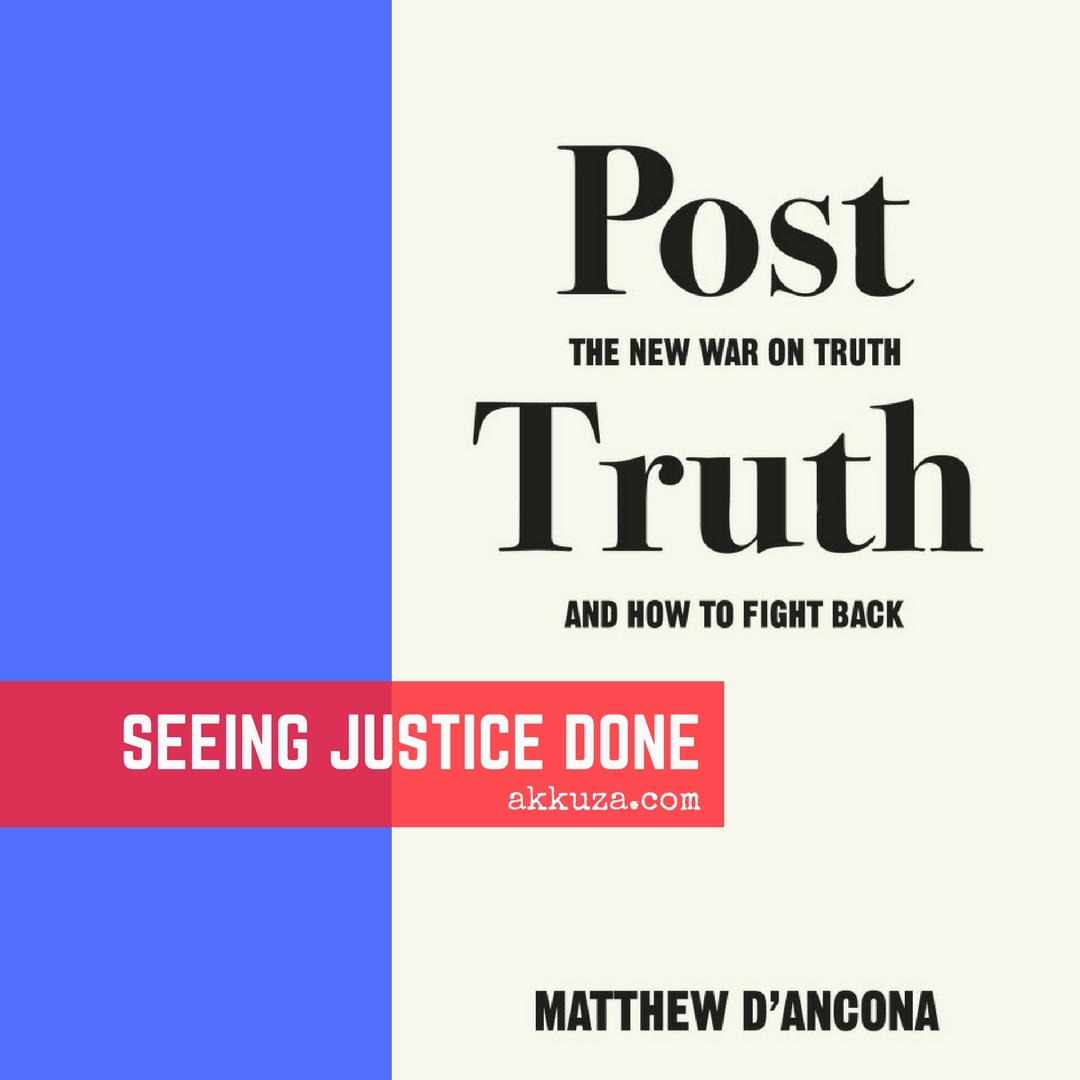
The collapse of trust is dangerous. As Matthew d’Ancona (who I rely upon quite liberally in this article) states “… all successful societies rely upon a relatively high degree of honesty to preserve order, uphold the law, hold the powerful to account and generate prosperity”.

Without the real value of truth our gauge of what the people appreciate shifts dramatically. Law, the rule of law, is not about faith. The very concept of a working system under the rule of law is not designed to work depending on the number of believers in the system. There is a word for a system based on belief: Religion. The rule of law is not about faith. Nor is it about hope – hope that justice is done. The danger of misinterpreting the phrase “seeing that justice is done” is based on the simple fact that it is part of a larger whole.

Fearne brought up ‘the rule of law’ often and it was like the devil quoting scriptures

The full phrase in fact is, “Not only must justice be done, it must be seen to be done”. Remove the first part – actually and linguistically – and you get an act of prestidigitation, where you are made to believe that something is there when it is not. Such a magic act requires a theatrical appeal to emotional intelligence of the highest kind: it not only requires that you believe but also that you suspend that belief and actually believe what you are being told that you should see.

“Seeing justice done” should in fact be the final act of a progression of events that include justice actually being meted out. In the past weeks we have seen the concept of the rule of law twisted and turned beyond recognition. The danger is that people begin to believe that what they see in action is the rule of law when actually it is the rule by law. In his Commentary on the Constitution Tonio Borg sets out the distinction clearly: “So the rule of law is a concept which gauges not just the number of laws enacted but their nature and direction. It is also a political concept so that something, which is clearly within the parameters of the law, may still go against the rule of law in spirit.”

Watching Chris Fearne squirm to Tim Sebastian’s questioning on the Conflict Zone (DeutscheWelle) was not pleasant. Fearne brought up “the rule of law” often and it was like the devil quoting scriptures. The Prime Minister appealing in court in order to stop inquiries, redacted contracts because commercial interests trump public interest, quoting laws in order to prevent sharing of information regarding passport buyers… that is just an aperitif.

We have naively called the new religion out as spin. It is not just spin. It is a dangerous belief system that is supplanting what should be a concrete system based on law and inspired by natural justice. Bringing three men before the courts of law for the heinious murder of a journalist can never be seen as the final curtain call that proves that all is well in the state of the Republic.

Believe me, it is not.

Jacques Zammit is a référendaire at the Court of Justice of the European Union and one of the founders of the Advocates for the Rule of Law. Opinions expressed in this article are strictly personal.

Facebook Comments Box

Trump u Gerusalemm: Titnehha l-maskra

Intervent li għamel Karl Schembri fil-gażżetta t-Torca. Din qiegħda tiġi riprodotta hawn bil-permess tiegħu. L-opinjoni espressa fl-artiklu hija tiegħu personali.

L-aħbar li l-Amerka tirrikonoxxi Ġerusalemm bħala l-kapitali tal-Iżrael m’għandha taħsad lil ħadd. Jekk xejn, fl-aħħar, tneħħiet il-maskra tad-dupliċita’ perversa tal-Amerikani lejn il-kwistjoni tal-Palestina. Trump, bil-vulgarita’ medjokri tiegħu, ineħħi kwalunkwe pretensjoni falza lejn l-hekk imsemmi ‘proċess ta’ paċi’. Staqsi kwalunkwe Palestinjan u jgħidlek, “xi proċess? B’min trid titnejjek?”. Trump fl-aħħar ta s-siġill tal-approvazzjoni tiegħu lejn kull illegalita’ li twettaq l-Iżrael fil-Palestina okkupata. Mit-tkeċċija tar-residenti Palestinjani f’Ġerusalemm, għat-twaqqiegħ tad-djar u l-iskejjel Palestinjani, sal-bini tal-kolonji Lhud fil-qalba tal-Palestina. Tneħħiet ukoll il-pretensjoni li l-Amerka hija l-medjatur ta’ rieda tajba bejn l-Iżrael u l-Palestina. Trump għamilha ċara iktar minn qatt qabel, imma ma ninsewx li taħt Obama nbnew l-iktar kolonji fl-Istorja u kellna l-ikbar gwerra mdemmija fuq Gaża.

Il-mistoqsija issa hi: X’se tagħmel il-bqija tad-dinja? X’se jagħmlu l-kapijiet Għarab? U x’se jagħmel Mahmoud Abbas? Diġa’ rajna ftit kliem ta’ rabja mill-kapijiet minn madwar id-dinja. X’se jagħmlu dwarha? L-Għarabja Sawdija, il-Ġordan, l-Eġittu u l-istati pupazzi kollha tar-reġjun m’huma se jagħmlu xejn. Bħalissa qed jittollerraw ftit protesti fit-toroq. Ftit ieħor jibdew jarrestaw l-imqarbin li jgħollu leħinhom.
Abbas, li kieku għandu ħabba waħda ta’ dinjita’, ixolji l-Awtorita’ Palestinjana, jagħlaq ir-rappreżentanza Palestinjana f’Washington DC, u jiddikjara darba għal dejjem li l-ftehimiet kollha, ibda minn Oslo, huma nulli u mitfugħin fil-miżbla tal-Istorja. Imma mhux se jagħmel hekk. Jiddependi mill-Amerikani biex iħallas is-salarju tiegħu stess u ta’ eluf ta’ impjegati tal-Awtorita’ Palestinjana.

Il-PLO — l-Organizazzjoni għall-Ħelsien tal-Palestina, imissha issa tagħmel dak li jgħid isimha — twassal għal-liberazzjoni tal-Palestina. Ma fadalx triq politika miftuħa. Għall-Ewropa, dan huwa ċans biex tidħol bħal qatt qabel u tiddefendi l-liġi internazzjonali. Malta għandha tgħolli leħinha fl-Ewropa u tfittex gvernijiet li huma tal-istess fehma sabiex jagħmlu pressjoni fuq l-Iżrael.

L-Iżrael issa, bis-siġill ta’ Trump, se tkompli tagħmel dak li ilha tagħmel għal deċennji. It-tindif etniku tal-Palestina. Din tħalliha b’żewġ possibiltajiet: Jew tiddikjara l-Palestinjani ċittadini tagħha u ttihom drittijiet indaqs bħal-Lhud tal-Iżrael, jew inkella taċċetta li dan huwa stat ta’ Apartheid. U lkoll nafu kif il-bqija tad-dinja trattat l-Afrika t’Isfel fis-snin tal-Apartheid.

Karl Schembri għex għal erba’ snin fil-Palestina okkupata u bħalissa jgħix fil-Ġordan fejn jaħdem bħala media adviser għal-Lvant Nofsani ma’ aġenzija umanitarja. L-opinjoni espressa f’dan l-artiklu hija biss dik personali tiegħu.

Facebook Comments Box

The Truth when Lies are Paid for

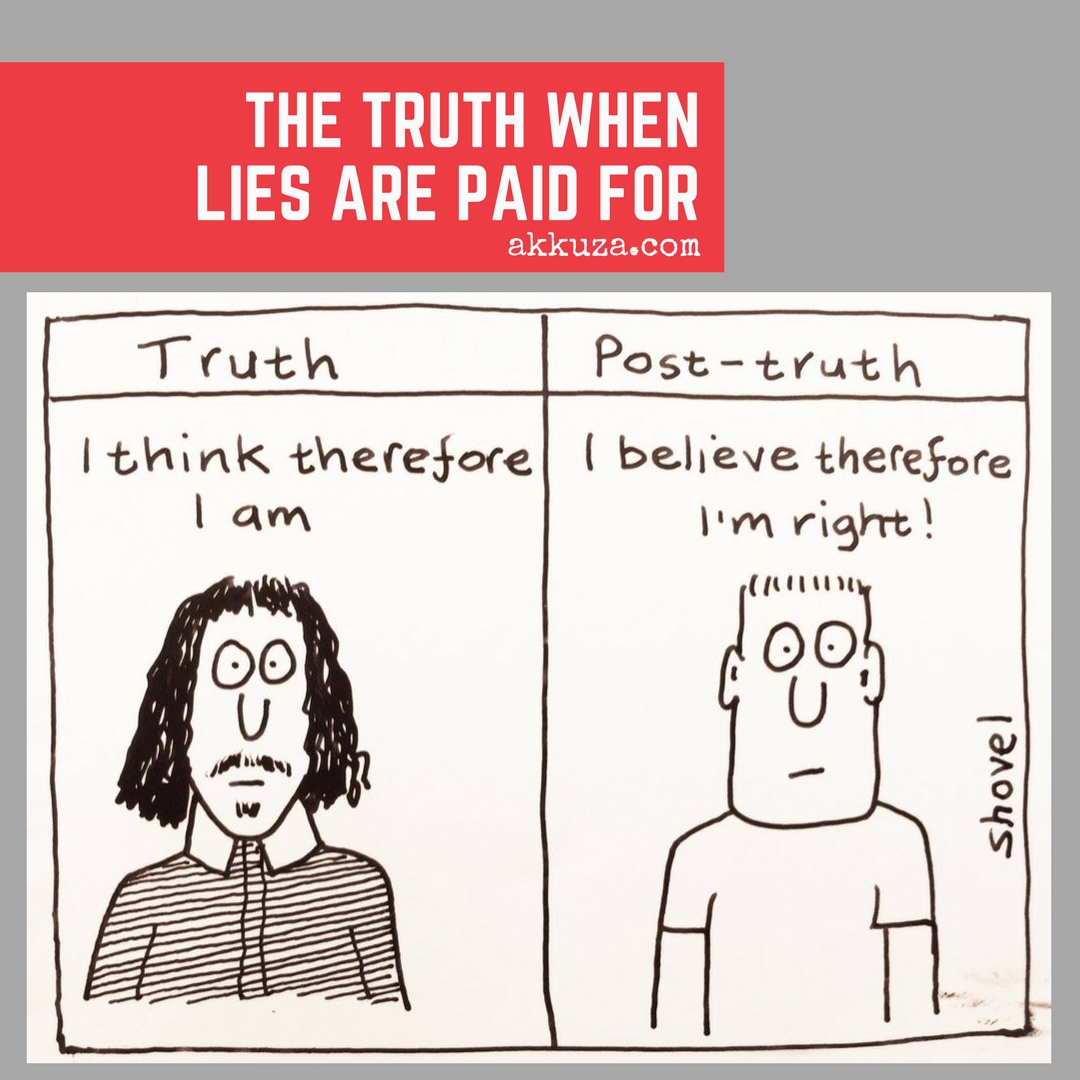
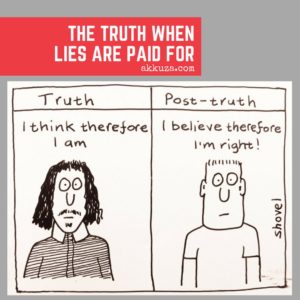
Way back in 2005 I chose the slogan “the truth, if I lie” (la vérité si je mens) for this blog. The truth is an important aspect whether we are talking about reporting or opinion forming. Facts and the truth should be the basis of assessment in a normal democracy. We all know by now that in this age of post-truth this has changed:

“We have entered a new phase of political and intellectual combat, in which democratic orthodoxies and institutions are being shaken to their foundations by a wave of ugly populism. Rationality is threatened by emotion, diversity by nativism, liberty by a drift towards autocracy. More than ever, the practice of politics is perceived as a zero-sum game, rather than a contest between ideas. […] At the heart of this global trend is a crash in the value of truth, comparable to the collapse of a currency or a stock.” (Matthew D’Ancona, Post Truth, The new war on truth and how to fight back).

One manifestation of the manipulation of truth is the increasing use of space on mainstream media for paid propagation of information. Large chunks of public money are used to buy space on media to sell statements in an effort to turn them into universally accepted truths. More often than not the use of “statistics” is facilitated by the virtual disappearance of any proper watchdog and by the building of walls of silence that laugh in the face of the transparency that should be reinforcing the veracity of such statements.

Take the “record unemployment” figures that this government loves to flaunt. Behind such figures lie so many half-truths buried in statistical convolutions such as the reformed unemployment scheme that ensures that people vanish off the lists much before they enter gainful employment, such as the obvious reliance on a bloated civil service to take on more “jobs for the boys”. That same record unemployment was behind the use of the power of incumbency in the last election where famously Gozitan entrepreneurs and SME’s and employers in the entertainment industry found themselves short of staff simply because the government did the magic absorbing trick of vanishing their employees away into the civil service.

But there is another equally worrying trend. The government has found ways to buy “authenticity” by purchasing its way onto spaces in the media that could deceivingly be passed away as independent reporting. In the beginning it was close collaboration with houses like The Economist hosting talks in Malta packed full of government spokespersons and ministers. The Economist would be happy to lend its name to a national government paying its way into its discussion space. Two “The World in XXX” events plus one “Mediterranean Leadership Summit” were thus organised by the Economist in Malta at the Hilton Portomaso. The Mediterranean Leadership Summit, held in 2016, included Henley and Partners as its Gold Sponsor (we all know who these are), the Libyan Investment Authority as its Silver Sponsor (notwithstanding the fact that the LIA had had its assets frozen by the UN since 2011), and Finance Malta and Maltco lotteries as contributors.

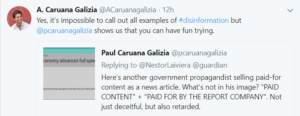
It is not just events though. Articles can now be bought. Yes, you read that right. Articles on major international news portals can actually be “paid content”. Thus, the CNN article doing the rounds about Malta being one of the Top 15 country destinations for Christmas was apparently yet another paid article. Here are Andrew and Paul Caruana Galizia calling out another paid report, this time one that appeared on the Guardian:

Do not underestimate the government use of paid social media ads and posts (such as facebook campaigns). As time goes by, the Facebook algorithms are fine tuned to push to the top of your screens any paid information. While you scroll through the online papers and you see repeat adverts also paid for by government to promote its spin remember that. The campaign to disinform is much stronger than you think. The solution is to be vigilant and call out whenever you can.

Finally do not let the irony escape you that these lies and half-truths are funded by YOUR money. You are actually paying taxes that are then used to sell you untruths.

It’s a liars’ world out there. The truth, if I lie.

Facebook Comments Box

The Empress has no clothes!


Eleonora Sartori returns with a guest post concerning the concept of shame and its value in today’s society,

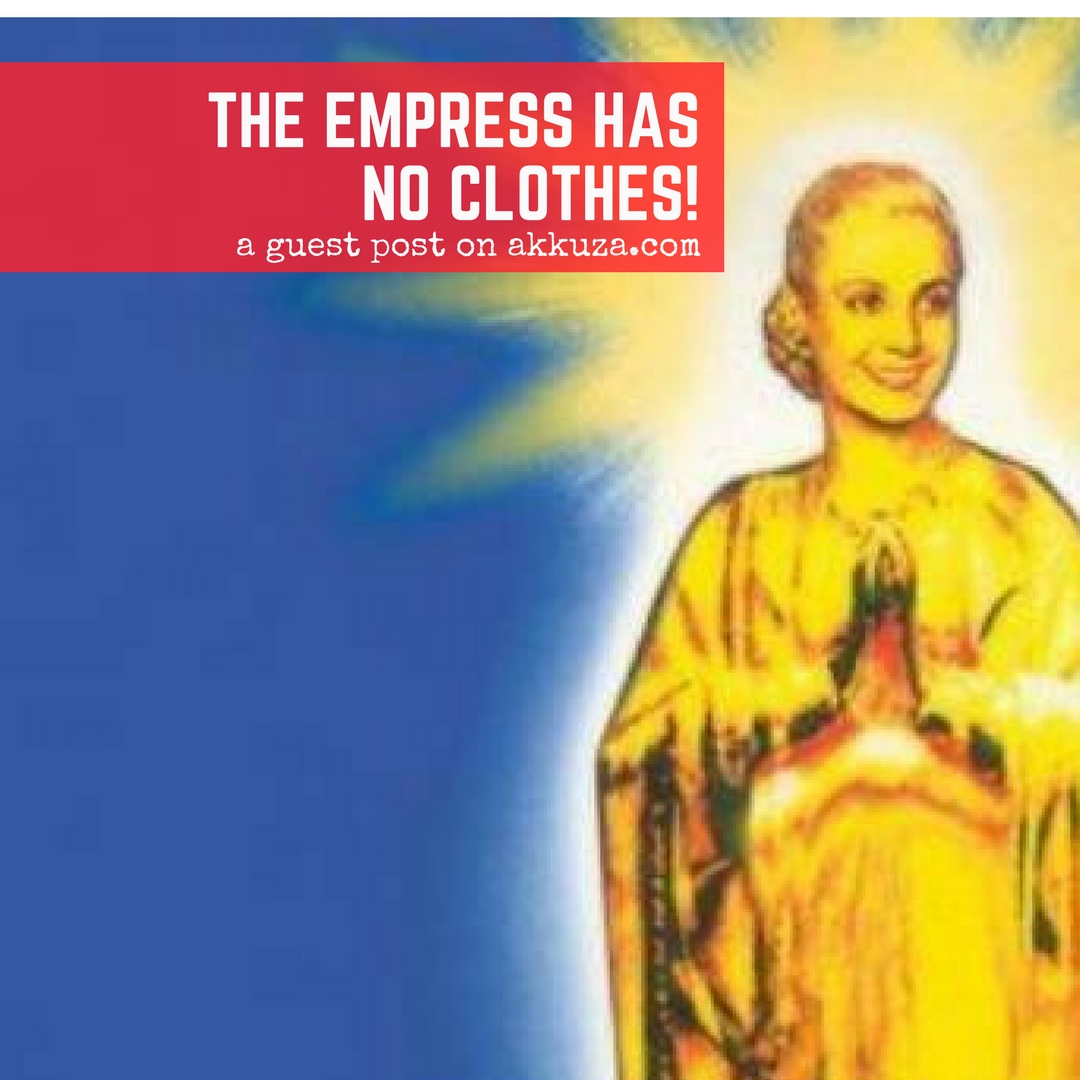
The Empress has no clothes! (Not that she would need much in the Bahamas).

“A sinner comes before you, Cersei of House Lannister. Mother to His Grace, King Tommen, widow of His Grace, King Robert. She has committed the acts of falsehood and fornication. She has confessed her sins, and begged for forgiveness. To demonstrate her repentance, she will cast aside all pride, all artifice, and present herself as the gods made her….

This is how George R.R. Martin describes the ritual of punishment and penance named “walk of atonement”, used to publicly shame women accused of adultery or prostitution. The confessed sinner has to walk a certain distance stripped of all clothing, exposed to the eyes and jeers of the common people.

Somehow, this brings back the image described in the Gospel of John, the Pharisees, when a woman who has committed adultery is brought unto Jesus since she is meant to be publicly shamed by being stoned. Shame is in fact a condition of humiliating disgrace or disrepute, the ignominy of being subject to a very degrading condition. However, Jesus unexpectedly answers back: “He that is without sin among you, let him first cast a stone at her.”

“He that is without sin among you”. Another aspect of shame, this time related to the self-awareness of one’s own sins. Shame caused by consciousness of guilt, shortcoming or impropriety.

Shame is indeed a manifold concept. It is also a very important pillar of humankind, as very well stressed by Professor Gardini in an article published some weeks ago on Sette – Corriere della Sera (Di cosa ti vergogni?).

But first, why am I talking about shame right now?

I felt the urge of sharing these thoughts when yesterday I read about the fact that the wife of your Prime Minister has been nominated Volunteer of the Year. As correctly put in an article published on The Shift, “The issue at stake was not the validity of Michelle Muscat’s contribution to charity which includes a 10-hour swim to raise funds for the charity she chairs, but the lack of institutional sobriety that comes across when organs of the State bestow honours on the immediate family members of high ranking officials” (It’s all about perception my dear).

The lack of institutional sobriety combines with the constant lack of transparence of appointment procedures on a worldwide scale. I’m just too tired of this ambiguous scenario we’re currently living in, where on the one hand, we have Ivanka Trump championing the cause of women empowerment by carrying out a Fashion Diplomacy strategy and on the other hand, we see Time Magazine nominating the members of the successful and long-awaited #MeToo campaign as Person of the Year.

Does no one feel ashamed for this current situation?

Then I remembered the article of Professor Gardini and I understood the core message conveyed by it. We’re no longer used to feel any shame nor to feel ashamed. Yet, I truly believe that restoring this precious feeling could only improve the democratic society in which we ought to be living in the 21st century.

Referring to Cicero in his analysis, Professor Gardini underlines that he who is capable of feeling shame presumes the existence of a superior entity, a so-called “superior thought”, that is able to assess and judge the insufficiency of one’s actions and in front of which one needs therefore to repent and rehabilitate. This superior thought is nothing but a set of values to which abides the community to whom we belong. A set of values respected by the other members of his community, who can judge and criticize you if you go off track.

Therefore, the sense of guilt is not merely private, but has a public dimension too. It’s the core expression of the principle of accountability.

But what about this principle in the digital era?

Professor Gardini correctly points out that nowadays we no longer belong to a community, but we choose virtual groups to which we want to belong. These groups do not form small societies based on confrontation and discussion, but instead exist as virtual projections of one’s imagine of one’s self. I create my group and in that group I am that particular version of myself.

Thus, in my virtual group I can always claim to be constantly right, since I have the right to reject every kind of confrontation and the arrogance not to take into account any potential different opinion. So much for the principle of accountability.

And yet, there is a very simple way to restore the role of shame in our modern society.

It’s every citizen’s duty to reintegrate into their daily routine the perception of shame and shameful actions. As well pointed out by the Background Paper published by SIDA on Accountability, Transparency and the Rule of Law within the Post-2015 Agenda, “the mere process and framework of accountability, transparency and the rule of law is not enough. What comes out of these structures and processes will, in the end, be determined by the social cohesion among people, as well as by the values and the political environment in society. Individuals have responsibilities and powers of their own to change and affect social norms and trends. Formal structures alone can never guarantee decent societies. »

It is you, the people, who have to publicly shame who you think does not abide by your set of values.

“Then the eyes of both of them were opened, and they realized they were naked; so they sewed fig leaves together and made coverings for themselves.” reads Genesis 3:7.


Facebook Comments Box