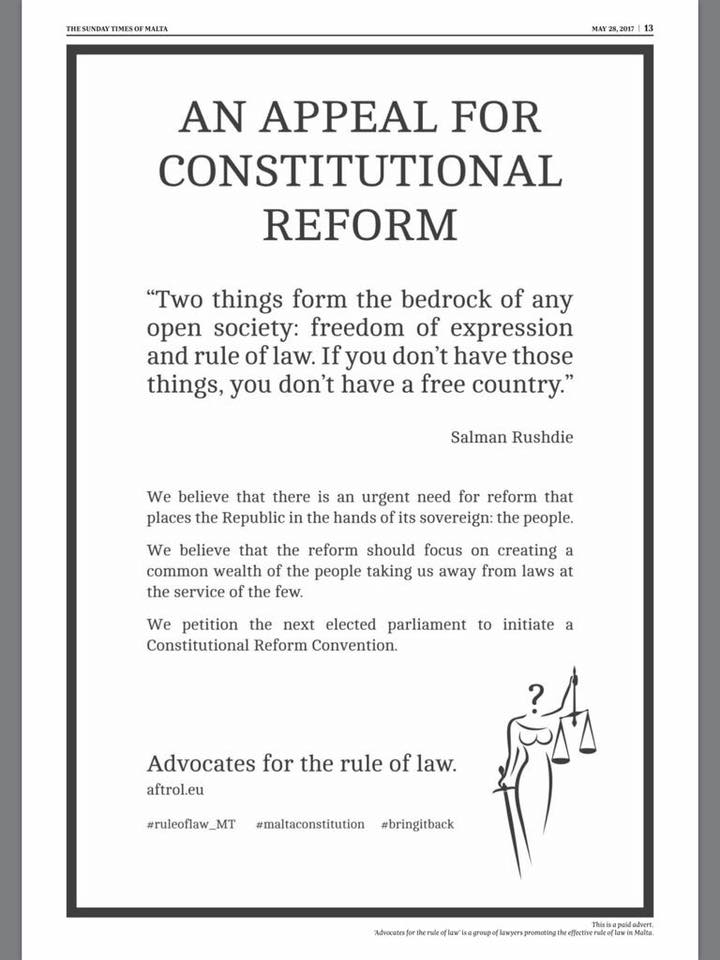
Let us begin with a truth that bears repeating: democracy does not die in one fell swoop, but by a series of quiet manipulations, each too technical to stir mass indignation, each cloaked in the language of efficiency, reform, or sovereignty. Malta is not facing an immediate coup. But what it is experiencing is something more insidious: a slow, deliberate capture of the very institutions designed to safeguard the public from arbitrary power.
This is not a matter of partisan allegiance. It is a matter of record. And the record is clear.
Over the last decade, Malta’s government has steadily expanded its reach over institutions that were once conceived to act as checks on executive power. The judiciary has found its independence compromised—not with tanks in the streets, but with legislation in Parliament and political appointments cloaked in the veneer of reform.
One need not speculate. The Venice Commission, the Council of Europe, and multiple rulings from the European Court of Justice have signalled alarm. Judicial appointments were, for years, controlled by the Prime Minister’s office. Though recent changes were made following external pressure, the culture of loyalty and reward remains. Judges rise not merely by merit, but by proximity to power. And when they speak out—if they speak out—they do so at their own peril.
This is not the natural order of things. It is a design.
Oversight mechanisms have not been dismantled; they have been neutralised. The Planning Authority now issues permits in defiance of local plans and common sense. Its appeals tribunal, once a citizen’s last recourse, is to be stripped of real power under new legislation that proposes that courts may no longer revoke unlawful permits. Instead, they must refer the matter back to the same authority whose decision was deemed defective. This is not justice; it is theatre.
What becomes of a nation where wrongdoers can outlast the process meant to stop them? Where court action becomes a maze designed to exhaust, confuse, and bankrupt rather than to protect? In such a nation, impunity is not an accident—it is a feature of the system.
One may ask: where are the anti-corruption laws? Where are the safeguards? They exist, on paper. But paper burns. Legislation intended to curb corruption has been hollowed out by amendments, delayed by “consultation,” or applied selectively. The Freedom of Information Act remains more honoured in the breach than the observance. Whistleblower protections are limited in scope and rarely invoked. Asset declarations are filed but not verified. And the institutions charged with enforcement—the Commissioner for Standards, the Ombudsman, the Auditor General—are afforded just enough power to seem respectable, and just enough constraint to remain ineffective.
This is the scaffolding of democratic decay. The façade remains intact: there are courts, there are laws, there are committees. But the substance has shifted. What was once meant to serve the public now serves power. Those who protest are smeared, sued, or ignored. Civil society is tolerated but never embraced.
This is not a new story. Other democracies have walked this road—Hungary, Turkey, Poland. Their governments too spoke the language of reform. Their leaders too invoked the will of the people as they dismantled the machinery of accountability.
And let us be clear: this is not about one scandal or one administration. This is about a systemic drift, a deliberate weakening of the structures that make accountability possible. It is about a state that no longer tolerates friction—be it from courts, journalists, NGOs, or ordinary citizens—and seeks instead a smooth path to its ends, unchecked and unchallenged.
The result is a nation where corruption does not need to be concealed; it thrives in plain sight, protected not by secrecy but by inertia. It is a nation where reform is promised as a shield, and delay becomes a tactic. A nation where outrage has become routine, and resignation replaces resistance.
But resignation is not destiny.
Malta is still a member of the European Union. It is still bound by the Charter of Fundamental Rights. The courts in Luxembourg still have jurisdiction. Civil society still speaks, though with growing fatigue. Journalists still report, though some have paid the highest price. The fire has not gone out—but it flickers.
We must remind ourselves, as Edward R. Murrow once did in darker times, that “a nation of sheep will beget a government of wolves.” The purpose of institutions is not to please the powerful, but to restrain them. The rule of law does not ask whether the law was passed by a majority, but whether it serves justice.
This is not the end, unless we accept it as such. The law can be restored. Institutions can be rebuilt. But only if we speak plainly, act firmly, and refuse to be lulled into silence by the language of procedural normalcy.
The time for euphemism is over.
This is the record. And it is our responsibility to change it.
