The Debono Damocles’ Sword still hangs on the nationalist government notwithstanding all the peace entreaties of the last hours. Lawrence Gonzi must be plucking away at his own version of “loves me – loves me not” petals while rumour has it that the strategy team at Pietà are already hard at work preparing for a tough campaign. So what we have really is speculation about the “when” of an election and the closer we get to the official expiry date of the nationalist mandate the more the “if” becomes superfluous. It’s all well and good for the punters and underground betters who would slip a euro or two on the outcome of Thursday’s confidence vote but if we were to look at the happenings from a wider point of view the importance of this moment is minor. Trivial even.
For the day will come when the election is called – with or without a Franco tantrum – and the nation will shift to election gear without as much as a by-your-leave. That day will mark the first day in the life of Franco the non-entity, relegated to the footnotes of history and the school reports of a Jesuit college. It will also be the end of speculation as to whether an election should take place and this will be replaced by speculation on who will get the most votes. We’ve seen the polls that talk of swings of point advantages and of the presumed underdogs. We are still in the realm of electioneering though – it’s all about tactic. When to call the election, what marketing and spin to push in the run up to gather people’s attention, and then we move into the appearances – the debates, the flaws and the track records.
All well and good. We are after all experts in the field. If Italy is a nation of football coaches, Malta is a nation of election supremos. Everybody knows what it takes to win an election. Or to lose it. What we do seem to be forgetting more and more – as we are all taken up with suppositions, political chess moves and admiration/scorn at the latest politician who makes his move in the arena – what we seem to be forgetting is that politics is about content. You know: the program, the manifesto, the ideas, the management plan, the principles espoused by the candidates. Yep those. Because whether Franco caves in on Thursday or whether we will have an election close to the next budget makes no difference. Theoretically we need to be voting on content.
And my friends, lend me your ears – I’ll repay you with interest – of content there does not seem to be much. Gatt, Cachia Caruana and lord knows who else might be locked in some room planning strategy but if they are going by the same measure as last time round then strategy involves packaging muck and shit and selling it as gold in the hope that enough consumers fall for it. There will also be large helpings of “the others are a crock of unelectable shite” to go around – which is short of a synoptic way of saying “hey, who cares what we have to offer – so long as you don’t get the other bunch”.
Now if I was a part of the Nationalist party with its history I would be speaking in the language of sacrifices and principles. This is the time of sackcloth and rolling up of sleeves. This is the time for the party to look inwards and ask itself who it wants to be and what principles it wants to espouse. From the social (education, pensions, solidarity) to the economic (how to run a nation responsibly, thriftily while stimulating creativity and open competition). First get your DNA in place. Then comes the all important part. Only get people on board who are willing to fight for this plan. They must believe in these principles more than they must yearn for power. For power is borrowed in trust but principles should be for life.
The sacrifice that a reformed nationalist party must be prepared to make is that it should be clear that it prefers principles over power. A minority in parliament with strong beliefs is a stronger foundation for the future than a ramshackle combination of mercenaries prepared to win the temporary vote but without a clue about the road ahead.
This is the real prep talk that should be on the lips of the nationalist party team right now. It should be obvious that power for power’s sake is a dangerous weapon indeed. And I have the feeling that the first person to notice this will be Joseph Muscat should he wake up in a Castille office the first working day after the election.
Much is being made in the Labour-friendly press and media about the supposed strategic “U-turn” that is in progress in the spanking new halls at PN HQ. I will look into the fallacy of the “u-turn” argument in one of my next posts and will attempt to explain how rather than a “u-turn”, the current within PN thinking might actually be a correct interpretation of christian-democrat politics for the 21st century – always admitting that there is one version of correct in politics (let’s call it “more correct”).
What is more important at this junction is that the nationalist party wants to be seen as being seriously committed to a set of updated values – a commitment underlined by the fact that Lawrence Gonzi spoke in terms of a “pacta sunt servanda” (patti chiari, amicizia lunga) approach. That’s right. If this exercise is not going to turn out to be an exercise in shiny marketing rewrapping of the kind that was slowly proving to be the undoing of the nationalist party’s values then it should not be limited to fine talk but should be transformed into concrete action.
The fourth point in the new PN document presented at the General Council is a direct reference to “taking decisions responsibly”. With the commitment to take decisions responsibly comes the onus to take responsibility for one’s actions. A tautology if ever there was one but a clear one for that. Accountability can no longer remain a buzzword in the propaganda circles when you are committing yourself to strengthening the value-driven approach to politics.
Which is why Joseph Grech of the Gozo Channel Co. should no longer hold the position of Chairman today. A ministerial reprimand does not suffice in the eyes of those who are supposed to be learning the new lessons and approach of “patti chiari, amicizia lunga”. I don’t know if it was the young turk Carol Aquilina who stated that the PN rightly choses people it can trust to manage important positions in government or state-related companies. Sure Carol, but the corollary to that reasoning is that the PN trusts such persons to carry out the job because it believes that they are the right vehicles to bring into effect the policies that are inspired by the PN’s basic principles. The circle of trust is double – the PN government trusts them with putting policy into action but it does so as the custodian of the trust “lent” (and I emphasise the lending part) to it by the people.
Joseph Grech’s move to call back a Gozo Ferry was not a gaffe. It was an administrative no-no of the highest order – described as an “abuse of office” in most law books. A serious government wanting to impress with the value of responsibility cannot factor the idea of “resignation” out of the equation… otherwise the message is not of responsibility but of “friends of friends” come what may.
The meter of updated values has to begin to apply as of yesterday. Even when selecting its round of candidates for next elections the PN must bear this in mind. You cannot whitewash over past errors simply by wearing a new dress. Pardon the cliche but actions are worth a thousand words… and the PN needs to start acting fast.
Labour (Inhobbkom’s Labour not Ed’s New New One) is busy conferencing this weekend. They’re huddled cosily in the university’s Aula Magna for a full day of talks in a conference entitled “Revisting Labour’s History” and I still cannot get over the fact that I was unable to make it there. Yes, you read that right, I would have loved to witness at first hand this conference of sorts that is part of the wider Labour strategy of “Re-”s. They’re re-visiting their history, re-inventing their logo, re-gurgitating old economic principles, re-moving their facial hair and (once again) re-cycling an image that has been a work in progress since is-Salvatur ta’ Malta went into re-tirement (never a minute too late).
There’s something manifestly wrong in the way Labour went about this whole “re-” business though, and this weekend’s conference contains some clear pointers to what that could be. Someone, somewhere is guilty of a gross miscalculation when choosing the title first of all: “Revisiting Labour’s History”. It’s the political equivalent of a Freudian slip combined with all the evident trappings of a modern day “Pimp my Party” in the making. The term “revisit” is a few letters away from becoming “revise” and I have a hunch that this is not a small coincidence.
In legal terms, when a court revisits an earlier decision it normally does so because of the necessity of reinterpreting the earlier position – there would be not other reason to revisit and reopen the case. In historical terms there is another “re-” word that is of relevance here. It’s the idea of revisionism. Revisionism need not always be extreme as in holocaust denial. Reading through the agenda of this weekend’s conference, I couldn’t help but think that Labour is sorely tempted to rewrite some chapters of history of its own. They’ve been at it for a while now and we have all become used to the polyphonic history of our islands – whether it is sung by Mary Spiteri to the tunes of Gensna or whether it is yelled from the pedestals of il-Fosos by the latest crowd-stirring nationalist orator – the messages are always excitingly dissonant and cacophonous: the result of two virtual realities and perceptions colliding.
Rapid eye movement
The political audience is already, as it is, doomed to the regular resurrection of revisited myths and legends in our political discourse. The narratives woven by opposing parties are now firmly ingrained in our collective minds and it is hard to reasonably detach from them completely. It is extremely significant that, bang in the middle of the process of change and reinvention, Labour chose to “revisit” its history and discuss, among other things: “The Worker Student Scheme: 1978-1987”. As I type (11.30am, Saturday, 2 October), Peter Mayo is about to launch into an explanation of how Great Leader Mintoff (May God Give Him Long Life and Order a Hail of Stones on All His Evil Wishers) sowed the seeds of the stipend system and how we must be eternally grateful for his insights that allowed us to progress to a university accepting 3,000+ freshers this year.
The irony will be lost on the listeners sitting in that cosy hall of the Aula Magna on the 2nd of October 2010 that 33 years and one day before this the atmosphere in that very same place would best have been described as tensely electric. I wonder whether Peter Mayo will stop for a moment to explain to the young listeners (I’d imagine a Nikita Alamango fawning in the audience – one who according to her latest Times “blog” post cannot stand the PN reminders of the past) that on the 3rd October 1977 the opening ceremony at university featured heavy protests by the medical students who had just been shut out of the course (and always risked brutal cancellation if the thugs decided that it was open day at Tal-Qroqq).
Sure, it was not yet 1978 so it might (just) be beyond Peter Mayo’s remit. He will be forgiven therefore for not reminding those present that only two days later, on 5 October 1977, the man dubbed as is-Salvatur tal-Maltin would walk past a group of students chained to the railings in Castille oblivious to the fact that his government’s decisions in the educational sector (the much lauded Worker Student Scheme) were about to deny thousands of young people the path to tertiary education and send them abroad in droves.
Remember, remember the 5th of October
To be fair to Peter Mayo he probably couldn’t dare criticise the workings of the Great Leader. Not after a wonderful morning discussing his battles with the church in the sixties and his “electrifying” speeches to the proletariat. The electric effect Mintoff and his handymen had on some parts of the population would best be described as “shocking” actually. Whatever you may think of Labour’s dim-witted purposive ignorance of the past and bulldozering of historic relevance, don’t you for one moment run away with the idea that it is only the party of Joseph, Evarist (Bartolo – of removed stipends fame) and Alfred (Sant – of interview boards at university) who is in the business of revising historical facts.
You see, I sympathise with such Young Turks as Nikita Alamango who are frustrated at having to carry the burden of Labour’s past every time they squeak a new idea or criticise the current regime (sorry – did I say regime? – it’s the “Re” word fixation). Hell, this week even the German Republic paid the final instalment in World War I Reparations (started paying in 1919 and was suspended as long as Germany was split). Ninety-two years on and the German conscience is slightly freer – so why not Labour? Most times they are right. PN lackeys all too often emerge from the primordial slew of infertile political ground and rely on historical mudslinging for want of a better argument.
The problem I have with Labour is twofold – disputing the relevance of past actions is one thing. Revising (sorry, revisiting) them is another. Revisiting them on the anniversary of events that marked the watershed of Old Labour’s hopeless politics of the late 70s is insulting – insulting not just to the PN hardliners but also to neutral observers like myself who can see through the charade. Labour cannot expect this to go unnoticed. It is strategically stupid and politically insensitive. It does not stop at conferences: Recently, someone from Labour’s “think-tank” (IDEAT) was busy on Facebook quoting a party press release which stated that the current government’s agreements with China are a confirmation of the Labour vision of the seventies. Sit down and weep.
Virtually real
Mine is not simply an angry case of indignation though. Labour’s Revisionist Conference is part of a wider mentality that is the inner workings and thinking of the two major parties in this country. In this day and age of multimedia and mass communication, the modes of communication might be evolving at such a rapid pace that we will soon be tweeting in our sleep, but there is one basic constant whether it’s TV, radio, newspaper or Internet and that constant is the word. In principio stat verbum (in the beginning was the word) and it’s going to be with us for a long time yet.
Words and their meaning are at the basis of whatever construction of reality we choose to live in. Einstein once stated that reality is an illusion but a very good illusion at that. The PLPN (un)wittingly engage in a constant battleground of establishing the reality in which we live (and that is why they NEED the media influence). Whether we are considering the “cost of living”, the “minimum wage” or the “living wage”, we sometimes fail to notice that a large number of constants that we take for granted in these arguments are the fruit of elaborate definitions of perception suited to whatever party is making its claim. We are not that dopey really – there is a general acceptance that “parties colour the world as best they see it”, and although as a nation we struggle to come to terms with irony and sarcasm we still manage to joke about the PL-PN chiaroscuro worlds.
I am not sure however about how much the electorate is in control of the button that switches us between perception and reality. How capable are we of switching off the virtual reality and putting our foot down when we believe that things have been taken too far? Can we decide when we want to open our eyes? Are we, like the character in Almodovar’s Abre Los Ojos (open your eyes – spoiler warning) still able to opt out of the programme that creates a “lucid and lifelike virtual reality of dreams” and yell that enough is enough? Worse still – have the very parties that are responsible for the manufactured realities that we inhabit become so embroiled and enmeshed in them that they are unable to find the switch themselves?
Denial
Take the Nationalist Party. They are an incredible subject for this sort of test. This week they engaged in a mind-boggling collective exercise of denial of truths. We had Minister Tonio Fenech and his cataclysmic Tax-Free Maid slip. Watching The Times interview that gave Tonio a chance to right his previous wrongs was like watching an exercise in verbal prestidigitation featuring a ministerial equivalent of the Mad Hatter. Quizzed on VAT he replied on Stamp Duty and vice-versa, and then went on a trip about not having to answer about private affairs that he himself had brought up as a public example. You could only squirm in your seat as you watched Tonio attempt to make his statements vanish into thin air. Apologists tried other tactics – the cream of the crop coming from the Runs claiming that since the law is inadequate then Tonio and his maid are right in not following it to the letter. Perception? Forget the doors… they’ve swallowed the key.
Meanwhile El Supremo del Govermento was busy wearing the party hat, having been asked to pass summary judgement on the PBO-VAT saga. Prime Minister Lawrence Gonzi found absolutely nothing incongruous with the fact that his very exacting sec-gen failed to apply his own standards of political propriety when faced with a legal crisis of his own. Same same but different – just like in the alleyways in Thailand when they sell fake brands. Fake – it’s just an illusion of reality but not exactly so.
As if PBO and Tonio were not enough, we also had the DimechGate spin-off in the form of the uncomfortable presence of Robert Arrigo – the last of the disgruntled backbenchers. PN councillor Yves Cali was the latest to slip in a frank interview with The Times in which he more than just alleged that Arrigo was in the business of throwing his weight around the council to get what he wants. Yves (or Bobby) tried to retract his statement so an irritated Times published a transcript of the interview in which the allegations were made. A transcript – that’s a word for word proof that the statements were made. Quizzed about this, Paul Borg Olivier (fresh from his own reality check) came up with the quote of the week by insisting that the transcript published by The Times was “not faithful to the statement of clarification made by Yves Cali”.
Open your eyes
Take your time and read that short, Orwellian PBO phrase. If ever there was an example of the convoluted logic somersaults performed by parties to twist your perception of reality, here it was.
The transcript (a text bearing witness to reality at its crudest) was not faithful to the statement of clarification (an attempt at revising/reinterpreting that reality). And which reality does PBO want you to believe? No prizes for guessing.
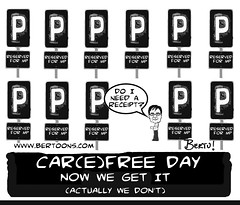
We need to open your eyes. This is a political generation that one week expresses its love for the environment on car free day while parading in front of journalists using alternative modes of transportation and then, in the following week, the collective parliamentary group (PLPN) self-allocates a huge chunk of (previously pedestrian) Merchants Street for reserved MP parking in connivance with the Valletta Local Council (remember Cali? “We serve our MPs and Labour serve theirs”). The excuse? It will free up more parking for residents and visitors. Park and Ride anyone?
It’s time we opened our eyes – and remember, sometimes actions speak louder than words.