Broken Bad the first

The most expensive salvage operation in history takes place today. It will cost nigh 300 million dollars to lift the Costa Concordia out of the waters close to Giglio Island in Italy. Captain Schettino’s handiwork has led to a magnificent effort in logistics and this in turn has hogged the headlines this week – ahead of Japan’s latest natural crisis.

Closer to home the Nationalist party begins its preparations for the annual Independence Day celebrations. The young PN leader was the author of what I thought was a rather weak catchphrase in the run up to the last election: “Gas down għal-ġol ħajt” would be repeated with ecstatic fervour by the die-hards at every other rally. Fast forward half a year and Simon Busuttil finds himself at the helm of a shipwrecked party that risks total collapse into oblivion if no salvage operation takes place some time soon. Sadly the focus seems to be (or, given the way things work in the PLPN world, has to be) on the money.

I hate to use words like “the problem is” because this blog is about punditry that does not go to the extent of scientific analysis. In other words I have no polls and statistics to back what in the end are “hunches”. Yet, given the sufficient dose of necessary caveats, I would not think it to be amiss to state that “the problem with the PN is” that it is still thinking in the same old, same old mould. This “Broken Bad” series is an attempt to look into what is wrong and what can be righted. Like the legend of the phoenix…

Get Lucky?

So to begin with, what is left of the PN admin seems to have this massive obsession with financial debts. You cannot reasonably claim that this worry is not understandable yet there is much to be said about the fact that the financial burdens of the PN are an inheritance that is directly related to the current modus operandi and mindset of the party. In other words the current debts can only get worse if the party keeps on thinking in terms of playing the game as they have for the last thirty years. Unsustainable media and the absence of a real thinking machine (that was forfeited ages ago to be replaced by a combination of “crowd sourced blah” and “knee-jerk-I-have-an-ideas”) meant that the PN was fully equipped only for the race to mediocrity.

The whole party structure is geared to reward yes men and “loyalists” of a very troubling kind. They’re the kind that think in term of village kazini and would follow any dictat without batting an eyelid. Don’t be fooled by the upstarts who brought the last government tumbling down – they were the price to pay for an all-embracing pick and mix of candidates that our two party alternating system has created. They are the wrong symptom to look at.

What the PN should be focussing on at this stage is one crucial question. “Where are our leaders?” The answer to that should explain why there is a current dearth of leadership now and even more crucially why there does not seem to be a concrete possibility for future leaders to emerge. The PN could wrongly try to emulate the PL and come up with populist rhetoric and cheques that will bounce back in the very near future. The temptation is there and the current brand of PN politician is very much made in that mold.

It is useless to think strategically if you have no basic plan. It is even more useless if your lack of a basic plan exposes the lack of a soul. The PN should be asking itself why it is in the business of politics. Yes, after all these years this is the kind of question that should be at the very basis of it all. The next step would be to build around that. To start thinking again instead of reacting ridiculously. Get out of the box. Think differently and build a party around those thoughts.

It is hard, very hard for a whole system to be completely upgraded… from scratch. The last six months have exposed a seriously weakened PN – lacking moral fibre it has coughed up hopeless positions that are sons of panic thinking. Just think on how the PN congratulated the Labour government for its Libya energy agreement only to notice much later how shallow the MOU really is. This weekend the PN toyed with the idea of making a fuss about Busuttil being booed – it’s back to the “x’gharukaza these Laburisti” way of thinking that will get it nowhere.

So the first rule the PN must look at is the most important one: Know thyself. Why is the nationalist party in politics in the 21st century? It takes a second to wreck it… it takes time to build. 

Minority reports

If it is up to the victors to write history then the losers are busy writing reports. That is just what the PN has just finished doing and it has published an executive summary of this analysis of the 2013 election result. Chaired by the papabile Anne Fenech the committee produced a litany of reasons divided into three parts: Why the Nationalist party lost, Why the Labour party won, and a part that includes suggestions for the future. Unlike the trend in Labour documents the executive summary does not have an obsession with numbering (check out the Law Commission’s latest report for a veritable OCD of numbering) but contains a list all the same. In the words of Eco “We like lists because we don’t want to die“.

In actual fact the first two lists are just a survey – a sort of vox pop  the likes of which could have been obtained by any kind of survey company operating on the market. They are not in themselves the reasons why the nationalist party lost the election (or why Labour won) – they are the reasons why people did not vote for the PN and voted for the PL (sometimes, but not always, “instead” could fit at the end of that sentence). It might seem to be the same but it is different. A survey company would only have omitted those grating praises of the outgoing nationalist party and its achievements (the truth is hard to swallow indeed).

As a political party (and for heavens’ sake don’t give me the movement crap), the Nationalist party is duty bound to look deeper into its soul than simply listing the ills of the people in a quasi-maniacal manner. Idiots without a clue about politics had come up with such lists and polluted the facebook pages with obsessive statuses much before the commission could even start applying its enigmatic PESTLE approach (Ghallinqas kelli ragun fuq din). Worse still the report falls short (but only just) of blaming an ungrateful electorate for not rewarding a highly successful administration – admittedly the temptation is always there (just look at AD).

The report also risks glorifying Joseph Muscat’s “success” notwithstanding the jibes and qualifications that are present at every point in part two. The two lists  – the anti-PN grievances and the analysis of the carrots that Labour distributed for its success – are dangerous in that they seem to push the PN into the ugly ground of emulating the Taghna Lkoll formula. That formula is not about politics but about marketing and building on dissatisfaction. It is the push towards the most mediocre of “political” methodologies represented by a manipulation of people’s needs in order to get into power (promising Turkeys to abolish Christmas) followed up by a display of ineptitude, abuse and lack of direction once such power is achieved.

The PN is in a much luckier position than AD in that it holds the lucky seat of alternation and the dice are seriously tricked in its favour when it comes to having to convince a Labour voter to switch back to itself. The committee is aware of this and has grounded its third part on that type of recommendation – of bringing voter into the fold of this “familja nazzjonalista”. J’accuse has always found this hermeneutic apartheid that grounds our political thinking both distasteful and counterproductive. The labour backlash in government is also a result of this way of thinking.

What the PN needs is to think different. To think outside the box. It risks wasting lots of precious time falsely “rebuilding” by thinking in the same terms as its Commission. What the PN really requires at this point is a look within itself – a hard thought evaluation about what the party means and what it wants to achieve for itself but more importantly for the nation. it needs to ask important questions that define its value and ethical make-up and build upon that block. As the Golden Circle goes it needs to be asking less about what it does or how it does it and focus much, much more on Why.

Once that message is clear Chris Said’s horses and men can begin to put Humpty together again.

The Emperor’s Purse

Much like what happened in the case of his new clothes, the emperor’s purse and his dealings with it tend to be talked about in a very circumstantial manner. The norm is either that of criticising the corrupt wastage or applauding some genius plan – much depends on which side one’s bread is buttered. There are a few reflections to be made as to recent developments in matters relating to the Emperor’s purse.

First up, the Emperor in government. We read that the Commission has recommended the opening of an Excessive Deficit Procedure against Malta and that Malta is the only EU state that will be facing this predicament. What it means is that since Malta has exceeded the 3% deficit threshold it will have to succumb to recommendations and suggestions by the Council as to how it could reduce that figure to below 3%. Still geared in “opposition” thinking, the Taghnalkoll government is eager to put the blame on its predecessor – insofar as the existence of the excessive deficit is concerned (and this even after Muscat claimed that he did not want to make a political football out of it).

There is a contradiction that was identifiable early on – while cost-cutting measures such as creating the world’s first part-time eternal flame were still being announced  (and less than 10,000 euros will be saved by the cabinet that is costing the citizen 60 million 6 million euro more than the previous per year) we heard this absolute gem from the government in reaction to the Commission’s assessment:

Although Malta is the only country set to be placed under fresh EDP, the Maltese government insisted that the Commission’s recommendations were a positive sign for its own economic and fiscal plan in its reaction to them this afternoon. It pointed out that the Commission did not impose additional measures on the country’s budget, stating that this showed its confidence in the new government’s plan.

Which is great no? Only there is one big flaw. Everybody who is anybody knows that the budget referred to in this quote is the same budget that was first voted against by the current government (disguised as a constructive opposition) then approved quickly once it was in government (disguised as a progressive government). Whatsmore that budget is the very same budget devised by that devious and scheming ex-Minister Tonio Fenech – yep, the Nationalist Party In Government Budget. So the emperor is lying… because if anything the fact that the commission did not deem fit to impose additional  measures on the country’s budget only goes to show that the previous stewards of our financial ship had steadied it in the right direction.

Which brings me to the stewards’ current predicament. The appointment of Ray Bugeja to head the PN commission on party finances has been hailed as excellent because the commission is supposedly full of competent people. The whole hand clapping and back slapping exercise might still prove to be futile because what many people are failing to see (or to want to see) is that this is not the case of a company with a profitable product needing tweaking. This is a political party that operates very much in the PLPN tried and tested system of bartering that is only another way of trading in influence.

Short of recommending a complete meltdown of debt-carrying party “resources” there is little that any bunch of King’s Men could do in an honest fashion to put this particular Humpty Dumpty together again. Though the work of Bugeja’s commission is shrouded in economic terms (Sibna sponsor!) the truth remains that it is an issue of party finances and financing – one that has recently been pushed to the discussion table without any particular happy ending in sight. It is a political and maybe even a constitutional issue that will only be solved superficially by an internal party committee. Bugeja’s work seems doomed to be a rubber stamp for more bartering systems, more trading in influence… in short more of the same.

Unless of course the PN gets serious about the business of politics and abandons that very damaging route of politics of business. Int taf x’ifisser!

Manifestly Political – a zolabyte

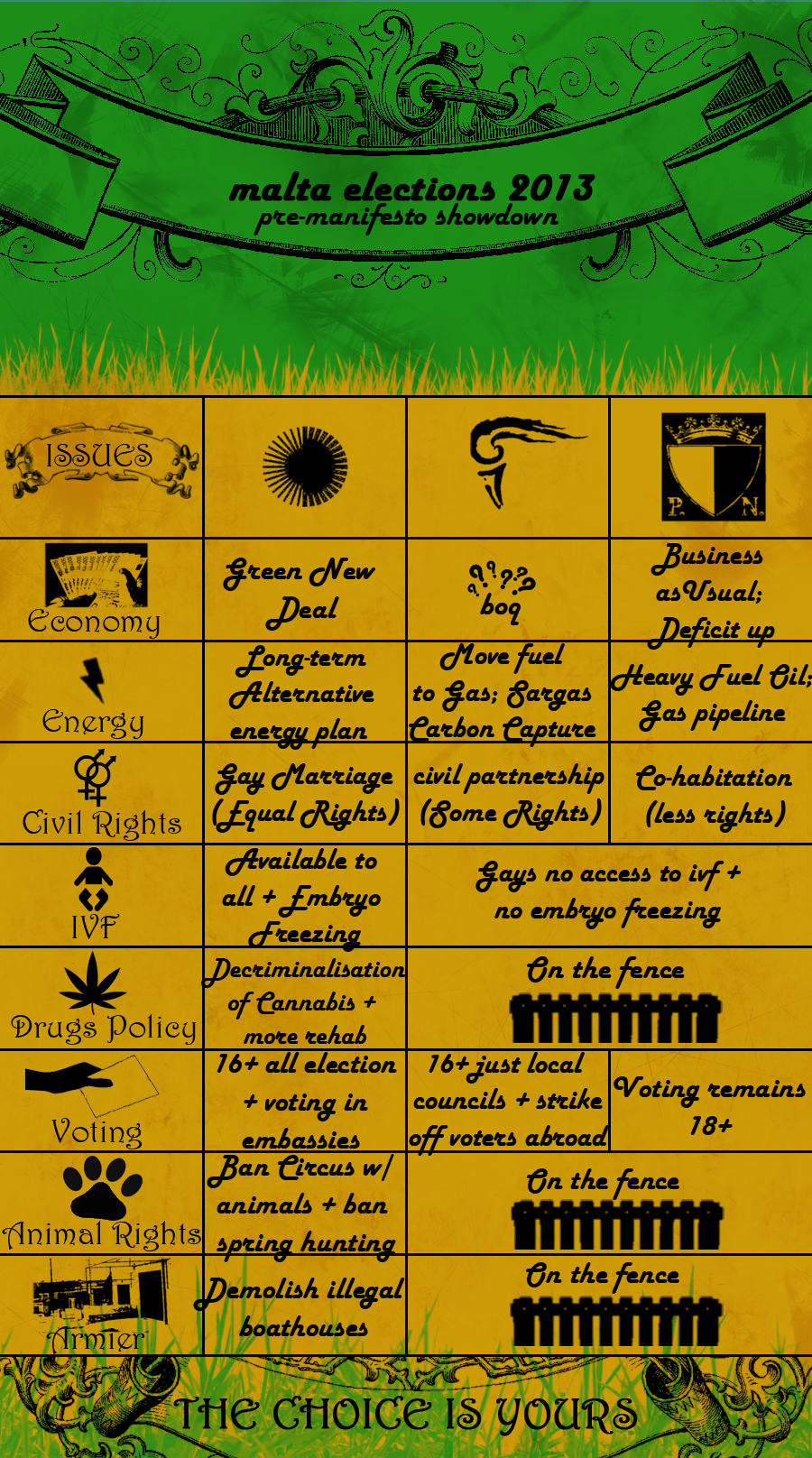
AD’s PRO André Vella has submitted this post as a Zolabyte. In this piece and accompanying infographic Vella compares how the three parties square up before all the manifestos were published. 

A political manifesto is the official seal of approval of a party’s agenda when (and if) in power; but the truth is that certain policies and positions are already lauded in public before approved by any party executive or general meeting.

For any political party, there are two types of issues. The issues you want to avoid, and the issue you can’t stop to talk about. Then there are the not so clear issues which are somewhere in between. Let’s take gay civil rights for example. PL want to flaunt their stance of civil union (which is more liberal than PN) but they do not want to focus on their contradictory inequality of what they are proposing (by not granting gay couples full rights). PN want to talk about gay rights as well, to regain that conservative base by scaring them with the image of a little child having two daddies, doing so knowingly that they might risk alienating the few pink votes they have. For the Green Party, at least, this issue is not in the middle as they took the clearest path towards gay marriage, being the only party fully endorsing MGRM’s proposes.

Somehow, the bigger parties always have the greatest challenge to appease as many people as possible, a task which fails most of the time as you cannot bind a long-serving successful party to populism instead of an ideology.

So while we all wait for the three manifestos to be officially approved, here is a little Infographic, shedding light on some party positions depending on public remarks passed by party officials or press releases. If it looks biased, it is because it is. Until the manifestos are publicly available, this is the pre-manifesto showdown of Malta Elections 2013!

The author is the PRO of Alternattiva Demokratika – The Green Party.

andrevellapic

*****
Zolabytes is a rubrique on J’accuse – the name is a nod to the original J’accuser (Emile Zola) and a building block of the digital age (byte). Zolabytes is intended to be a collection of guest contributions in the spirit of discussion that has been promoted by J’accuse on the online Maltese political scene for 7 years.
Opinions expressed in zolabyte contributions are those of the author in question. Opinions appearing on zolabytes do not necessarily reflect the editorial line of J’accuse the blog.
***

Resigned to reason

The “Christmas Truce” has gone up in ashes with a Ho! Ho! Ho! and without so much as a by your leave. It was obvious from the start (as we had predicted) that the two parties would be unable to contain the inertia of the electoral swing. The 9th of March has a gravitational pull of its own that knows no truces and acknowledges no pauses. Even before the big Anglu Farrugia bomb had fallen into the atmosphere like a big party pooper, the two parties were still heavily active on the promotional front but nothing really changes there.

Anglu’s resignation promises to be much more than a blip on the “truce” agenda. Labour have been forced to hold an extraordinary council meeting between Christmas and New Year. No time to unwrap the presents and no time for Luciano to regale us with the latest news from under the Christmas tree at Casa Busuttil (Labour). Instead Labour will be cooped up voting for their new Deputy Leader for Parliamentary Affairs. Which is quite a bitch really. In the first instance, Parliament is all but wrapped up now and Labour could have provided an interim leader without having to go through the pains of an expedited deputy leadership campaign. The post itself – as was the case with the PN – is not an issue really. Labour’s deputies have been useless props all along – causing more harm than damage (and you cannot say we didn’t tell you so before this happened) – so this is nothing to do with the post per se.

So what IS happening? Why has Labour so evidently gone for this step? Let us see what we can read in them while the facts are still fresh:

1) The Truce

The run up to the truce was an all round victory to the nationalists. Poll gaps were softened and thanks to the shenanigans of Anglu Farrugia (and the complicity of TVM) , the last memory before Christmas would definitely be the bumbling deputy’s antics on Xarabank. Not good, Labour would say. What Labour needed was not a truce but a “casus belli” – an excuse to reset its train on tracks. Ironically Anglu’s perceived moment of triumph over Simon – the very appeal case of which Simon was absolutely ignorant – turned out to be his cup of hemlock. Comments made by Anglu later in the week would become the excuse for Labour to dump excess baggage and to keep the momentum going. Forget Santa… this Christmas the people will have “a new deputy leader”. It was a bit like wishing for an electric car racing track and getting a woolly jumper instead. (Ghax dak ghandek bzonn).

2) The Resignation

I’m quite sure that whoever is supposed to be planning Labour’s campaign must be believing that they have carried out the smartest of moves. In one fell swoop Labour rids itself of an inconvenient bungler, keeps the electoral momentum going and has paved the way for the election of a deputy leader who is capable of returning the swings from that supposed Goliath called Simon. Wrong. We do not need to wait for the election of the new deputy to find out why. First of all Labour has shown once again that it is reactive and never proactive. They allow the Nationalist Party to dictate the rules of the game once the election is in full swing. No matter how much Joseph twists and turns about a “culture of resignation” he will never sell it through. The real reason is that Labour needed a replacement and they needed it fast. In falling for this trap they have allowed the discussion to shift into the barren (and relatively irrelevant) land of Deputy Leaderships. Again J’accuse asks: Since when do Deputy Leaders or Vici Kapi run the country?

3) The Culture of Resignation

Yes. Labour do have a point to win here, albeit a very minor one. Nobody is kidding anyone – this was not an automatic resignation by Anglu Farrugia. He was asked to resign and as we have seen from his reaction and letter, he was not exactly pleased with the result and showed so clearly. He DID resign though – which is the point I mentioned earlier. Muscat still CAN move his people around with relative ease something that Lawrence Gonzi plainly could not do throughout this legislature. It’s a damp victory of course since I am quite sure that the mechanics of this system depends very much on whether you are in government or still desperately aspiring to get there. Farrugia was not in the same position as a Pullicino Orlando or a Debono to mention the obvious two.

It is also about a culture and approach to resignations. I still cannot understand Labour’s fully. On the one hand they are rather cynical and are prepared to break up Christmas in order to realign their electoral plans. On the other hand this resignation turns out to be weakened and diluted by Joseph Muscat’s offer to Farrugia that “the door is still open” for him. How exactly Joseph? What does that mean to us idiots who still believe that a party candidate is accepted when it is clear that his opinions and ideas conform with that of the party ticket? It’s the “anything goes” mentality really – and it also goes to show why the resignation was more about replacing Anglu than about removing him.

4) Teamwork

A small word about teamwork. Joseph got to kick out Anglu without too much squealing and protesting. Labour is taking a risk (whether it is calculated though is another thing) here. An internal election in this period is either going to be a doctored affair – with the anointed one already chosen and pushed – which will make it look fake. It could also be an acrimonious affair that exposes certain faults in the party. The PN media have already started pushing on the weak link of Jason Micallef (as though electoral district rivalries were non existent in the PN camp). Joseph Muscat has been forced to declaim one of his usual tautologies: after a break from promising the eradication of poverty (St. Francis will not be proud) he came back with the assertion that “anything that the PN says is a lie”. If I were the PN Communications office I would issue a quick festive press release in the light of this statement: “Joseph Muscat ragel tal-ostra“.

5) The Nationalists

They’ve definitely been thrown by this sudden earthquake. They might smile while gritting their teeth at any mention of the culture of resignation that so plagued them during the last legislature but that will be a small price to pay. What they have to hope is that the new deputy leader from Labour HQ is not a clone of Simon – which he can very well be. Bar the fact that such a deputy will inevitably have militated against membership of the European Union (or protested mildly) we can expect another person with experience in the EU – an MEP. They’d be surprised at how fast the Labour supporters and the ditherers might warm up to a Louis Grech or Edward Scicluna di turno. Simon’s call until now has been “to bring something new” to Maltese politics since he always worked in Brussels (although he DID write the last electoral manifesto for the PN). Well, Labour might just be about to clone Gonzi’s new toy and in the local world of zero sum assessments it might not be too long before the “Simon move”  will have been replicated.

So the nationalists are right about the Simon effect. Anglu Farrugia did end up resigning after that ill-fated debate on Xarabank. It was not because of any kind of outstanding performance by Simon though. This was a delayed reaction by Labour who has realised very late in the day how badly one of its deputy leaders was effecting its points at the polls. The truth is that Anglu should never have been on the team – or at least he should have been hidden smartly in the same manner the PN hides its more embarrassing (but vote promising) candidates.

Conclusions

There’s much more to be read and seen in this but these are the first impressions. The main certainty we have is that this Christmas will be tinged in red with a couple of PN sideshots every now and then just to keep us in the spirit. The early impression I get is that Labour was pushed to immediate action because of the results that it was seeing the polls – which can only mean that the great divide is no longer so great. It also means that the next campaign promises to be much much more than a simple walkover.


Not Simon Busuttil

Much is being made by the nationalist party and its faithful supporters about the goodwill that the election of Simon Busuttil to vice-leader has brought about. We have heard plenty of words about the change that Simon is supposed to bring about to the nationalist party – presumably the same mistakes of the past will not be committed again, particularly in the arrogance department. Presumably (again) the nationalist party will take care before fielding candidates whose ego will barely fit in one seat of our hallowed chambers in parliament.

With these thoughts in mind I found this video doing the rounds on social networks rather intriguing. It’s a perfect picture of “old vs new” – hosted on a labour station of course – a clear effort to expose the warts (past and future) that the PN carries. And they seem to have been quite successful in doing so (forget the title chosen by the uploader – I don’t think any one of the two egos was comfortable here).

I wonder what Simon makes of this (witt rispekt).