Leader of the Opposition

Adrian Delia is frantically fighting a race against time. It has become increasingly evident that his gamble for leadership of the nationalist party did not include the foresight or plan that would account for the fact that he needs to find a way to get into parliament. This lack of foresight does not bode well for the nationalist party – that it is lead by someone unable to make the most simple of calculations is not exactly a bright light for the future. If my sources are right, plan B for Delia and his entourage seems to be the harassing of a number of MPs that are judged as most likely to want (or to be forced) to give up their seat and make way for the half-heartedly anointed one. It is a clumsy and roundabout way of doing things that jars conspicuously with the declared marketing of TeamDelia of wanting to unite the party behind Adrian as quickly as possible.

Unwitting supporters have even been asked to turn their guns onto the PD as though the damned coalition meant that the Democratic Party owed the Nationalist Party anything other than collaboration in parliament against the forces of corruption. Kudos to Marlene Farrugia who has strongly retorted that she will not be turned in this respect and that the PD will jump at any chance to take the place of any MP who chooses to call it quits and force a by-election. Of course Delia and his team will choose to take this opportunity to ride roughshod over the concept of coalition and collaboration – hatred of anything the coalition was about is after all one of the hallmarks of Delia’s New Way. So much for a deeper understanding of the changes that are necessary in the way politics is made.

But what about the Holy Grail position of the Leader of the Opposition? Well, constitutionally we are in a bit of a conundrum. First of all, none of the conditions that create a vacancy of the position of Leader of Opposition (Article 90(3) of the Constitution) has been fulfilled so technically since Simon Busuttil is still a member of the House of Representatives and consequently has not vacated the position. Let us assume that by informing the President of his intention to no longer lead the nationalist party, Simon Busuttil has de facto given up his place as Leader of the Opposition that he occupied under the terms of 90(2)(a) of the Constitution. In that case, until Delia manages to find a way into Parliament we can try to see who can legitimately fill that constitutional role come the 1st of October. Whichever scenario you take, whether it is under article 90(2)(a) (the MP who leads the opposition party with the largest number of members) or under article 90(4) (If, in the judgment of the President, a member of the House of Representatives other than the Leader of the Opposition, has become the Leader in the House of the opposition party having the greatest numerical strength in the House) – in both cases the Leader of the Opposition is (a) a member of the house and (b) commands/leads the largest number of opposition members. In the absence of the party leader (Adrian Delia) the obvious constitutional choice until the dilemma is solved is to nominate the Deputy Leader for Parliamentary matters (Mario DeMarco) as the Leader of the Opposition.

Sure, it can be a strange situation where the Leader of the Party is not the same person as the Leader of the Opposition but this does not mean that it cannot and will not work. As I said, Delia should have foreseen this situation before he decided to throw in his name as a leadership candidate. It’s not like he was not asked the question as from the start of his campaign. Even a minimum of constitutional knowledge would have told him that no MP on any side of the house owes any party anything. The seats are not theirs to give – they have been elected by their constituents and owe them the duty of representation. Giving up that seat for a man who only three months ago was unwilling to represent any part of the nation would be a betrayal of their constituents of the highest order.

I am quite sure that in the end one MP will be found who will give in to the heavy handed tactics of TeamDelia. It does not bode well at all though. It is one thing to elbow your way into the leadership of a party, it is another altogether to bulldoze your way into a constitutional position without the least bit of deference to the constitutional principles that underlie a constitutional democracy.

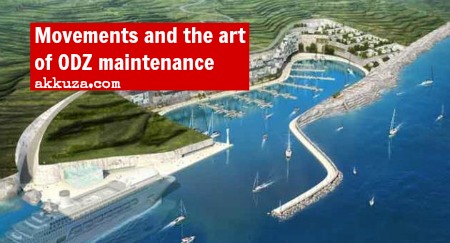


Movements and the art of ODZ maintenance

movementamaintenance_akkuza

Chapman Taylor know something that most of us don’t. Or so it seems. It’s par for the course for Muscat’s government – surprises are sprung, agreements are made without consultation and, of course, electoral promises are broken without losing the beat. Chapman Taylor of Milan jumped the gun by “mistakenly” announcing that they had been awarded the project for what is termed “the development of an unused quarry”. The announcement came complete with pictures of a yacht marina and tourist village, a stones throw away from the idyllic bay of Hondoq.

The architect’s firm has admitted that this was a mistake since the adjudication process is still ongoing. Sadly for Muscat and his band of transparent and meritocratic men this is just another in a long series of projects (we’re still debating the Jordanian Builder’s Toy University in an ODZ) that are sprung on the public as a fait accompli. This one is environmentally and politically sensitive since once again the government would be playing with the shoreline as well as giving the go ahead for a project that would have a huge impact on the environment both on and off shore.

Which brings me to the discourse regarding movements. That this project will be as vociferously opposed as the Zonqor Visa-Machine for Upmarket Arab Sons and Daughters should be taken as read. That the newly created Front Harsien ODZ will take up this baton should be inevitable. The real question is on the long-term destiny of this kind of movement. I have already hinted that the party in opposition should not be shunned or pushed away because of its history with the environment – rather – it should be obliged to commit and tie its destiny to a holistic plan that is based on preservation and enhancement of our environmental heritage.

Does that transform the environment and ODZ into a political football? It has to. It is useless bringing up old grudges and pointing fingers at the PLPN system and claiming that this has to be a political-party-neutral effort because that only means relegating this issue to a knee-jerk/NIMBY kind of issue that has to work in fits and starts every time the party in power decides to steam roller over any form of environmental obligation.

The PN is at a point of transformation. It is at the point of defining its long and short term goals. This is the time for the “movements” to strike and force the PN to become a stronger, more effective and more decisive force than what the AD has ever been. The agenda for environmental protection must become the PN’s because that is the only way it can become part of the system rather than constantly in battle with it.

Muscat’s “movement” has been uncovered as a travesty. His courting of the environmental lobby has been proven time and again to be just words for short term game. There is no space for a real environmental agenda in his plans because it jars deeply with his dealings with constructors and vendors. He has chosen to keep the Sandro Chetcuti and Jordanian investor cards closer to his chest. He still believes that his job-creation words can charm the population into submission and acceptance of hideous plans that threaten our eco-system. If not that than the false battle against the elite in mimic of his hero Mintoff should do the trick.

Movements have a temporary and transitional role in our system. They are intended to influence the parties that matter in a system that is sadly and insufferably a bi-partisan tragedy. For too long have we tried to be convinced that the third way could be an option by driving a wedge in between the parties of the status quo. While in theory it should and would work, in practice it faces a system that was scripted and written for the preservation of the bipartisan alternation notwithstanding the dangers of a race to mediocrity. The weakest link in the system is actually the citizen who reinforces it with his vote.

It is only in moments like these – of crisis (in a philosophical sense) – that movements can play a role. By taking control of the PN agenda on environment and forging it in a lasting way that can guarantee the creation of positive policies for present and future generations much more can be achieved. Obviously this does not mean relinquishing the role of opposing current projects.

The battle to preserve Zonqor and Hondoq and their surroundings has only just begun.

Podemos.


The Lie of the Movements

liemovement_akkuza

When Joseph Muscat came up with the idea of backing a Jordanian builder’s plan to try his luck with owning a university, and when Joseph Muscat agreed to place this trial run uni on public ODZ land, he had no idea of the movement that would build up against him. This is the generally accepted storyline as it is evolving. Muscat makes a pact with the devil and sells off another piece of prime national land and suddenly everybody who counts is up in arms united against the tyrant’s move.

The question of whether or not the university is a legitimate educational enterprise or whether it is really a trojan horse for well-heeled arab youngsters to get their temporary visa into Schengen as a bonus add-on to a pay-as-you-go diploma has been mostly set aside. The political debate as it is has almost entirely swallowed the spin that this is a bonus for education in Malta (or as Varist infamously put it  – breaking of the university monopoly in Malta).  Some academics have started to rumble about the lack of transparency in this regard but most of the rumbling is and has been about the violation of Malta’s ODZ – outside development zone – rules.

Muscat helped push the disdain factor to new limits with his “by hook or by crook” approach early on. This managed to unite a number of different lobby groups under one banner – the newly formed Front Harsien ODZ (Front for the Protection of the ODZs). It’s a simple banner to fall under – if you have Malta’s ODZ and their preservation at heart then you can join. The founders were quick to point out the apolitical nature of the front – in the farcical Maltese style of apolitical that still defies real definition.

The actual political milieu had also begun to have its say. While the Front could boast of the support of various NGOs and of course of Alternattiva Demokratika – ever consistent in its environmental battles – its ranks were soon boosted by the rationally vociferous Marlene Farrugia and her husband Godfrey who is also the whip of the Labour party. We also had the admirable Desiree Attard – a Labour councillor in Marsascala who joined the ranks of those opposing the rape of ODZ land.

Was this a Movement in the making? Is this the opportunity to plant a Podemos or 5stelle? Probably not. The only way the Front Harsien ODZ could rally sufficient support is by staying out of actual politics. Popular movements in Malta – real ones with political stands not faux movements glued together with the sole aim of achieving power – can only be created around issue-specific moments. They can be partially successful if they prove not to have a long term ambition of becoming a party (as in contest an election).

Front Harsien is an important reaction of civic society. It is destined though to remain an issue specific blip on the political spectrum. Which brings me to the party in opposition. A number of backers of the Front Harsien have been quick to shoot down any attempt by the PN to make the issue its own. Their reasoning is that the PN track record on development does not allow it to take a stand now.

In many ways this antagonistic approach is flawed. Given that the Front Harsien has no aspiration to become a political movement, the second best thing it could do is to engage directly with the parties in their respective roles. Right now engagement with the party in government means opposing its plans to ruin ODZ whenever they crop up. Engaging with the PN intelligently would not mean acting as though it is the same antagonist as when it was in government. This is the time to get clear, precise commitments from the PN about how it would act when it inevitably – one day – is in control of the reigns of power.

Getting the PN to clearly commit to protect ODZ’s in the future is as much of a victory for the Front Harsien as would be preventing the PL government from ruining the ODZ at the moment. Exponents such as AD’s Cassola and Cacopardo would do better than rant about PN ‘hypocrisy’ because in realpolitik terms when it comes to safeguarding the ODZ it gets them nowhere.

Get the PN to commit and commit clearly and half your work is done. The other half is more difficult. Get Muscat and his jordanian partners to keep their hands off the ODZs… then the work of the movement is done. And the lie of the land will have taken a good turn.

The unpredictable past

portents_akkuzaThe Russians had an interesting expression while under the communist rule. They would say that even the past is unpredictable – because it kept getting rewritten in order to better fit the needs of whoever was in power at some particular moment. I was reminded of this when I read about the PL Deputy Leader’s surreal “Thank God for Simon” speech at the opening of the Labour Party Conference. Particularly interesting was the section about how Mintoff had transformed Malta into a chicken that lays golden eggs and how the nationalist party in government had managed to turn these eggs into leg. Presumably the chicken was not stolen from someone else – seeing how our potential new residents seem to think that Maltese are “chicken thieves” all.

Elsewhere on the net during my latest period of self-imposed exile, we saw that not too endearing man or woman who frequently gets pride of place on the blog that we still like to call the Runs hit the nail on the head a couple of times. It would seem that certain arguments that would not have been seen as valid under a nationalist administration are now worth entertaining. Ah well, the past – as they say – is so unpredictable. The gist of what the Scooter persona said was very much a summary of what was oft repeated on this blog and hence very acceptable to our ears. It had much to do with with why the nationalist party in power lost the plot – particularly with regards to the (un)conscious re-prioritisation of certain values.

Prominent among these values is that of wealth, translated unfortunately by our political aficionados into an idolisation of “money”. In a letter to the press that I had co-authored and co-signed a couple of elections ago we (the co-authors) had pointed out how the Nationalist Party only functions as an efficient vehicle of popular sentiment and representation whenever it manages to put its thumb on a “proper and just cause”. Thus 1987 with all its promises of change from the socialist block, 1992 with the continuation of the change and the beginning of the mission of European Membership … all the way to 2004 and actual membership. Having dragged an overall skeptical nation into the EU, the PN failed to regalvanise its sense of purpose with new blood. The downfall from then on was all too easy to predict. No purpose, no party.

A pragmatic and cycnical Labour has stuck to one purpose – transparently clear through all the marketing stunts – hanging on to power. Labour is the perfect machine of the PLPN era. It sells an idea of representative majoritarian democracy (with hugely familiar consonances with Gaddhafi’s Green Book of Instructions for Popular Democracy) while actually dealing solely in power-trading politics. The ultimate unit is not values but greed in a wider sense. You get what you want if you are willing to play along with the tune. Lobbies are transformed into piglets running around the teat of a mother pig that is itself busy swilling at the trough. Rights are not really so much a matter of discussion as much as a form of barter in the power game. Which explains the roughshod manner in which even those rights that could be described as universally desirable are suddenly introduced.

With the PN currently in “renewal” mode and the PL preparing for its first reshuffle, the present is not half as clear as it could be. The first headlines to trickle out of the PN reform conference seemed to me to be heavily reliant on cosmetics and the cliché point winners (more women, more participation). I may be missing something but I did not really see much that was related to the PN soul-searching for that new basic sense of purpose that builds upon past ones (notably upon EU membership). Ironically much of the way that the Labour government played the EU side with regards to the citizenship issue was not too different from how the PN itself had “used” EU structures for other sensitive issues – and I have hunting particularly in mind.

The PN would do well to examine the possibility of becoming stronger on Europe. More Europeanist. Yes, it is possible. For until this moment what with all the “good” it may have done by forming the bulk of the movement for EU membership, the heritage that the PN left behind points to anything but a Europeanist wave. Our knights in shining armour (as they portray themselves) might have galloped all the way to the door of Europe but their horses are still tied outside. Europeanism might be a solution that the PN could explore and embrace. It will not be easy because for too long has the PN kidded itself that it carries a 100% Europeanist movement behind it. It does not. A battle would still have to take place for such Europeanism to assert itself. And there is no guarantee that such a philosophy and politics could be a “winner” on the Maltese stage.

A murky past, an even murkier future. Things are definitely going to get interesting.

The Unbearable Schizophrenia of Being the PN

It’s a tough time for the opposition. That it is so is surprising since the Labour government is generously providing all sorts of opportunities for an alert opposition to be critical. Having said that, it is also true that the long-term effects of the Taghna Lkoll wave will continue to be sustained so long as the party in government acts and thinks as a party in opposition. Bad as it may be for governance (and harmful) it still seems to do the works in the perception polls.

Back to the PN. Their nominations for the MEP elections are shaky to say the least. It is hard not to look at the list of candidates announced up until now and not to think of them as a motley result of the push and pull of different inner strands of the party. Some are totally new to the field of politics (Jonathan Shaw or Helga Ellul) and still ride on the obsession of one part of the PN that still confuses corporate and political guile/power if and where it exists.

Bar the tried and tested Metsola who should hopefully make it back to Brussels to build on what turned out to be a positively surprising performance there is not much hope that shines out of the PN list. The list though is just made of people. It is the policies and politics that are still rather unfathomable – what kind of party will people be voting for?

Unfortunately for the men and women from Pietà there is no easy answer to that one. The PN still betrays signs of inner tensions. To begin with the party whose internal politics depends very much on the formation of factions has not managed to shed the inner fault lines that turn out to be debilitating in the long run. Add to that the fact that the party has still not managed to have a long hard think about its value base and what it wants to represent. Not a good place to be in when we are in the times of Civil Union Bills.

It is just such a bill that exposes the frailties of the PN as a party. On the positive side the political differences as to what position to take on various aspects of the bill are commendable. They are signs of a party that still has some vestiges of political thinking or ticking going on. Whether you agree or disagree with any of the factions is not the point – what is clear is that the PN has clear symptoms of multiple personality disorder verging on schizophrenia.

Without going into much detail as to the different sections themselves we can still see how the PN’s outside front can turn out to be shallow and non-committal.  A telling moment was when the PN managed to confirm that it would back the Civil Union Bill but then went on to say that it would propose amendments that would differentiate the Unions from marriage. The cake and eat it. It’s why it is easy for Joseph to go on riding the opportunist bulldozer and claim that the PN is being equivocal on this point.

The danger for the PN is that having so many different political backgrounds really means that the PN is constantly in the position of being more parties than one. There is a conservative strand and a social democrat style of Christian-Democracy that often swings to the left side of the spectrum. Unlike the PL that has reneged completely on any kind of association with value-driven politics, the PN is simply at a point of having to define its priorities and possibly decide whether the different strands can be accommodated in one monolithic structure.

Another aspect of PN’s schizophrenia is related to its having to deal with the past. The corollary to Muscat’s constant jibes at the PN’s history is that any new position by the PN has to take into consideration its very recent track record. A case in point is the Passports for Sale saga. The PN might have unearthed a Fenech Adami refusal to one such proposal in its early days of government but a simple search as to who the main protagonists in the new scheme are clearly indicates that Gonzi’s government might have had similar plans on the backburner itself.

These are tough times for an opposition still trying to get on its feet and one that is in search of a clear identity. I’ve written this before and don’t mind repeating it again now – before venturing to sell its message to the people the PN must first be sure that it knows what that message is.

Know thyself. Then go out and fight the behemoth that is threatening to run riot with this country.


Broken Bad the second

“We may be broke but we are not broken”. I may be paraphrasing Beppe Fenech Adami a little here but that was the thrust of his address on the granaries last night. Well, that’s too bad Beppe because I’ve chosen the title for this little series about the PN quandaries and it’s there to stay. Obviously I do believe that the party is pretty broken besides being broke and I will not deny that the not so subtle reference to one of the greatest series ever written for TV made the choice of this title much much simpler.

Having got that off my chest let me now turn to the PN Leader’s speech last night. Simon Busuttil switched away from reminding us how Joseph Muscat has lost his map and for one night seems to have focused on his own house that needs setting in order. This is the right time of course in which the PN can engage in a little introspection and the granaries is the right forum for such introspection to be given the seal of approval. Busuttil told the crowd that the PN has always had vision and has had vision for 49 years and he added that the PN still has vision now. But does it?

Some readers will hopefully forgive me for another reference to Guy Ritchie’s movies but all that talk about vision reminded me of a Vinnie Jones speech in Snatch – he had an idea about what exactly it is that has drive and clarity of vision, he was not too impressed about its cleverness though. The thing is I have an aversion to party conference/mass meeting/staged event rhetoric and that aversion is deeply rooted in the fact that most times the basic building block of such rhetoric is good old bull. The point about having vision is not that you talk about it but that you act upon it. You see Simon, to people like me your talk about having vision is not very different from Joseph Muscat’s talk about having a road map.

Six months have passed since the ignominious thrashing at the polls for the PN. During those six months it was supposed to go through the inevitable “sackcloth” moment that involves a diet of humble pie and much (very much) introspection. During those six months we did not expect the PN to renege on its constitutional responsibility to act as an opposition and guardian. The latter work comes as second nature of course but its importance should never be underestimated – the opposition has a very important role to play within our constitutional structure and an important part of that task is keeping the government in check when it comes to seeing whether it is delivering what it promised.

But that’s not what the “vision” bit is about. The vision bit is directly linked to what I spoke about in the first part of this series. The PN is supposed to be asking itself what kind of party it wants to be. In a way it needs to be reinventing itself to a certain extent – particularly if it does not want to fall into the same ruts of the past. It is encouraging (very) to see Simon Busuttil distinguishing between the politics of salesmanship and the real politics of values. What is not really credible is the assertion that the PN has already found its vision. Really?

Unless this vision has been cloned from some outside source there have been little clues to show that the PN is reforming its forma mentis and that it has developed a new basic building block upon which to build a real plan that can be pitched to the voters eventually. Nobody is expecting the PN to come up with an electoral manifesto as of yesterday and to be honest we would even be prepared to wait a little longer than six months given the structural deficiencies (administratively speaking) within which such intellectual revival needs to take place. In the meantime though I would dare suggest that the PN undertakes an exercise of intellectual honesty with its closest members as well as with the more discerning of voters.

“We have worn the sackcloth, we repent, we recognise where we need to go and we are beginning to work to get there” would have been a splendid start. Throw in an appeal for involvement that does not smack of a recruitment campaign for billboards and yes-men (and women) and you might just be on the right track.

Returning the nationalist party to the value-driven movement that is built on the value of the human being and his potential does not have to be a step back. It can be a step forward (as they like to say). It will take a bit of discipline to ignore the instincts and bad habits that have developed over the past.

It will mean that they don’t need to bother much about a few misplaced boos here and there.

Sticks and stones.