J'accuse: A nation divorced from reality

A few months ago I mentioned, in an interview on Dissett, that blogs were holding a mirror up to our society and that our society did not like what it saw. The process of reflection has been going on for some time now and whether it is the sudden urgency with which we are discussing Jeffrey Pullicino Orlando’s Bill or whether we are lost in the aftermath of the Stitching decision in court, we are constantly confronted with a picture of Maltese society – warts and all.

Much has been made of this idea that the battle between conservatives and progressives has reached its defining moment, but there is more to it than the centuries-old battle between preservation and change. While following debates on both divorce and censorship over the past week, I have noticed a trend in some of the arguments. Both subjects deal with specific values and bring to the discussion table a plethora of issues that have for a long time been dealt with quietly and away from the public eye. There lies an important point for this argument. I harbour a strong suspicion that one field in this debate – that of the conservative elements who are normally both anti-divorce and pro-censorship – is firmly rooted in denial.

This denial is built around a permanent incapacity to reconcile the facts thrown at them daily by the world around them with the principles and dogmas that they have been brought up to regurgitate. There is an innate inability to question and examine the unfamiliar allied with an ability to blot out huge portions of their own experience that would be incongruous with the very principles they would love to follow. It’s complicated. But you’ll soon see what I mean.

I can’t believe it’s not Shakespeare

Back in the time when I could play football for hours during break without fearing for life and limb, I used to return to my fourth form English literature lessons looking forward to the latest text on offer. I still vividly remember a particular play about a dysfunctional, murderous couple who were never up to any good. The woman (should I say woman?) in particular was quite a devil of a woman. To this day I am impressed by the passage of the play where she invokes the spirits to unsex her pronto and to transform her into the very embodiment of cruelty that is bereft of any remorse – a machine honed to commit any form of evil without any pangs of conscience.

That a woman would be prepared to relinquish her very own sex in order to become a perfect evil machine was surprising enough. There was more though. She then proceeds to invite murderers to come suckle from her breasts that, thanks to the aforementioned transformation, no longer provided maternal milk but had been transformed into a source of gall. Gall being of course the mediaeval word for wrath, anger, hatred… you get my drift.

Behind every great man lies a great woman. With this couple the woman is both schemer and mastermind, egging on a weak-willed husband to murder and remorseless backstabbing for the sake of power. When her husband’s will seems to wane and when he seems to be reneging on his conspiratorial promises, she once again provides him with an inspiring speech. Well, inspiring is one way of putting it. What she does tell her pussy-footing husband is that if it was her being held to her word, she would do so even if she had promised to bash the brains of her own infant. Her nonchalance is legendarily spine-chilling. She has “given suck” she says and “knows how tender ‘tis to love the babe that milks me”, but she would still “while it was smiling in my face, Have pluck’d my nipple from his boneless gums, And dash’d the brains out, had I so sworn as you Have done to this”.

A charming Lady she must have been, no doubt, this Mrs Macbeth. For yes messieurs et mesdames, this devilish dysfunctional couple is none other than the ill-fated Thane of Cawdor, Glamis, etc and his belovèd wife, and the play in question was written by the much acclaimed Bard of Avon himself – one Mr Shakespeare William of Stratford-upon-Avon. Given that the shenanigans to which these two got up could easily fall within the parameters of dangerous sexual perversions, as well as the imagery of assault and murder of suckling babes, it is a wonder how our English teacher – good, old Ms T. Friggieri – managed to present this play to a class of young impressionable adolescents without too much trouble.

Censor this?

Even if Ms Friggieri had the text whipped from her hands by Malta’s punctilious Bord ta’ Klassifika ta’ Pellikoli u Palk (hard one that, given that she is also the chairperson of said board), we could always fall back on William Golding’s magnificent Lord of the Flies and the wonderful metaphor of collective sexual climax among shipwrecked pre-adolescent boys as they stab away at a pig while being carried away in an ecstasy of violent and murderous pleasures. Who ever said school literature was boring? I wonder what the kids at Saint Aloysius’ College are reading today in the post-Stitching world. And will the Jesuits take the pupils on a trip to the cinema over Easter to watch Mel Gibson’s The Passion of the Christ replete with exaggerated scenes of violence and sadistic suffering far beyond anything found in the Scriptures?

Gibson, Golding and Shakespeare. All use their medium to deliver a message. The audience is not expected to sit back and literally consume all that is set out before it but is rather expected to question the content. The complex characters in Shakespeare’s Macbeth expose the dangers of a quest for power – Tolkien gives us the Ring, Shakespeare gives us an unsexed half-demonic woman prepared to bash the brains of her own suckling offspring. Golding examines humanity at its most crude and Gibson? Well, Gibson took the narrative of the suffering of the Son of God and exaggerated it beyond recognition. By the very standards imposed by the Stitching decision, Gibson’s film should never have made it to the silver screens in Malta (nor, should we really be punctilious, should most tracts of the Bible).

I could go on. The list is endless. As Rupert Cefai rightly pointed out, we might be the victims of our own hypocrisy. We would be prepared to censor the portrayal of a father lifting a dagger to the skies about to murder his own son as being “violent” and “offensive to sentiments”, but we might change tack if we called the dad Abraham and the son Isaac. Every narrative has its medium and, yes, some are quite shocking. But the mere fact that they are intended to provoke does not mean that they are “bad” or “censurable”. In the end we must ask the question: Are we protecting our values or are we cushioning ignorance? The debate (unfortunately) continues.

He ain’t heavy, he’s my Jeffrey

Michael Briguglio, AD’s chairman, penned a brilliant article last Friday called “Censoring (post)-Modernity” and you can find it on www.mikes-beat.blogspot.com. In the article, he argues that when referring to “Maltese civilisation” the Court that gave us the Stitching decision was actually referring to “the dominant interests of the dominant institutions in Malta”. It goes without saying that, having written of the dangers of the stranglehold of bipartisan politics in Malta for over five years, J’accuse is in full agreement with Mike. The mainstream of both political parties is unable to deal with substantial issues such as divorce or the latest questions of censorship.

The traditionalist stranglehold must not necessarily be seen with a chiaroscuro sense of “good or evil”. It does, however, threaten to choke the rights and expressions of a different (and growing) minority aspiring to a more liberal (or if you like a toned down term, a more personal) lifestyle. This is the unrepresented minority that is not content with having others think for itself. It’s the same unrepresented minority that would like to be provoked and challenged with new ideas and which believes that the building block of society deserves a shot at a second chance if it is broken, and irretrievably so. It believes in not imposing its values and thoughts on others but, ironically, it also still feels part of the social fabric that keeps us all together.

Which brings me to JPO (abbreviation for convenience) and his Bill. It’s clumsy and elegant at the same time. It’s oxymoronically magnificent and has shocked the lethargic dinosaurs plodding at the head of Mike’s “dominant institutions” into action. Shocked was GonziPN (the man, the label and the immediate entourage) by the sudden need to take a stand without faffing away or hiding in a bishop’s frock (plus the lurking danger of a new perceived fragmentation of the party). Shocked was Muscat’s Progressive Party by the sudden realisation that its bluff, with all its flaws and miscalculations, had been called and that the honeymoon with all things progressive would soon be over once the cover has been blown. The lone part-time farmer, journalist and dentist from Zebbug had struck again with a vengeance and hooray for that. Yes, we applaud JPO for this shock treatment. No wonder we chose him as our Personality of the Year in 2008.

The Bill itself has a long way to go and there are many tricks up the sleeves of the dominant institutions before we could actually see a proper divorce bill introduced (hopefully not this cut and paste Irish job). There’s free votes and qualms of conscience, there’s an uphill battle to educate about the tutelage of minority rights, there’s a possible refusal by a Catholic President to sign the bill (an excuse to get out of the way after the recent faux pas?), and then there is the mother of all threats: an abrogative referendum. For if fundamental fanatics like the GoL people can go to extremes to coerce parliamentarians into signing bits of nonsense, how can we not expect equivalent tactics to get a future divorce bill abrogated by busybodies who would tell you when and where to copulate, if they could.

The battle lines have been drawn. Right now we should focus on the debate rather than on the people jumping in and out of the limelight. I for one am grateful for the empowered journals with their mini-video vox pops that persist in their duty to lift the mirror straight into the face of Maltese society but please, please, someone get that Board of Censors to prohibit the use of the phrase “as such” in an interview. This practical debate (fortunately) has begun.

Encyclopaedic

This article threatens to reach the encyclopaedic levels of old and that is because of the two subjects that provoke endless discussion. Do pop over to J’accuse the blog because we have been having quite a few interesting exchanges over the last few weeks. We’ll be writing and blogging from home base (Malta) next week and you’ll be able to hear about the latest ECHR case obliging a state to provide a proper set-up for its residents abroad to be able to vote (cheers to the Runs for the flagging). I pick up my rental car on Thursday morning and I hope that the roads will be a little calmer than has been reported over the last few days. Easy on the gas pedal, guys.

Finally, the World Cup will be one match short of being over by the time you finish reading this article. We will either have Spanish or Dutch celebrations – either way it’s a European victory, which is small consolation for those of us whose hopes lay elsewhere in the beginning. Unlike the eight-limbed cephalopod of note, my predictions for this world cup have been absolutely atrocious but I am still convinced that we have seen some good football. Speaking of the World Cup and Octopi, I leave you with a quote I pulled from Facebook. It’s by a colleague and fellow Juventino Damien Degiorgio:

“I’ve got nothing against Paul but World Cups used to be remembered for a Paul Gascoigne, a Paolo Rossi or Paolo Roberto Falcao, not for Paul the octopus” – brilliant.

(Errata Corrige: Chief Justice Roberts is NOT resigning as erroneously asserted in last week’s J’accuse. Chief Justice is there for life (a bit like a pet) – it is Justice John Stevens who has retired and will be replaced by Elena Kagan. Thanks to Indy readers the Jacobin and John Lane for the quick corrections.)

www.akkuza.com – uncensored, uncut, and unmarried. “Two-thirds of the country is divorced from reality. The rest would vote for divorce.” – from this week’s J’accuse.

He ain't heavy, he's my Jeffrey

As expected, GonziPN is already rallying up for the challenge of the double-D boob thrown at them by JPO (Double D stands for Divorce Debate in case you were wondering). The first concern for PN remains the need to convey the clear message that there is no threat to the relative majoirty – single seat government (obtained with a 1,600 vote majority – giving it very little moral authority to impose whatever principles it espouses beyond normal day to day managament of the nation). That concern has been shaken by JPO’s renegade move. At least we have to believe it is a renegade movethat has been both unvetoed and unvetted by the PN parliamentary group because, if we are to stick to this line, JPO presented this clone of Ireland’s Divorce Act without any help from his friends.

Unity before discussion is therefore a major point on Gonzi’s agenda. Even before venturing into the proselytising, catholic pandering and blatant ignorance of the duties of society towards the minority who do not believe that their life should be ruled by the Curia – even before that – Gonzi & Co had to reconcile JPO’s position with their own, for the sake of the government. Hence the comments last night by our PM appearing in this morning’s papers which are very revealing in deed – no need to wait for the parliamentary group’s meeting:

Prime Minister Lawrence Gonzi said this evening he did not agree with Jeffrey Pullicino Orlando’s position and with the method he used in presenting a private member’s bill on bill. He told timesofmalta.com: “This is a very serious matter. I have called a Parliamentary group meeting tomorrow, this has to be followed by a discussion at party level. Only then will we be able to take an official position.” Dr Pullicino Orlando, the Prime Minister said, took a personal initiative based on his personal position which was well known, so his position did not surprise anyone. However, Dr Gonzi said, this subject was so important that the electorate should have the opportunity to express itself after being informed. (The Unlinkable Times)

There you have it. The three pronged approach.

In primis, (you can imagine the serious face here) there is the acceptance of the fact that (a) GonziPN (the entity represented by the man) does not agree with JPO (rally behind me those who care for our future!) (b) GonziPN draws second blood by criticising the method of this travesty of a backstab (Private Members’ Bill? What’s that?). So the battleground is clear. Insofar as principles are concerned GonziPN’s camp is clearly in disaccord with the renegade sipper of teas. Insofar as method is concerned the jibe is less effective. When, after all, is a Private Members’ Bill useful in this duopolistic excuse for a parliament of ours if not in this kind of situation when it is patently obvious that none of the two formations supposedly representing the people seem to have an interest in putting before the assembly the largest elephent in the national hall? Bollocks to “I do not agree with the method”. Of course you don’t Lawrence. Even (and I stress that even) the conniving ginger boy in opposition recognises the use of the Private Member’s Bill although admittedly his intended use thereof was the closest time ever that politics could be described as being dyslexic.

In secundis there is the “very serious matter” business (as opposed to the comic matter of the price of oil, the hilarious matter of the White Rocks Complex tender process and the side-splitting matter of the barriers to electoral reform posed by PLPN). Indeed divorce is a serious matter requiring serious and informed debate. A serious and informed debate includes an end that is a final decision on whether it is to become law or not and not the abstract debate based on mental masturbation and catholic smugness that has dominated the island for nigh twenty years. So yes, Gonzi is right in describing the subject as “serious”. Contrary to all impressions, Gonzi & PN – two of the branches of the uncomfortable trinity of Gonzi & PN & Renegades – still do not have an official position on divorce. Have we been given a clue to a possible “official position” for PN MPs? Instead Gonzi is telling us that GonziPn still has to refine this political opportunity before launching the counterattack.

The build up has already started because in tertio GonziPN does not hesitate to clearly and unequivocally declare that JPO “took a personal initiative” (bang) that is “based on his personal position” (bang, bang) “which was well known” (bandage), so “his position did not surprise anyone” (bandage). Of course JPOs position did not surprise anyone. He almost gets away with it, he does this Gonzi. The “he ain’t heavy, he’s my brother” approach focuses on the content and away from the earlier gaffe regarding the method. Not so bloody surprising eh? So you all expected a Private Members’ Bill introducing divorce right? But wait. That’s not what you are saying. You are saying that you are not surprised that JPO has a diametrically opposed position to the GonziPN mainstream and that he has backstabbed the whole parliamentary group with this bill without so much as a “by your leave”. No shit Sherlock.

And that brings us to Gonzi’s last tirade. He did say that the subject is important (and serious) so “the electorate should have the opportunity to express itself after being informed”. An enigmatic sentence from the Sphinx would have been simpler to solve. You can of course understand it in the sense that in this country the regulation of divorce has the same perceived moral weight as say the introduction of the death sentence, the legalisation of abortion and the legalisation of marijuana. From that perspective it is probably understandable that every step of the way is transparent to the electorate as does not happen in other areas such as the awarding of land to foreigners, or the partitioning of electoral clout by the two main parties. So we will have a debate – and what a debate that promises to be – over the summer and presumably over the first months following the resumption of parliament after summer.

For good times, for bad times

The hidden bomb in this recognition of the importance of the electorate is one that has not been reckoned hitherto by the liberal advocates – the abrogative referendum. That’s a referendum proposed by the people (or an interest group) purposely to abrogate a law that has been enacted by parliament. And this is why divorce is a serious subject. Unless the argument is won convincingly explaining that divorce is a “right” of an important minority in this country while recognising that a majority of this country are still free to practice their religious beliefs and not use that right (also watch out for the faux laiques – against divorce because of the damage to the social fabric), unless that is done we risk having the shortest-lived divorce legislation in history. And that too could be thanks to a smug section of Gonzi’s PN.

Finally Gonzi’s comments are reconciliatory. Once again Jeffrey is the naughty boy who is tolerated by the slim majority PN. Whether such magnanimity is due to the thin line of parliamentary majority held by Gonzi’s rainbow party is another question. It is important for GonziPN to seem to be unwavered by this latest backstabbing setback. True, this time the party has changed what seemed to be a slip into a golden opportunity to trump the empty words of Muscat’s progressives who are left cycling in thin air but once again the fruits of PN’s rag-tag assemblage before the election are being sown. No matter – everybody can be carried on the bandwagon – after all “he ain’t heavy, he’s my Jeffrey”.

The road is long
With many a winding turn
That leads us to who knows where
Who knows where
But I’m strong
Strong enough to carry him
He ain’t heavy, he’s my brother

So on we go
His welfare is of my concern
No burden is he to bear
We’ll get there
For I know
He would not encumber me

If I’m laden at all
I’m laden with sadness
That everyone’s heart
Isn’t filled with the gladness
Of love for one another.

It’s a long, long road
From which there is no return
While we’re on the way to there
Why not share
And the load
Doesn’t weigh me down at all
He ain’t heavy, he’s my brother.

He’s my brother
He ain’t heavy, he’s my brother

J'accuse : The Banana Republic

There’s this company and its put a new product on the market. Over the last 80 days it has averaged a sale of 37,500 units per day. There’s this mayor who is doing all he can to tackle the problems of pollution and dust in the air that are threatening to rack up huge fines from the EU. There’s this politician who took a decision to sack a senior institutional member in less than three hours – that particular member had publicly misbehaved and given away signs of disunity among the leadership of the nation. There’s this immigrant woman who suddenly finds herself at the helm of an entire continent. There’s this tiny nation where democracy has been on hold for a while. And then there are the French and the Italians…

Entrées

And we’re back. A thousand apologies for last week’s hiccup – it’s my first since I began writing this column. Unfortunately, a combination of technological glitches (hotel WiFi was not what it promised to be and laptop started to play up) and the usual inability to deal with temporary shifts in the time-space continuum (coping with a change in time zone) led to one last desperate attempt to submit the weekly fare from onboard a sleepy Greyhound bus headed towards Washington DC in the early hours of the morning. The absence of any J’accuse fare last week is ample proof that this mission failed miserably. Hence esteemed readers were given a break from the usual disquisitions.

I was in America, the US of A – land of the free and home of the big – and I had a whale of a time. The danger of visiting a country obsessed with size is that you soon get the hang of it and before you know it the “whale of a time” becomes a “whale having a good time”. Not that I have assumed the proportions of our cetaceous giant cousins of the ocean, but let us just say that when reviewing the holiday photos I did not feel very comfortable about what seemed to be incontrovertible proof of a double-chin. It’s impossible not to eat in America. Like their cousins across the ocean (with whom they have shared many a battle – for or against – and a World Cup draw) the ’mericans are not particularly famous for their cuisine. Which is unfair. There are burgers in your average American eatery that provide the kind of satisfaction that would make El Bulli’s Ferran Adria cringe with jealousy.

And they love their entrées. It takes some getting used to this “entrée” business. You needn’t have been living on the fringe of frogland to know that an entrée is normally a smaller course that precedes the main course. In the US, the heading on the menu normally reserved for the main course is “Entrée”, which can catch you off guard if only for the few hours needed to consume the average bacon-cheese-Swiss edam-egg triple burger. Food is an art form worthy of a hall in the MOMA or Guggenheim. Every swish of ketchup, every hot dog and falafel stand on 42nd St, every Mr Softy lurking next to the ubiquitous post-boxes yell “Murder by Cholesterol”, but it’s only then that you begin to appreciate the “I’m lovin’ it” slogan.

Restrooms

It’s easy to understand why whole books have been written taking note of the cultural differences in the land of the large (Bill Bryson sticks out as the obvious example). From the libraries to the drugstores to the restaurants the evidence is all over. The obsession with large is fantastic – I was berated for using a wrong (smaller) cup for a beverage (drink – a “soda” actually is a “soft-drink”) and they look at you quizzically when you refuse to avail yourself of cheap upgrades for your meal. At the B.B. King Sunday Gospel Brunch with the “World Famous” (what would American lingo be without epithets?) Harlem Gospel Choir, I sat timidly watching the spectacle surrounded by hundreds of hippos and rhinoceroses swinging to the music and chewing on an eat-all-you-can buffet. I can’t. Eat all of that, that is. You know what? Screw political correctness. Big, fat American people are all over the place. Then comes the cherry on the cake (if you still have space): New York City has a campaign running to “reduce the amount of sodium” in foods. Apparently it’s bad for your health.

One last thing before this column becomes a running commentary of the Bryson kind. The lingo. They do not speak English in the US. I am not referring to Spanish soon becoming the national vernacular but rather to the complete, absolute and unequivocal rape of the language of Shakespeare. Not that it is not the right of the people across the pond to develop their own queer way of speaking English but I was not aware of how many simple words we use daily have been replaced. It’s not the “kerb v pavement” kind of thing.

It’s signs like “Restrooms One Flight Up” that get to me in a funny way. At first glance there is nothing abnormal with that is there? Think again. How many times have you seen that sign recently? What you may have seen is this one: “Toilets Upstairs”. There’s loads more where that came from and I am not complaining – it’s just part of the fun while staying in the US and in the city that never sleeps.

Jelly

NYC mayor Bloomberg has just announced that, despite the recession and the retreating power of the euro, the Big Apple has set its sights on reaching a record of 50 million tourists annually by 2013. They’re not far off that record, seeing as how they will probably hit 47 million this year. That’s 47 million potential gym clients in Europe by December 2010 – there must be a few easy bucks to be made somewhere. Speaking of bucks, another Big Apple that is on a roll is Steve Job’s ship. iPads have been on sale for about 80 days now and over 30 million units have been sold. Pastizzi anyone?

If selling iPads is a bit like selling cheesecakes in Hamrun High Street, then selling the new iPhone 4 is like giving out free pastizzi at City Gate on a Monday morning. We’ve stopped getting as excited as when the advent of the first iPhone was with us, plus the rapid development of Android might mean that Apple’s competitors might be catching up faster than Steve thought, but in any case, the iPhone and iPad will give us a reason to flex our digits and surf the net like never before.

One new development to look out for is Google’s Chrome OS. It might redefine what computers mean and do for us. Essentially, it takes all the advantages of cloud computing and uses them to eliminate start up time and hardware and software problems on your PC. Lost? Just sit back and wait… it will all happen to you as inevitably as the sun will rise tomorrow morning.

Cap it all

Washington DC’s mall must be one of the most incredible feats of democratic architecture ever. I do not mean the buildings themselves that surround the vast expanse centred around Washington’s monument (which looks like, and is inspired by, a phallus but which tends to cause no fuss at all in the US). What I mean is the use of symbols and space to immediately convey the meanings and principles upon which the American Dream was originally built. Remembrance, respect and aspiration. They are all there. From the magnificent Capitol, to the war memorials, to the Lincoln and Jefferson memorials to the White House. Standing under the Washington Monument on a clear night with the temperature hitting the nineties, you take a deep breath and an incredible head rush of history immediately assaults your brain. You see it all, from Leif Eriksson to Columbus to 1776 and beyond. It is hard not to feel awed and envious of the American Dream.

There were moments when my pride to be European kicked in though. None were more obvious than the “little” perks brought about by the EU. Take being “delayed” on a flight thanks to some bumptious handling by the Delta ground crew (half the commuters had been delayed to the airport by an extraordinary amount of traffic). No vouchers for food. No vouchers to phone home. No hotel in case of an overnight delay. Upon landing in Amsterdam for my connect flight, the wonderful people at KLM issued me a new ticket at no extra cost, handed me both food and phone vouchers as well as a smile that went along with the service. Thank you European Directives and Regulations. Damn you Delta Airlines and the insufferable desk clerk with monosyllabic vocabulary (i.e. NO).

The worst two things about a stay in the States though are both money related. First of all is the hopeless system of not including tax on prices. Whether in a supermarket or booking your hotel the price you see is not the price you pay. A $4.99 plug becomes something ridiculous like $5.13, which only means that your pockets will be loaded with pennies, dimes and quarters. Also, there seems to be a staunch resistance to using the practical one-dollar coins as against the filthy one-dollar bills – not to mention the irritating fact that all dollar bills are the same colour.

I could bother you with my grievances about the concept of “gratuity” at US tables (it’s a tip but sounds nicer when it is called a gratuity). I witnessed a waitress chase after a couple who dared leave a pittance on the table in tips and was also lectured to by a Russian taxi driver about the dangers of not tipping (the previous occupants had dispensed with the idea of a tip altogether) but the time has come for me to conclude.

Johnny Rockets

The blog is entering the summer phase and I have chosen “the Banana Republic” as the main theme. I will not discuss the merits and demerits of the World Cup performances as yet out of superstition. Brazil is still in it and looking good so that is fine for me. The Banana Republic will deal with the global village, with the local democracy put on hold by two parties who can only gain from the status quo and with the latest thrills from the technological development.

Congrats to the competition (MaltaToday) for the spanking new portal on the web – as I have long been saying, this step is an inevitable one for newspapers of today (hint and nudge to the Eds). The original battleground for online news seems to be gravitating around a more settled feel. The latest step is for papers to take back control of their comment board. Expect local papers to oblige users to register and sign comments in their own name sometime soon. That might lead to less comments and more quality.

The company in the intro was Apple of course. The mayor is Boris Johnson tackling London’s new levels of pollution. It was President Obama sacking General McChrystal after reading some remarks made by the general an interview with Rolling Stone magazine. It took President Obama a reading of the first few paragraphs to reach a decision to fire a general who had hitherto been thought to be indispensable to the efforts in Afghanistan (it’s not the war it’s the counterinsurgency, stupid). Julia Gillard, a Welsh immigrant in 1966, became Australia’s first woman Prime Minister when Labour leader Rudd stepped down following an inside revolt. There are no surprises in guessing that our democracy is still on hold following Labour’s walkout from the House Committee for the strengthening of democracy. Finally, there’s the French and the Italians. I guess some things are best left unsaid.

www.akkuza.com found a link between Inter’s pre-world cup championship victories and early exits (with dismal performances) by Italy. Four times out of five this has been the case –- the only exception being Mussolini’s Champions in 1938. Maybe there is more to it than just superstition.

Democracy on Hold

The Banana Republic Files. In today’s Times we find the report that “At the start of yesterday evening’s sitting of Parliament, the Speaker gave a written answer to a question by Nationalist MP Franco Debono on progress in talks on the financing of political parties, which he considered urgent.”

Well, thanks to Labour’s recent walk out and tantrum this is the current situation: “The House Select Committee on the Strengthening of Democracy had advanced its discussions on the topic. A period of public consultation on the electoral process and system had expired on December 18, 2009. The Speaker expressed the hope that the current situation, wherein the select committee was not meeting, would be temporary and the committee would soon be able to continue its work.”

Notwithstanding all the Speaker’s high hopes the bottom line is: democracy is on hold.

Earlier this week the Green Party filed a judicial protest over the electoral law. The legal challenge to article 52 of the Constitution was filed in Court as another direct result of the Labour abandoning of the process for “Strengthening of Democracy”.

No way forward for rules on party funding. No way forward on electoral reform. The future is dull. The future is a Banana Republic.

J'accuse : Friends

I am happy to say that I have a lot of friends who vote Nationalist (or Labour). I am not, if I may add, particularly ashamed to be seen with them. There. I’ve said it. I’ve come out and said it. It was killing me really, having to keep this secret to myself all this time, but now that I’ve come out and relieved myself of this bit of info burdening my conscience I feel much better.

If my declaration does not sound ridiculous enough, then what would you think if I felt the need to specify that “Actually I have some friends who are black”? You’d think me to be some weirdo living in some pre-Rosa Parks world of racial segregation. Incidentally, this is the 50th anniversary of the publication of that magnificent book by Harper Lee To Kill a Mockingbird – published only five years after Rosa Parks refused to give up her seat to a white man on a bus. I owe Harper Lee much of the inspiration for taking the legal career path, thanks to her unflinching Atticus Finch. Ironically, Harper Lee lives a very segregated life in Monroeville, Alabama (the real Maycomb from the story), conceding few interviews and having written pretty much nowt since the book that was voted into the top 10 must-reads of a lifetime (beating the Bible in the process).

It is very probable that the Mockingbird is a fictionalised autobiography of Harper Lee and that the character Scout in the book is actually Lee herself. Her best friend in the book, named Dill, is thought to be Harper Lee’s childhood friend Truman Capote. Though the friendship drifted apart in later years, neither of them was ever heard to say that they were ashamed of knowing one another.

Gays in the village

You know where I am coming from with all this “I have X friends” business – and no I do not mean Facebook. I am obviously referring to Prof. Anthony Zammit’s remark during the proceedings before the House Social Affairs Committee  (HSAC) at the temple of conservatism and bigotry. The subject was “the situation of homosexuals and transgender individuals” in Malta, and the information that we have at hand comes with the courtesy of a very “xarabankified” Times as one of my readers described it. For it is important to bear in mind that, in fulfilling its reporting duty, the Strickland House product seems to have shifted towards a more “provocative” approach in the presentation of its material – in some cases denaturing the very subject being reported.

It was thusly that The Times’ David Schembri kicked off with a very titillating title What Happens in the Bedroom is the Government’s Business only to fall foul of the timesofmalta.com inquisition and retract to a more moderate Parliament discusses gay rights (technical geeks did notice that the permalink (article’s web address) remained the same though – baby steps for The Times tech). So yes, as in Malawi, gay rights are still an issue for Malta’s democratic institutions to discuss.

What makes an individual (you’ve got to love the stressed use of the term ‘individual’ in the title on the HSAC’s agenda) gay? What is a gay couple? And what roles do they perform in the household? These are some of the crucial questions that seem to be automatically raised in this committee that feels and acts very much like some Victorian committee questioning Darwin’s preposterous assertions on apes, men and the like.

Only that here, thanks to a mixture of confused (and I may add unfair) reporting and clueless honourable gentlemen, we were not discussing the evolutionary merits of the opposable thumb but rather issues of a more personal nature of thousands of ‘individuals’ who inhabit the islands of Malta in the 21st century. We needn’t go so far as examining the red-hot issue of “gay adoption” that inevitably sparks fires and heats debates even in the most liberal of nations. We are talking of basic rights and liberties – such as the right to marry (and I speak of the civil law right for people not giving two hoots about sacraments humanly concocted in some Diet or Council in Trent).

Queer folk

The news from the HSAC was not promising though. There seemed to be much banter about whether it was the government’s business to have an eye in every bedroom. Edwin Vassallo’s assertion that “Yes it was” because we bear the consequences of such things as “teenage pregnancies and single parenthoods” looked slightly out of place in a forum discussing couples whose ability to reproduce among themselves can best be described as impossible. So unless some new religion is in the making, complete with dogma of “impossible conception”, something was definitely wrong with the perspective of the lawmakers in the House. Sure The Times correspondent peppered his “report” with anecdotes about MGRM’s ideas on “creative ways to have children” but surely this was not the original point of the agenda?

It then moved to the slightly queer (sorry) when Honourable Conservative Member Beppe Fenech Adami resorted to ballistic logic (in the sense that he approached the subject with the same level of convincing logic as a suicide terrorist strapped with explosives): What roles for gay partners? Who’s the man and who’s the woman in a relationship? Given that it is already hard to determine such “roles” in the post-nuclear family – we’ve all heard the one about the one who wears the trousers – the questions were as anachronistic as they were offensive. As BFA proceeded to prove that, since switching roles is not done in his domus, it couldn’t work anywhere else, the gods of logic threw a tantrum and collectively resigned.

At which point you can picture Prof. Anthony Zammit making his dramatic entry armed with a Damocletian sword and delivering the coup de grace to a discussion that never really stood on tenable grounds. “I have gay friends and I am not ashamed to be seen with them in public”. Ta-da indeed. I must confess that I do not know much about Prof. Zammit beyond what I read in the papers, but even had the pinker corners of the web not led to my discovery that he had more than a passing interest in the discussion, the kind of statement he came up with is flabbergastingly ridiculous. The only conclusion we could draw from the “xarabankified” report was that our current crop of representatives is far from representing a large crop of the voting population.

bert4j_100606 copy
Friends of friends

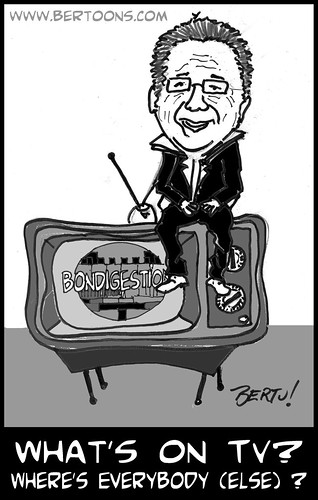
There’s that phrase again. Programmes on TV this week were rather amusing. Lou (of Bondiplus of Where’s Everybody?) got spanked on the backside by the BA for his Lowell programme, so Peppi (of Xarabank of Where’s Everybody?) set up a programme discussing freedom of expression and Lou’s spanking. Guests on the programme? Another ta-da moment. Lou Bondi and the ubiquitous media guru Joe Borg Father. I spotted WE’s Norman Vella on Facebook claiming that “In this programme Lou Bondi will not be the only guest. He will face people who publicly expressed themselves against his programme with Norman Lowell”. Incidentally, he was replying to a comment by Borg Cardona who had just implied that the Xarabank programme had an incestuous element in it.

The criteria used by the Xarabank crew reminds me of certain Times’ editorials (or of a conversation between Lou and Fr Joe) where they seem to assume that they are the only people to have a relevant opinion or to have actually expressed an opinion on any given subject. All three – Xarabank, Bondiplus and The Times – have become an institutionalised form of their relative medias and it is in that spirit that they are criticised. Frankly, all three could hold whatever opinion they like but their constant editorial position that obliterates any opinion they consider irrelevant (for irrelevant read uncomfortable to deal with) is worrying and stinks of a systematic effort to retain the stranglehold that they have built over a large chunk of the fourth estate.

I am not too sure that the credibility of all three is the same as they enjoyed a while back, even among the more conservative of elements. Having long abdicated one of the primary journalistic duties of proper investigation, they are now lost in a navel-gazing world of their own and they have constantly proved unable to deal with the wider democratisation of the media. While their voices might still be strong enough to be heard, and while they can still afford to ignore the disparate contradictory elements, they are noticing that their grasp is weakening and their efforts to remedy the situation is only leading them to descend into the comically absurd. So yes. We have Lou as a guest on Peppi’s show discussing how Lou and Peppi’s company should be allowed freedom of expression. Jolly good, I say.

Friendly fire

Finally, a few notes on friendly fire. Joseph Muscat was on Myriam Dalli’s TX this week. TX is a programme on Labour’s One TV (did I mention that we STILL have party-owned TVs in 21st century Malta?), so such notions as bias and doctored questions are only to be expected as annoying intervals in between shots of that Mediterranean beauty that is the programme presenter. The other person on the show glared at the camera and warned of the problems of corruption in the country while standing fast behind such weird notions as carte blanche for whistleblowers and promising the people €50 million (take from Peter give back to Peter) for the “unjust tax on vehicles”. Rather than traipsing uselessly with the kangaroos, Joe might want to polish up his knowledge of recent (very recent) ECJ jurisprudence before harping on about the latter subject. (I have friends who studied European Law and I am not ashamed to be seen with them).

Two notes on GonziPN and friends. Well done for the WiFi spots around the country. That is a bit more tangible than all the words about Vision 2015. Surely you should warn interested citizens that “free public WiFi” is not eternal. As in all similar European projects, expect a shift to paid services in the near future – whether big brother tells you or not. Also GonziPN’s little tryst with “non-politicians” at Vision2015+ felt like a very manufactured and simulated business among friends. Funny that name – Vision 2015+. A government plan gets a “+” tagged onto it and it becomes a party meet. A bit like programmes getting a “+” on their name on national TV. All they needed were Lou and Peppi at Vision 2015+ … but wait… they were there. So it’s OK, innit?

www.akkuza.com (j’accuse) has 301 friends on its Facebook page. Would you be ashamed to be seen as one of them?

Paragon of Democracy

Lights are out or returning back on this morning in Malta. It’s long past being a funny situation – the power station business that is – and the blackout will ironically throw more fuel into the incandescent fire that is every discussion about power stations, government contracts and governmental mismanagement.

While Malta floundered around in the dark UK Deputy PM Nick Clegg was busy reassuring his voters that the forthcoming government programme will include “the “biggest shake-up of our democracy” in 178 years”. This includes fixed-term parliaments, a fully elected House of Lords and a referendum on electoral reform.

The Liberal leader is in charge of the reform plans and has stated that he wants to “transform our politics so the state has far less control over you, and you have far more control over the state”. Centralised states were on the mind of Clegg throughout his presentation and at one point he stated:

Britain was once the cradle of modern democracy. We are now, on some measures, the most centralised country in Europe, bar Malta.

Now that’s a bugger innit? The contrast being made is obvious. Britain has relinquished its past as a “cradle of modern democracy” and having done so has approached – what? – Malta. Ouch. That hurts. It’s painful. But there must be a reason why Nick’s first thought when thinking of a decentralised (and consequentially distant from being a cradle of modern democracy) country leaps to Malta.

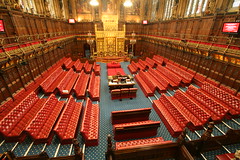
House of Lords Chamber
Image by UK Parliament via Flickr

My bet is that if any repercussions will be had in Malta all blame will fall squarely on the nutjobs at the Alleanza Liberali who have carried the “Liberal” name for quite some time now – with dire consequences on any chances that name might have if taken up by normal minded people. There might even be a photo of Nick with John Zammit (who is currently busy working on www.freewebs.com/mintoffjani) as part of his Mintoffjan/Liberal project.

It would be too easy though to blame it on the nutjobs though. Nick Clegg, deputy PM of one of the largest political realities in Europe does not think highly of our political system – were it just a voice out of the blue it would be something we could easily ignore. Instead, Clegg is simply confirming what this forum has said for ages – the PLPN duopoly has much to answer for in this respect.

Reblog this post [with Zemanta]