From Crimea to Benghazi

“Nurse of the Mediterranean”, “Florence Nightingale”. These terms are no coincidence and were not invented by some nationalist spinmeister in an effort to boost our “pride” in our country. As Maltatoday picks up on public sentiment and reports that three Maltese patients were moved out of the ITU to make way for injured Libyan persons (you can sense Saviour puffing behind this bit of news), it would do all of us a favour to calm down a little and have a look at the numbers behind all this fuss.

To me the crucial bit of the Maltatoday article is the part that reports the number of Libyan patients threatening to cause havoc with our health care facilities. Given the fuss that has been kicked up by the insensitive NIMBYISTS on one hand and by the superproud heroes of nationalist persuasion on the other you’d have thought we were talking of Lampedusa Thousands. Hah. The real number is 16. Sixteen. That’s a kindergarten class (I think).

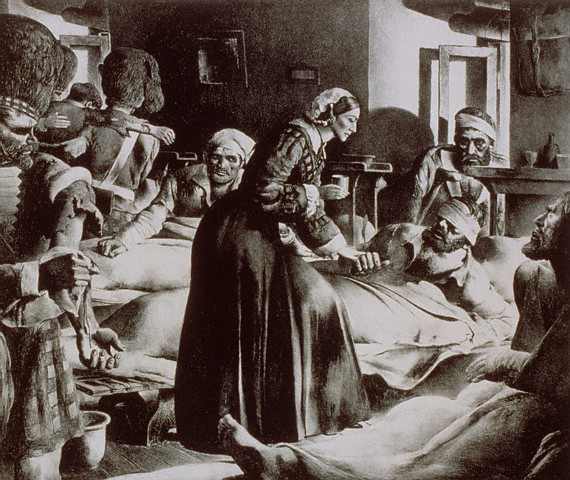
Let’s take the hands of time and turn them back a century and half ago. It’s November 1854 and there’s a war in the Crimea. That’s far, far away in Maltese provincial terms but since we were then under the administration of the British Crown we could not afford to ignore the geopolitical realities beyond San Dimitri point. The Crimean War gave the world the Charge of the Light Brigade, familiarity with the word Balaklava and Florence Nightingale. It was also the reason that Malta became, for the first time under British occupancy “the nurse of the Mediterranean”. Before that Malta had already played host to the Knights Hospitaller which is not simply a decorative adjective but an indication of the vocation of the Knights of St. John as medics. Hence the Sacra Infermeria.

But back to the Crimea and Malta. Here is Mr C Savona Ventura in an article I found quickly (not much time for research here) on the net describing Malta’s hospital role and the grand plans by Florence Nightingale herself to design a hospital in Malta. What is immediately striking is the request from Britain to set up to receive 10,000 (that’s ten thousand) war wounded on the island.

The Crimean War of 1854-56 served as a turning point in military medical administration. During the Crimean War Malta served as an outpost to treat wounded soldiers. The Malta Times wrote Orders were received here from England to prepare quarters for 10,000 men. Several localities are being fitted-up; among others, the Lazzaretto and adjoining Plague Hospital, where it is said there is room for 1000 men, and the Dockyard lofts where as many men can be housed. Convents will be used if absolutely required, but not otherwise.” The first wounded soldiers arrived from the Crimea in November 1854 [17]. (…)

Florence Nightingale in her book Notes on Hospitals first published in 1859 took up the proposal of a new military hospital in Malta. In the 3rd edition of her book dated 1863, Nightingale suggested that a new General Military Hospital should replace permanently the Valletta Station Hospital. (C. Savona Ventura – Military Hospitals in Malta)

If anyone has the time to find the actual figures of how many wounded were treated in Maltese hospitals in World War I and during the Crimean War it should help give us more of a sense of perspective to the political fuss that is being kicked up here.


During the First World War, like the Crimean War period, Malta served as a “Nurse of the Mediterranean”. From the Gallipoli campaigns 2500 officers and 55400 troops were treated in the Maltese hospitals, while from the 1917 Salonika campaigns 2600 officers and 64500 troops were treated. The years of the conflict thus required the significant augmentation of hospital beds for injured and sick troops. The number of beds in the Valletta Military Hospital were augmented from 26 beds to 340 and later to 440 beds. This augmentation was achieved by renovating disused wards and bringing the sanitary and medical facilities up to date. The Valletta Station Hospital served as a sorting base for the wounded arriving in the hospital ships prior to their being transferred to the other 30 hospitals and camps scattered over the Islands.  (also from C Savona Ventura – Military Hospitals in Malta)

* this post relies heavily on information gathered from the article “Military Hospitals in Malta” by C. Savona Ventura available here.

The Pride of Lions

Do you have Independence day hangover? Are you still reeling from the injection of pride in our country and its achievements – especially in its delayed reincarnation as the potential Florence Nightingale of the Libyan Spring? Or are you still feeling rather indignant at the “divisive” call for AST’s resignation? Better still, are you still clutching your aching sides after laughing all night at Labour’s non sequitur style reponse that “if my ex-Foreign Minister was an arsehole then your ex-Leader /PM / President played host to a flurry of arseholes in the early nineties”?

However you may have woken up this side of Independence Day, you will surely have gone through your morning papers and probably, like J’accuse, you’d have noticed the glaring inconsistencies in this proud nation’s dealing with foreigners. Here they are in black and white.

The Black – No to injured Libyans

On the one hand GonziPN’s efforts to weave a new heroic story into the tapestry of our PLPN history books have come under fire from an unexpected source. The (very christian) spokesperson of some Union of Nurses complained that Mater Dei has enough on its hands as it is and does not need to play nurse to any injured Libyans. Paul Pace, head of the MUMN told the government that “bigger countries with more facilities should address such problems”. Boom goes GonziPN’s plans of proud nation humbly serving the weak and the injured. Don’t hold your breath for a Joseph Muscat position on this mess by the way. He either criticises MUMN (read votes) for their tunnel vision or he criticises Gonzi’s plans thus losing cred on his “I love New Libya” mantra.

As for the proud nation sticking its neck out for others – here is the best source to tap the pulse of the nation … the Times online comment board:

Ms Maria Vella

Today, 09:59

Let us stop being all politically correct and call a spade a spade!

Mr. Pace did not beat around the bush and stated the situation as it is. We have enough Maltese patients (who pay taxes and contribute towards the running of this hospital) waiting for treatment, in corridors or at home, or even worse sent home because of lack of space but we find place and resources to treat foreigners.

Whilst my sympathies go towards the injured Libyans, charity should begin at home!

Now there’s a thought Mr. Prime Minister. A sympathy card to Libya and that’s that. Where’s Tonio Borg when you need him?

The White – Yes to rich magnates

Frank Salt, of Frank Salt properties, describes the new conditions for obtaining a residency in Malta as “a large hammer being used to crack a delicate egg” (TOM – Messing with the economic motor). Apparently the new conditions for your average Russian euro-burner to settle down in Malta are “very complicated, extraordinarily expensive, virtually prohibitive” – dixit Frank. It seems that the developers’ apple cart has been upset:

Was it sensible for the authorities to continue to allow new building developments specifically targeted at potential new foreign buyers, to sprout up all over our Islands, when they knew that they were about to unload this bombshell, that would and could, and no doubt will, upset the whole apple cart?

And the property developers are angry. They’re angry at the government that encouraged them to develop land to sell it off to Non-EU citizens (not injured Libyans mind you… for that we have Mater Dei) and then came up with these conditions. Here’s Frank being Frank again:

Today, the local property industry first works its backside off promoting Malta as a safe, inexpensive and pleasant place in which foreigners and their families can come and live in peace. Then, when the market gets off its feet, quality developments are built, foreign residents, permanent and temporary come to Malta to see whether they would like to live here… bang… once again it is time to mess things up.

And then there is the music for the environmentalist’s ear:

Now we have to see how we are going to sell the hundreds of properties that are currently on the market and those hundreds more that have new permits to build.

Dunno Frank. I’m thinking that you should sell some of that space to … lemme see… a Qatari developer who could then invest some of his money into … hmm… a hospital. There would  be some divine justice in that wouldn’t there? An exclusive hospital built to service the wounded and injured from the Arab Spring. The developers would get their money. The nurses would get their break from the influx in Mater Dei and the government would sell this off as some smart move. Lovely no?

Finale

Of course mine is a tongue in cheek suggestion to Mr Salt. What really jars is the existence of this reality on our tiny rock. On the one hand we have those christians who cannot accept the idea that our valuable hospital space is being taken up by “foreigners” (stop bleeding on my soil) and on the other we have those business minded few who are dying to get the right type of foreigner (those who bleed money) to our shores.

It’s normally Joseph Muscat’s job to blame Gonzi for everything under the sun (including tsunamis and world economic crisis). I’d just say simply that our political establishment are getting the “proud” citizens they have nurtured and that they deserve.

What you reap is what you sow. Maybe it’s time to wake up.


Press Standards & Poor Berlusconi

Italy’s sovereign debt rating has been revised downwards (A from A+) by Standard and Poor’s. The marginal comment to this revision was that the country’s outlook was “negative”. Notwithstanding Berlusconi’s “manovra” that seemed to have appeased worries in the institutional corridors of Brussels, the credit rating agency “cited fears over Italy’s ability to cut state spending and bring its finances in order, particularly given the country’s growth prospects.” (BBC)

The Italian government’s reaction to this revision is once again redolent of the double-vision that is evident in every major capital in Europe these days. On the one hand there is the inevitable reality that is a euroland crisis that is crying for a common solution (common because of the interdependence of the euroland states) while on the other hand there is the survival instinct of the parties in government eager to avoid losing valuable election points in the national microcosm.

Malta’s Labour has been lashing at Gonzi & Co. for what they claim is the “ostrich” mentality that has overcome Pietà and Castille. The tune from Labour and other critics of government is that the Government has “conveniently ignored” Moody’s recent downgrading. For its part, barring the bravado of mavericks like Austin Gatt, the party in government seems to be content with the government by default line that has worked so well in recent years. While it is true that Labour is far from offering a practical alternative to the current men at the driving seat, it is also blatantly evident that the government by default lacks a coherent, value-driven and globally conscious plan. Surely a tough nut to crack for voters.

Back to Berlusconi and his government. The first reaction to the S&P revision was a tirade on the fourth estate. His government and its manoeuvres was not to blame – instead it was the bad feeling and lack of confidence generated by the papers. Pity that the stock exchanges in Milan and elsewhere seemed to be more on the wavelength of S&P and the papers than on Berlusconi’s side. Here is part of Palazzo Chigi’s official reaction (from La Stampa):

«Il governo ha sempre ottenuto la fiducia dal Parlamento, dimostrando così la solidità della propria maggioranza. Le valutazioni di Standard & Poor’s sembrano dettate più dai retroscena dei quotidiani che dalla realtà delle cose e appaiono viziate da considerazioni politiche»

The question is whose reality (realtà) is the real one and whose is the virtual?

The truth is out there.


Qatar

It’s official. Malta is one of the safest places on earth (bar Qatar). Apparently the Maltese archipelago is one of the zones of the earth that is least prone to natural disasters with a 0.72% risk of such an abomination occurring. There is one country that is safer and that country is Qatar (0.2% risk). While I was reading this fact sometime yesterday it struck me that this was the second time that I thought of Qatar and Malta at the same time.

Qatar, a Gulf state that has hitherto lived in the shadow of its giant neighbour Saudi Arabia is living a gold age. Success story follows success story with social improvements and business stories being the daily staple diet of the Qatari people. Sure, they have been well treated by mother nature since they do not only sit on the safest real estate on the planet but it also happens to be a source of black gold. It’s not just that though. It’s what the Qataris are doing with it that is fantastic. They have large scale projects, a modern society that has attracted major sporting events (FIFA World Cup anyone?) and smart investments. Qatar was given a heads up by mother nature and capitalised on the consequences.

Hearing a report on France Culture about Qatar’s success story I couldn’t help but wonder how important it is for a nation to realise its assets and capitalise on them quickly and efficiently. It also means investing wisely and pushing for the right marketing….

Just think about this. The Malta Tourism Authority decided to sponsor a team in the UK in order to raise Malta’s profile among the Brit tourist crowd. Who did we choose? For some obscure reason it was Sheffield United. Now much as I might think that the blades have a wonderful footballing pedigree steeped in history I cannot but question whether this partnership was well thought out.

Back to Qatar. Next time you see Barcelona skip onto the field in their Champion’s League outfit take a look at the sponsor on their shirts. Let me just add that Barcelona were famous for being one of the largest teams that obstinately refused to accept a shirt sponsorship for a very long time before finally accepting to carry “UNICEF” in the place of advertising. Well UNICEF is there no more. Do you know which country’s name sits proudly on the chest of Xavi, Iniesta and Messi while they weave their magic infront of a global audience?

Yep. You guessed it. Qatar. In the form of the Qatar Foundation. Here’s the vision statement from their website:

an independent, private, non-profit, chartered organization founded in 1995 by decree of His Highness Sheikh Hamad Bin Khalifa Al-Thani, Amir of the State of Qatar, to support centers of excellence which develop people’s abilities through investments in human capital, innovative technology, state of the art facilities and partnerships with elite organizations, thus raising the competency of people and the quality of life.

And here is their mission statement:

Qatar Foundation’s mission is to prepare the people of Qatar and the region to meet the challenges of an ever-changing world, and to make Qatar a leader in innovative education and research. To achieve that mission, QF  supports a network of centers and partnerships with elite institutions, all committed to the principle that a nation’s greatest natural resource is its people. Education City, Qatar Foundation’s flagship project is envisioned as a Center of Excellence in education and research that will help transform Qatar into a knowledge-based society.

Now that’s what I would call smart.


Crisiswatch

Controversial historian Niall Ferguson sees no solution for the current European Debt Crisis which he describes as a “European Lehman Brothers“. Are we really in for a shocker? Is the biggest strike still to be dealt on the European economy? Will the euro suffer the consequences? Worse still, is it – as Joseph Muscat would have it – the fault of GonziPN?

Lunchbreak

Right now is the time of that gap in the time-space continuum when the General Box labelled “Summer” starts to shut slowly taking with it the smells of the sea, the sweaty brow of the aestival traveller and the dizzy dreams of dolcefarniente. At the same moment the musty smells of the humid “Autumn” box start to drift into the atmosphere – spreading like a cold virus at the break of September. It’s a general feeling of stasis before the momentum returns of “work as usual”.

The Times (UK) economic commentator Anatole Kaletsky had a great article referring to the seasonal changes in Wednesday’s edition (Take cover: A financial hurricane is blowing in – *paid subscription required). Kaletsky highlighted the fact that in moments of great financial depression, the worst period to look out for is the end of August – beginning of September period:

Almost all the great financial crises of history have occurred between late August and mid October: the Wall Street crash in September and October 1929, the collapse of the prewar gold standard in September 1931, the sterling devaluation of September 1949, the collapse of the postwar Bretton Woods currency system in August 1971, the Mexican default in August 1982, which triggered the Third World debt crisis, the stockmarket crash on Black Monday in October 1987, the break-up of the European exchange rate mechanism on Black Wednesday in September 1992, the Russian default in August 1998, the Lehman bankruptcy in September 2008 — the list goes on.

Kaletsky plugs into the general feeling of doom and gloom that your average news follower might be experiencing at this moment in history. You know that feeling don’t you – Death’s scythe all over the place, the misery of war, famine and pestilence coupled with stories of natural hurricanes and financial earthquakes. For heaven’s sake, I was reading the same issue of the Times yesterday and I had in mind to do some more honeymoon travel research after that. Sure enough, two (two I say) articles about honeymoons where disaster struck – sharing the same page. A man eaten by a shark and another couple run over by a car. And this was the Times mind you, not the Daily Mail.

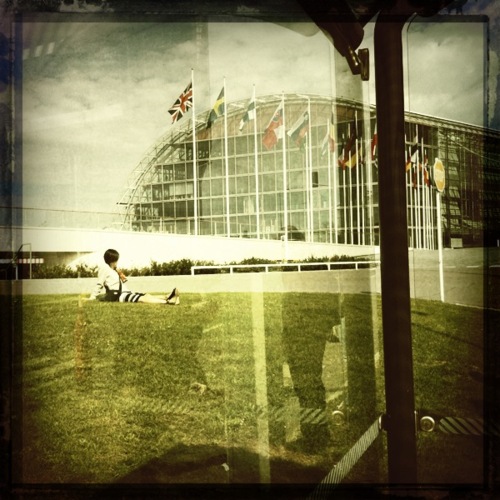
Doom and gloom or not, September has come rushing in closing what has been for the North of Europe the coldest summer in living memory. We might still be in time to witness the collapse of an economic system or at least feel the full brunt of the economic crisis. We might still witness more death and disaster before the month turns into October and drags to All Hallows Eve. September might be the time to appreciate the little moments of calm. Just like the lady I caught lounging on the grass on the bus stop behind the EIB (European Investment Bank).

The flags fluttering in the late summer breeze, the sun bearing down in a warmish afternoon and the relaxed fonctionnaire lapping up (or should I say stealing) the last of the summer rays. Forget the hurricanes for another day. It’s time for the galactic lunchbreak.

Carpe diem.

[learn_more caption=”photography”] Photo shot using Hipstamatic app on an iPhone 5. lens: Libatique 73 film: Cano Cafenol place: Kirchberg, Luxembourg (BEI Bus stop) date: 01.09.11 around lunchtime.[/learn_more]