Cheap noodles and les nouveaux pauvres

Marie Louise Coleiro Preca II is not the name of a boat. It is the name of MLCP’s second facebook page that was started after the first one was oversubscribed. Marie Louise Coleiro Preca II shared a post with Marie Louise Coleiro Preca about a meeting that was held at the PL club in Fgura where the subject seems to have been the “energy poor” and someone liked this post today so it came to my attention. These are not, as you might presume, people who are experiencing strong withdrawal symptoms from their last intake of Red Bull but rather a newly defined class of poverty that has been created by… you guessed it… GonziPN’s exorbitant energy bills.

A woman with respiratory problems, who had an electrically-operated oxygen tank at home, ate cheap noodles every day to be able to afford her utility bill, Labour health spokesman Marie Louise Coleiro Preca said yesterday. (…) “There are people who are energy poor. I spoke to a woman from Cospicua last week. She needs an oxygen tank at home to live. She just about passes the means test, so she’s not entitled to the energy benefit. She told me she can only afford to eat noodles,” Ms Coleiro Preca said.

There is something surreal about this kind of presentation. It probably has a lot to do with Labour’s generally bungled way of public relations and transmission of information. You cannot help but wonder how comfortable Joseph Muscat, Anglu Farrugia and the other geezer from the triumvirate of oxymoronic progressives can be with having their mugshot plastered on the walls of Kazini under the ubiquitous torch like some latter day Stalinist cult. There under the pictures of the future saviours of the nation sat the survivors of a not too distant socialist government plugging the narrative of the “new poor” – les nouveaux pauvres.

Marie Louise Colerio Preca II was armed with stories of the quasi-poor who “just about pass their means test” (the rare kind of test one would rather fail) and therefore cannot claim any energy benefits. So the nouveaux pauvres are condemned to eating “cheap noodles”. Do they even realise what it is they are writing? Stop for a second and think. “Cheap noodles”. As against bloody what? Gourmet noodles? And why noodles? Does noodles sound poorer than pasta asciutta?

Cue the erstwhile troubador of great socialist lore Joe Debono Grech who, once the list of nouveaux pauvres esquisses was done, ” called on his party to reach out to people by teaching people about the history of the party that worked so hard to fight poverty”.

There is something plastic about all this. Which is not to say by far that the tough economic times have not hit the people where it hurts. It is not to say either that the noodle woman shares the same problems as, say, Times columnist Kenneth Zammit Tabona who recently also complained about the exorbitant figures that turn up on his utilities bill. It’s just that Labour seems to be willing a fantasy land of misery – a potemkin village in reverse. There under the watchful eyes of The Three Leaders Who Will Guide Us In The Battle Against Poverty, the stakhanovist socialists of yesteryear spun the narrative of les nouveaux pauvres creating the new oppressed who will need a new socialist, progressive spirit to lead them out of damnation.

Fgura election prospective candidate Charles Agius joins in with enthusiasm:

(he) said that during home visits he met families who had their electricity supply suspended because they did not pay the bill. They took their children to their neighbour’s house to use the computer.

See the concept of the bare essentials? Under a previous patch of “utility poverty” (still living memory for many) you would have said that following the latest water and electricity cut parents took to filling buckets of water from the sea and kids went to bed early in the dark. Nowadays the nouveaux pauvres first thought is where to get access to the closest working PC. Plus ca change.

This is not a post that denies the existence of hard up situations in our midst. It is a post that looks at the instrumentalisation of what might be desperate cases in order  to spin an opportunistic narrative with no solution in sight. Labour is doing its damned best to redefine the goalposts by creating this new social strata which we can define as the nouveaux pauvres. Forget the middle classes or the pepe – hamalli divide. The pigeon-holeing is now strictly concerned with the reclassification of the grumbling masses into a reversed potemkin village of nouveaux pauvres. It suits the whole narrative well enough so long as the gullible and partisan are the ones being targeted.

Still. Cheap noodles?

Cabinet Decisions & RCC’s Head

The Labour party has finally found a way to get at Richard Cachia Caruana on something based on fact rather than on the irritation at an unelected person having a purported strong influence on cabinet decisions (pace Franco Debono). The accusation is based on Wikileaks that portray an active RCC (oh the heavy acronym) lobbying with the US for the reactivation of Malta’s Partnership for Peace membership. The buzzphrase on social networks this morning is : “Allura RCC ikbar mill-parlament?”

I’ve always found this fixation with RCC quite a curious one. The man obviously has much clout and his opinions seem (or seemed) to be highly valued within the inner decision making circles of government. That he might not be directly accountable for many a blunder might raise important questions about the structure of our elected elite. On the other hand there is a bit of an emptiness in the grudges that are held against the man. The business of government is one that does not only require elected politicians in their roles of PMs and ministers but also gets done with a caravan of policy advisors (at least we hope so) who come election day risk their position as much as the rest of the ministerial entourage. Feeble as it may be – it does give you an idea of a form of accountability.

Secondly, RCC might be counted among a list of a few intelligent persons upon whom the Gonzi cabinet depended for a long time as a sounding board as well as to prepare future policy objectives. Again the main caveat here is that I do not know the man from Adam except for the rumours within the halls of civil servicery that are not too kind on him insofar as temper and perfectionist tantrums are concerned. Be that as it may I still find the accusations of “unelected mandarin” rather feeble and populistic. After all what do you expect? Governments will lend an ear to whoever they believe are competent advisors – my only grudge here is that all too often it seems that this government depends on one channel of information without really viewing alternatives – but that is another story.

Back to the PfP issue. When the participation in the PfP program was finally reactivated in 2008 it was a cabinet decision. Not parliament mind you – cabinet. Whether the groundwork for this reactivation had been prepared by extra-cabinet members such as RCC is something one would hope for rather than condemn. Switch back to 1996 and consider Sant’s de-activation of PfP membership in the name of “neutrality”. Irrespectively of whether you agree or disagree with Sant’s interpretation of neutrality there is one point that sticks out on that day.

The seat at Castille had barely gotten used to the shape of Sant’s behind yet Sant via his cabinet took a decision to withdraw from the PfP. One could also safely assume (or, again, hope) that Sant was acting on the basis of advice from specialist persons within the field – unelected technocrats who participate in the work of government in order to facilitate its operation.

Is Sant greater than parliament? No. Neither is RCC. Nor is the cabinet. The fact remains that Malta’s original decision to take part in the PfP formed part of a wider EU participation program in an early nineties nationalist government. The withdrawal by Dr Sant was accepted as a legitimate cabinet decision by his government (based on an electoral programme promise) and the re-activation by the subsequent nationalist government was the result of another cabinet decision that itself was based on the fact that the nationalist party had never changed its policy on PfP membership (which is why I believe that it is correct in claiming that it did not need to include the re-activation in subsequent electoral programmes).

Whether RCC as part of the hidden machinery of government lobbied with governments and institutions or not is a probability that is now confirmed by the Wikileaks. We see no wrong in the fact that this occurred since the decision to activate, withdraw or re-activate lies purely within the power of cabinet and in this case RCC would be acting as the humble servant of the latter.

It’s either that or else we can safely say that both the Labour government 1998 and the Nationalist government 2008 acted as though they were above parliament. Which would not be such a great surprise but we’d rather stick to facts than speculation or misinformation.


Show me the money

Dosh

Watching Chelsea replicate Internazionale’s catenaccio last night I could not help but wonder why I still harboured feelings of sympathy for the London club built to the tune of Abramovich’s millions. There is a general sense of resentment that is held against football clubs built with the money of tycoons and not with the sweat and capability of good planning – just look at the opprobrium that the City side of Manchester have attracted thanks to the millions thrown at them over the last few years.

The rules of the Premier league have evolved since Portsmouth went into administration under the watchful eyes of the management of the world’s most successful tournament. Anybody wishing to spend a few million bobs on his favourite toy will now have to bear the scrutiny of numerous tests aimed at ensuring that the provenance of the money is legit. Mr Madjesky of newly promoted Reading knows a bit about these tests as the proposed purchase of the newcomers by Russian family Zingarevic is on hold until the appropriate checks are made. The Premiership is no place for recycling money – that’s for sure and until Platini’s fiscal rules on club finances are activated the current rules will go a long way to avoid jackals spoiling the fate of historic teams.

Another man reported to have eyed investment in the Premier League was Emir Al Thani of Qatar. He was supposedly prepared to part with over a billion dollars to get his hands on Manchester United. The Red Devils are still owned by some US Emir Glazer but Al Thani has meanwhile been reported to have set his eye on investing his (country’s) billions elsewhere. Maltatoday reported that Qatar was eyeing up a €1 billion investment in Enemalta. Now it may be a far cry from dealing with Alex Ferguson but Al Thani and Qatar might have their reasons to be attracted to investing in the tiny island’s power grid.

The Maltese government is going to great pains to whet the Qataris appetite and has apparently got plans to set up an embassy in Doha. Which is good to a certain extent. There is nothing wrong with building good relations with some of the countries that seem to still have money in a world of begging bowls and bailout plans. There is a big but however – and not of the Sir Mix-a-Lot kind.

Friends United

While the Qatari government might have an impressive CV on its lap with regard to investment, future planning and whatnot (last night Chelsea faced a Barcelona team that featured the Qatar Foundation sponsor on its shirts) it does remain a country that, democratically speaking, is in the throes of early development. Babysteps. We are talking of an absolute monarchy and although elections are planned for 2013 the consultative council remains just that – consultative. As for the human rights track record, though we are not talking North Korea you may see more from this Amnesty International Report:

Women continued to face discrimination and violence. Migrant workers were exploited and abused, and inadequately protected under the law. Around 100 people remained arbitrarily deprived of their nationality. Sentences of flogging were passed. Death sentences continued to be upheld, although no executions were carried out.

Forget free expression or press freedom too. Which is a bit worrying. While the behemoth parties in Malta are currently engaged in a “Your Friends are Worse than Mine” battle regarding past and present relationships with illustrious leaders of the Libyan Jamahiriya or North Korea we have this kind of proposed agreement in progress. Our question is: How far does the “beggars cannot be choosers” principle apply? Just like Mintoff took the begging bowl to North Korea and China and shut his eyes to the desperate cries of oppressed workers in those countries (so long as il-Haddiema got their dishout of SAG weaponry) are we not committing the same error today?

I am not convinced that Emir Al Thani can become another Gaddafi but does this kind of international agreement not merit a better form of scrutiny? What policy should Malta have in this sense? If we were talking about a multimillion investment by a private company do we dive in blindly thanking whatever Madonna is currently in vogue for the windfall? In the case of companies there is a due diligence process that is (hopefully) conducted.

White Rocks

On a final note I notice that the ghost of the White Rocks multimillion sport investment has resurfaced conveniently in the run up to another election. We had not heard about the White Elephant for quite some time now – just as the trombones and trumpets surrounding SmartCity also went deafeningly quiet. Clyde Puli (another not too ubiquitous politician) has told us that “substantial progress” had been made in talks with investors. The figure of 800 new jobs was obviously mentioned but there seemed to be no more information forthcoming about what stalled the talks in the first place and why over a year after the initial brouhaha we are just able to talk about “substantial progress”…

Show me the money? And at what cost?

 
***

Thrifty with Facts

Thanks to an Evarist Bartolo link on facebook I came across this article on Maltastar that compares the wages between Malta and Luxembourg taking data from a recent survey based on “average wages” and the Purchasing Power Parity. While it is interesting to look at figures consisting solely of wages as averaged out in relation to how they could be spent in the US it is obvious that a peek at the utility of that same wage in the country where it is earned would give a less skewed picture.

So while Maltastar is busy comparing Malta’s average wage of 1,808 dollars per month to Luxembourg’s whopping 4,089 dollars (top of the world) per month it would do well to look out for other stuff such as the actual cost of living in those countries.

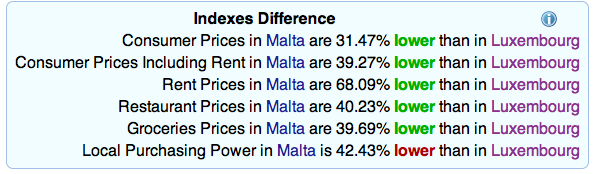
I could not find Luxembourg or Malta on the famous Economist Big Mac Index that is based on the One Price comparison for good. I don’t frequent McD mainly because of my allergy to gluten so I would not know the prices myself. I did found this site called numbeo however that does a cool comparison thingy between states. Sure enough I confirmed what I was suspecting and here are the facts for your perusal.

Just for the sake of perspective look at the rental costs for a 1 bedroom apartment – Luxembourg average is 950€ per month while Malta is 350€. As for buying property in Luxembourg compare the 5500€ price per square metre to Malta’s 2500 €.

This is not to say that Malta’s salaries are great or that prices cannot be more competitive but rather to point out that sticking to comparing wages is deceptive and intentionally portrays a fraction of the picture. Just to give you an idea of how relative the issue is, some unions of the EU fonctionnaires based in Luxembourg have been complaining that the salaries for Luxembourg workers are equal to those based in Belgium even though the cost of living in Luxembourg is much higher.

As in the case of the gas price hike J’accuse’s point is that rather than selective charts to fuel the discontent of the voter what we really need to see is what the political parties gearing up for next election are offering on their programmes so that we may be able to assess if any part of it includes – oh hope – solutions or at least attempts at solutions.

And by the way Varist, the guys at Maltastar COULD make an effort rather than cut and paste Ruth Alexander’s article from the BBC site. Next time you decide to cut and paste you should not leave out this damning assessment on the reliability of the figures:

In truth, the economists at the ILO have had to rely on very patchy statistics. Data is missing for some countries – even a country as large as Nigeria, for example. And also, the economists at the ILO are only counting wage earners.

They exclude huge numbers of people who appear in the poverty statistics but not in the calculations for the average wage – pensioners, children and stay-at-home parents, for example, and even the self-employed.

The number of self-employed is huge. In developed countries about 90% of working people are paid employees, but that figure is lower in many developing countries. For example, in South Asia, where many people are self employed or independent farmers, just 25% of workers are salaried.

The conclusion drawn by Ruth Alexander in her article must not have made for comfortable reading at Maltastar because it defeats the very (loose) point they were trying to make. Maltastar’s selective reporting (cutting and pasting) centred on comparing Malta’s wages with the best in the world. In truth the report concludes that ” that the worldwide level of economic development is in fact still pretty low, in spite of the huge affluence that we see in some places.”

Essentially an uncomfortable truth that the economic pains that are being suffered in Malta are (unfortunately) a symptom of a “worldwide level of economic development”. Sadly for Maltastar and Varist, it’s not GonziPN who is to blame.

Fools for love

The 6c price hike in fuel announced by Enemalta and effective today risked being a very nasty April Fools joke. Apparently it wasn’t. Fuel prices will go up in Malta, much as they are doing in the rest of Europe and the world. Only in Malta though will the blame be lain squarely at the feet of GOnZiPN. A quick run through facebook yesterday gave me a concerted effort from Labour MP’s and apparatchiks all complaining that Gonzi is adding on to the misery suffered by the Maltese families.

It’s useless arguing with a Labour diehard who is desperate to blame Gonzi for anything. Apparently Gonzi waited for the local council elections to be over before announcing the price hike. Sure. So did David Cameron, Jean-Claude Junker, Angela Merkel and the rest of the European leaders. Not to mention Barack Obama in the US. Can you picture Cameron sitting patiently waiting for the last results from the San Lawrenz count to peter out before making his move on the cost of fuel in British petrol pumps?

“Are the Saint Lawrence results in yet George? Can you be so kind and ask Cruddas to get another bottle of that Moet while we’re waiting'” Meanwhile, in the real world here’s an Essentiel article from Luxembourg explaining why the price of fuel is going up everywhere: “Porquoi l’essence flambe en Europe?“. See Edward Zammit Lewis, Chris Cardona, Evarist Bartolo? I am not motivated by a penchant at defending the current government, I am just intrigued by what Labour is proposing to do in the same circumstances.

Will Joseph Muscat give us the wild promise of subsidised petrol? Do his Labour fanatics know that voting for a government that subsidises fuel means voting for a government that will have to find a way to pinch the money for that subsidy from their pockets? Of course they don’t. Or if they do become aware of that then they will let loose with a volley of non sequiturs starting with “Mela Sant kellu ragun bl-Isvizzera fil-Mediterran”. Blind fools. The lot of them.

Luxembourg has just reached a record high price for fuel. In Britain a threatened strike by petrol pump owners led the general public to become brutally aware about the importance of alternative modes of transport. To us at J’accuse the brutal truth  that is exposed by the price hike in fuel is the actual relative cost of the botched attempt to reform public transport with the Delia-Gatt Arriva Plans. In times like these your car becomes a luxury to be used sparingly. Buses become popular if their service is efficient. In Wallonia – the French-speaking part of Belgium, recent figures suggest a doubling of the public service commuters (mainly buses). From 200,000 to 400,000 users in one year.

A smart opposition would put its finger on the real problem. Now, more than ever a proper and fully functional transport system is needed. Incentives from workplaces for employees to use buses would help – a workcard that covers the bus trips for example. Of course you cannot have buses running late or running never. But opposition is not about being smart. It’s about stoking the flames of anger and relying on the cheaply available fuel of blind faith.

Opposition is built on fools for love.


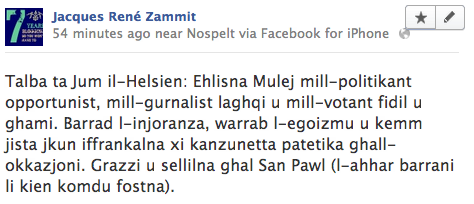
Qabel ma konna xejn

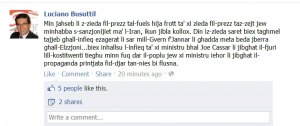
Tismagħom jitlewmu dwar festi nazzjonali u tibda taħseb u tehwden int ukoll bla ma trid.

Jgħidulek li qabel ma sirna indipendenti konna dejjem niddependu mill-barrani. Biex ksibna l-kostituzzjoni tas-64 konna xbajna telgħin u neżlin Londra nittalbu bis-sassla. U l-kolonjalist jitnejjek bina bejn bid-‘divide and rule’, bejn bil-‘language question’ bil-Malti lingwa tal-kċina u bejn bil-poteri tal-‘gvern’ Malti jingħataw u jittieħdu skond il-bżonn.

Meħud minn Facebook illum. Isem mistur.

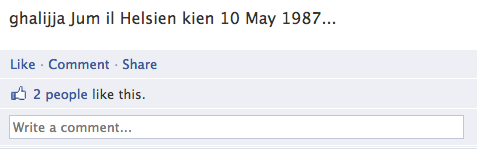
Jgħidulek li sakemm ħadna r-repubblika fis-74 konna għadna Monarkija. Indipendenti iva imma b-wiċċ ir-Reġina tifkira ta’ passat servili ta’ ‘l fuq min 260 sena kolonjaliżmu.

Meħud minn Facebook illum. Isem mistur.

Jgħidulek li sakemm ma konniex aħna li ma ġeddidniex il-kuntratt mal-qawwa Ingliża (jew forsi ma ġeddewx huma), il-barrani kien għadu parti intrinsika fil-ħajja tagħna. Konna għadna niddependu fuqu u fuq l-infiq tiegħu. Għadna imwaħħlin maż-żejża. Jgħidulna li dakinhar ħadna rajjna f’idejna meta ħlisna mill-barrani. Dakinhar, jekk temminhom, il-Malti seta’ jibda jgħix u jkun hu biss responsabbli (u ħati) tan-nisġa tad-destin tiegħu.

Jgħidulek li mingħajr l-indipendenza, mingħajr ir-repubblika, mingħajr il-ħelsien ma konniex inkunu n-nazzjon jew ‘ġens’ li aħna. Kważi kważi iridu jiddefinixxu lil pajjiżna b’dawn it-tlett avvenimenti.

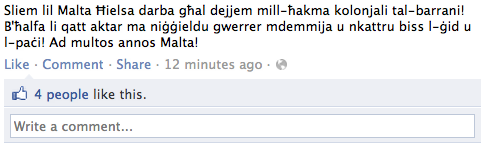
Jgħidulek dan kollu… imma allura qabel… ma konna xejn?

Meħud ukoll minn Facebook. Tiegħi.