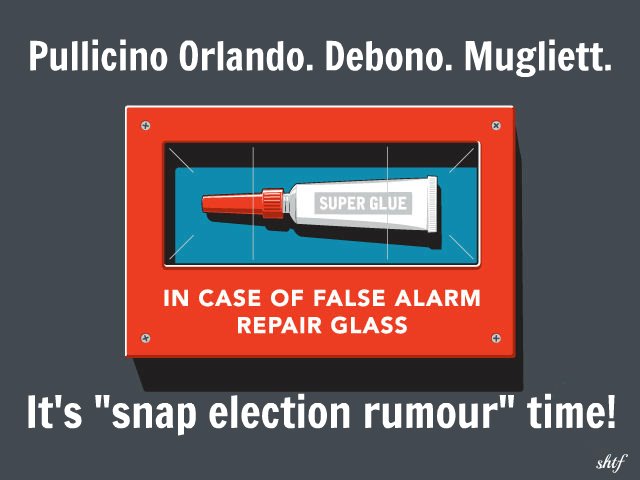
The Cantankerous Voter

The leader in this week’s Economist advocates a form of financial federalism as a sort of Plan B to combat the economic crisis. Europe has moved far from the “deepening vs widening” debates of the mid-nineties. After Maastricht the questions being asked were mainly with regard to the various geometries that the next step of integration would take and how far would states go in relinquishing sovereignty to a higher order. Then came the euro.

The launching of the single currency was meant to be a grand step in the wider project of integration. A european construct that had been built on the foundations of economic incentives and integration could not but rejoice in having its own single currency. One interesting remark in the Economist appreciation of the causes behind the euro crisis was with regard to this very moment of crystallisation – when Europe got its own coin.

In fact the euro came around a good sixty years into the roller-coaster ride that was gradual european unification. For most of that sixty years Europe had been built on the safe assumption that the project was one very good way to avoid the return to the bad habits of internecine warfare that had plagued the old continent from time immemorial. More importantly the constitutive demos of this project could be sold a series of integrative steps without having too much of a say in it.

The post-war generation did not need reminding that having the Germans and French sitting at a table discussing mutual improvement was much much more preferable than Blitzkrieg and the travails of la resistance. Up until the early nineties this meant an institutional construct that had glaringly obvious deficiencies in its democratic structures. The symbiosis between Council, Commission and Parliament together with the occasional wink from the court in Luxembourg delivered results – top among which was the huge relief that this was an ever growing club of nations NOT GOING TO WAR WITH EACH OTHER.

By the time the euro was launched the face of the demos had changed radically. Old threats and bogeys had either been long forgotten or been dropped along the way. 1989 and the disappearance of the big menace behind the Iron Curtain were also factors that distanced the link between the benefits of mutual cooperation on the one hand and the benefits of cooperation on the other.

The euro was born on the brink of world economic meltdown. A post 9/11 US was also reeling from its failed financial bets and the European crisis followed suit in the second half of the first decade of the 21st century. Europe’s baby was not exactly a crowd pleaser. The demos could only associate the euro with trouble – trouble of the worst kind that takes money out of pockets, destroys jobs and voraciously devours any dreams of prosperity,

The challenge of the European union and its leaders is to continue to sell the project for its benefits beyond the facile association with euro tinged misery. From Greece to France to Malta whether the demos will be able to relatch to a promise and a new european dream will depend on how the plan for the future is revealed and sold.

More importantly it depends on whether there is a plan that involves the kind of cooperation and integration that made the first half-century of European union such an outstanding success…. in spite of the feelings of doom that are all-pervading right now.

The Bowel Movement

I’m tempted to start a political movement. It will be one that is guaranteed to win over hundreds of thousands of votes. Ok maybe a bit less. But the formula is a winner….

The movement will divest itself of anything remotely political in value. There will be no reference point as to whether we would weather an economic storm with austerity or growth other than the mother of all policies: WE DO WHAT YOU WANT (or at least we tell you we will).

This political movement will renege any sense of partisan affiliation. It is not a Labour party. It will not carry the burden of a polka-dot history of gaffes in recent years. There is no baggage and no place for old-style politicians who plan to think in terms of “principles”. Pipe-smoking politicians who dare stand in the way of the progressive tsunami of this movement will be ignored and ignored till they stand aside. The added benefit of its being neither a party nor a value-laden vehicle means that persons of any previous colour persuasion are welcome. Nationalists, labourites, alternattivisti… you are welcome under our big tent. You need not throw away your “tessera” just join our tsunami of change.

We will fuel the movement with the promise of change and hope. Young people will be allowed to be young. Persons seeking employment will be allowed to seek employment. We will cut spending and increase spending. We will reinstate subsidies on utilities and channel public money obtained through taxing the citizens into funding these subsidies that are intended to make citizens spend less.

We will be a shield against the corrupt and incompetent who are paid to work for us. We will channel spite, anger and jealousy and reward them. We will drive a stake through the Malta caste system and return the power to the middle masses. Who are the middle masses? Why you dear reader – dear voter… anyone with a gripe and a reason to complain is the middle mass. And we are the answer to your prayers. We are the new shit!

We do not only intend to drive partisanism into the ground but also any semblance of principles, values and ideas. We will be driven on pure hope, ambition and the desperate need to get rid of the old shit and bring in the new.

Because we are confident that you will like this new shit.

Vote for the Malta Bowel Movement. We’re worth it.

Austerity : the vote killer

Given the choice between the opinion of resident Times economist Daniel Finkelstein and that of Cyrus Engerer on the current “wave of change” hitting Europe and the wider world I should be forgiven for opting for the former. It is an undeniable fact that popular sentiment lies closer to Cyrus Engerer’s way of thinking – that there is a social-democrat/socialist/progressive wave of change that is rejecting austerity and that has some plan to rebuild Europe through jobs and competitiveness. Or something like that.

I chose Cyrus simply as an example. His sentiments echo clearly those of many other “anti-austerity” hopefuls – and not just in Malta. Here is Cyrus posting on facebook commemorating Europe Day (my translation):

This year Europe Day has a more important meaning where we are watching Europe that has for a bit over ten years been practically run by conservative parties. Last year Denmark chose the Social-Democrat party, France did the same last Sunday and it seems that Social-Democrat parties have begun to win local and regional elections in many countries (Germany, Malta, United Kingdom). The call for the leftist parties is one of hope, progress and growth thanks to investment in youth, education and work instead of austerity. What do you think?

Well I think that Cyrus is confused about the real drive behind the votes. His activism within Malta’s Labour party, a party that is eager to jump onto what seems to be a progressive bandwagon might have much to do with this and he cannot be blamed for this bit of predictable rhetoric. On the other hand the current political situation merits a deeper analysis than the simple explanation of a pendulum switch from conservative to socialist (&c.).

I believe that this is not really a positive vote in favour of some progressive (or socialist or social democrat) pan-European movement but a negative vote against austerity. Cyrus omits to mention, for example, the administrative elections in Italy which were not exactly a success for the Partito Democratico – the largest leftist movement in Italy. Instead, the administrative elections produced a surprise result with the popularity of the Grillini (Movimento Cinque Stelle) best described as the anti-establishment party. Beppe Grillo – the movement’s founder described the success of his Movimento in this manner:

Qui siamo veramente a un cambiamento epocale di pensiero della politica. I cittadini votano se stessi. Stiamo avendo successo. Questo è solo l’inizio. Dalla rigenerazione di cui parlava il nostro presidente della Repubblica, siamo passati alla liquefazione. La destra, il Pdl, il centro: non c’è più nulla. Si stanno liquefacendo in questa diarrea politica. Finalmente i cittadini si riappropriano delle istituzioni perché sono le istituzioni.

Grillo’s analysis centres on the rejection of the current political establishment – the liquidation of the standard political system. Though not far from the truth, Grillo’s reading of the signs is also “egoistic” in political party terms. We could acknowledge “positive” voting for the grillini but then again the message of “ousting” the political establishment is much stronger and larger than the Grillo reality. For that we have just to look at the Le Pen vote in France. Once the first round of presidential elections was over and the options were red or blue we did not really witness the landslide rejection of Sarkozy and the tsunami of progressive votes that many had predicted. Hollande and his progressive growth promises just about scraped through.

Yes, socialist and labourite parties across Europe would love to believe in a wave of positive choices in favour of a program built on investment and spending to encourage growth. That would be the program that ultimately delivers the death sentence  to the Merkozy inspired austerity measures. But do they really have something going? Or is this the child spitting out the medicine and going for the sugared placebo? Even before we start hedging our bets on whether the placebo of “growth” and “the new Marshall plan” will work we should be asking what these programs really mean.

Back to Finkelstein – whom I will quote in order not to bastardise by summarising:

Here’s what I think happened in Greece, and in France, and in the local elections in Italy a few days ago. Voters went to the polls to see if they agreed that two plus two equals four and decided that they did not. Simple arithmetic ran for office, and lost.

Now what exactly does Finkelstein mean by “simple arithmetic”? Thankfully Finkelstein explains what this actually translates to in democratic terms:

The financial crisis saw governments step in to take over debts that had been incurred by private citizens. They could do this because their power to tax their citizens assured lenders that they were good for the money. But two things have happened since 2008. The first is that the size of the debt grew so large in some countries that even its power to tax wouldn’t raise enough money. The second, which was dramatically underlined by the election results at the weekend, is that the power to tax proved to be theoretical. Democratic governments can’t tax (or reduce spending) if voters won’t let them.

The clash between financial reality and democratic response is as big a political crisis as most of us have ever seen. All over Europe, voters are in revolt against paying the bills they and their fellow countrymen have incurred. And not just in Europe. A recent visit to Japan found a country flitting from one prime minister to the next and still, after many years of struggle, no closer to determining how — or even whether — to deal with its economic problems.

On Europe Day, we would do well to look more closely at this kind of message. The rhetoric of “growth” is all well and good. So is it facile to condemn “democracy controlled by markets”. The importance of responsible governance can never be sufficiently underlined. When I look at the recent outings by Joseph Muscat what with all the karma that “Taghlim. Tahrig. &c” I can only see a pandering to the huge chunk of voters who will act as most voters would: voting for the option that promises less tax and more spending.

Malta does not even have a movement such as the Movimento Cinque Stelle – and what with Alternattiva seeming to be lured by the progressive promises of a “growth driven” plan of recovery (an inevitable step given AD’s heart lies strongly with the working left) there seem to be less options for delivering the message of no confidence to the entire political class. Meanwhile in parliament today Tonio Fenech summarised what this year’s budget means to the population:

“(…) increasing pensions, the tax reductions for SMEs and for parents whose children are in private schools, the incentives for the property sector and the investment we’re carrying out in the economy,”

The brunt of his attack on Joseph Muscat was based on the notion that this government has actually increased spending notwithstanding the 40 million euro budget cuts. Interestingly Fenech’s damning accusation for Muscat was that “A Labour government will be an austerity government… “. This leaves us with much food for thought regarding both political parties. Is Gonzi’s PN eager to shed any links it has with “austerity” plans and if so does that mean that both our main political parties are jumping on the “growth” bandwagon because that is where the votes evidently lie?

Earlier Fenech had sung his praises for Francois Hollande’s policies regarding the stability pact stating that:

the Maltese government has “consistently emphasised that growth and stability go hand in hand and should not be divorced,” adding that the pact needs to be balanced between growth and stability because “there is no growth without stability.”

President Barroso of the European Commission has given a lukewarm reception to the Hollande ideas (see this article on the WSJ) so where does this put the PN government policy wise? Will it be backing Hollande to the hilt in this new battle of “austerity vs growth”?

Given that elections are still round the corner, and once the focus shifts away from Franco Debono’s timetable for parliament, it will be interesting to see how the “growth vs austerity” battle will translate in Malta. Better still, it will definitely be another sad day for the anti-establishment voters who would have hoped for an option that recaptures the power that has long been lost to the institutionally cocooned  behemoths that we have long labelled as “PLPN”.


* Note: The Times (UK) article links might not be immediately available to non-subscribers.

Allons enfants de l’austerity

Some required reading from today’s Figaro. Unfortunately the editorial is still not available online for non-paying members so I have typed out the main quote. We will see more of this in tonight’s debate between Francois Hollande and Sarkozy  but what is more interesting is how the main thrust of the problems that will be debated is a universal set of issues that apply Europe-wide.

Last time round the nationalist party cloned Sarkozy’s slogan “Ensemble, tout est possible” (Flimkien kollox possibli). This time we might see some more inevitable parallels. France’s “progressive” left built around anti-Sarkozyism is running a campaign built on “Hope”.

Hollande has promised employment and work but while his appealing rhetoric might sound great for the anti-austerity crowd it has already attracted the worried stares of the financial markets. Sarkozy is basing his challenge on facing the stark reality of failed models and failed economies.

May day’ speeches in Malta might be a taste of similar things to come closer to home. Joseph Muscat’s hope and rhetoric still fails the basic test of “Show me the money”. Combine that with his pre-hedging regarding “Hofra Mark 2012” (or the gap in finances he will obviously be surprised to discover once he is elected PM) and you seem to be getting a perfect clone of François Hollande.

There is much more to be read into this and I will do so as soon as I find the time. Here is part of Le Figaro’s editorial. For an amusing reading try replacing NS with Lawrence Gonzi and FH with Joseph Muscat.

“(NS) a défendu un nouveau modèle français, fondé sur un constat d’évidence : la mondialisation bouscule tout, tout est donc à repenser si on ne veut pas etre englouti. Le viex modéle social, perpétuellement financé à crédit, ne tient plus la route. Si l’on ne fait rien, il s’écroulera bientot. (…) (FH) connait bien le problème de fond de sa campagne. Il promet des choses qu’il ne pourra tenir, puisque tous les créanciers de la France – la fameuse “finance” – l’observeront seconde par seconde.”

(watch the video top-right from 14 minutes)

The “after” party

In parliament it’s been reduced to a question of motions and counter-motions. While the nation fakes a collective breath-holding session as the MP’s battle out the latest round the few who can be bothered set up impromptu betting odds as to what will happen next in the drawn-out Debono saga. In the press we have the usual white elephants – from the White Rocks Sports Complex that resurfaced a few weeks ago to the Feasibility Plans for Bridges to Gozo.

All the while the business of government is stalled and hedged because the money bills have not been voted and because – let’s face it –  every other moment is being dedicated to secret strategy meetings (pace Maltatoday) that are about as secret as whatever Jeffrey Pullicino Orlando has had for lunch or Owen Bonnici’s latest hobby. The opposition is busy painting the state of the nation as one floundering in abject poverty, expensive bills and of course mention has now begun to be made of the debts and holes that this government will bequeath to its successor. Mais bien sur.

While the circus is in full force the world around the navel-gazing isle is on a rapid mission of the “change or bust” kind – one that cannot afford to give a rat’s arse about arty farty obvious promises in the form of Joseph Muscat’s latest populist mantras. Whether the circus lasts till June or October one thing is for sure. There will be an end to the party. After that it will be down to the business of governing in a time of austerity.

Speculation is rife that this spring could end up being a hot European spring politically with the anti-austerity wave finally taking the European leaders heads-on. A Hollande vicotry in France and a failure by Merkel to push on with further measures could risk spelling disaster for the fragile instability that currently is a European reality. Within that perspective – and outside the childish noise of the four walls of our Franco-led parliament – the future looks daunting.

Will our parties take the realist approach and moderate their promises in the run up for an election? Will they participate in a much needed eye-opening campaign for voters to appreciate the realities of the world beyond the shores of San Pawl-il Bahar and Mellieha? Or will they proceed with their pie-in-the-sky populisms feeding off a skewed view of the world and the immediate economic ills?

At this rate, the after party promises to be uglier than the mother of all hangovers.

When Franco is history

Back in January when Franco Debono’s rumblings had set everyone on edge and prepared a nation for a snap election that never was J’accuse was busy pointing out that the fascination about all things Franco would soon be overshadowed by much more pressing concerns. The national fascination with the controversy surrounding snap elections and the precarious nature of one-seat majorities is a manna and a blessing in disguise to both political parties.

So long as your average citizen is overcome by an all consuming interest in following Franco’s every step and second guessing the next election date, the PLPN circus can continue to fake their preparedness for the forthcoming election. With that kind of perspective whether we are in for a snap June election (as seems highly unlikely) or whether Gonzi’s government will drag on to an October grande finale should actually become a secondary issue.

Sure, Labour can get its political mileage on such slogans as “iggranfat mas-siġġu tal-poter” as much as the PN can retort with the less effective”kilba għall-poter ta- Joseph“. The political battles are fought on the immediate: the power struggle, the stretched interpretations of representative malaise that result from the tweaked electoral rules, the Labourite quest to redesign Malta as a reverse Potemkin village, the Nationalist attempts to portray the world as an ok place to be if Franco didn’t exist…

Forget programs and plans for the future. The parties can avoid that completely. Ours it is not to know what measures will be taken by the next tenant in Castille. Once Franco is history and the elections have come and gone what is the program for the nation? We pointed this out in January and nothing has changed since then. The same questions can be asked of the same people.

Here are some snippets from January’s posts as reminders:

Windows of Opportunism

Muscat’s Labour seems intent on repeating GonziPN’s fatal error of 2008. They prepare for some sort of electoral victory but is this a party that is proving that it has the right credentials to govern? The smokescreen of the Franco saga might invigorate Labour hopefuls and build their hope for a change in government. The removal of the power weary Nationalists would not come a moment too soon for them. The mistake they make is that they equate the satisfaction of removing an expired government with the automatic assumption that anyone who steps in by default will be good for the job.

That Constitutional Question

Even though our political parties operate on the assumption that “loyalty” is universally automatic they have now been exposed to the democratic truth that it is not. The failure is not of the system but of the arrogant assumption that the bipartisan mechanisms that the parties have written into the constitution will guarantee their permanent alternation. Franco’s methods might be obtuse and distasteful especially when they betray blatant and crude ambition but on a political level the renegade politician who disagrees with the party line was not only predictable but threatens to become a constant in the future.

Malta Post-Franco I

The biggest surprise for J’accuse was that many people were surprised at the outcome. That there were many (many) men in the street still crossing their fingers rooting for Franco to vote in favour of the confidence motion was acceptable.That it became increasingly evident that the Labour party actually had hoped for this to happen exposed new levels of naivety within the party’s strategists.

There were less sighs of relief from the Nationalist party end but this was probably more due to the fact that they were fully aware of some sort of deal with Debono that had avoided the worst. The nationalist party would live to govern another few days but the exercise of damage limitation had not avoided multiple bruising and the attempt to portray any sense of triumphalism that Joseph’s side had been “defeated” would only expose a shallowness and falsity that aggravated matters further. The cracks had just got wider and hell did they know it.

Malta Post-Franco II

What next for Debono? It remains to be seen whether the nationalist party will play out their part of the deal that won them a temporary respite from the Debono tsunami. His role within the party is imperiled if he fails to obtain the right to present himself as a candidate for the next election. Technically his career should be over: “sacrificed” as he likes to put it, for the greater good. Ironically he might be a magnet for the kind of voter that liked his shit-stirring antics and who would rather vote a maverick than vote labour. That kind of voter believed Franco’s promises of reform and is the kind who would have loved Franco’s swan song in parliament.

Debono’s fate is intrinsically tied to the decisions that the party that he claims he loves will take in the near future. If the PN once again will be in the business of assembling a rag-tag group of disparate candidates then he might be in on the off-chance that his Champion of the Disgruntled image wins him a few number 1s. It will be a hard struggle though and until the next elections Debono might still have the last word in precipitating a Nationalist party decision to go to the polls.

The Age of the Generalissimo is, in all probability, almost over.


Malta Post-Franco III

Buying time also means buying time for the government projects that were coming to their end to be finalised. There will inevitably be accusatory fingers pointed at projects and laws finished and enacted on the eve of an election. Honestly speaking most would have been end-of-term projects anyway and would have suffered the same fate. That is not the biggest problem for GonziPN. The biggest problem is that this  ”leadership race” is the last-ditch reaction by Lawrence Gonzi and worse, an insistence on engaging within the “presidential” context dynamic. What remains to be seen and what is of paramount importance for the party is whether it is learning from the past mistakes. To do so it has to acknowledge them humbly and prepare to rebuild from scratch.

2012 is many political light years away from 1989. It might still not be too late for the nationalist party to make an appointment with history and use this latest borrowed time to take up real politics (not realpolitik) once again. For that it needs less noise, less drama, less taste-based propaganda and bull and to concentrate on the substance. Values, policies and a bottom-up realisation that this is the time to face new challenges within new parameters might only just make it.

Will fate throw another lifeline for the PN and spare it the (by now very necessary) years of rebuilding in opposition? We can only hope that if it does then the Nationalist party gets down to the real business of politics.

Malta Post-Franco IV (Labour)

Much like gonziPN in 2008, Labour are fashioning a campaign around the promise of one man: Joseph Muscat. Once you get over the noise about “Instability”, “gonziPN’s dismantlement”, “Inefficiency” etc, once the whole fracas surrounding Franco’s last hold on government is over… you will be left with the naked truth. Two parties geared up for election. What is Labour promising? Joseph Muscat that’s what. Peel away the complaints and the only inkling of a plan you have is a “vision” held closely to heart by Joseph Muscat. They tell us they trust him. On what basis? Because he SAYS he can run a country? On what principles? With what reference point?

After Franco we got a Labour party beating its chest ready for action. Franco’s shenanigans required that parties showed themselves prepared: just in case. To the observer on the sidelines – not particularly bothered with partisan flag-waving – it was evident that Labour was nothing but a party of words and slogans. I know you won’t believe me so here are three random interventions from Labour’s General Council. Chris Fearne, Chris Cardona and David Farrugia Sacco take to the podium. Do they mention one… just one… idea they might have as a basis for change? Honestly… beyond the plaudits for Joseph and the list of grievances (legitimate as they may be) is one of these potential election candidates telling us anything except that they trust in Muscat’s vision?

Lawrence Gonzi’s ridiculous show of leadership challenge and defence (the Soviet acclamation?) might have bought time for the nationalist party to get its act together for the eventual battle. Meanwhile Labour could do well to keep the public opinion momentum going with the drum beating it loves to impress… but it would also do well to come up with some homework pretty soon because if we were into voting for visions then we’d have Angelik as Prime Minister.

see also : Iacta est?