Maduro, Gaza and Black & White Politics

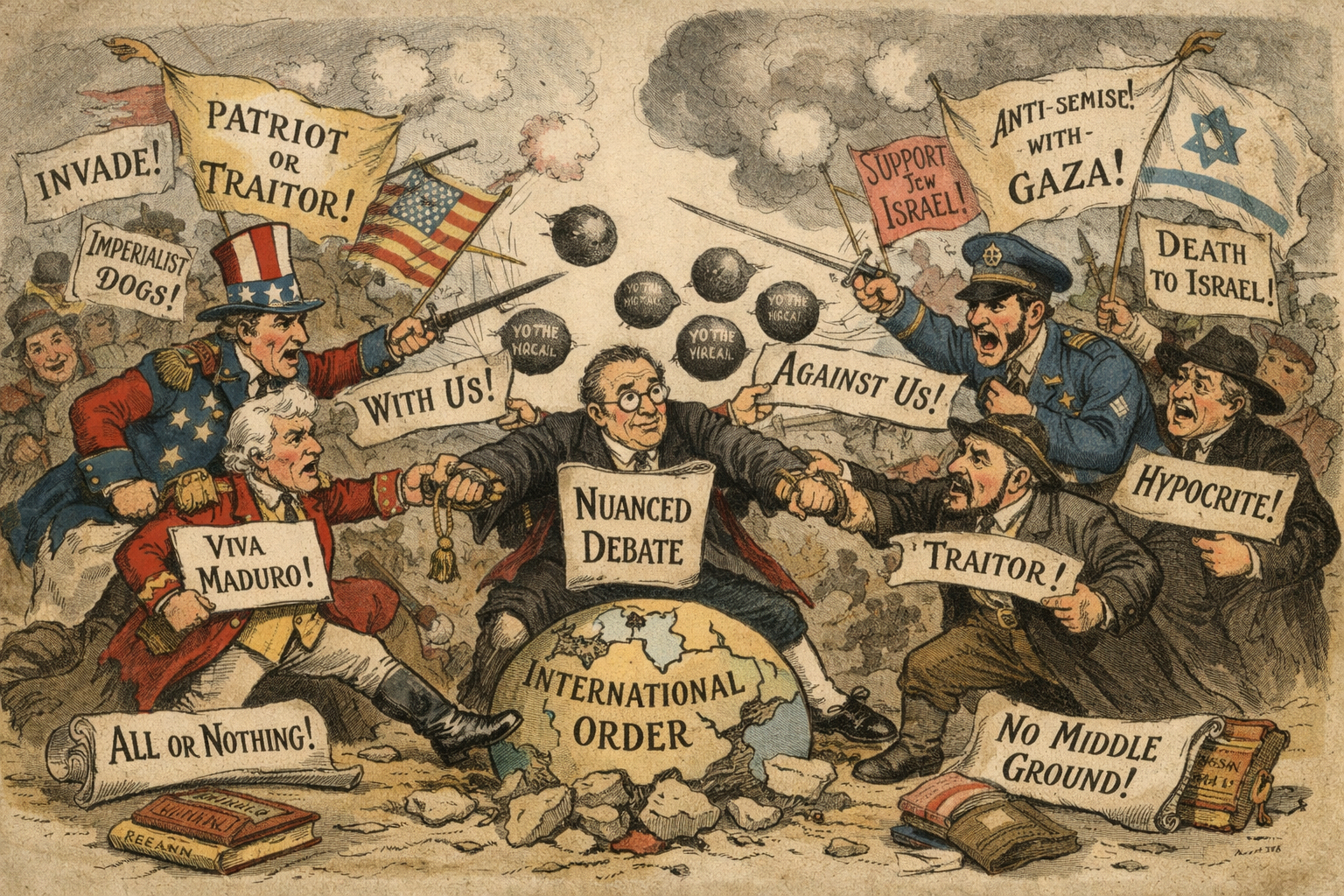
Public debate is losing its ability to handle complexity. Arguments are increasingly forced into tribal binaries: for or against, pure or condemned. The invasion of Venezuela, the Gaza tragedy, and the EU dispute over using frozen Russian assets for Ukraine all reveal the same reflex. It is now difficult to say two true things at once, to condemn authoritarianism while also condemning unlawful intervention, or to criticise a state without attacking a people. This black and white mindset weakens international norms and nourishes demagogues. Democracy requires nuance, patience and good-faith disagreement. Reality is complicated. Our thinking should be too.

There was a time when disagreement was an art. You could walk into a bar or a family lunch and discover that people could argue over politics, football and philosophy and still recognise that the world is complicated. Today that space is shrinking. The appetite for complexity has been replaced by an insistence on purity tests. You are either fully with us or fully against us. Min mhux magħna, kontra tagħna. Nuance is not only unwelcome. It is treated as betrayal.

The past months have offered an almost laboratory perfect demonstration of this drift. The reaction to the decision by Donald Trump to invade Venezuela has unfolded not as a debate about sovereignty, international law, regional stability and the Venezuelan people themselves, but as an online morality play. Choose your colours and shout. That is the extent of it.

It is apparently no longer possible to say the following simple adult sentence: Nicolás Maduro presided over an authoritarian and economically disastrous regime, and at the same time the United States is in clear violation of international norms by invading a sovereign state. The first half of that sentence will get you branded as an apologist for imperialism. The second half will earn you the label of socialist sympathiser. In some corners you will be accused of both simultaneously. The problem is not only intellectual laziness. It is a deeper abandonment of the idea that two truths can coexist, that moral judgment requires more than a team scarf.

The same flattening of thought is visible in the debate over Israel and Gaza. It should be straightforward to condemn the actions of the Israeli government and the devastation visited upon civilians in Gaza, while also rejecting any form of hatred toward Jewish people. Yet the public square rewards those who refuse this distinction. If you criticise the state of Israel you are suspected of hating Jews. If you are vigilant about antisemitism you are assumed to be endorsing every policy of the Israeli government. Whole histories, legal frameworks and human tragedies disappear into this binary grinder.

The same reflex has marked the European debate on whether to deploy frozen Russian assets to support Ukraine. What is in truth a complex web of legal constraints, property rights, market stability risks and the creation of precedents in international financial governance has been flattened into a shouting match. EU institutional leaders who counsel caution are instantly branded as timid bureaucrats indifferent to Ukrainian suffering. Those who advocate rapid and expansive use of the assets are dismissed as reckless ideologues ready to shatter the rule of law when it suits them. Member states with deep exposure to financial markets or constitutional limits on expropriation are accused of selfishness, while states urging faster action are caricatured as naïve moralists. Lost in the noise is any recognition that democratic leaders may be grappling in good faith with genuinely difficult trade offs, where support for Ukraine must be reconciled with the long term credibility of Europe’s legal order and the stability of its financial architecture.

There is a hidden cost to this constant demand for black and white answers. It corrodes the very architecture of the international order. That order is not a slogan. It is a mesh of norms, institutions, messy compromises and evolving jurisprudence that has been built to prevent precisely the rule of the strongest from becoming the only rule. When citizens lose the habit of thinking in layers, of holding tension, of accepting that rights and wrongs can intersect in uncomfortable ways, they also lose the instinct to defend that order. If every conflict is simply a clash between absolutely good and absolutely evil, then treaties, courts and multilateral processes are just inconvenient obstacles.

Social media has rewarded outrage and punished hesitation. Politicians have learned to fear the fifteen second clip more than the considered argument. Academia sometimes retreats into jargon while journalists are pushed toward headlines that perform rather than inform. Each of these trends narrows the space for complexity. The end result is a civic culture that treats reflection as weakness.

Yet reality stubbornly remains complicated. Venezuela is a country of immense suffering whose people deserve democratic dignity without foreign tanks rolling across their soil. Israel is a state with real security concerns whose government can still commit grave wrongs. The United States can speak the language of liberty and simultaneously trample the very rules it once helped to draft. These are not contradictions to be resolved by erasing half of the picture. They are the texture of the world we actually inhabit.

Recovering the capacity for nuanced judgment is a democratic necessity. Citizens who cannot think beyond binary choices are easy prey for demagogues. Institutions that depend on public understanding become brittle when that understanding collapses into slogans. International law becomes performative when publics refuse to see its value except when it flatters their tribe.

The antidote is unfashionable and slow. It requires reading rather than scrolling, listening rather than waiting to speak, arguing in good faith rather than hunting for trophies. It requires the humility to admit that one can be wrong about part of an issue and right about another, that moral clarity is not the same thing as intellectual simplicity.

We do not need a world with fewer disagreements. We need disagreements that are worthy of the complexity of the world. The alternative is already visible. It looks like foreign policy by thunderclap, public debate by accusation, and a steady erosion of the fragile agreements that keep power in check. Black and white may be easier on the eye. It is a disastrous way to see reality.

GRECO, Galdes and Non-Regression

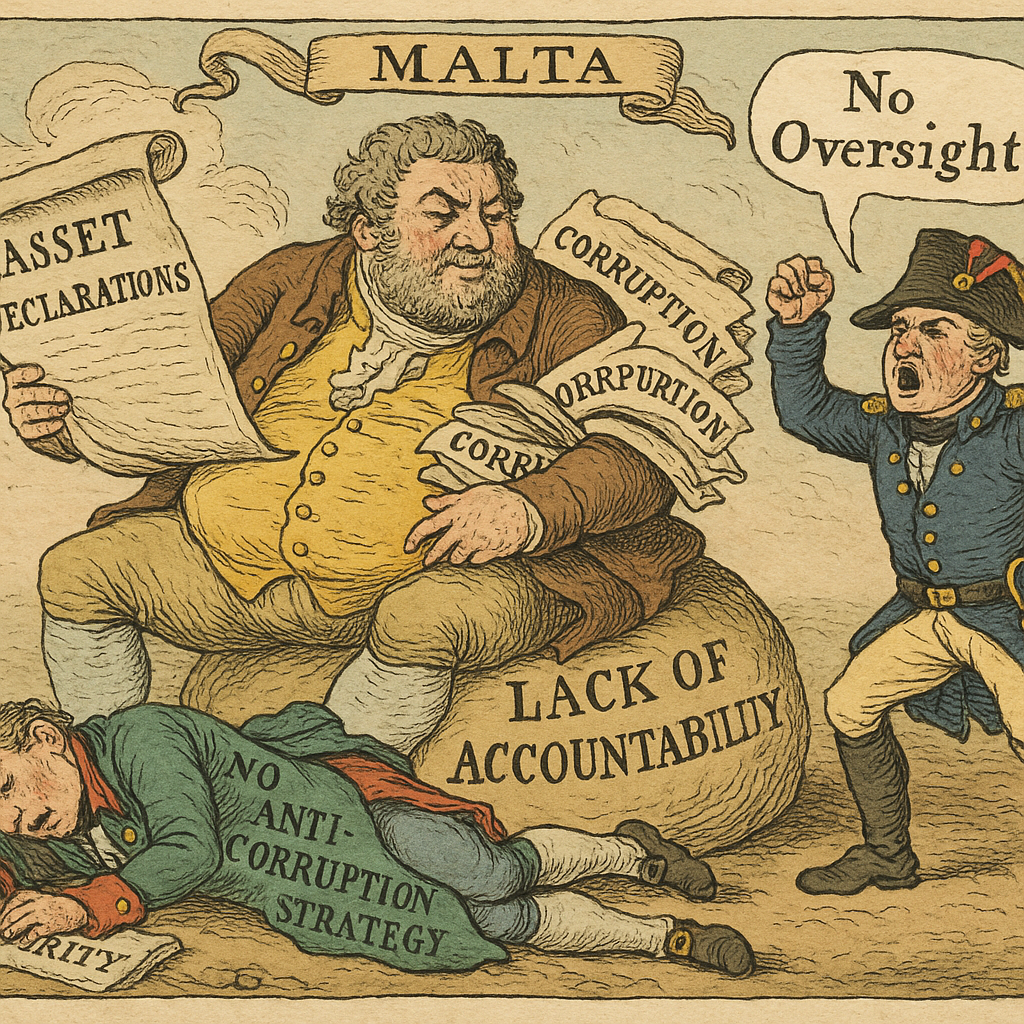
Malta’s latest GRECO compliance report again highlights systemic failures in three core areas: integrity standards for persons holding top executive functions, an effective and transparent asset-declaration regime, and the absence of a comprehensive anti-corruption strategy. GRECO’s conclusion is blunt: Malta remains in a state of insufficient compliance, with several recommendations untouched and others only partially implemented. These gaps concern the very mechanisms meant to prevent undue influence, conflicts of interest, and the misuse of public office.

The deficiencies identified by GRECO have gained renewed relevance in light of the recent scandal involving the Minister for Affordable Housing, whose unexplained personal financial arrangements and opaque dealings have raised serious questions about ethical conduct at ministerial level. In any functional integrity system, such a case would automatically trigger institutional scrutiny – but Malta’s framework remains either ineffective or deliberately under-used. This weakness is compounded by the Prime Minister’s continued refusal to publish Cabinet ministers’ asset declarations, despite years of external pressure. Without accessible declarations, there is no public or institutional ability to verify conflicts, enrichment during office, or improper benefits. GRECO has repeatedly stressed that transparency cannot exist where declarations are either incomplete, unverified, or withheld entirely. The government’s ongoing resistance transforms what should be a basic safeguard into an empty formality.

These failures collectively create an accountability vacuum. The absence of a binding anti-corruption strategy means there is no coherent framework setting out risks, sanctions, preventive measures, or oversight responsibilities. Weak or hidden asset declarations deprive journalists, civil society, and Parliament of the information necessary to detect conflicts of interest or illicit gains. The lack of integrity rules for persons at the apex of government leaves wide discretion with minimal scrutiny. The combined result is an environment where abuse is not merely possible but structurally facilitated, and where wrongdoing can remain undetected until exposed by coincidence rather than institutional design.

In the broader context of EU law, this trajectory raises serious concerns under the non-regression principle articulated by the Court of Justice in Repubblika. The Court held that Member States may not backslide on rule-of-law standards essential to maintaining judicial independence, good governance, and effective enforcement of EU law. By allowing its integrity framework to stagnate – and in key respects regress – Malta risks falling below the minimum constitutional safeguards expected of an EU Member State. The persistent refusal to strengthen transparency, regulate conflicts of interest, and implement anti-corruption structures may therefore be understood not merely as a domestic governance issue, but as a potential breach of the EU’s foundational requirements, undermining mutual trust and the proper functioning of the Union’s legal order.

Is the President right to refuse the Binance pledge?

An analysis of the legislative and regulatory scenario concludes that given the current record and supervisory posture, the legal and governance case for refusal is robust.

Malta’s Community Chest Fund (MCCF) has declined a long-pending Binance crypto pledge – originally around € 200k in 2018 BNB and now quoted around € 39m – citing reputational and governance concerns about the provenance and disbursement method. Reporting indicates Binance wanted funds sent directly to individual patients’ wallets, bypassing MCCF’s ordinary controls; the President publicly called it a “bogus donation,” while the Prime Minister urged reconsideration. Court filings between MCCF and Binance over related disputes have recently been settled out of court, but the charity has now walked away from the offer.

The legal risk in accepting the donation turns on Malta’s Anti-Money Laundering (AML)/ Countering the Finance of Terrorism (CFT) framework and the charity’s fiduciary and data-protection duties. Under the Prevention of Money Laundering Act and subsidiary regulations, Malta’s Financial Intelligence Analysis Unit (FIAU) sets and enforces AML obligations and can receive suspicious transaction reports; while a state charity may not itself be a “subject person” like a bank or Virtual Asset Service Provider (VASP), it must not facilitate laundering and would typically rely on obliged intermediaries (banks/payment providers) to conduct KYC/KYB, source-of-funds checks and ongoing monitoring. If red flags arise, accepting the funds could expose the charity to regulatory and reputational harm and, in extreme cases, criminal risk tied to receiving proceeds of crime.

Verification of the legality of sources in this context is feasible in principle but not straightforward. Binance itself has faced repeated statements from Malta’s financial regulator that it is not authorised in Malta under the Virtual Financial Assets (VFA) regime; today the MFSA is also the competent authority for crypto-asset supervision under the Markets in Crypto-Assets Regulation (EU). Because Binance is not licensed in Malta, Maltese authorities cannot rely on local prudential/AML supervision of the donor, making enhanced independent verification prudent. Technically, blockchain analytics can trace wallet histories, but “clean” on-chain flow is not a legal guarantee of legitimacy; only obliged entities’ due diligence, sanctions screening and, where necessary, law-enforcement intelligence can comfortably de-risk the funds.

Practically, the authorities with roles here are:

  • the FIAU (national AML/CFT authority) for guidance, intelligence and potential directions;
  • the MFSA (supervision of VFA/MiCA service providers, public warnings on unlicensed activity) given the donor’s status;
  • the Sanctions Monitoring Board for EU sanctions compliance if any listed persons, chains or jurisdictions are implicated;
  • the Police/Asset Recovery Bureau and Attorney General for proceeds-of-crime issues; and,
  • at sector level, the Office of the Commissioner for Voluntary Organisations where charities’ governance intersects with financial integrity.

If MCCF were to reconsider the pledge, it would need a bank or regulated payment channel willing to complete full Customer Due Diligence (CDD)/ Enhanced Due Diligence (EDD) and source-of-funds/wealth checks on the donor wallets, structured in a way that respects GDPR (particularly the prohibition on disclosing special-category health data without a proper legal basis), rather than direct-to-patient transfers demanded by the donor.

Given the current record and supervisory posture, the legal and governance case for refusal is robust.

The Political Reaction

The Prime Minister and the Leader of the Opposition seem to have a common point in their reaction to the news of the President’s refusal of the ‘bogus donation’. The Prime Minister stated in a direct way that the current regulatory framework should be sufficient to clear the funds for use. He was unable to hide his evident anger at what he (almost) called “being purer than the pope” (he changed tack last minute, probably realising it was not the best pitch to make. He did argue however that other countries who criticise Malta would probably welcome Binance themselves, admittedly without giving one clear example of where this is the case – relegating this statement to spin and speculation rather than concrete fact-based evidence.

Alex Borg on the other hand was more evasive, preferring to throw responsibility on regulatory authorities. He seemed to imply (just like the PM) that 39 million was too big an amount to risk losing. He stressed that the work of regulatory authorities is crucial in this sense and should the Binance donation pass scrutiny with a clean bill of health then much use could be made of that amount. Not exactly agreeing with the president then and more in line with Abela’s take though with less determined tones.

What to make of it then? I would say that the optics count for a lot. Binance’s history is tainted with a number of cases in France and the US concerning money-laundering and money laundering for terrorist groups. Their legal issues related to money laundering have resulted in significant financial penalties and ongoing scrutiny, reflecting broader regulatory challenges in the cryptocurrency sector. This kind of history means that an analysis as that conducted above would end in a strong legal and governance case for refusal. It is indeed worrying that the two leaders are so quick to dismiss this history in a “Malta qatt ma irrifjutat qamħ” sort of way.

Cultural Heritage and Tradition in the Constitutional Orders of Italy and Malta

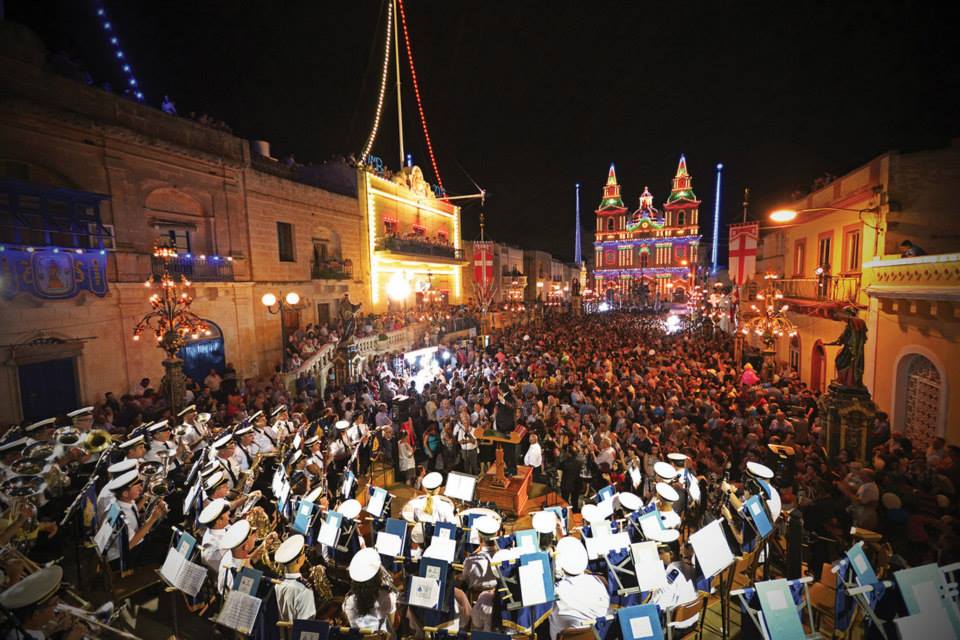
Across Europe, the protection of cultural traditions and pastimes sits at the crossroads between constitutional identity and legislative policy. While all Member States acknowledge culture as a public good, few have given it explicit constitutional status. Italy stands out as a state where culture is embedded in the constitutional text as a foundational value. Malta, by contrast, protects its traditions through statute and policy rather than constitutional law. A comparison between these small Mediterranean states reveals how constitutional design shapes the strength and enforceability of cultural protection — and how both models interact with broader principles of European law.

In Italy, Article 9 of the Constitution occupies a central symbolic and practical role. It declares that “the Republic promotes the development of culture and scientific and technical research” and “safeguards natural landscape and the historical and artistic heritage of the Nation.” This brief clause has evolved into one of the pillars of Italian constitutional identity, second only to the protection of human dignity and democracy. The Constitutional Court has interpreted Article 9 expansively, seeing it not merely as a programmatic statement but as a binding constitutional duty on public authorities. The protection of culture, landscape, and heritage has thus become an enforceable constitutional good, capable of limiting legislative and administrative action.

The 2022 constitutional reform further strengthened this framework, explicitly adding the protection of the environment, biodiversity, and ecosystems “also in the interest of future generations” to Article 9. The reform linked environmental and cultural heritage under a single constitutional ethos — the idea that Italy’s identity rests on the continuity of its landscape, arts, and traditions.

This constitutional culture is reflected in a dense network of legislation, most notably the Codice dei beni culturali e del paesaggio (Legislative Decree 42/2004). The Code translates Article 9 into practice by defining, classifying, and regulating cultural assets, landscapes, and intangible heritage. Interestingly, the Italian model is not purely centralised. The Constitution assigns significant powers to the Regions and local authorities under Title V (Articles 117–118), which divide legislative competences between the State and the Regions. Culture and tourism fall within the category of “concurrent competences”, meaning that while the State lays down the fundamental principles, the Regions enjoy the power to legislate in detail and to promote regional traditions and local cultural practices.

This regional autonomy is vital for Italy’s cultural richness. Local authorities support and regulate traditional events such as the sagre popolari — village fairs celebrating local produce, crafts, or patron saints — as well as historical pageants, dialect preservation initiatives, and folk music festivals. Each Region has its own cultural statutes: for instance, Tuscany and Emilia-Romagna provide funding and legal recognition for traditional community events, while Sicily and Sardinia operate under special statutes granting even broader cultural powers. The sagra popolare thus becomes not only a communal celebration but also an expression of constitutional pluralism — the coexistence of local traditions within a shared national framework. Through Article 9 and regional competences, Italy has constitutionally integrated its living traditions into the structure of the Republic itself.

Malta’s situation is markedly different. The Constitution of Malta (1964) contains no article equivalent to Italy’s Article 9. Cultural protection is mentioned only indirectly in the Preamble, which commits the nation to safeguard “the heritage of the past.” There is no recognised fundamental right to culture, no constitutional duty upon the State to promote or preserve heritage, and no judicial doctrine elevating culture to constitutional rank. Instead, the Maltese system relies on ordinary legislation and policy measures.

The Cultural Heritage Act (Cap. 445 of the Laws of Malta), enacted in 2002, provides the legal foundation for the protection and management of both tangible and intangible heritage. It establishes Heritage Malta and the Superintendence of Cultural Heritage, the principal institutions responsible for preservation and registration. Under this Act, traditional practices — such as village festas, għana (folk singing), carnival, the regatta, or traditional crafts — can be recognised as part of the national heritage inventory. Complementary legislation, including the Environment Protection Act (Cap. 549), covers aspects of landscape and environmental heritage. Malta’s National Cultural Policy (2015, revised 2021) serves as a guiding framework, but it remains a policy document without constitutional force.

This statutory model has important consequences. Cultural protection in Malta depends largely on executive discretion and funding priorities, rather than on judicially enforceable duties. Courts rarely invoke cultural considerations as constitutional values when adjudicating conflicts between development and heritage. The constitutional silence on culture also limits the use of cultural arguments in administrative or constitutional litigation. Where Italy’s Article 9 allows judges to weigh culture and heritage against economic or infrastructural interests, Maltese law offers no equivalent balancing principle at constitutional level.

At the European Union level, the two models interact differently with supranational norms. The EU’s legal framework recognises culture as an area of supporting competence. Article 167 of the Treaty on the Functioning of the European Union (TFEU) requires the Union to contribute to “the flowering of the cultures of the Member States,” while Article 22 of the EU Charter of Fundamental Rights obliges respect for cultural, religious, and linguistic diversity. These provisions, though not directly enforceable, shape EU policy and interpretive practice. They give Member States space to justify national cultural measures — for instance, subsidies, preservation laws, or regional protections — as expressions of their national identity, which the EU must respect under Article 4(2) of the Treaty on European Union (TEU).

Italy’s constitutional framework aligns naturally with this European approach: its Article 9 and regional competences provide concrete expression to the Union’s abstract respect for diversity. The Italian model shows how national constitutions can transform cultural policy into a constitutional commitment compatible with EU law. Malta, on the other hand, exemplifies a system where EU-level cultural principles reinforce policy rather than constitutional obligation. The EU supports Maltese initiatives through programmes such as Creative Europe and through recognition of heritage sites and intangible practices, but these remain dependent on political choice rather than constitutional mandate.

Ultimately, the contrast between Italy and Malta illustrates two distinct ways of embedding culture within law. Italy’s constitutionalisation of heritage and regional traditions transforms culture into a legal value of the Republic, linking identity, landscape, and citizenship. Malta’s statutory model reflects a policy-based conception, where culture thrives through institutional commitment and community participation rather than constitutional adjudication. Both approaches, however, belong to a broader European story — one in which traditions, pastimes, and collective memories form part of a shared commitment to identity, continuity, and the democratic value of cultural diversity.

Alex Borg’s PN: The Party as an End in Itself? 

The first days of Alex Borg’s leadership of the Partit Nazzjonalista leave me with more questions than answers. He has stepped into a role that carries the weight of history—but also of failure, stagnation, and disillusionment. The PN isn’t just in opposition; it’s in crisis. And yet, if you listened only to Borg’s early speeches, you’d think the most pressing challenge facing Malta was rebuilding the “glory” of the party itself. 

This is where the problem begins. 

Borg has so far focused heavily on “the party.” Its structure. Its morale. Its past. His language is full of admiration for the PN’s historical victories, its “heroes,” its contributions to the country. That may be comforting to some within the party. But it’s not what the country needs. Malta doesn’t need a nostalgic PN. It needs a credible alternative to the current government. Borg seems more interested in reviving a brand than offering a vision. 

It’s not wrong for a new leader to stabilise the party he inherits. That’s normal. A fractured, demoralised party is no platform for national leadership. But the problem with Borg’s early leadership is that it stops there. He’s not using the party to build a project for Malta—he’s rebuilding the party as the project itself. In that sense, it’s not clear whether he sees the PN as a vehicle or a destination. If it’s the latter, he’s missed the point of political leadership entirely. 

A party is not an end in itself. Its purpose is to offer the public a better way forward—to translate values into policy, and policy into real change. That’s especially true for a party in opposition. If the PN is to be more than a relic, it needs to be in a permanent state of readiness to govern. Not just to oppose. Not just to commemorate itself. Borg’s early rhetoric avoids hard policy choices, complex realities, or clear ideological direction. There’s no talk of climate resilience, housing, tax justice, digital infrastructure, public health reform, or how to break Malta’s addiction to corrupt planning deals. There’s no signal of how he plans to regain the public trust—especially from younger generations, many of whom have no memory of the PN’s “glory days,” only its long decay. 

That silence is loud. 

“Un programma politico non si inventa, si vive.” – Luigi Sturzo 

Is it too much to expect vision this early on? No, it isn’t. The PN has been out of power for more than a decade. Anyone taking over now should arrive prepared—not just to lead a party, but to lead a country. Vision isn’t a five-year plan or a document you publish at election time. It’s a direction, a set of priorities, a set of truths you’re willing to stand by even when they’re unpopular. Borg hasn’t even hinted at one yet. And the vacuum is glaring. 

Instead, we’ve heard what amounts to internal messaging—calls for unity, loyalty, revival. That might resonate with the grassroots, but it does little for the rest of the country. Borg may be consolidating control, but to what end? If the goal is to win power, then he’ll need more than loyalty and internal discipline. He’ll need trust, and trust is built on credibility. The PN won’t get there unless it starts talking to people outside its own echo chamber. 

Even more worrying is Borg’s silence on the rule of law. Under Labour, Malta has seen deep institutional erosion—from the collapse of regulatory oversight to the stalling of investigations into political corruption. These are not abstract issues. They affect everything from business confidence to environmental degradation to our democratic dignity. The PN under previous leadership has found it hard to keep this issue alive. Worse still, it has chosen to either engage in petty squabbles with NGOs fighting the Rule of Law battles or worse still it chose to blame its woes on the fact that such battles were ‘distracting’ or ‘unpopular’. 

Borg so far seems uninterested—or unwilling—to confront it head-on. Has he already calculated that this battle is unwinnable? Or is he too afraid of alienating potential swing voters who see such talk as polarising or elitist? 

If he drops the rule of law agenda entirely, it will be more than a tactical retreat—it will be a moral failure. Malta needs political leaders willing to do more than win elections. It needs leaders who will fight for the future of the state itself. 

It’s not enough to invoke the past. The PN was once a party that brought Malta into the EU, strengthened the economy, and helped build modern infrastructure. But that was then. A new generation wants to know what comes next. How will Malta shift away from short-term profiteering and towards long-term sustainability? How will we build a fairer economy, a less polluted environment, and a digital system that works for citizens, not just government departments? These are not romantic questions. They’re real and they demand answers. 

So far, Borg has offered none. 

If this continues, the PN under his leadership will become a sort of political heritage NGO—committed to preserving its memory, but incapable of shaping the present. And in a country that desperately needs serious alternatives, that would be a tragedy. 

Borg still has time to prove otherwise. But the clock is ticking. If he wants to lead Malta, not just the PN, he’ll need to step outside the party walls, take a stance, and speak not just to his members, but to the country. 

Otherwise, he’s not building a future. He’s curating a museum. 

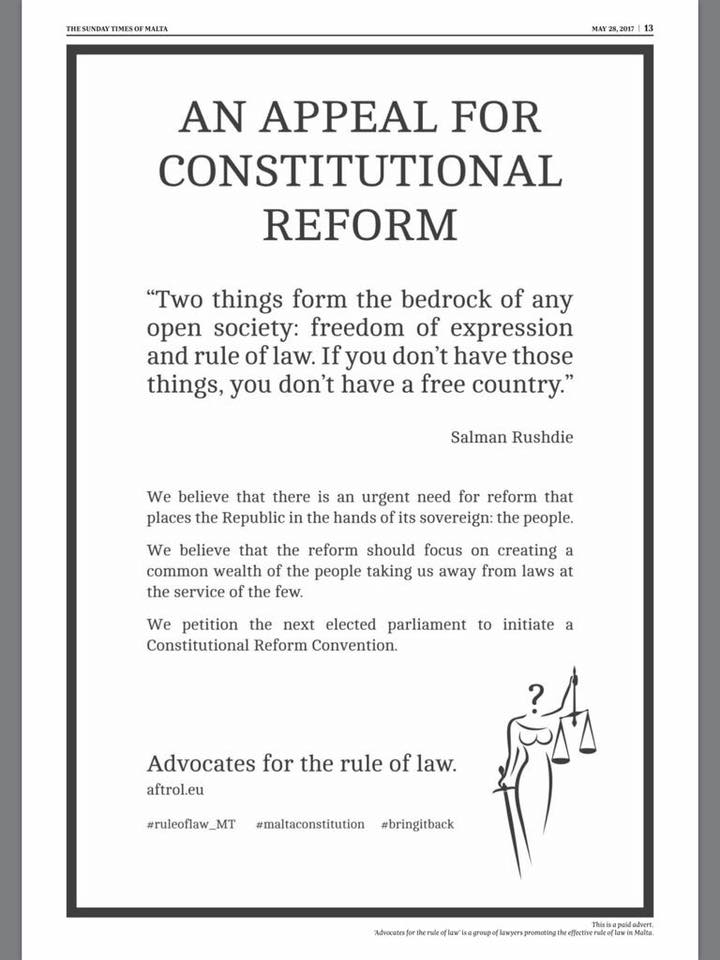
CAVEAT LECTOR: Let me be clear. My critique is that of a citizen who has no direct, vested interest in the PN. My interest is in having a credible opposition that is a valid alternative for government. Beyond that I also harbour a faint hope that the next government will champion the reforms needed to revert to a state of rule of law.   

This Is the Record: Malta’s Institutions Are Being Hollowed Out 

Let us begin with a truth that bears repeating: democracy does not die in one fell swoop, but by a series of quiet manipulations, each too technical to stir mass indignation, each cloaked in the language of efficiency, reform, or sovereignty. Malta is not facing an immediate coup. But what it is experiencing is something more insidious: a slow, deliberate capture of the very institutions designed to safeguard the public from arbitrary power. 

This is not a matter of partisan allegiance. It is a matter of record. And the record is clear. 

Over the last decade, Malta’s government has steadily expanded its reach over institutions that were once conceived to act as checks on executive power. The judiciary has found its independence compromised—not with tanks in the streets, but with legislation in Parliament and political appointments cloaked in the veneer of reform. 

One need not speculate. The Venice Commission, the Council of Europe, and multiple rulings from the European Court of Justice have signalled alarm. Judicial appointments were, for years, controlled by the Prime Minister’s office. Though recent changes were made following external pressure, the culture of loyalty and reward remains. Judges rise not merely by merit, but by proximity to power. And when they speak out—if they speak out—they do so at their own peril. 

This is not the natural order of things. It is a design. 

Oversight mechanisms have not been dismantled; they have been neutralised. The Planning Authority now issues permits in defiance of local plans and common sense. Its appeals tribunal, once a citizen’s last recourse, is to be stripped of real power under new legislation that proposes that courts may no longer revoke unlawful permits. Instead, they must refer the matter back to the same authority whose decision was deemed defective. This is not justice; it is theatre. 

What becomes of a nation where wrongdoers can outlast the process meant to stop them? Where court action becomes a maze designed to exhaust, confuse, and bankrupt rather than to protect? In such a nation, impunity is not an accident—it is a feature of the system. 

One may ask: where are the anti-corruption laws? Where are the safeguards? They exist, on paper. But paper burns. Legislation intended to curb corruption has been hollowed out by amendments, delayed by “consultation,” or applied selectively. The Freedom of Information Act remains more honoured in the breach than the observance. Whistleblower protections are limited in scope and rarely invoked. Asset declarations are filed but not verified. And the institutions charged with enforcement—the Commissioner for Standards, the Ombudsman, the Auditor General—are afforded just enough power to seem respectable, and just enough constraint to remain ineffective. 

This is the scaffolding of democratic decay. The façade remains intact: there are courts, there are laws, there are committees. But the substance has shifted. What was once meant to serve the public now serves power. Those who protest are smeared, sued, or ignored. Civil society is tolerated but never embraced. 

This is not a new story. Other democracies have walked this road—Hungary, Turkey, Poland. Their governments too spoke the language of reform. Their leaders too invoked the will of the people as they dismantled the machinery of accountability. 

And let us be clear: this is not about one scandal or one administration. This is about a systemic drift, a deliberate weakening of the structures that make accountability possible. It is about a state that no longer tolerates friction—be it from courts, journalists, NGOs, or ordinary citizens—and seeks instead a smooth path to its ends, unchecked and unchallenged. 

The result is a nation where corruption does not need to be concealed; it thrives in plain sight, protected not by secrecy but by inertia. It is a nation where reform is promised as a shield, and delay becomes a tactic. A nation where outrage has become routine, and resignation replaces resistance. 

But resignation is not destiny. 

Malta is still a member of the European Union. It is still bound by the Charter of Fundamental Rights. The courts in Luxembourg still have jurisdiction. Civil society still speaks, though with growing fatigue. Journalists still report, though some have paid the highest price. The fire has not gone out—but it flickers. 

We must remind ourselves, as Edward R. Murrow once did in darker times, that “a nation of sheep will beget a government of wolves.” The purpose of institutions is not to please the powerful, but to restrain them. The rule of law does not ask whether the law was passed by a majority, but whether it serves justice. 

This is not the end, unless we accept it as such. The law can be restored. Institutions can be rebuilt. But only if we speak plainly, act firmly, and refuse to be lulled into silence by the language of procedural normalcy. 

The time for euphemism is over. 

This is the record. And it is our responsibility to change it.