More on Thrift

One of the books I’m reading deals with the issue that we were talking about on this blog yesterday (“Thrifty with facts”). “The Price of Everything” by Eduardo Porter is an interesting study into the “true cost of living” and attempts to give an interesting perspective on otherwise mundane facts. My original post had been triggered by the fact that Maltastar deemed it fit to compare average wages in Luxembourg and Malta ostensibly because the evident gap would mean that the Maltese and only the Maltese have it worse off all round.

One of Porter’s chapters deals with how firms selling goods operate on the market in such a manner as to obviate the possibilities of the consumer to purchase comparatively. In other words, firms will go through great lengths to ensure that the consumer is not in a position to compare the price of their products with those of their competitors. We see this when a price is camouflaged under a pile of add-ons, bonuses, offers etc. Another of Porter’s interesting observations is that different brackets of the population have different shopping habits for different reasons. High wage earners give less value to the time spent comparing prices and tend to shop off the cuff while low wage earners are prepared to invest time in order to get the bargain.

Studies (I know that vague term is ugly but give it a chance) have shown that the same product might sell for very different prices depending on the customer involved. I do not need to believe some obscure study. SATURN, an electronics goods operating in Luxembourg has proven to be quite a good example of this practice  over the past few months. I have noticed that anything from headphones to in-car hands-free sets can vary in price depending on whether you opt to shop at Saturn in the city-centre (Gare area) or whether you drive to Esch-Belval (20 minutes highway).

It’s not just electronic goods either. Malta has now got Lidl as a household name. Luxembourg too has its different tiers – from ALDI (think lidl but cheaper – yes, cheaper) to Delhaize via Cora, Cactus and Auchan (that’s Pavi in Malta) you would have to command a panoply of comparative programs in order to get your really thrifty shopping list.

Am I making a point here? Well yes. It might be worth reflecting that when we speak of Malta’s consumers we are not talking of one homogenous block. Times may have changed from when Mintoff’s budget was eagerly awaited in order to know the going rate for the next year for a can of sardines but that does not mean that consumers are not still a varied bunch that are daily tackling the traps and offers of a myriad of shopping establishments.

One instant in the movie the Iron Lady struck me (or was it “The Road to Finchley”). Thatcher knew the price of butter in the stores (she was after all a grocer’s daughter) but her fellow politicians did not. I wonder whether some intrepid reporter could cold question Lawrence Gonzi and Joseph Muscat and find out whether they know the going rate for a carton of milk or butter (even if it’s the fake kind). Before our politicians can fan the flames of discontent with regard to the cost of living they would do well to show a little more understanding of the situation.

Is there open competition in Malta? Are your Pavi’s and Arkadia’s and Smart’s providing a range of prices that might be beneficial to the consumer? That too must be taken into account. Before we look outside our shores and focus on how much money is ending up in other people’s pockets it would be interesting to know who is spending what and where with the money that ends up in our own.

Feedback is welcome. Meanwhile here is an excerpt from the Porter book.

According to a study of Denver shoppers families that make more than 70,000 dollars a year pay 5 per cent more for the same set of goods than families making less than 30,000 dollars. Singles without children pay 10 per cent less than families with five members or more. Families headed by people in their early forties pay up to 8 per cent more than those in their early twenties or late sixties. Retirees are much more careful shoppers than middle-aged people. They search dutifully for the best deal and end up paying nearly the same amount for the same product. People in middle-age, by contrast, buy more carelessly. The prices they pay are all over the map.

Thrifty with Facts

Thanks to an Evarist Bartolo link on facebook I came across this article on Maltastar that compares the wages between Malta and Luxembourg taking data from a recent survey based on “average wages” and the Purchasing Power Parity. While it is interesting to look at figures consisting solely of wages as averaged out in relation to how they could be spent in the US it is obvious that a peek at the utility of that same wage in the country where it is earned would give a less skewed picture.

So while Maltastar is busy comparing Malta’s average wage of 1,808 dollars per month to Luxembourg’s whopping 4,089 dollars (top of the world) per month it would do well to look out for other stuff such as the actual cost of living in those countries.

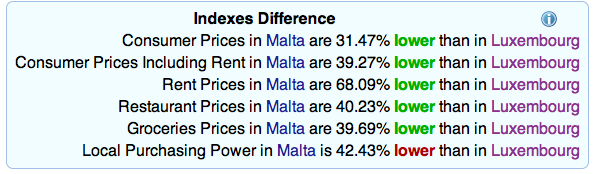
I could not find Luxembourg or Malta on the famous Economist Big Mac Index that is based on the One Price comparison for good. I don’t frequent McD mainly because of my allergy to gluten so I would not know the prices myself. I did found this site called numbeo however that does a cool comparison thingy between states. Sure enough I confirmed what I was suspecting and here are the facts for your perusal.

Just for the sake of perspective look at the rental costs for a 1 bedroom apartment – Luxembourg average is 950€ per month while Malta is 350€. As for buying property in Luxembourg compare the 5500€ price per square metre to Malta’s 2500 €.

This is not to say that Malta’s salaries are great or that prices cannot be more competitive but rather to point out that sticking to comparing wages is deceptive and intentionally portrays a fraction of the picture. Just to give you an idea of how relative the issue is, some unions of the EU fonctionnaires based in Luxembourg have been complaining that the salaries for Luxembourg workers are equal to those based in Belgium even though the cost of living in Luxembourg is much higher.

As in the case of the gas price hike J’accuse’s point is that rather than selective charts to fuel the discontent of the voter what we really need to see is what the political parties gearing up for next election are offering on their programmes so that we may be able to assess if any part of it includes – oh hope – solutions or at least attempts at solutions.

And by the way Varist, the guys at Maltastar COULD make an effort rather than cut and paste Ruth Alexander’s article from the BBC site. Next time you decide to cut and paste you should not leave out this damning assessment on the reliability of the figures:

In truth, the economists at the ILO have had to rely on very patchy statistics. Data is missing for some countries – even a country as large as Nigeria, for example. And also, the economists at the ILO are only counting wage earners.

They exclude huge numbers of people who appear in the poverty statistics but not in the calculations for the average wage – pensioners, children and stay-at-home parents, for example, and even the self-employed.

The number of self-employed is huge. In developed countries about 90% of working people are paid employees, but that figure is lower in many developing countries. For example, in South Asia, where many people are self employed or independent farmers, just 25% of workers are salaried.

The conclusion drawn by Ruth Alexander in her article must not have made for comfortable reading at Maltastar because it defeats the very (loose) point they were trying to make. Maltastar’s selective reporting (cutting and pasting) centred on comparing Malta’s wages with the best in the world. In truth the report concludes that ” that the worldwide level of economic development is in fact still pretty low, in spite of the huge affluence that we see in some places.”

Essentially an uncomfortable truth that the economic pains that are being suffered in Malta are (unfortunately) a symptom of a “worldwide level of economic development”. Sadly for Maltastar and Varist, it’s not GonziPN who is to blame.

Fools for love

The 6c price hike in fuel announced by Enemalta and effective today risked being a very nasty April Fools joke. Apparently it wasn’t. Fuel prices will go up in Malta, much as they are doing in the rest of Europe and the world. Only in Malta though will the blame be lain squarely at the feet of GOnZiPN. A quick run through facebook yesterday gave me a concerted effort from Labour MP’s and apparatchiks all complaining that Gonzi is adding on to the misery suffered by the Maltese families.

It’s useless arguing with a Labour diehard who is desperate to blame Gonzi for anything. Apparently Gonzi waited for the local council elections to be over before announcing the price hike. Sure. So did David Cameron, Jean-Claude Junker, Angela Merkel and the rest of the European leaders. Not to mention Barack Obama in the US. Can you picture Cameron sitting patiently waiting for the last results from the San Lawrenz count to peter out before making his move on the cost of fuel in British petrol pumps?

“Are the Saint Lawrence results in yet George? Can you be so kind and ask Cruddas to get another bottle of that Moet while we’re waiting'” Meanwhile, in the real world here’s an Essentiel article from Luxembourg explaining why the price of fuel is going up everywhere: “Porquoi l’essence flambe en Europe?“. See Edward Zammit Lewis, Chris Cardona, Evarist Bartolo? I am not motivated by a penchant at defending the current government, I am just intrigued by what Labour is proposing to do in the same circumstances.

Will Joseph Muscat give us the wild promise of subsidised petrol? Do his Labour fanatics know that voting for a government that subsidises fuel means voting for a government that will have to find a way to pinch the money for that subsidy from their pockets? Of course they don’t. Or if they do become aware of that then they will let loose with a volley of non sequiturs starting with “Mela Sant kellu ragun bl-Isvizzera fil-Mediterran”. Blind fools. The lot of them.

Luxembourg has just reached a record high price for fuel. In Britain a threatened strike by petrol pump owners led the general public to become brutally aware about the importance of alternative modes of transport. To us at J’accuse the brutal truth  that is exposed by the price hike in fuel is the actual relative cost of the botched attempt to reform public transport with the Delia-Gatt Arriva Plans. In times like these your car becomes a luxury to be used sparingly. Buses become popular if their service is efficient. In Wallonia – the French-speaking part of Belgium, recent figures suggest a doubling of the public service commuters (mainly buses). From 200,000 to 400,000 users in one year.

A smart opposition would put its finger on the real problem. Now, more than ever a proper and fully functional transport system is needed. Incentives from workplaces for employees to use buses would help – a workcard that covers the bus trips for example. Of course you cannot have buses running late or running never. But opposition is not about being smart. It’s about stoking the flames of anger and relying on the cheaply available fuel of blind faith.

Opposition is built on fools for love.


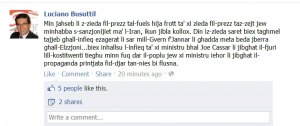
Qabel ma konna xejn

Tismagħom jitlewmu dwar festi nazzjonali u tibda taħseb u tehwden int ukoll bla ma trid.

Jgħidulek li qabel ma sirna indipendenti konna dejjem niddependu mill-barrani. Biex ksibna l-kostituzzjoni tas-64 konna xbajna telgħin u neżlin Londra nittalbu bis-sassla. U l-kolonjalist jitnejjek bina bejn bid-‘divide and rule’, bejn bil-‘language question’ bil-Malti lingwa tal-kċina u bejn bil-poteri tal-‘gvern’ Malti jingħataw u jittieħdu skond il-bżonn.

Meħud minn Facebook illum. Isem mistur.

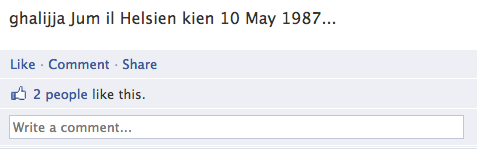
Jgħidulek li sakemm ħadna r-repubblika fis-74 konna għadna Monarkija. Indipendenti iva imma b-wiċċ ir-Reġina tifkira ta’ passat servili ta’ ‘l fuq min 260 sena kolonjaliżmu.

Meħud minn Facebook illum. Isem mistur.

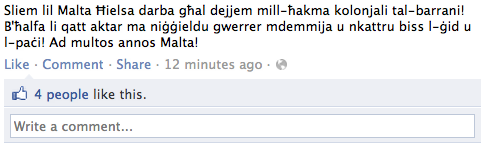
Jgħidulek li sakemm ma konniex aħna li ma ġeddidniex il-kuntratt mal-qawwa Ingliża (jew forsi ma ġeddewx huma), il-barrani kien għadu parti intrinsika fil-ħajja tagħna. Konna għadna niddependu fuqu u fuq l-infiq tiegħu. Għadna imwaħħlin maż-żejża. Jgħidulna li dakinhar ħadna rajjna f’idejna meta ħlisna mill-barrani. Dakinhar, jekk temminhom, il-Malti seta’ jibda jgħix u jkun hu biss responsabbli (u ħati) tan-nisġa tad-destin tiegħu.

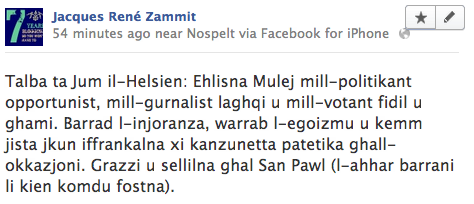
Jgħidulek li mingħajr l-indipendenza, mingħajr ir-repubblika, mingħajr il-ħelsien ma konniex inkunu n-nazzjon jew ‘ġens’ li aħna. Kważi kważi iridu jiddefinixxu lil pajjiżna b’dawn it-tlett avvenimenti.

Jgħidulek dan kollu… imma allura qabel… ma konna xejn?

Meħud ukoll minn Facebook. Tiegħi.

Bland about Mintoff

When author Immanuel Mifsud was last in Luxembourg he attended a Q&A session. Someone in the crowd began her question to the author with the phrase “I’ve never read any of your books but…”, I cringed and switched off after that. I had resolved not to talk about the “Dear Dom” movie until I got to actually see it – which I hopefully will this April if it’s still running after the 4th. This post is not about the movie itself but about reactions to the movie and was prompted by Yana Mintoff Bland’s comments to the Times.

In a nation that is defined with reference to “the other” where narratives are painted in dual tones and where national holidays are as divisive as ever it is hard to keep to the objective plot. The issue here is whether Pierre Ellul’s Dear Dom commits any injustice towards Dom Mintoff – the politician. By examining that issue you are also perforce obliged to tread the dangerous ground of puncturing “the Mintoff myth” – or the mythology that centres around the greater image of the man who can boast among his nicknames “Salvatur ta’ Malta” (Saviour of a nation).

From what I could gather from the blurbs and promos, Ellul’s work is a sort of letter addressed to the ageing leader that ends up becoming a carousel run through his political career. But what is Yana Mintoff Bland complaining about? Dom’s daughter is now a candidate for the Labour party in one of the districts where her dad’s myth continues to shine (notwithstanding the “traditur!” interlude).  The heading of the Times article  (Yana Mintoff: Family speaking to lawyers on Dear Dom film) leads one to presume that Mintoff’s family is preparing to sue Pierre Ellul (or Falkun) – at least most people do not “speak to lawyers” just for kicks.

I see two problems here. First of all Mintoff Bland’s grievances are with the bias that is apparently evident throughout the film. Mintoff Bland however seems to emphasise the character depiction of Mintoff as in his power-driven motivation as well as the idea that he is vengeful and angry. Interestingly there are very few allegations on the part of Mintoff Bland that are based on what would be a misrepresentation of facts. While she may not like the way Mintoff’s character and motivation is portrayed she has little to say about whatever facts are pictured in the movie. Whether a documentary’s judgement on somebody’s character could be subject to a challenge in the court of law is highly dubious.

There is another issue that is glaringly contradictory. On the one hand Mintoff Bland would argue that Mintoff Snr never got a chance to reply to Pierre Ellul’s letters and more importantly that he would have done so. On the other hand Mintoff Bland seems to be prepared to take legal action in the name of her father. Which would not make much sense unless her father was incapable of doing so himself.

These two issues lead  me to conclude that the only reason Mintoff Bland is kicking up a fuss is to attract media attention and to appear the paladin defender of the myth that has been built around her father.

When I think back to the bio-flicks I have seen from “The Iron Lady” through “Invictus“, “Malcolm X” and “the King’s Speech” I realise that behind every politician there is a human with human traits. This humanity is defined through interaction with others and the producer of a bio-flick will inevitably set his or her angle or agenda or theme throughout the documentary. It is not to be judged as good or bad but rather with a measure that bears in mind that history and the documentation thereof is rarely, if ever objective.

You can read twenty books about the life of Fidel Castro and you are guaranteed to get twenty different versions.  It’s not because it’s Castro. It could be Lenin, Kennedy, Mao, Jesus (hell, there’s not one official biography of J-dude but four – Matthew’s, Mark’s, Luke’s and John’s) or Gandhi. Paul Ellul’s movie should be taken for what it is – a perspective on the life and works of one of Malta’s noisiest politicians from the twentieth century.

Like Castro before him, Mintoff’s hard-headed reply could probably be implied without even watching the film…

La historia me absolverà” … then again, maybe it won’t.

The Four Week Break

It was already clear from the fact that no money votes are being taken in parliament. If we needed any confirmation then this came with the long Easter break that our elected underpaid representatives have taken. The length of this year’s parliamentary Easter recess is four weeks.

In the meantime and run up to this recess we have had the entertaining news coming from the reform committees set up in parliament in order to appease the renegade rebels turned reformers. Anything from constitutional law to bird-hunting becomes fair game (excuse the pun) for these sans-pareil legislators. Our collective political system, working in the twisted ways of which only it is capable, seems to have finally come to terms with the fact that reforms are needed. At least that is the first half of the message.

The second half brings us back to the same starting point much like the proverbial crab. Because while much parleying is being partaken of in parliament, nothing much will come out of the projects unless we will be witnessing a flurry of legislative initiatives at supersonic speed – always hoping that no other renegade majoritarian decides to rock the boat.

The opposition will complain about this but it is busily concerned with misinformation about spending cuts. This in itself is a taxing (excuse the second pun) exercise in contradictions. On the one hand the opposition has turned all its guns on the €40 million worth of expenditure cuts that the government must perforce perform while on the other that same opposition lets its imagination run wild with promises of the spending kind should it ever be relieved of its duties as eternal opposer.

As for the party in government (as distinct from the government) the whole kitchen business seems to be panning out quite unsatisfactorily. One wonders how long Simon Busuttil’s bland expression will entertain the many doubting Thomases who he set out to convert. You can only squeeze out so many half-hearted mea culpas from the nationalist fold and when you combine this fact with the menu of reality bites that Simon must explain to the masses by Pentecost (in as many languages as they can understand – thank God for the Holy Spirit) then the nationalist eggs surely cannot all lie in Busuttil’s basket.

What is really interesting is the relative silence of the usually noisy nationalist pundits and spin-machine. Aside from the various ministerial projects being rolled out in a hurry like an extended red carpet the nationalist machine remains relatively subdued. Even the blogosphere has felt the punch of this (controlled? concerted?) self-gagging exercise. Which leaves the Labour clones clucking in a cacophonous circus of empty noises and barks. Next chapter: poverty and “the precariat” (something to do with poor people or Saint George Preca, or both).

We are left with a couple of figolli to enjoy at the end of this period of fasting and self-denial. It’s also a time of reflection that should lead to the huge celebration with the return of the saviour. Only this time we are really left wondering…

who will it be?