When Franco is history

Back in January when Franco Debono’s rumblings had set everyone on edge and prepared a nation for a snap election that never was J’accuse was busy pointing out that the fascination about all things Franco would soon be overshadowed by much more pressing concerns. The national fascination with the controversy surrounding snap elections and the precarious nature of one-seat majorities is a manna and a blessing in disguise to both political parties.

So long as your average citizen is overcome by an all consuming interest in following Franco’s every step and second guessing the next election date, the PLPN circus can continue to fake their preparedness for the forthcoming election. With that kind of perspective whether we are in for a snap June election (as seems highly unlikely) or whether Gonzi’s government will drag on to an October grande finale should actually become a secondary issue.
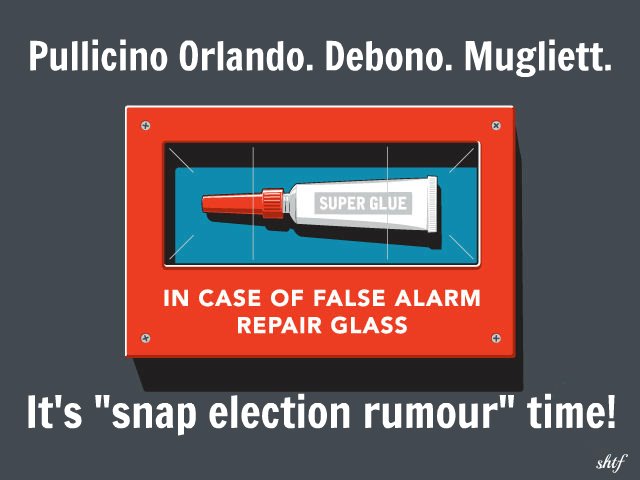
Sure, Labour can get its political mileage on such slogans as “iggranfat mas-siġġu tal-poter” as much as the PN can retort with the less effective”kilba għall-poter ta- Joseph“. The political battles are fought on the immediate: the power struggle, the stretched interpretations of representative malaise that result from the tweaked electoral rules, the Labourite quest to redesign Malta as a reverse Potemkin village, the Nationalist attempts to portray the world as an ok place to be if Franco didn’t exist…

Forget programs and plans for the future. The parties can avoid that completely. Ours it is not to know what measures will be taken by the next tenant in Castille. Once Franco is history and the elections have come and gone what is the program for the nation? We pointed this out in January and nothing has changed since then. The same questions can be asked of the same people.

Here are some snippets from January’s posts as reminders:

Windows of Opportunism

Muscat’s Labour seems intent on repeating GonziPN’s fatal error of 2008. They prepare for some sort of electoral victory but is this a party that is proving that it has the right credentials to govern? The smokescreen of the Franco saga might invigorate Labour hopefuls and build their hope for a change in government. The removal of the power weary Nationalists would not come a moment too soon for them. The mistake they make is that they equate the satisfaction of removing an expired government with the automatic assumption that anyone who steps in by default will be good for the job.

That Constitutional Question

Even though our political parties operate on the assumption that “loyalty” is universally automatic they have now been exposed to the democratic truth that it is not. The failure is not of the system but of the arrogant assumption that the bipartisan mechanisms that the parties have written into the constitution will guarantee their permanent alternation. Franco’s methods might be obtuse and distasteful especially when they betray blatant and crude ambition but on a political level the renegade politician who disagrees with the party line was not only predictable but threatens to become a constant in the future.

Malta Post-Franco I

The biggest surprise for J’accuse was that many people were surprised at the outcome. That there were many (many) men in the street still crossing their fingers rooting for Franco to vote in favour of the confidence motion was acceptable.That it became increasingly evident that the Labour party actually had hoped for this to happen exposed new levels of naivety within the party’s strategists.

There were less sighs of relief from the Nationalist party end but this was probably more due to the fact that they were fully aware of some sort of deal with Debono that had avoided the worst. The nationalist party would live to govern another few days but the exercise of damage limitation had not avoided multiple bruising and the attempt to portray any sense of triumphalism that Joseph’s side had been “defeated” would only expose a shallowness and falsity that aggravated matters further. The cracks had just got wider and hell did they know it.

Malta Post-Franco II

What next for Debono? It remains to be seen whether the nationalist party will play out their part of the deal that won them a temporary respite from the Debono tsunami. His role within the party is imperiled if he fails to obtain the right to present himself as a candidate for the next election. Technically his career should be over: “sacrificed” as he likes to put it, for the greater good. Ironically he might be a magnet for the kind of voter that liked his shit-stirring antics and who would rather vote a maverick than vote labour. That kind of voter believed Franco’s promises of reform and is the kind who would have loved Franco’s swan song in parliament.

Debono’s fate is intrinsically tied to the decisions that the party that he claims he loves will take in the near future. If the PN once again will be in the business of assembling a rag-tag group of disparate candidates then he might be in on the off-chance that his Champion of the Disgruntled image wins him a few number 1s. It will be a hard struggle though and until the next elections Debono might still have the last word in precipitating a Nationalist party decision to go to the polls.

The Age of the Generalissimo is, in all probability, almost over.


Malta Post-Franco III

Buying time also means buying time for the government projects that were coming to their end to be finalised. There will inevitably be accusatory fingers pointed at projects and laws finished and enacted on the eve of an election. Honestly speaking most would have been end-of-term projects anyway and would have suffered the same fate. That is not the biggest problem for GonziPN. The biggest problem is that this  ”leadership race” is the last-ditch reaction by Lawrence Gonzi and worse, an insistence on engaging within the “presidential” context dynamic. What remains to be seen and what is of paramount importance for the party is whether it is learning from the past mistakes. To do so it has to acknowledge them humbly and prepare to rebuild from scratch.

2012 is many political light years away from 1989. It might still not be too late for the nationalist party to make an appointment with history and use this latest borrowed time to take up real politics (not realpolitik) once again. For that it needs less noise, less drama, less taste-based propaganda and bull and to concentrate on the substance. Values, policies and a bottom-up realisation that this is the time to face new challenges within new parameters might only just make it.

Will fate throw another lifeline for the PN and spare it the (by now very necessary) years of rebuilding in opposition? We can only hope that if it does then the Nationalist party gets down to the real business of politics.

Malta Post-Franco IV (Labour)

Much like gonziPN in 2008, Labour are fashioning a campaign around the promise of one man: Joseph Muscat. Once you get over the noise about “Instability”, “gonziPN’s dismantlement”, “Inefficiency” etc, once the whole fracas surrounding Franco’s last hold on government is over… you will be left with the naked truth. Two parties geared up for election. What is Labour promising? Joseph Muscat that’s what. Peel away the complaints and the only inkling of a plan you have is a “vision” held closely to heart by Joseph Muscat. They tell us they trust him. On what basis? Because he SAYS he can run a country? On what principles? With what reference point?

After Franco we got a Labour party beating its chest ready for action. Franco’s shenanigans required that parties showed themselves prepared: just in case. To the observer on the sidelines – not particularly bothered with partisan flag-waving – it was evident that Labour was nothing but a party of words and slogans. I know you won’t believe me so here are three random interventions from Labour’s General Council. Chris Fearne, Chris Cardona and David Farrugia Sacco take to the podium. Do they mention one… just one… idea they might have as a basis for change? Honestly… beyond the plaudits for Joseph and the list of grievances (legitimate as they may be) is one of these potential election candidates telling us anything except that they trust in Muscat’s vision?

Lawrence Gonzi’s ridiculous show of leadership challenge and defence (the Soviet acclamation?) might have bought time for the nationalist party to get its act together for the eventual battle. Meanwhile Labour could do well to keep the public opinion momentum going with the drum beating it loves to impress… but it would also do well to come up with some homework pretty soon because if we were into voting for visions then we’d have Angelik as Prime Minister.

see also : Iacta est?

Cheap noodles and les nouveaux pauvres

Marie Louise Coleiro Preca II is not the name of a boat. It is the name of MLCP’s second facebook page that was started after the first one was oversubscribed. Marie Louise Coleiro Preca II shared a post with Marie Louise Coleiro Preca about a meeting that was held at the PL club in Fgura where the subject seems to have been the “energy poor” and someone liked this post today so it came to my attention. These are not, as you might presume, people who are experiencing strong withdrawal symptoms from their last intake of Red Bull but rather a newly defined class of poverty that has been created by… you guessed it… GonziPN’s exorbitant energy bills.

A woman with respiratory problems, who had an electrically-operated oxygen tank at home, ate cheap noodles every day to be able to afford her utility bill, Labour health spokesman Marie Louise Coleiro Preca said yesterday. (…) “There are people who are energy poor. I spoke to a woman from Cospicua last week. She needs an oxygen tank at home to live. She just about passes the means test, so she’s not entitled to the energy benefit. She told me she can only afford to eat noodles,” Ms Coleiro Preca said.

There is something surreal about this kind of presentation. It probably has a lot to do with Labour’s generally bungled way of public relations and transmission of information. You cannot help but wonder how comfortable Joseph Muscat, Anglu Farrugia and the other geezer from the triumvirate of oxymoronic progressives can be with having their mugshot plastered on the walls of Kazini under the ubiquitous torch like some latter day Stalinist cult. There under the pictures of the future saviours of the nation sat the survivors of a not too distant socialist government plugging the narrative of the “new poor” – les nouveaux pauvres.

Marie Louise Colerio Preca II was armed with stories of the quasi-poor who “just about pass their means test” (the rare kind of test one would rather fail) and therefore cannot claim any energy benefits. So the nouveaux pauvres are condemned to eating “cheap noodles”. Do they even realise what it is they are writing? Stop for a second and think. “Cheap noodles”. As against bloody what? Gourmet noodles? And why noodles? Does noodles sound poorer than pasta asciutta?

Cue the erstwhile troubador of great socialist lore Joe Debono Grech who, once the list of nouveaux pauvres esquisses was done, ” called on his party to reach out to people by teaching people about the history of the party that worked so hard to fight poverty”.

There is something plastic about all this. Which is not to say by far that the tough economic times have not hit the people where it hurts. It is not to say either that the noodle woman shares the same problems as, say, Times columnist Kenneth Zammit Tabona who recently also complained about the exorbitant figures that turn up on his utilities bill. It’s just that Labour seems to be willing a fantasy land of misery – a potemkin village in reverse. There under the watchful eyes of The Three Leaders Who Will Guide Us In The Battle Against Poverty, the stakhanovist socialists of yesteryear spun the narrative of les nouveaux pauvres creating the new oppressed who will need a new socialist, progressive spirit to lead them out of damnation.

Fgura election prospective candidate Charles Agius joins in with enthusiasm:

(he) said that during home visits he met families who had their electricity supply suspended because they did not pay the bill. They took their children to their neighbour’s house to use the computer.

See the concept of the bare essentials? Under a previous patch of “utility poverty” (still living memory for many) you would have said that following the latest water and electricity cut parents took to filling buckets of water from the sea and kids went to bed early in the dark. Nowadays the nouveaux pauvres first thought is where to get access to the closest working PC. Plus ca change.

This is not a post that denies the existence of hard up situations in our midst. It is a post that looks at the instrumentalisation of what might be desperate cases in order  to spin an opportunistic narrative with no solution in sight. Labour is doing its damned best to redefine the goalposts by creating this new social strata which we can define as the nouveaux pauvres. Forget the middle classes or the pepe – hamalli divide. The pigeon-holeing is now strictly concerned with the reclassification of the grumbling masses into a reversed potemkin village of nouveaux pauvres. It suits the whole narrative well enough so long as the gullible and partisan are the ones being targeted.

Still. Cheap noodles?

I.M. Jack – the Monday Progressives

Short notes from the weekend.

Marine – Le Pen got 20% of the votes in yesterday’s first round scrutiny in France. Francois Hollande (complaining left) will battle it out with Nicholas Sarkozy (exhausting right) in the next round of votes that will determine the next Monsieur le President. French radios are all abuzz this morning about the record number of votes that Le Pen’s extreme right obtained as though this signifies anything other than a strong meeting point for an angry protest vote. The main problem for Hollande and the progressive anti-Sarkozy coalition he will probably amass for the showdown in two weeks time is the same as that of most left-leaning oppositions around Europe: the absence of a plan. A campaign that is built on disgruntlement and anger at the economic crisis and at the perceived arrogance with which the right handled such crisis can work to get a party into power: the next step of what to do with that power is equally important though and that is what is so worrying about the so-called progressive movement.

Sondages – An archaic law in France prohibits the media from announcing the results of exit polls before eight in the evening. In the past Belgian and other francophone media such as Swiss and Luxembourgish have been used to circumvent this prohibition. This year a number of French publications will be facing court procedures for having dared to publish the results by seven in the evening. A full hour before most polling stations closed.

Disgruntled votes – Le Pen’s followers are already talking about “pegging their nose and voting left”. Nose pegging is fast becoming a trend in the anti-voting that takes place in modern democracies plagued with a dearth of propositive policies. It would seem that the aim of most voters is simply to avoid giving another term to Sarkozy – few votes are used to vote positively, for someone with a plan. Even Le Pen’s voters are prepared to vote for the much detested left so long as Sarkozy and his UMP are broken up. So much for solutions to the ills of the 21st century.

The Value of Human Life – Newspaper reporting of the fine accorded to contractors whose “work” had brought about the death of an elderly woman in Sliema risks being very misleading. The fine of €8,000 is ridiculous and nowhere near being the proverbial “prohibitive” which is what fines are meant to be. It was meted out under rules and laws that apply to work conditions. That those rules need to be revised immediately to be more than a prohibitive warning for contractors is patently evident. On the other hand the fine has nothing to do with the value of the life of the woman who lost her life in these circumstances. The Times report actually referred to other civil cases in progress and one can presume that this is a civil compensation case – the kind of case that actually quantifies the losses for relatives as well as for injured persons. Controversial as such judgements on the value of life may be (do read The Price of Everything) they are a very different kettle of fish from the “fine” that has hit the news and misguided so many people.

Quatrains – On a footballing note it is interesting how following yesterday’s trouncing of Roma, the media tried to focus on the minor incident between Lamela and Lichsteiner. Even more interesting were the attempts of some Romanisti to condemn the Swiss for his “unwarranted provocation”. What was he guilty of doing? The very same thing supercapitantotti had done eight years ago to Igor Tudor… only that time, since Totti was not (heaven forbid) wearing the glorious striped colours it was not a provocation but a saintly gesture. Relativism. It’s everywhere. Quattro e a casa.


Cabinet Decisions & RCC’s Head

The Labour party has finally found a way to get at Richard Cachia Caruana on something based on fact rather than on the irritation at an unelected person having a purported strong influence on cabinet decisions (pace Franco Debono). The accusation is based on Wikileaks that portray an active RCC (oh the heavy acronym) lobbying with the US for the reactivation of Malta’s Partnership for Peace membership. The buzzphrase on social networks this morning is : “Allura RCC ikbar mill-parlament?”

I’ve always found this fixation with RCC quite a curious one. The man obviously has much clout and his opinions seem (or seemed) to be highly valued within the inner decision making circles of government. That he might not be directly accountable for many a blunder might raise important questions about the structure of our elected elite. On the other hand there is a bit of an emptiness in the grudges that are held against the man. The business of government is one that does not only require elected politicians in their roles of PMs and ministers but also gets done with a caravan of policy advisors (at least we hope so) who come election day risk their position as much as the rest of the ministerial entourage. Feeble as it may be – it does give you an idea of a form of accountability.

Secondly, RCC might be counted among a list of a few intelligent persons upon whom the Gonzi cabinet depended for a long time as a sounding board as well as to prepare future policy objectives. Again the main caveat here is that I do not know the man from Adam except for the rumours within the halls of civil servicery that are not too kind on him insofar as temper and perfectionist tantrums are concerned. Be that as it may I still find the accusations of “unelected mandarin” rather feeble and populistic. After all what do you expect? Governments will lend an ear to whoever they believe are competent advisors – my only grudge here is that all too often it seems that this government depends on one channel of information without really viewing alternatives – but that is another story.

Back to the PfP issue. When the participation in the PfP program was finally reactivated in 2008 it was a cabinet decision. Not parliament mind you – cabinet. Whether the groundwork for this reactivation had been prepared by extra-cabinet members such as RCC is something one would hope for rather than condemn. Switch back to 1996 and consider Sant’s de-activation of PfP membership in the name of “neutrality”. Irrespectively of whether you agree or disagree with Sant’s interpretation of neutrality there is one point that sticks out on that day.

The seat at Castille had barely gotten used to the shape of Sant’s behind yet Sant via his cabinet took a decision to withdraw from the PfP. One could also safely assume (or, again, hope) that Sant was acting on the basis of advice from specialist persons within the field – unelected technocrats who participate in the work of government in order to facilitate its operation.

Is Sant greater than parliament? No. Neither is RCC. Nor is the cabinet. The fact remains that Malta’s original decision to take part in the PfP formed part of a wider EU participation program in an early nineties nationalist government. The withdrawal by Dr Sant was accepted as a legitimate cabinet decision by his government (based on an electoral programme promise) and the re-activation by the subsequent nationalist government was the result of another cabinet decision that itself was based on the fact that the nationalist party had never changed its policy on PfP membership (which is why I believe that it is correct in claiming that it did not need to include the re-activation in subsequent electoral programmes).

Whether RCC as part of the hidden machinery of government lobbied with governments and institutions or not is a probability that is now confirmed by the Wikileaks. We see no wrong in the fact that this occurred since the decision to activate, withdraw or re-activate lies purely within the power of cabinet and in this case RCC would be acting as the humble servant of the latter.

It’s either that or else we can safely say that both the Labour government 1998 and the Nationalist government 2008 acted as though they were above parliament. Which would not be such a great surprise but we’d rather stick to facts than speculation or misinformation.


Show me the money

Dosh

Watching Chelsea replicate Internazionale’s catenaccio last night I could not help but wonder why I still harboured feelings of sympathy for the London club built to the tune of Abramovich’s millions. There is a general sense of resentment that is held against football clubs built with the money of tycoons and not with the sweat and capability of good planning – just look at the opprobrium that the City side of Manchester have attracted thanks to the millions thrown at them over the last few years.

The rules of the Premier league have evolved since Portsmouth went into administration under the watchful eyes of the management of the world’s most successful tournament. Anybody wishing to spend a few million bobs on his favourite toy will now have to bear the scrutiny of numerous tests aimed at ensuring that the provenance of the money is legit. Mr Madjesky of newly promoted Reading knows a bit about these tests as the proposed purchase of the newcomers by Russian family Zingarevic is on hold until the appropriate checks are made. The Premiership is no place for recycling money – that’s for sure and until Platini’s fiscal rules on club finances are activated the current rules will go a long way to avoid jackals spoiling the fate of historic teams.

Another man reported to have eyed investment in the Premier League was Emir Al Thani of Qatar. He was supposedly prepared to part with over a billion dollars to get his hands on Manchester United. The Red Devils are still owned by some US Emir Glazer but Al Thani has meanwhile been reported to have set his eye on investing his (country’s) billions elsewhere. Maltatoday reported that Qatar was eyeing up a €1 billion investment in Enemalta. Now it may be a far cry from dealing with Alex Ferguson but Al Thani and Qatar might have their reasons to be attracted to investing in the tiny island’s power grid.

The Maltese government is going to great pains to whet the Qataris appetite and has apparently got plans to set up an embassy in Doha. Which is good to a certain extent. There is nothing wrong with building good relations with some of the countries that seem to still have money in a world of begging bowls and bailout plans. There is a big but however – and not of the Sir Mix-a-Lot kind.

Friends United

While the Qatari government might have an impressive CV on its lap with regard to investment, future planning and whatnot (last night Chelsea faced a Barcelona team that featured the Qatar Foundation sponsor on its shirts) it does remain a country that, democratically speaking, is in the throes of early development. Babysteps. We are talking of an absolute monarchy and although elections are planned for 2013 the consultative council remains just that – consultative. As for the human rights track record, though we are not talking North Korea you may see more from this Amnesty International Report:

Women continued to face discrimination and violence. Migrant workers were exploited and abused, and inadequately protected under the law. Around 100 people remained arbitrarily deprived of their nationality. Sentences of flogging were passed. Death sentences continued to be upheld, although no executions were carried out.

Forget free expression or press freedom too. Which is a bit worrying. While the behemoth parties in Malta are currently engaged in a “Your Friends are Worse than Mine” battle regarding past and present relationships with illustrious leaders of the Libyan Jamahiriya or North Korea we have this kind of proposed agreement in progress. Our question is: How far does the “beggars cannot be choosers” principle apply? Just like Mintoff took the begging bowl to North Korea and China and shut his eyes to the desperate cries of oppressed workers in those countries (so long as il-Haddiema got their dishout of SAG weaponry) are we not committing the same error today?

I am not convinced that Emir Al Thani can become another Gaddafi but does this kind of international agreement not merit a better form of scrutiny? What policy should Malta have in this sense? If we were talking about a multimillion investment by a private company do we dive in blindly thanking whatever Madonna is currently in vogue for the windfall? In the case of companies there is a due diligence process that is (hopefully) conducted.

White Rocks

On a final note I notice that the ghost of the White Rocks multimillion sport investment has resurfaced conveniently in the run up to another election. We had not heard about the White Elephant for quite some time now – just as the trombones and trumpets surrounding SmartCity also went deafeningly quiet. Clyde Puli (another not too ubiquitous politician) has told us that “substantial progress” had been made in talks with investors. The figure of 800 new jobs was obviously mentioned but there seemed to be no more information forthcoming about what stalled the talks in the first place and why over a year after the initial brouhaha we are just able to talk about “substantial progress”…

Show me the money? And at what cost?

 
***

Deconstructing Malta’s Architecture

Or rather its architects. An article on last Sunday’s Times “Property slowdown driving architects out of business” focused on the employment problems faced by architects today “with large architectural firms laying off staff due to lack of work”. It is not clear whether the article was prompted by a press conference or press release or indeed whether it is the result of a sudden decision to educate the employability of budding Renzo Pianos. The clips taken from the Malta Developers Association president (ex-Minister and MEPA pioneer Michael Falzon) combined with a similar article on Maltatoday (Property developers on warpath…) would lead one to believe that the Times’ effort is a failed attempt at transforming a drab lobby release into a news item.

What does jar however is the quality of the complaints by the “architects” who apparently are going out of business because of “exorbitant fees” being charged by the planning authority. The logic underlying the developers’ lobby is mind-bending. They cannot really complain about the construction free-for-all being reined in – not much sympathy there right? Instead the complaint is disguised behind the more human approach of “unemployed persons” – these persons being the architects who have been thrown out of the large architectural firms  after they “had been employed when the property and construction sectors were booming.”

Then comes the surprise admission:

One architect said the firm where he worked was moving away from simply designing apartments, maisonettes or villas and was turning to renovating vacant properties in an attempt to make them attractive to prospective buyers.

Really? Is renovating vacant properties rather than injecting more concrete into the earth a last ditch resort? Well I never. I’d have thought that the renovating bit would have automatically superseded the need to flood the market with new properties when even those available are having a hard time to sell.

If you go by the Maltatoday article then the other problem is the Inland Revenue valuation of apartments. A bargain buy means nothing when the IR inspectors value it at a much higher “potential” price. You do not have to be in the architecture business to be shocked by the IR evaluations – just watch it happen whenever somebody inherits a property or there is the division of a property between co-owners.  There might be a point where the tax on a sale is actually higher than the profit being made.

The question I have though is whether the business of unemployment of architects is really the heart of the problem. Could it not be that our “development industry” is based on a self-destructing business model that is also harmful to the nation? The warts of the system are bound to be exposed much further during a slump in the sales market but the whole wheels that make the system turn might be aiming in the wrong direction. A development industry that focuses heavily on constructing, constructing, constructing without diversifying into more socially friendly models (dare I mention CSR) will hardly find any supporters for its cause beyond the politician who is in dire need of their money. Ironically it is this kind of money that the constructors no longer seem to be able to provide – which bodes for interesting times.

Meanwhile spare a thought for the unemployed architects.


(check out Kunstler’s TED talk “The Tragedy of Suburbia” in the mediabox – that’s the top right corner)