Inspiration

Asked to comment on Trump’s recent victory, comedian John Stewart made a fair point when he stated that one point that struck him during the election was that no one had asked Trump what was needed to “Make America Great” again. We don’t have the “metrics” to measure how Trump will achieve this greatness because we were never told what was missing for the “Greatness” to be there. It’s not just a question of metrics it is also a matter of not knowing what to aspire for. Make America Great sounds like a great project and to participate in that project would be an inspiration for every citizen ideally. Is it though?

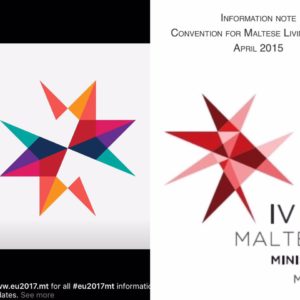
Back in Malta I noticed a post on facebook by a professional graphic designer named Corinne Cutajar. Here is what she had to say about the logo adopted by Malta for its period of EU Presidency:

Waking up to this… don’t know whether to feel amused or pissed off for having my logo (right) copied. Last year I got hardly any exposure for my work and yesterday this student’s copy was blown out of proportion! #goodriddance

15095125_10154031273106129_6191463164038075204_n

Yep. It’s quite a blatant rip-off. This from the government that is supposedly all about artists and their freedoms and development. Let us not forget the high rise tax that is supposed to be channeled to a fund for artists or something of the sort. Malta’s government and its Minister of Culture who is somehow obsessed with fantasy novels are desperate to Make Artists Great again. If you want to get a finger on the pulse of what people really are bred to think about artists and compensating their efforts then look no further than this article on Illum where a hairdresser complains about the annual fee that he has to pay to the Performing Rights Society in order to play music in his salon.

The Hamilton business was also an interesting turn in the first days post-Trump’s election. By now we have all heard of the drama troupe that decided to take advantage of the presence of Trump’s VP-elect in the auditorium to read out a sort of liberal declaration reminding Pence of the diversity of the electorate and of the hope that no body will be left behind when making America great again. I must admit that I do find it ironic that the message in the theatre piece is not enough and that a troupe has to hijack the audience after the curtain falls in order to add a bit of its own drama full of bourgeois menace. At the same time the reaction by Trump and his supporters is outright ludicrous – surely VP Pence is made of sturdier stuff than one that wilts when confronted with a different message than his own.

Only this morning we got reports that Trump has backed out of an interview with the New York Times because he does not like the way they report him. Very un-presidential. Our very own Trump-at-home and his minions are making it a habit of engineering press conferences and tailor-made Q&A’s in order to be in a position of answering only the questions he/they like/s. The difference is that the veil on Making Malta Great has long fallen. We are now in the phase where the masks are thrown and the only inspiration left is the jobs for the boys, the few lies that still fall on fertile ground and the ever-widening ‘establishment’ that is none other than the circles of beneficiaries of the decisions of a government that is the antithesis of greatness, of meritocracy and of decency.

Copy that.


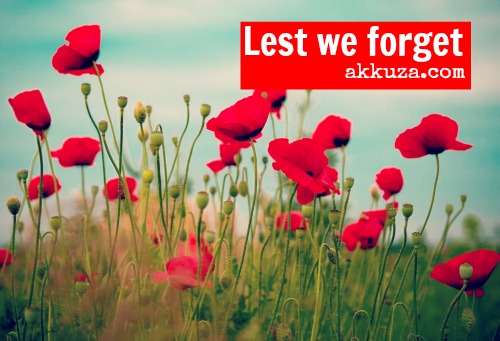
Lest we forget.

lestweforget_akkuza

FIFA, the world football organisation, is set to fine the English and Scottish FA if they go ahead as planned and wear football gears emblazoned with the poppy in tomorrow’s World Cup Qualifier. The problem is not that England and Scotland will wear the poppy on their gear during the football match. The problem is that all the other countries won’t.

“Lest we forget” is not an exaltation of war heroes it is a timely annual remembrance of the follies that the whole world descends into on an all too regular basis. Rather than fining the English and Scottish FA’s for wanting to wear the symbol despite the sanctions, FIFA should be using its world stage to encourage ALL countries to wear signs of remembrance.

Because yes, we do forget. Too often. Too quickly.

Ban the Bikinini

bikinini_akkuza


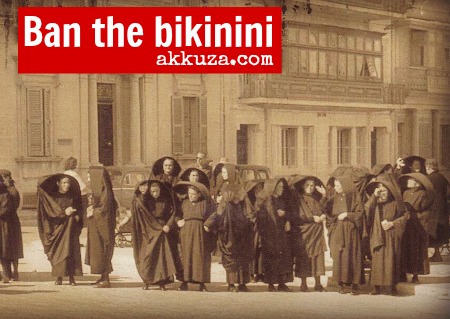
A French court has given some reprieve to the burkini craze that struck the last part of the crazy summer news. After several French beach-side resorts had banned the wearing of the burkini at the beach things had gotten even hotter with a few incidents of aggression. We had also seen some officers of the law inflict fines on women who insisted on wearing the apparel that many conservatives perceived to be provocative. One aspect of the burkini saga was particularly jarring and confusing. On the one hand those who could be said to be of a liberal frame of mind would argue that it is not up to the state to tell women what they can or cannot wear at the beach. This was not to be an extension of the “public security” debate surrounding the burqa. Here was another facet of the issue – whether the wearing of a burkini is yet another vindication of the rights of self-determination under the western-style package of individual rights.  The counter-argument of course was made that the burkini is yet another extension of the “oppressive” nature of Muslim strictures. Women, the counter-argument goes, should not be forced to wear a burkini or a burqa and therefore should either not wear them or basically not turn up at the beach at all.

I admit that it is all mighty confusing. The whole question of volition lies behind the dilemma. Is it a choice that women make of their own volition or is it something that is being forced upon them by their religion? If it is being forced upon them under the religion they freely choose to adopt is it then up to the state to prohibit the wearing of more modest attire? This is not a question of mores per se. After all we only (only?) have to go back around a hundred years to find that the social regulation of modest attire at the beach was a standard held highly by the majority of the members of society. Even closer to this day and age I have a very clear recollection of groups of women hitting the beaches early in the morning and swimming in full black dress. A religious inclination and interpretation of the concept of modesty was behind it all at the time too.

I’m just back from a holiday in the states during which I had the chance to swim in a couple of hotel pools to cool off the California sun after a day of driving and touring. It was not uncommon to share the pool with men who swam in t-shirt and shorts – modesty? Perhaps. Or maybe, unlike me they were not prepared to wield the sad excuse for a beer belly that I have developed. The thing is that swimming attire IS a question of choice and the state should not be anywhere near regulating what people wear when they take their dip. The whole burkini issue got out of hand – primarily because what people wear to swim is no business of the state but also because discussing the oppression of women by some religion or another has no place in this context.

Watching Maltese persons comment on the burkini ban was another thing altogether. This is a country that still regulates what people can or cannot wear at the beach by law anyway. A woman opting to sunbathe topless in Malta will almost certainly feel the strong arm of the law come down on her. Streaking is also against public mores for the most part and the recent trend of gentlemen taking up nude walking along the sea front does not seem to be forcing any change in the status of illegality that they enjoy.

The reality on the tiny Mediterranean island is such that anybody barking about the burkini ban missed the fact that we are quite content in having the state tell us what we can or cannot wear on our own beaches without as much as batting an eyelid. Add that to your list of ironic things if you are Maltese lovinmalta, I’m sure you’ve got one somewhere.

Wir schaffen das!


merkel das akkuza

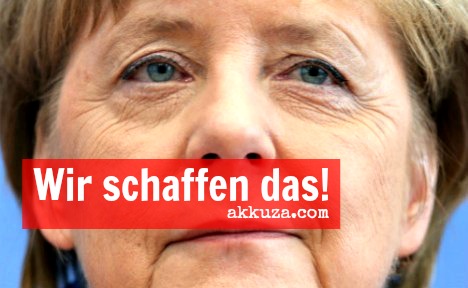
Angela Merkel seems to still be on the side of deep European values that are the heritage of this continent’s history. Many were expecting her to have a change of heart on her refugee policy following the latest attacks in Bavaria that could be linked in some way or another to the influx of refugees. Instead she has chosen to clearly state that there is no going back on the “open-door refugee policy”. What remains to be seen is whether she will insist on the Merkel Method approach to solving refugee-related issues EU-wide or whether she is now prepared to adopt a more federalist approach. Full article here.

Speaking for the first time after a Syrian refugee blew himself up in southern Germany, Chancellor Angela Merkel reaffirmed her commitment to helping refugees on Thursday.

“Wir schaffen das [we’ll manage it],” Merkel said, repeating the famous phrase she uttered almost a year ago which set off a dramatic wave of migration to Germany.

Her government would stick to its course on refugees, but it would also reinforce efforts to fight the causes of the refugee crisis, she said.

“We have already achieved very, very much in the last 11 months.”

Defending her decision to stop applying EU asylum rules to Syrian refugees, she said she had “acted in line with my knowledge and conscience.”

The Chancellor had broken off her holiday in eastern Germany to come back to Berlin and address the nation after a string of bloody attacks, three of which were carried out by refugees, left the country shaken.

“The attacks are harrowing, depressing and depraved,” Merkel said, adding that “terrorists want to destroy our ability to live together harmoniously”.

“They sow hate and fear between cultures and religions.”

“That two men who came to us as refugees carried out the attacks in Würzburg and Ansbach mocks our country,” she said.

Civilizational taboos have been broken, Merkel said, adding that the attacks took place in locations where any of us could have been – a point she had also made after a shooting spree in Munich on Friday left nine people and the gunman dead.

Asked by a journalist if terrorists entering Europe is the price we pay for our humanity, Merkel replied: “We know since at least the Paris attacks that Isis also use refugee routes to smuggle terrorists through.

“We have also know for a long time about the travel routes taken by people who are threats to the state. We need to check all of these routes and also live with the danger of terrorism.”

She refuted that this was the most difficult point in her chancellorship.

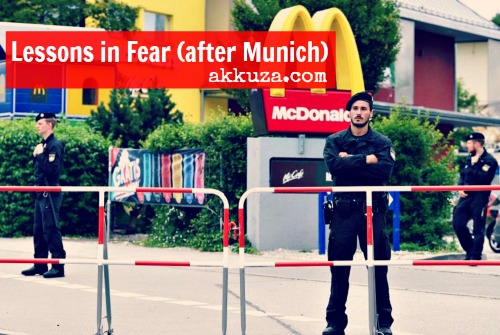
Lessons in Fear (after Munich)

fear munich akkuza

It’s a new thing now. Not Pokemon I mean, but this habit to drop “and Munich?” in conversation without as much as a semblance of intent to actually engage about the matter beyond signalling a mutual acknowledgement of the existence of yet another horrible event marking the simultaneous deaths of multiple human beings. “And Munich?” dropped at some part of an exchange is meant to imply a plurality of emotions, feelings and thoughts without actually dealing with them. In post-fact, emotion driven society there is a whole series of “taken as reads” packaged in a two-word reference.

“And Munich?” means that they have stricken again. It means that we are condemned to live another series of days in anxious attention watching the news to hear about how yet another subset of innocent victims had their lives cut short and how the state can do nothing or seems to be unable to do anything about them. “And Munich?” means that the terrorists are winning the war and that all we can do is share a feeling of helplessness as the multi-headed hydra strikes again with wanton abandon and without any recognisable pattern. “And Munich?” definitely implies that the refugee/immigrant problem is out of hand and that whether we like it or not it must be stopped. “And Munich?” includes the sentiment that now even Merkel’s Germany is no longer safe from gun or truck wielding maniacs so why should we be safe? “And Munich?” insinuates that we are living under constant siege and in constant fear and that nothing seems to be able to save us.

Therein lies the problem. Social discourse prefers not to engage but rather to wallow in emotional dysfunctionalism. There is no effort to define beyond the effortless generalisations and assumed truisms that sweep everyone and everything under the same carpet and into the same media-wrapped boxes of cliches. Munich showed us the direction in which we are moving when it comes to fear-based social reasoning.

The first clues came with the breaking news. “Shooting in Munich” did not need any further elaboration. We, and when I say we I mean the global media village’s spectators, were already braced for the worst. A series of automated events were expected to be put into place. “The escalation”, “the police reaction”, “the heroes on scene”, “the vindication”, “the first amateur videos and reports”, “the rise in number of reported victims”, “the stand off”, “the resolution”, “the global political condemnation”, ” the solidarity and mourning” and of course “je suis Munich”. All these steps were in place in our collective minds once the our medium of choice tweeted us the breaking news that there had been a new “Shooting in Munich”.

Then came the early analysis as the events continued to unroll before our eyes. Munich Police stated that since a man had wielded a gun in public this had to be treated as a terrorist attack in order to mobilise the maximum resources to counter its effects. It was an interesting honest statement at a very early stage. As far as I can recall it is the first time that while we had an “attack” in progress we were given direct access to the security protocols of the nation in question. The official reaction is, rightly I add, tuned to assume that we are dealing with a terrorist of the organised (ISIL) type and then question that assumption later. The reasoning is clear and pragmatic – in the worst case scenario the security forces are right and they have all the means to deal with the issue. In the best case the attack is not really a terrorist attack but one that seems to be so due to the circumstances and still all means have been deployed to minimise the damage.

It turns out that the Iranian born 18-year old who went on a shooting spree in a shopping district of Germany’s third largest city was actually emulating a Norwegian far-right madman who had gone on a shooting spree among a group of political youths on an holiday island in Norway. The Iranian was more Breivik and less Daesh. Yet we would only find that out over 24 hours after the events. As it turns out, the Munich police deployment of security measures – blockdown on transport, curfew, assumption of other shooters involved in the attack – may have saved more lives and contained the damage. Similarly, the social mindset as the events unfolded demonstrated a “trained” mentality among the general public. Twitter hashtags offered support and shelter to anyone stranded in the potential zone of carnage, Facebook triggered a fine-tuned function that helped people show that they are safe and sound, the media (or most of it) knew better than to defy police instructions not to share videos and images at the peak of the crisis.

So what lessons do we draw from the Munich attack? Early the next morning I put the following post on facebook:

One of them is as old as the word itself: it takes FEAR and TERROR to make a TERRORIST. Not ISIL, not an organised network of sharpshooting ideological maniacs, not immigrants who got in under the radar with intent to kill, not far right extremists with an agenda. Those are all masks and labels that hide the real danger – misfits, renegades, angry individuals who will prey on the new mindset of fear. One man with a gun is no longer a criminal – he is a terrorist (hasn’t crime always spread terror?) and the third largest city in Germany is locked down.  The biggest cause of fear is lack of knowledge. Today’s society needs new ways of responding to these realities. Part of that development lies in understanding how and why all this is happening.

I do believe that is our biggest lesson yet. We have come to realise that due to a combination of circumstances that include the immediacy of breaking news and coverage we are a society that easily falls prey to fear and helplessness. Crimes and criminals that involve deaths and victims are no longer to be treated “simply” as such but as part of a wider bigger problem that is holding all of society at ransom. the new crime of “terrorism” is like nothing that we have ever seen before – mainly BECAUSE of the immediacy of the breaking news when the situation is no longer limited to the immediate closeness of wherever the events unfold but involves a whole global community. This sense of communal fear and helplessness was previously not achievable by similar groups as ISIL operating on the basis of terror and fear – the IRA, the Brigate Rosse, Bader Meinhoff, the PLO.

This psychological hostage situation is exacerbated because all the while society will carry on with its own agenda and there will unfortunately always be the misfits, the renegades and the angry individuals who will commit crimes that would in all other circumstances not qualify for the “terrorist” moniker but that will henceforth contribute to the generation of mass hysteria and uncertainty.  It is important for all of society to take time and understand such acts – in order not only to be in a position to better react to them in the future but also to try, as far as possible to avoid them ever happening.

The best way to fight fear is with knowledge.