Dalligate… avec du recul – part I (European Lobbying)

I did say yesterday that the (ex) Commissioner Dalli case smacks of the surreal. With a little less than twenty-four hours time for reflection and with a flurry of statements and press conferences to look at (not to mention the early-worm analysis) we can safely conclude that the case is less surreal and more multi-dimensional.

Strange as it was seeing Lou Bondi among the legion of journalists querying the Commission’s move following the OLAF report, it was a fitting reminder of the (at least) dual dimension of this case. Bondi’s questions (and those of a few other journalists who bothered to research the Malta dimension) represented the Maltese interest in the affair. The TVM talk-show host is undeniably partisan (a “renown fact” some would say) in his approach and this element of partisanship was present in the Brussels Q&A. Even from our point of view, watching the events unfold yesterday we could not resist wearing Maltese partisan glasses – whether you formed part of the “we want Dalli to fail (see we told you so)” brigade or the conspiracy theorist “the evil clique has hit him hard” clan. It is inevitable in our Melito-centric way of thinking: this was happening in Brussels because someone in Malta needed it to happen.

But that is not necessarily the case is it? Here’s why.

European Lobbying after Dalligate

I spoke to a few colleagues who have worked closely within and around the lobbying industry in Brussels. Tucked away as I am in the Grand Duchy of Luxembourg I cannot claim to have first hand experience of lobbying (and thank heavens for that since my work depends on not being influenced by outside lobbying  – it IS a court of law you know). Insider information has therefore been crucial to better understand the works.

First there is the business of lobbying. Commissioners meet companies, associations and lobby groups regularly. It is not a hidden fact. You can actually check out a Commissioner’s agenda for such meetings -they are public knowledge. John Dalli has himself shown that he met most of the Tobacco Industry groups in preparation for his next Tobacco Directive in which he has invested much of his time. The trick here is to try to understand and find out exactly how far the Dalli-Zammit connection took this particular type of contact and lobbying. What the journalists were legitimately querying yesterday (particularly to the enigmatic OLAF chief Kessler) was “where is the wrongdoing”?

Industry experts will tell you that lobbying to meet a Commissioner is legit. That a go-between asks for money to set up a meeting “is neither here nor there”. The no-no bit comes when you “trade in influence”. If I understand this correctly it means that the Commissioner and his entourage don’t only deal with access to the Commissioner but also put a price on “changing legislation itself”. Which is where the whole business of proof remains hazy. Kessler told us that the proof was circumstantial and the OLAF report actually concludes that no legislation was influenced while adding that Dalli was aware of the dealings. The emails – the few that have surfaced (one actually) are neither here nor there. What is holding Dalli/Zammit back from publishing all the correspondence with Swedish Match?

An ex-colleague of mine at the Court, now busy on the lecture circuit blogged about Dalligate and its repercussions. Here is what he has to say about Dalli’s position:

These findings of the OLAF do not seem to prima facie warrant Mr Dalli’s resignation and contribute to make its sudden move appear as an overreaction to the questionable behavior of an individual foreign to his office. However, the language chosen by the Commission to convey the findings of the OLAF report is quite ambiguous and opens to speculation: to what extent Mr Dalli knew that he was the object of lobbying by a member of his Maltese entourage? OLAF seems to suggest that he was actually fully aware of this fact. Did he take any action to limit these lobbying efforts? And more importantly: to what extent Dalli’s behavior, even though a inert one, has been such as to breach the duty of integrity to which he was bound under Article 245 TFEU?

These questions cannot be answered easily and without the appropriate proof. In order to build a case for his defence, John Dalli would have to probably do the following:

  • prove that the draft Directive was not influenced by the smokeless tobacco clan (no legislation effected)
  • publish the full exchange of correspondence with any lobby teams (correspondence made in his name and to which he had access)
  • procure a list of witnesses to any meetings that occured
  • show a list of other companies/associations that he met
  • possibly provide a timeline that could show that Swedish Match’s dealings turned sour after a possible rejection.
Until that happens we must bear in mind that lobby relations in Brussels have now shifted to a new paradigm. Dalligate  will have endless repercussions on the lobbying industry in Brussels, because it will mean that a company/association really has to watch out how to approach any Commissioner, how to word emails and more. Meanwhile, the Commissioners and their staff (thousands of them) will have to revise the conditions for meeting industry reps, something which until now has been done, according to industry practitioners with ease and without any stains.Comparisons are being drawn to the “Cash for Access/Lobbygate” scandal in the UK in 1998. (Incidentally it takes quite a desperate bit of research to rely on the impressions of a Daily Mail blogger to gauge impressions abroad on Dalligate -baksheesh? really? Is 1998 really that far back Synon? Rule Brittania fejn jaqbillhom dawn l-iStricklandjani).
On the face of the information that has been made available until now – and barring any prova regina that might still be hiding in the OLAF report – the Commission (and Dalli) seems to have been an easy target for entrapment by an angry lobbyist combined with the presence of an OLAF that is enthusiastic to prove its worth. Dalli and Zammit might be eventually found to be guilty of over-enthusiastically engaging in “cash for access” dealings (not exactly baksheesh Synon) and thus leaving the door wide open for an industry specialist to work it to its advantage. Alberto Alemanno asks a few questions in this respect:
In these circumstances, the sudden resignation of Mr Dalli is somewhat surprising as it is likely to weaken not only his personal position but also that of the EU Commission. While the EU Commission emerges as the looser of this ‘situation’, the prima facie winner seems instead Swedish Match, one of the leader producer of smokefree tobacco products. One may legitimately wonder what has been the exact role played by the company in the birth of the professional relationship between the Maltese entrepreneur and the company. Was Swedish Match a victim or the creator of such a relationship?

Should it turned out that it has been the latter, the trap that Swedish Match seem to have successfully tended to Mr Dalli could turned out to be counterproductive: the benefit it could gain in messing delaying the preparation of the revised directive might be offset by the negative image it gained in originating this scandal. Should instead turned out that Swedish Match was the innocent victim of a fraud (read its yesterday’s press release), nobody will feel very sorry for a company selling tobacco products and willing to hire somebody who was ready to leverage on his personal relationship to steer the outcome of the policy process.

In any event, this episode, although unfortunate for everyone, has the merit to bring to public attention the limits of today’s tobacco control efforts : the lack of an open, evidence-based and non-ideological debate upon the future of tobacco (including snus). My claim is that should such a debate exist neither Swedish Match nor Commissioner Dalli would have fallen victim of the snus’ trap.

 So to conclude part one. Dalligate issue goes far beyond the preoccupations of our navel-gazing island. An important European institution has been rocked by the scandal – the practices of the lobbying industry are bound to be revised and many questions have cropped up that remain as ye unanswered. Prominent among which is the distinct possibility that a lobby group that is sufficiently motivated and irked by a current Commissioner might find a way to use the EU’s own mechanisms to rid itself of an uncomfortable interlocutor.
If this is the case there is much reviewing left to be done.
* J’accuse would like to thanks the persons who under the veil of anonymity provided relevant insight into the world and workings of lobby-groups in Brussels. The next post will focus on the Malta repercussions of Dalligate – from nominating a new Commissioner, to the effect on an electoral campaign to the suspension of Dalli’s “interference” in local politics.


Emails in context (Snuff)

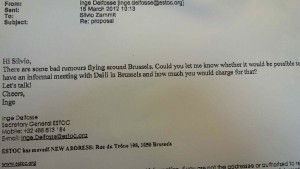
MaltaToday have published a loose email that is obviously part of a wider correspondence between ESTOC (European Smokeless Tobacco Council) and Silvio Zammit. This email would appear to vindicate the assertion that Silvio Zammit was offered money to set up a meeting between ESTOC and John Dalli. the words “would appear” are important here.

The email (see pic below – click to enlarge) is obviously not the first contact between ESTOC and Zammit. Aside from the fact that the ESTOC contact refers to Mr Zammit by name – implying a high level of familiarity, the subject of the email clearly demonstrates that this is a reply in a chain of mails. The subject tag is “Re: Proposal”. So the last email before this was from Silvio Zammit to ESTOC and is called “Proposal”. It is highly unlikely that the subject matter was added in this email since the “re:proposal” bit clashes with the context of the current text. it is more probable that the ESTOC contact (Inge) was using the shorter method of “Reply” in the email.

We do not know what was the content of the previous email (and neither – apparently – do MaltaToday).

There are a few considerations to be made here with regards to the lobby groups and Commissioners. The Belgian channel RTBF described this case as one of “trafic d’influence‘ and it is important to bear in mind that this is the nature of the fraud involved. It is not uncommon for go-betweens to liaise for meetings with Commissioners but it is illegal for Commissioners to sell their powers and discretion to bidders.

The issue at stake here is twofold. Firstly there is the issue of the relationship between Silvio Zammit and a lobby group. What was the offer? Who made it? Who established contact? What was being sold/offered? How much of the Commissioner’s ultimate discretion was being put on the table for “sale”?

The second issue is whether John Dalli knew of these transactions and whether there was an actual possibility that the Commissioner’s discretion be tied/influenced by these monetary offers.

I can see no reason why, if this email is intended to prove that Silvio Zammit was the subject of “baiting” by the Smokeless Tobacco lobby, then the whole correspondence is not being shown. The only plausible answer I have to that is that the original contact was made by Silvio Zammit and that the earlier emails would only show that it was his contact that got the ball rolling. Needless to say, ESTOC might have pounced on the opportunity of throwing a bad light on a Commissioner whose legislative activity and programmes were not very helpful to their cause however they were could have been helped by Zammit’s availability and familiarity.

Gays and bendy buses

Magistrate Peralta’s decision this morning seems to have caused quite a ripple effect in the ether and beyond. What seems to have irked most people is the assertion that the accused in the case in question was justified in feeling provoked by an Australian (drunk) man’s implication that he (the man) was gay. Prominent among the court’s considerations was the fact that the events took place in the village of Mellieha and that it appeared to be “part of the mentality of society there” to feel offended by the insinuation that one was homosexual.

Conclusions are drawn quickly by the public jury but we might be missing the wood for the trees. Magistrate Peralta’s assessment is not that it is ok for people to be provoked whenever there was an insinuation that they were gay. What the Magistrate was bound to do is to assess whether any man in the same circumstances and context was justified in claiming that he felt provoked. It is a sort of “when in Rome standard”. Unfortunately, in such situations, the court is called upon to take a snapshot of our society as it is and work with the tools at hand.

I find it hard to believe that anyone can seriously think that in our country (and not just in Mellieha) the general feeling when someone implies that you are gay is not one of contentment and pride. Last I checked the term “pufta” was not exactly used within the context of lauds and accolades. Which is not to say that I agree with the judgement handed down – I have an absolute aversion for people who hide behind the “I saw red” theory – whatever the provocation they might feel to have suffered. All the derision of Mellieha and its residents can only be extended to all of this sad country of ours that seems to be genuinely shocked whenever one of its warts props up in the mirror.

Speaking of warts, Minister Austin Gatt surely has better things to do than to attempt (feebly) to reply to Boris Johnson (not Johnston) and his bendy bus statements at the Tory conference. To begin with I do not feel that Malta was given pride of place in that comment and was only a postilla to the primary idea that Boris’ mayorship had actually gotten rid of the bendy bus affliction that had littered the London streets like a latter day pestilence. To follow, Gatt and his minions best keep their mouths shut when it comes to anything Arriva, let alone the bendy buses. For heaven’s sake what’s all this nonsense about “mathematical calculations” when we all know of the bendy buses stuck in Mrabat and Mater Dei roundabout?

So what? Johnson’s joke about getting rid of bendy buses was at Malta’s expense. So what, Emmanuel Delia cannot take a jibe lying down so he gets his master’s ministry to type what he must have felt believed to be a witty retort (hoho the Labourites are agreeing with the Tories) and doesn’t even manage to get the Mayor’s surname right. Once again we demonstrate an incapacity to stare the truth of our warts in the face (or warts on our face). Bendy buses suck, Austin (and Manuel) and no amount of attempts at replying to the magnificent stage master that is the Mop of London will change that.

Next time, Austin (or Manuel), if you want to really get the feel of your average Maltese reaction in such situations just write a short telegram to Boris. One word would suffice…

“Pufta”.

Il-politika tal-friża

Aħna li ngħixu il-bogħod minn xtut gżiritna inbagħtu l-iktar mill-bard u kesħa li taffliġġi l-ambjenti illi naħdmu fihom tmenin fil-mija tas-sena. Filgħodu naraw it-tbassir tat-temp b’għajnejna jaqgħu l-ewwel fuq it-termometru u imbagħad inqabblu malajr malajr mat-temp f’Malta. Dalgħodu per eżempju jien u nsuq minn fost l-għelieqi fit-tramuntana tal-belt ta’ Lussemburgu tajt daqqa t’għajn lejn x’immarka t-termometru ‘abbord il-vettura’… tlett gradi ċentigradi (bis-sinjal ipetpet jiġifieri possibli li ssib silġ fuq it-triq u suq bi prudenza). Il-kesħa u l-friża … ma nħobbuhomx.

U dan l-aħħar id-diskors politiku reġa’ waqa’ bl-ikreħ fuq l-iffriżar. Xejn ma nħobbuh l-iffriżar f’pajjiżna. Tiftakru lil Sant hekk kif ġie elett fil-gvern x’għamel? Iffriżajna t-talba ta’ sħubija fl-Unjoni Ewropea. Tfajniha fil-kexxun maċ-ċanga u mal-pork tistenna li tiġi xi ruħ tajba u tħollha (kif ġara ftit wara – ukoll grazzi għal Mintoff, ma setax jonqos). Imbagħad ġew Eddie u Guido u x-ċuċ hu il-majkrowejv.

Imma illum il-friża hija l-iktar waħda tal-biża. Qed jitkellmu u jixlu u allegatament jillibellaw lil xulxin kawża tal-misħuta iffriżar tal-paga minima. Din tal-iffriżar tal-pagi kwistjoni kurrenti ħafna. Ara biss x’ippropona fil-baġit tiegħu il-gvern ta’ Hollande. Il-ħaddiema tal-gvern Franċiż se jkollhom il-pagi tagħom iffriżati – ma jistgħux jieħdu iktar żiediet. Minn x’imkien kellhom jibdew jissikkaw iċ-ċinturin. Kellhom xorti il-ħaddiema tal-gvern għax oħrajn bħal dawk ta’ Arcelor-Mittal fil-Lorena ġirien tagħna sejrin saħansitra jitilfu xogħlhom meta tagħlaq waħda mill-aħħar fabbriki siderurġici f’żona li żmien ieħor kienet il-pulmun ekonomiku tal-Ewropa.

Imma konna qed ngħidu. Il-paga minima. Mela qed jgħidu li Muscat qal li se jiffriża l-paga minima (u ejja ninsew il-living wage) għax qal (u dan qalu) li ma hux se jżidha. Sewwa. Imma imbagħad kif spjega sew mingħalija Spiteri – kemm ilha teżisti il-paga minima l-ebda gvern ma żiedha u dan qed ngħidu mill-1974. Sewwa ukoll. Jiġifieri biex niftehemu jekk iffriżar ifisser li ma żżidx il-paga minima oltre il-COLA (Cost of living adjustment – li ġeneralment jittraduċi f’pakket sigaretti) allura kemm in-Nazzjonalisti u kif ukoll il-Laburisti ilhom li tefgħu il-paga minima fil-friża u insewha hemm għal 38 sena. X’bard.

Iżda anki jekk nieqfu hawn u naħsbu ftit fuq verament x’inhu jingħad mill-partiti nindunaw li l-friża hija ukoll tal-ideat. Għax tal-Lejber sabu x-xoqqa f’moxxtha u erħilhom jgħajjru l-PN giddebin għax Muscat ma hu se jiffriża xejn. Tal-PN għadni ma fhimtx eżattament x’jaħsbu għax jew se titkaża bl-iffriżar u allura inti se tieħu azzjoni differenti i.e. mhux tiffriżaha imma żżidha jew tagħlaq ħalqek għax inutli tgħajjar lil ħaddieħor li jagħmel eżattament li qed tagħmel int. Tal-alternattiva kienu ċari … bl-alternattiva fil-gvern togħla il-paga minima. Imma l-AD fil-gvern? Il-votant ilu li tefa’ dik l-idea fil-friża.

Il-PLPN moħħom biex jiġġieldu u jillibellaw dwar dak li mhux se jagħmlu. Sadattant il-valuri u pjanijiet ċari dwar dak li forsi se jagħmlu jekk jiġu eletti għadna ma rajna xejn minnhom. Billboards kemm trid imma fi żmien ta’ baġits awsteri fi Spanja, fl-Italja u anki fl-Ingilterra, il-partiti tagħna moħħhom biex jittrasportaw id-diskussjoni fuq l-eventwalitajiet ineżistenti.

Fi kliem ieħor ħafna paroli fl-arja, ħafna xinxilli, mass meetings, kungressi u x-naf jien… u l-ideat, pjanijiet konkreti u rieda ta’ tmexxija għaqlija ilhom li intefgħu fil-friża.

F’dan il-pajjiż ma nsolvux problemi… nindukrawhom.

Talk is cheap

The reports from Malta are beginning to make the island sound like Italy in the famous “anni di piombo” – only that stabbing, and not shooting, seems to be the preferred form of violence in 1/3 of the cases reported in the last three days. Sadly all the victims were of the gentler sex and ,coming as the they did after Josie Muscat’s unfortunate choice of words, the crimes have somehow been linked to some twisted train of thought that might exist in the mind of the aggressors. It goes something like “Hey, that nutcase Josie said that most times when a husband beats his wife this boils down to having been provoked. So let me get out my special Laguiole knife and find ma biatch and stab her to kingdom come”.

Tenuous? Very much if you ask me. I’m thinking that it does not really take a very wrong idea being expressed publicly for it to trigger off this kind of crime. In most cases these are crimes of passion – and the kind of passion we are talking about is far far beyond the realm of “first transport of sudden passion inspired by Josie Muscat’s non sequitur of a statement”. Besides, what about the Moroccan lady also found “in a pool of blood” but about whose death there is no suspicion of foul play? Respect for the deceased prevents me from passing observations that would be more appropriate in the case of Frankie Boyle but surely the asses out there braying about Josie’s Provocatory Inspiration should know better?

Then there’s the political side. This morning’s standard read through my FB wall led me to the tiny post by Labour’s president Stefan Zrinzo Azzopardi. This other course colleague of mine (a vintage year that class of ’99) posted:

“Three grave crimes in three days – three women victims – action is required! Do you remember “at home and at work without fear?””

The last reference is to an old PN electoral slogan. Stefan probably does not see the irony that the “fear” in question at the time managed to hit home to many people because it was the kind of fear instilled by the Mintoffian regime. Like it or not the culture of not being safe at work or at home (and I would add “at school”) was very much the result of thuggery and violence that was rampant in the late seventies and early eighties. So yes, Stefan, I do remember the slogan and it’s rather funny that you’re asking us to remember it seeing how your movement is so adamant about how useless these Mintoffian flashbacks are.

As for the link between the three crimes and some implied inactivity by government this is even more tenuous than the Josie Muscat link I mentioned earlier. It is stomach churning material how members of both parties find it so easy to throw illogical leaps and links at what they must assume is a very gullible electorate fully believing that anything goes. A Moroccan woman died in a fall – the cause of death is still uncertain – at home, a former policeman shot his wife and an MMDNA nurse was stabbed in Qormi – and whose fault is it according to Stefan Zrinzo Azzopardi? Why obviously it’s the fault of the party that once had “at home and at work without fear” as its slogan.

To be fair to Stefan it’s not just him playing this game. PR man Varist has already regaled us with a couple of insinuations too while a couple of sanctimonious bloggers are “guilty” of playing both the “blame Josie” and “blame Gonzi” game.

It’s going to get hotter as the election date gets closer. Hold on tight and try very hard not to be provoked.

Wikileaks à-la-carte

The Maltese blogging scene is nowadays taken for granted as a major participant in the field of information processing. The Blogosfera is as varied as ever, covering a panoply of interests with the occasional blog or two getting its moment of limelight within a particular sphere. markbiwwa.com recently let out a rant about the dos and donts of blogging (and what’s wrong with the word “blogosphere”). It’s been some time now that conceited bloggers like myself (wankellectuals) have been a proverbial pain in the arse for mainstream media pointing out flaws, errors and journalistic faux pas.

Melahart was at it this week commenting on the selective editing that seems to be the trend in some papers (Media manipulation…) while Rich Muscat Azzopardi also had a good point to make about the Times’ trend to becoming a click-hunting site above all (Rightly So). I’ve got some bad news for Rich. His autopsy on local journalism comes a little too late.. J’accuse had proclaimed it dead a while back after a particularly jarring episode of Bondiplus regarding Plategate.

The role of blogs and bloggers in filling the vacuum of investigative journalism is what triggered off this post in actual fact. Given how most media establishments in the country are agenda-driven or just downright lazy, the levels of investigative journalism have fallen to an all time low. Blogs and bloggers (not Times trolls mind you) might just be in the right place to fill the gap.

Take the Running Commentary. Back after the traditional end of summer pause, Daphne has set her sights on a deal between Polidano and Mintoff’s offspring. In her first post on the subject Daphne called for a Public Inquiry. The facts mentioned in the posts relating to the issue are just that: facts. They are publicly available to anyone wishing to discover them – in the archives of MEPA to begin with.

Now I do not believe that Daphne spent her little sabbatical recovering from the trauma of Mintoff’s passing away looking through random archive of the MEPA records. What probably happened is that somebody (a mole, a snitch, a leaker,… whatever) passed on this information to Daphne with the intention of getting as much public coverage for this bit of news. Used to be such news would go to a media outlet but then again… given the subject matter what better place to go to than Malta’s blog with most hits?

Am I saying it is wrong? Not at all. Expect more of this phenomenon as things get to a head. A while back we had also featured a Polidano related post on J’accuse. In March we were writing “Polidano Can, if he thinks he can” pointing out the rough manners in which Polidano literally bulldozers over our planning laws. In that case too I had received a pointer as to some illicit night time action in which Polidano was engaging in some property close to Zmerc in Balzan – what prompted me to give particular attention to the matter.

The network of blogs – with different affiliations, orientations or independent minded persons – that has developed over time might end up with Malta having its very own unofficial network of Wikileaks. What worries me is that each blogger will have a sieve of their own with regard to what information can or cannot be published. Expect blogs associated to the mainstream parties to be very selective as to when to make a noise about information in their possession. Expect others to proceed cautiously as they are drawn closer and closer to the limelight of lawsuits, libel proceedings and other “democratic” mechanisms of silencing the truth.

Expect, in other words, the development of a network of Wikileaks à-la-carte. Probably not the best of worlds but already going a long way into filling the gap left by a media system that is either dead or in a long coma. Or in the case of the Times… busy chasing the cheap click.