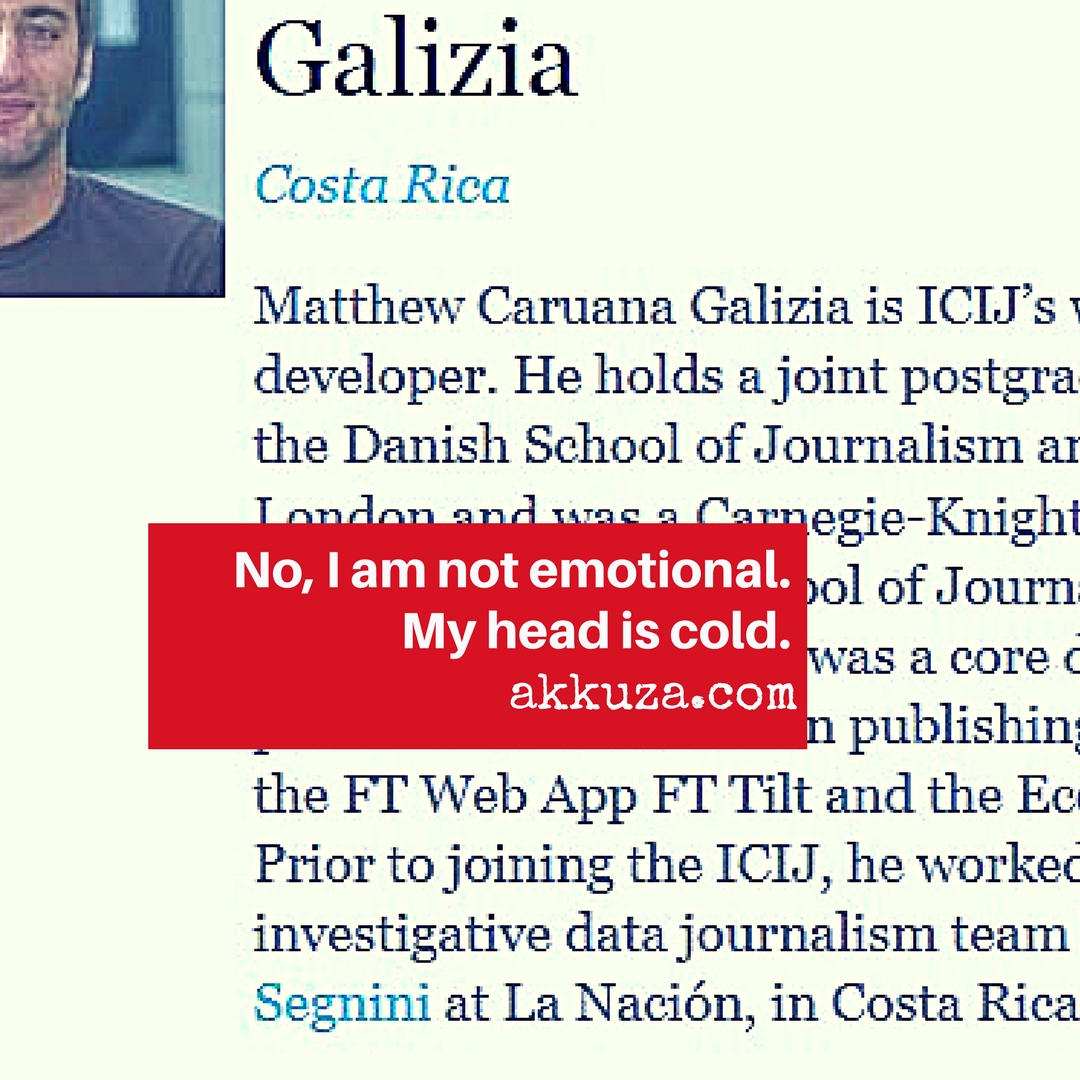
No, I am not emotional. My head is cold.

The exchange in court between Minister Cardona’s lawyer and Matthew Caruana Galizia prompted me to start a meme using Matthew’s reply. #iamnotemotional. Later I received a private message from a member of Daphne’s family pointing out that the full quote that day included the phrase “My head is cold”. Eleonora saw this exchange and was inspired to write this new contribution to J’accuse. 

On 20 July 1992 Lucia goes to the Law Faculty of Palermo to sit for an exam. Her father, Italian judge Paolo Borsellino, has been killed the day before by a car bomb in Palermo, near his mother’s house. When she sits down in front of her professors, Lucia is asked whether she’d like to come again in another session, given the circumstances in which she currently finds herself.

Notwithstanding her deep sorrow, Lucia answers that she’ll go ahead with the exam on that very day. The day after her father has been murdered and somehow failed by the same institutions that he gave his life to represent.

On 17 October 2017, Matthew publishes a post on facebook explaining why “a culture of impunity has been allowed to flourish by the government in Malta” and listing the names of those who did not take action and therefore were responsible for this. The name of the Maltese PM is among these. Matthew’s mother, Maltese blogger and investigative journalist Daphne Caruana Galizia, has been murdered the day before by a car bomb in Bidnija, near her own house.

When asked to comment on Matthew’s facebook post by CNN journalist Christiane Amanpour, the Maltese PM stated that in those words he saw a son who had just found his mother in pieces and therefore that he “would be insensitive to take exception to anything he says”. He also added that he would have written or said worse things if he had found himself in Matthew’s position.”

On 23 October 2017, Matthew, Andrew and Paul go to court along with their father Peter to replace respectively their departed mother and wife in the libel cases against her instituted by Minister Chris Cardona and his personal adviser Joseph Gerada. As reported by Maltese media, when the court informed both parties that it would adjourn the cases to December so as to allow time for things to settle, Matthew indicated his wish to make a statement.

He declared that he wanted to “make it clear that we want the case to continue,” because “Chris Cardona has an interest in stopping the case to go forward.”

Mr Cardona’s legal advisor answered that there was no such intention on their part, but that he fully understood that the comment was the result of strong emotions experienced at present.

At that point Matthew answered: “No, I’m not emotional. My head is cold.”

When I read about this last episode in court, I immediately connected it to the answers of the Maltese PM to Christiane Amanpour and felt deeply offended.

Firstly, because it reminded me of when I began my legal practice and I had to accept sharp comments from my senior colleagues because not only was I young and inexperienced, but I was a “young lady” who wanted to become a criminal lawyer. You have to understand that until the end of the 80s, most European legal cultures did not really allow the idea of women practicing criminal law because of those “special days when they get so emotional”. Unfortunately for our male colleagues, we had brilliant examples to prove them wrong – one of them being Donna Clio, the wife of Italy’s former President Giorgio Napolitano.

Secondly, and most deeply, I was offended as human being. You do not exploit someone’s sorrow to build yourself a potential excuse if you find yourself in the public eye for the actions you have allegedly committed. You simply do not.

Because the fact that someone is currently mourning the loss of someone does not mean that his or her mental abilities are impaired. Would you have called Matthew “emotional” had he decided to go to a grocer to buy some bread? No. And given that going to court or posting on facebook a clear summary of why the situation ended up being this desperate requires a bigger amount of intellectual skills (no offence implied), I’m pretty sure that Matthew was fully aware of his actions when carrying them out. Even – or better said, especially while mourning the loss of his mum.

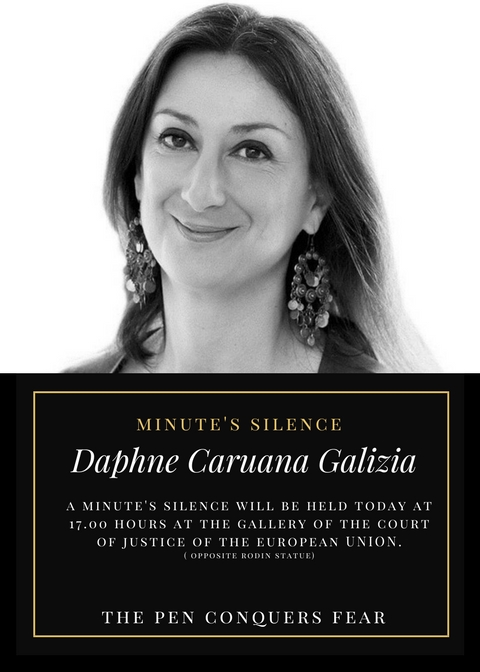
Finally, I was offended as European citizen. While the fact that the family is actively taking action in order to pursue Daphne’s quest for the truth notwithstanding their pain is labelled as “emotional” in Malta, the European Parliament, the most representative EU Institution, has invited that very family to Strasbourg. The family today were present at a plenary session during which there was a minute of silence to honor Daphne and a debate on the status of freedom of expression at EU level. The same Institution paid its respects to her memory by naming its newsroom after Mrs Caruana Galizia.

In today’s speech, the President of the European Parliament, Mr Tajani, said that “Our Union is far more than just a market or a single currency. It is the manifestation of our values, of our identity, at the heart of which stand freedom and dignity of the individual. If we are to defend that freedom and that dignity, inside and outside the Union, we must safeguard the independence of the press. I am proud that this Parliament has always been in the front line of that battle. Daphne’s murder must not go unpunished. How can we credibly claim to defend journalists around the world if we cannot even offer them protection and justice here at home?”

He then directly addressed the family, saying that “Her family is here with us today in the gallery. To them, I would like to say that we are together in spirit with the thousands of Maltese who on Sunday took to the streets to call for justice and to pay tribute to Daphne’s work. And today 500 million Europeans stand together with the people of Malta.

Mr Tajani did not call them “emotional” for being there. Instead, he underlined the fact that we all, not just Daphne’s family, stand united to call for justice and, most important of all, to pay tribute to her work.

Because even if you’re still mourning the loss of someone, your genuine quest for the truth is the only true homage you can pay to someone whose life has been lost while searching for it.

As Judge Borsellino used to say, ““The brave dies once, the coward a hundred times a day.”

THE GOVERNMENT LIES – a look into government spin in the aftermath of Daphne’s assassination

In this first of a series of posts, JOE BLOGGS (a pseudonym) takes a close, hard look at the evolution of government spin in the aftermath of the assassination of Daphne Caruana Galizia. This did not start on October 16th. Read on…

Speed is essential.

As we have heard many experts say, the first 24 hours after a crime are key to secure evidence at the crime scene and avoid contamination. Secure the area swiftly and efficiently, bring in forensics and interview eye-witnesses. The time taken to do that is inversely proportional to the likelihood of apprehending the offender.

Much like in the Egrant case just 5 months ago, we are well aware that this did not happen in the case of Daphne Caruana Galizia’s cold erasure by car bomb on Monday. It would be interesting to know how long it took the Malta Police to secure evidence in each of the prior 10 car bombs since this government took office in 2013, half of which happened under the present Police Commissioner’s 1 year watch alone. Whether this latest failure to act swiftly is down to sheer incompetence or worse, reluctance, will undoubtedly be the subject of continued debate. There will also be cries for responsibility to be borne and faith restored in the soon to be renamed ‘Malta Police Farce’.

However, this narrative is not about that.

This narrative is about the insensitivity of a Prime Minister and his government (and the Labour Party, like many things in Malta, the line got blurred) obsessed with PR, spin and its “greater plans”. So obsessed, in fact, that the public execution of a journalist, one of its most vociferous and effective critics, gets treated coldly. To them, this is a mere PR crisis and they are proceeding to manage that “crisis” with clinical precision and efficiency.

Much like the situation was “managed” when politicians in government were proverbially caught with their trousers down in the ICIJ’s Panama Papers (they are all still very much in office after what can at best be described as a brushing off) and myriad other scandals that, in any other reality, would have ended political careers. Not here.

Man is an apex predator, not because we are particularly big or have sharp teeth or claws but, besides our inventiveness, we are designed to run for far longer than quicker prey. We tire them out. Then, when exhausted and their stride slows, we can isolate them from the herd, encircle them and strike.

This game plan works outside the Savannah and can be applied to scandals, calls for resignation and critics too. You just need to take some measures, batten down the hatches and wait out the news cycle.

Manage the immediate aftermath swiftly, dilute the news, point fingers and attack the messenger if you must, spread seeds of doubt and up the freebies, divide and, if you can wait out the reaction, people will eventually tire and lose interest. People move on, they accept compromises, they forget. This is only set to get worse as younger generations with ever less will or patience to read replace those that do (votes for 16 year olds just speeds up the process). The cycles are getting shorter and, on longer term or macro issues, less intense.

This narrative focuses on the PR crisis management exercise and explains its elements. There is a lot of background and much darker sides to this story which must be told, which is why what started off as a post needed to be broken up and will likely have to become a serial. The trick is to know where to look. The government is PR savvy and has advisors (including Trump advisors and their tools of the trade) on tap, so even if the soulless felt no sadness, surely they will have been told that on a week of national mourning, flags should fly half mast. They did outside Malta including in Brussels but those on government buildings, including Parliament, did not budge an inch and in all likelihood they will not. If you have not realised or questioned, I invite you to ask yourself why this is. Similarly, during a silent protest by Maltese journalists in Valletta on Thursday, whilst journalists were placing placards about freedom of expression and laying flowers on her impromptu shrine, one person strategically and slyly tossed a copy of L-Orizzont on the far left and slipped away. Although the cover of that edition bore a headline claiming that Muscat would leave no stone unturned to find her killers, the knowledge that that same newspaper called for her cleansing just months earlier and the absolute detest that Daphne had for that propaganda outlet may have escaped many. This was the journalistic equivalent of taking a dump on her grave. The offensive rag thankfully disappeared by Friday evening.

Daphne Caruana Galizia’s death comes at a convenient time.

Like gazelles running for our lives on the scorched desert plains slowly drifting apart from what was left of our herd, we are exhausted and broken in. Resigned to our sad fate.

The 2017 snap election was designed to be a charge of the light brigade. The net result was effectively the smoking out any remaining dissenters (ponder here for a minute as to why a government that knows it still has a huge majority acted as though the opposition stood a chance) and “shock and awe” the others into the silence of acceptance and helplessness. Again, compromises. The snap election victory was followed by a farcical debate in the European Parliament on the state of the rule of law in Malta where the government quite happily paraded its LGBTI and civil right friendly laws to pinkwash its abysmal record in good governance and human rights. It also mentioned its much vaunted two gimmick laws, the removal of prescription on crimes of corruption for politicians (tiny tip, it does not apply to Chiefs of Staff and other cronies or to other crimes such as money laundering) and the so-called Protection of the Whistleblower Act (a law already pending in Parliament neutered through the inclusion and need for official recognition as a whistleblower by politicians and by ensuring that reporting lines for corruption by and large lead straight to politicians). The PANA committee was just ignored and its legitimacy questioned. Locally, the great “don’t attack Malta or dirty our name with foreigners since we need their business” line was peddled (think of the scope, timing and effects of MaltaFiles) and bought readily. Omertà by any other name.

The official line also peddled was that the Opposition’s and Civil Society activists’ criticism of corruption was “negative”, “had no proof” and full of “hate” whilst the government’s winning campaign was “positive” (we will talk about subliminal messages later as we stray into the fascinating realm of commercialised PSY-Ops). Awash with cash from multi-million deals shrouded in secrecy with the Azeri and Chinese governments as well as from closely guarded golden passport and VISA schemes, the government promised that the best times for this country are ahead of us, we just need to put up with a little scandal or hiccup here and there but do not criticise us because that is negative.

A couple of editorials in that Labour newspaper (L-Orizzont) called for the cleansing of negativity and the journalists that spread it including the late Daphne Caruana Galizia so that the government may continue with its grand plan. The official line in relation to those editorials was condemnation but yet mere weeks later that editor joined the hordes of Labour journalists and media relations people employed since 2013 with an unspecified job at the Office of the Prime Minister undoubtedly involved in propaganda, likely with the Department of (mis)Information.

A whistleblower who was never acknowledged as one and who was effectively ridiculed and branded as a liar, thief and Russian whore by the government machinery (a magistrate’s comments left much to be desired too), rightly fled. The guns turned on the Opposition leader, Simon Busuttil (negative) who was also subjected to ridicule in the press by government officials parading as opinion columns.

A new opposition leader, whom Daphne also criticised for his baggage (one cannot rally behind a leader to clean up this sorry state if his background and baggage does not inspire faith), stepped out of the side-lines and riding on a wave of “positivity” swept up the party vote. The reason for this victory and the resulting attacks on Daphne by those who just months earlier egged her on, was negativity and criticising corruption does not appeal to the majority so we must compromise. A new normal, just one or two notches lower.

Journalists were replaced or fell quiet and new opinion columns by officials within the Office of the Prime Minister popped up boasting about this country’s prosperity and deriding negativity. The eunuch press slipped back into its habit of cutting and pasting from government press statements, never questioning or digging.

Then the news disappeared. Under the threat of financial ruin and likely political pressure, articles screaming about money laundering, kickbacks and Azeris through the bank where the whistleblower worked (Pilatus Bank) disappeared or were amended without so much of a note. What would have caused uproar in a normal country, caused little more than a whimper. A blog post about Franco Debono’s polo shirt and the size of the logo got more of a reaction than one reminding people of the gravity of an Orwellian situation that permits the erasure of the historical record.

On 9 October, 2017, the government unveiled its budget for 2018 branded as the first ever budget without new taxes. A surplus budget. Malta is rolling in dosh from the sale of passports to Chinese, sheiks and Russians at Euro 1m a pop and the best days for our country are just around the corner. We will create a new authority entrusted with doing up all of Malta’s roads (funded by passports), explore a national blockchain strategy (CryptoRubble springs to mind), build like there’s no tomorrow and generally make hay.

Daphne’s last post, a silent scream about the dire situation where the Chief of Staff and head of anything strategically important, Keith Schembri, who rode out the many scandals including Panama Papers in which he was not only implicated but appears to have master-minded, is continuing with a defamation court case against the ex-opposition leader for daring to call him corrupt, defied her views on the news cycle. Isolated and frustrated she exclaimed about the dire situation. Were it not for the explosion that finally ended her Running Commentary just 30 minutes later, that post would have had at most double digit shares, a few daring comments by people under pseudonyms and some more praising her for giving the Opposition leader, Adrian Delia, a break. Then the 11th car bomb went off in a quiet country lane on a day when one of the subjects of Daphne’s most harsh criticism was on roster duty as inquiring magistrate, the fifth anniversary of the forced resignation of another who called her his nemesis and just 3 days away from the 38th anniversary of another Black Monday.

That is the backdrop. Make no mistake, the ship that is the national psyche has been listing for a while. We need to acknowledge that, though we recently refurbished it with ebony planks and sterling silver nails, the deck is almost vertical before we even attempt to right this ship. If you are reading this from Malta then you likely went to today’s demonstration, likely jeered and shouted for freedom of expression and the protection of journalists but just days before Monday 16 October, 2017 I bet that you were wondering whether it may be worth taking down an old facebook post or cover photo talking about corruption lest it damage chances of some crumbs or favour.

I should get back to the immediate reaction but will have to tackle that in the next part along with a wider look at how we got here. Until then maybe watch Black Mirror and wonder why, if this is not a political assassination, magistrate Consuelo Scerri Herrera’s first and only act before accepting to recuse herself from this investigation summoned what distinctly looks like a gang.


For your sake and ours, please don’t look away

Justin Borg-Barthet, a Maltese citizen, is a Senior Lecturer in EU law and Private International Law at the University of Aberdeen. He is the author of The Governing Law of Companies in EU Law (Bloomsbury/Hart 2012) and several papers on mutual recognition in EU law.

In the Maltese Parliament yesterday, Simon Busuttil MP appealed to the international press to keep a watchful eye on Malta. Malta, he says, needs this independent and objective scrutiny more than ever now. He’s right, of course. Freedom of the press in Malta is under grave threat. Daphne Caruana Galizia was, in many ways, the last line of defence.

Her assassination completes a process begun many years ago in which the media has been systematically intimidated, weakened and bribed to the point of effective castration. Consider, for example, the eerie silence in the press in matters concerning Pilatus Bank, the Malta-based money-laundering outfit for international Politically Exposed Persons and the failure of anyone (bar Daphne) to comment on the quiet deletion and censoring of what little they dared publish. This silence from the local media appears to be a consequence of threats from the aforementioned bank of costly (but vexatious) legal action in the United States. Reportedly, Daphne too was in receipt of such heavy handed threats but stood fast to her truths.

Malta now relies on the international press to provide a truly free account of the deterioration of the rule of law and corruption of administrative practices there.

But keeping a careful eye on Malta is not only in Malta’s interest. It is in the global interest too. This is why the Treaty on European Union enables action against Member States who persistently breach the rule of law. It is not because the EU is a safety net for the Member States, but because judicial, administrative and legislative decisions of Member States have extensive external effects. Contrary to President Juncker’s recent protestations, when Simon Busuttil pleaded with the EU to cast its eye over Malta, the rule of law in a Member State is not a purely internal matter. The EU is duty bound to keep one of its own in check, for the good of the wider bloc.

While we’re on the subject of President Juncker, let’s not forget his spine-chilling defence of Joseph Muscat in the European Parliament. It is an open secret that Joseph Muscat intends to replace Donald Tusk as President of the European Council. And here is President Juncker publicly defending and enthusiastically applauding an ambitious man, a man whose connections to Azeri and Chinese corrupt dealing – particularly in the oil, gas and solar energy markets – are, at best, at arm’s length.

But back to the rule of law in Malta: Malta is an EU Member State. The Member State remains the basic unit of EU law and policy-making. The adoption of legislation requires the consent of Member States, usually achieved on the basis of consensus. This means that compromises are made to accommodate Malta’s position. Malta sometimes has formal veto rights too. The European Council, made up of heads of government of the Member States, determines general EU policy direction.

The Member States also have powers of appointment; they nominate members of the Commission, the Court of Justice and the Court of Auditors. The gravity of a Mafia State holding such sway over the largest trading bloc in the world hardly needs explanation.

But it gets worse. The EU/EEA internal market functions, primarily, on the basis of the principle of mutual recognition. Mutual recognition essentially means that that which is lawful in Malta is presumed to be lawful elsewhere. This includes gambling services, letterbox companies, and the many other services Malta has developed since 2004 to reap the benefits of EU membership. The EU has several international trade deals, some of which enable mutual recognition in the services market. In future, Malta may well be in a position to provide passporting rights to Canada, for example. In other words, laws and administrative decisions determined by a Mafia State are automatically recognised, and their effects felt, far beyond its borders.

This is true of judgments of the Maltese courts too. The Brussels I Regulation requires judgments of courts of one EU Member State to be recognised and enforced elsewhere in the EU. There are movements towards a similar global convention to further develop the Hague Choice of Court Convention. The EU, and therefore its Member States, is party to these negotiations. Decisions to weaken judicial independence in Malta have global effects.

In other words, the assault on press freedoms in Malta concerns you directly. Daphne Caruana Galizia was assassinated because she exposed the crooks who have come to control an important part of EU and global governance. This is not of concern only to fewer than half a million Maltese citizens, but genuinely affects the entire globe. It is that serious.

To the international media, I have this to say: Please, for your sake and ours, do not look away.