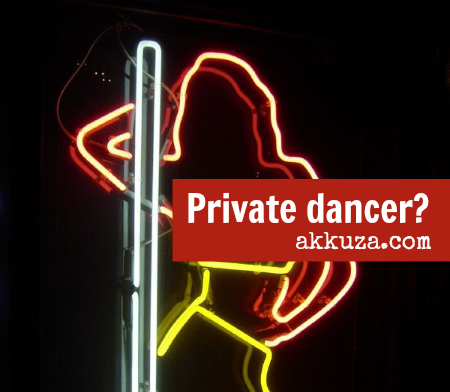
Private dancer?

A news item on a Belgian radio last week spoke of how students were turning to new forms of income to subsidise their studies. One form of income was a new service being provided whereby students agreed to perform cleaning services (the French term is “technicien des surfaces”) while wearing sexy underwear. Persons buying the service presumably got their kicks from watching scantily dressed women perform household chores. The company providing the service had strict rules including “no physical contact” and would cream 30% of the charge for having provided the contact.

The debate was obviously centred around whether this was a form of “proxénétisme” (another funky French word for prostitution). Apparently the issue of voyeurism does not fall strictly into that category. Another issue was whether this amounted to exploitation (or sexploitation) of the fairer sex and the reply by the company was that they were also planning to introduce male versions of the service.

Back on the island for a short break I have just come across a new report from the Maltese courts. A magistrate has just held (in the reported words of the press) that “Baring breasts while lap dancing not a scandal“. To begin with, it is not strictly speaking a business of the law whether or not a “scandal” exists so the title is more than just misleading in this sense. The real fact of the matter is that a court of law in Malta has finally held that what goes on in strip clubs is not exactly secret and that it is up to a mature person to decide whether or not he wants to go there or not.

In many a way this can be seen as an important development and not just for strip club issues but also in situations like drama or theatre where the question of censorship might have been brought into play. The first thing that came to my mind was the “Stitching” question which could have benefited from that kind of assessment in the first place – once you are warned that a play will have adult/mature content you should not then complain about the content being offensive to your particular morals.

In the case of strip clubs we might be spared the pathetic “my bra fell off” kind of defence that made a mockery of the very public secret of why people frequented the kind of establishment such as Steam. Such as this one:

Camilleri herself testified and said that she works as a lap dancer and the Police had gone in. She was wearing a bikini top and boxer shorts.  She said that her bra had loosened a bit because she had been dancing, and when she noticed what had happened she immediately put the bra back into place.

The case in question probably does not itself solve the issue of the legality or otherwise of strip clubs in Malta. The legal twist lies in the fact that prosecution of such “offences” hinged on the notion of “public indecency” and “performing immoral acts in public”. In both cases the “public” element of the offence was crucial and what this case seems (again I only comment on the press report) to do is to confirm that the offence does not exist once it is carried out in a private establishment – where as the court report goes: “mature people should know what a type of club “Steam” and others similar are. It is the person who chooses to go in or not.”

So as far as legalese goes what we have is a confirmation of the fact that what goes on in strip clubs does not violate the provisions of public indecency or public offence to morals. What remains to be seen of course is whether the country has a policy on stripping in private places or whether the hypocritical lacuna will remain as it is. Businesses have spread across the red quarters of Paceville and there’s no denying that it is a booming trade.

The dangers of exploitation and what is called white slave traffic remain rampant and now that the traditional form of discouragement – the prosecution on the basis of public indecency – seems to have fallen there should be an informed and responsible attempt at proper regulation (which does not necessarily translate to banning the Full Monty) in order to ensure that all actors in the trade are sufficiently protected. The business of strip clubs cannot and should not remain the elephant in the room that is only mentioned to contribute to some form of  voyeuristic entertainment in the media industry.


Facebook Comments Box

Twisted like Beckham

The man is an icon worldwide. An idol for many. There’s no doubt that this retiring 38 year old millionaire who is apparently in line for a knighthood is one of the most recognisable faces on the planet. Kudos to the soon to be Sir David. Since he hit the scene as a young teenager he has been an incredible sensation. His first goal for United was in a 3-1 loss to Villa – a loss that prompted the great Alan Hansen to mouth the words he’d always regret “You can’t win anything with kids”. (Incidentally Hansen too announced his retirement from Match of the Day this week).

Yes, Beckham was part of an incredible line up of youngsters that would have a brilliant future ahead of them and there’s no denying that the generation of Fergie’s babes went on to perform some magic culminating perhaps in their extra-time scrap victory over Bayern Munich. Beckham spoke in an interview with Gary Neville shortly after his announced retirement and it was immediately obvious that the shadow of his “celeb status” was an uncomfortable burden of which he was only too painfully aware. He knows that he’ll be remembered for “other things” but would prefer to be remembered as a hard-working football player.

The thing is that apart from a hopeless taste in women (Victoria? What were you thinking Becks?) and kicking off a  penchant for funny names for kids, Beckham the man shows a great charisma and personality. His shy presence (and yes, apparent charm for the ladies) work wonders for his PR – and what a brilliantly managed PR that is. What about Beckham the footballer though?

No doubt he is above average. He’s no Messi , no Cruyff, no Pelé. The guy could deliver a cross magnificently and could take wonderful free kicks. Outside the celeb and paparazzi world he probably would not be such a highly ranked player. He could never skip his opponent but when he caressed the ball to pass it, it would generally obey him. You do have to factor what his charisma brought to a changing room as part of his sporting prowess but when it comes to magnificent free kicks and good wing action I believe the football factory in Brasil would suffice to provide a myriad others who could have qualified for the same calibre of ranking.

If you really need names I’ll give you Roberto Carlos, I’ll sell you the Juninhos (both Pernambucano and Paulista) and of course Ronaldinho. Looking a bit backwards there’s the inimitable Rivaldo and free-kick wise I’ll throw in an Eder, a Dunga and the inimitable Branco. That’s just Brasil. They might not have had the charisma that rode on the wave of the “three-lion” marketing of a UK-focused world sport media but hell did they have the quality. This is not to diminish the sporting qualities of Beckham but rather to put this skewered paparazzi-bloated image into perspective.

As for the “numerous great teams” Beckham played with. Well, sure there’s United and Real. After that it’s an abyss of cameo appearances in a Milan struggling to find some sort of shape, a league double with – yep, the mighty LA Galaxy – and finally the dismal showing with Paris Saint Germain (13 appearances, 1 assist, 0 goals, 1 red card). When you are David Beckham you can still talk about going out when on top after the PSG performance. The press will believe you. They want to. Because your face is money. Your image is money. The football does not really count at that point.

Yes, Beckham’s career deserves a nod and a bit more because the lad had an undeniable talent. Jamie Carragher too announced his retirement this week after 737 matches for Liverpool. Another indefatigable player will be hanging up his boots and he too deserves the praise and respect – in a way his story of loyalty makes him much more of the traditional, dying breed of footballing star than Beckham.

So respect to David Beckham for his footballing career. Another above average player leaves the stage. And in many ways football’s loss is ours too… though the celeb status that the likes of Beckham rolled into football will surely not be missed.

At least not for the real football fans.


Facebook Comments Box

Intellectual cowardice and the constitution

MaltaToday carries a report about a man who was arraigned in court for having made what turned out to be false claims about ex-PN leadership contender Francis Zammit Dimech. The man had made these claims on Facebook and Zammit Dimech considered them to be sufficiently injurious and false as to take legal action in this regard (an action for defamation). The outcome is a slap on the hand for the man and apologies that were accepted.

When the law works like a properly oiled machine every citizen gets the service that he deserves. Not only that though, you also have to consider that the correct balance of different freedoms will eventually finds its natural or legal course. Unlike the Paywall Paper and the Indy, MaltaToday does not seem to carry the controversial reports with regards to George Vella’s statements about wanting to rein in the media. Nobody seems to have bothered to transcribe the controversial part of his address so J’accuse has gone and done that for you:

Ejja let us rein in, ejja nikkontrollaw il-media taghna. Mhux inbilli nghidu” ahna le m’ghandna xejn kontra dak u ahna pozittivi” imma imbaghad nafu li l-media taghna (stampata, viziva whatever)  tibqa’ ssawwat tibqa’ ssawwat u tikkritika…hija parti minnha. Ma nistax nghid jiena “le ahna nirrispettaw lil dak li jkun m’ahniex aggressivi” u jkollok il-midja aggressiva u min jifhem fil-midja jghallimni illi taf tkun iktar aggressiv bil-midja milli b’ilsienek u  bil-mod kif inti titkellem imma naraw illi ikun hemm dak l-element ta’… forsi jghiduli “x’ghandek kontra l-media”, il-media allahares ma kenitx, hija r-raba kolonna tad-demokrazija… però il-media responsabbli ukoll u ma nistax jien nuza l-media biex inkeskes biha minn taht biex tohloq l-opinjonijiet minn taht biex naghmel character assassinations minn taht imbaghad nigi nghid “le imma ahna irridu nikkoperaw”. Dawn huma affarijiet illi sfortunatament matul is-snin li ili hawn gew jien rajthom, ghaddejt minnhom u inhoss illi ma gewx ikkontrollati ghal kollox. U irridu noqghodu attenti ghaliex jekk kemmildarba ahna ma jkollniex kontroll fuq dawn l-ghodda illi (gustament ghaliex le) il-partiti illum ihaddmu halli jkunu jistghu iwasslu l-messagg taghhom inkunu qieghdin xorta niffomentaw id-disgwid, niffomentaw il-bad blood u ha nghid wahda halli inkun qed nirrepetiha ghall-miljun darba din : Jekk ahna l-politici ma nirrispettawx lilna infusna, il-poplu ma jirrispettaniex.

It’s a ramble that taken out of context seems to be the fruit of a sudden afterthought in the middle of a speech. Vella’s call to “rein in media” was quickly the subject of newspaper headlines – at least the Independent and the Times. The Independent now carries a clarification by Dr Vella who stated that he was referring to “self-regulation”. There was talk or mention of “breach of privilege” though that seems to have died down too. Some reflections can be made though of what actually was said (and was not said) in those few lines by our Foreign Minister.

1. The forum

George Vella chose to utter these ambiguous words in parliament. True “media taghna” presumably refers to “the media that we own” – which basically could mean the party propaganda machines. Why do so in parliament? Why mention “media” generically in the next statements? The use of phrases such as “character assassinations” is either naively stupid or an attempt at being smart. There is only one type of media that has been constantly pigeonholed as being the main culprit of character assassinations and “attakki fahxija” and that is not one owned or accountable to any of the parties.

2. Practice what you preach

If the problem were limited to the ridiculous state of the party propaganda machines Vella could do nothing better than start cleaning up the act in his own house. Assuming any journalists are left that are not currently in the employ of government then one would expect Vella to be addressing his party’s media lackeys and giving them a new task and set of standards that he so dearly aspires to. After that he could invite the PN to do the same with their own house. A speech in parliament about “media needing to be reined in” that speaks of the “fourth estate” can only be alarming because any excuse is possible to suddenly have parliament assuming the role of regulator and censor.

3. Publish and be damned

Vella’s outburst can be excused because it seems to have been an off the cuff, unprepared set of remarks. Then again this is the foreign minister speaking in parliament. He may have the fault of not being a lawyer and not understanding the import of each and every word that he will utter but that is no excuse at this level. It could only get worse should he really consider to unearth the tool (weapon?) of parliamentary privilege rather than use a press conference to clarify his statements (hopefully in a credible manner). (see Indy report on breach of privilege)

4. Intellectual cowardice

The fear that the parties and their followers have of the power of some sections of the media is incomprehensible. The elephant in the corner in Vella’s speech is another Vella (albeit née Vella). The obsession with the Caruana Galizia’s and Borg Cardona’s of this world has become one gigantic ridiculous mountain. It has led people to confuse free and open discussion, to ignore the basic protections that exist at law should they require them and above all to ignore the fact that blogs and bloggers only have power when people give much value to what they write.

Unlike many of my colleagues I will defend the right of every single blogger to publish and be damned especially if there is an infinitesimal risk that through some rare moment of insight shining from among  a myriad bullshit posts  that blogger could function as another tool in this fourth pillar of democracy.

The gullible willingness of sections of the population who would willingly accede to Vella’s requests to “rein in and control” shocks me a million times more than some ridiculous pink magazine style blog posts about the latest antics of one of our public figures. Even more shocking is the intellectual cowardice of many who would fear speaking out openly against any attempt to introduce regimes that stifle thought and expression with some pithy excuse of protecting the public.

Facebook Comments Box

The cost of a paper

So the Times must have gotten their feathers ruffled by the news that their spanking new premium scheme is rather “hackable”. That’s only if you call refreshing a page before the irritable subscription request pops up “a hack”. The thing is that beyond what are surely teething problems for the Times (and more particularly for whoever came up with the javascript paywall (see that biwwa? I said paywall) lies a future of secured “income”. Once the flaws are solved then the paywall will definitely be in place for the news website (not portal – idem biwwa?) and readers will have to decide whether paying the €3.99 a week is worth every penny.

That, I believe, is the real question. For all you need to do – as J’accuse reader John Lane has already done – is compare the cost of subscribing to the Times of Malta online (and that is only online – not including print) to that of other papers/journals. I have taken a cursory look and looked around some major titles. The most striking fact is that the UK Times – loaded as it is with goodies and extras – turns out to be cheaper than the Maltese Times. Here is a table of sorts for the sake of comparison:

27€
Le Figaro
€27 per month (includes delivery of printed version and free watch)

24€
Le Monde
Formule Integrale – 24,90€ per month

19.33€
International Herald Tribune & New York Times
Unlimited access to the IHT smartphone apps, IHT app for iPad and NYTimes.com. €19.33 per month (25$)

19€
The Economist (digital + print)
€19 per month

15.96€
Times of Malta
Digital ONLY. 3.99€ /week once the introductory €2.99 expires

14.15€
The Times (UK) Classic Pack (top range) – €14.15 (£12) per month

It’s not just that though is it? For only 3€ more you could have access to the Economist online and receive it at home. Or you could opt for the New York Times/Herald Tribune alternative. The UK Times still remains the strongest contender for value for money – and don’t forget you could get all the local news for free from the Independent, MaltaToday and the various news websites that spring up such as iNewsMalta.

So yes Times people, once you stop grinding your teeth at these offensive bloggers who found a flaw in your paywall system you might have to contend with an even bigger flaw in your business model. If my O’level economics helps me in any way this has something to do with “opportunity cost” – basically your potential readers might take this opportunity to waive the cost for your subscription and go for something – how shall I say it? More worth the euros and cents?

Facebook Comments Box

This wall is on fire

Kurt Sansone’s Sunday morning article introducing the Times’ (of Malta) new premium scheme kicks off with a tenuous comparison to the introduction of the Rediffusion a good 77 years ago. Biblical scholars tell us that the number 77 signified a very large number as in Jesus’ affirmation “I tell you, not just seven times, but seventy seven times!”. Aeons if you like. The introduction of the rediffusion is in fact not just the matter of another century but in technological terms it is comparable to prehistory. You can get radio anywhere now – especially via internet. I recently discovered the strange experience of driving through forests in Luxembourg while listening to eight-ninety-seven-bay… thanks to an internet connection hooked onto the car sound system.

What rediffusion did was bring wireless entertainment to many homes. I’m not sure whether Kurt opted for the aesthetic/nostalgic approach before dropping the bomb and announcing that “It is within this scenario that timesofmalta.com will from to­morrow offer its readers premium content against payment, a first for any Maltese news website.” That’s another record broken, or should I say broken record? Kurt moves on to examine the “ruffled feathers” and follows this up with the question: ” Should news content delivered by media organisations over the internet remain free?”

It turns out that breaking news will still be accessible (that’s the top part of the TOM page – the one most prone to errors caused by expediency) but the rest will be accessible only once you pay to get through the firewall*. So in actual fact what you would have to pay for is the analysis and blogs and maybe the odd bit of odd news – the rest you could read anyway. Which is just as well given how the Independent has upped its updating frequency and seems to be serving the purpose of immediate news provision just fine – which would make the Times charging for the very same news ridiculous (also considering the other news websites available for public consumption).

So what can we really make of this premium site move? To begin with you do get a feeling that the guys at the Times think a tad bit too much of themselves and their content. The suspicion that you get is that the Times had lured the multitude of commentators (that it insists on calling bloggers) into some form of addiction and is now hoping that they will be willing to pay to sustain their habit. In recent months it was also evident that the Times was delaying the uploading of most content that was not breaking news even more. Sunday articles would only be up on Monday – giving us online commentators a hard time to keep up with the “opinion” corners.

Did the Times gain anything economically from this move? I wouldn’t know. What I can say is that the move is a huge gamble – one that could deliver a sucker punch to the ego of the whole set up at Allied Newspapers. Unlike the printed paper that many faithful readers would buy out of habit on any given Sunday, the payment for online content seems to require a different level of commitment. When one considers the alternatives online and the actual quality of what is being offered by the Times itself it is hard to see how easily internet users would part with even a tiny sum to fall in line with the Times new premium policy.

The Times also forgets one major detail. The “breaking news” bit that is free is a common currency that can be found elsewhere. If anything the Times should have been using its additional “exclusive” content to lure more readers while boosting its advantage through the sale of advertising. The dastardly combination of addicted commentators and free riders should have meant that the Times was steadily building a huge audience – one that should be translated to advertising revenue. What the Times seems to be preferring to do is to slay the goose – sure you get rid of the “scum” (and avoid having to employ a comments censor) but you are risking to get rid of the whole base upon which your online business should have been built.

Much of what is happening can be attributed to a very Maltese way of thinking about knowledge and power when it comes to the media. The traditional media houses still think very much in term of controlling the way information comes out and is presented. From the Times to MaltaToday to the Malta Independent it is the same story that only varies very slightly. The Times has gone one step ahead – charging for what it deems to be premium news. The mentality is sadly very much in the style of Rediffusion  seventy-seven years back – the notion of one-way traffic of information controlled at source that is deemed by the provider to be the “best possible wireless entertainment”. We beg to differ.

Come to think of it there’s a lesson that Times readers could learn from a great wall builder. When the Chinese built their Great Wall most thought that it was meant to keep invaders out. In actual fact its main purpose was to keep the Chinese in.

* It has been pointed out to me by experts in the field that the term “firewall” is not an accurate description of the Times’ premium scheme. The actual name is a paywall. I wrote the article labouring under the illusion that a paywall is a type of firewall that requires payment to be overridden – much like the troll-ridden toll bridges of lore. In this case it turns out that payment for access to a troll-ridden site means that it is a paywall. Apologies for the confusion.

Facebook Comments Box

Neighbours

You’ve probably by now seen the news clip featuring Charles Ramsey the saviour of the 10-year captives in Cleveland, Ohio. News crews have been roaming the neighbourhood trying to obtain different angles from neighbours in the area. How long had you lived nearby? Had you noticed anything strange? The usual really. We saw the same thing happen with the Chechen brothers guilty of the bomb plots at the Boston marathon. It’s become one of the main bylines whenever a tragedy happens. From Anders Breivik to Marc Dutroux it’s as though we cannot really accept that the person next door could be your next mass murderer or serial killer.

Then again it’s not like this kind of person go around with a warning label on their forehead. This pampered society of ours is very protected when it comes to labelling – to the point that we need to label the obvious: “Smoking may harm your health” or, as featured on a peanut confection, “May Contain Nuts”. Interaction with neighbours is important in a healthy society because with healthy interaction you get a solid community. One of the largest religions on the planet boasts of a great philosophical maxim that transcends the purely spiritual: “Love thy neighbour as thyself”. At one point in his interview Ramsey  says something that is very telling. I paraphrase here: “The point where a little white girl runs into the hands of a black man, that is the point where you can tell that something is wrong.”

Yes. It’s a very telling statement. Ramsey could afford to make that statement that clearly exposes the divided lines of his corner of the world because the focus was on the saving of the girls. The truth is that everyday life in that part of Cleveland Ohio is probably very much inclusive of little white girls who are brought up to distrust the black men – even if it’s their next door neighbour. Another lady interviewed by the BBC stated that her granddaughter had seen “a naked lady crawling in the backyard”. Her reaction? She told her grandchildren to keep away from that house.

But these things only happen to other people in big countries don’t they? Affarijiet tat-TV. Are we sure about that? The tasteless comments underneath a Times of Malta report regarding the search and rescue operation for the 5 missing French persons might give us a good idea about our good neighbourly policies. Commentators deemed it too expensive. If you allow me the crass comparison we were not even talking about the boatloads of anonymous travellers from the sub-saharan world but of five Europeans – a genre of sailor that is more palatable to the Maltese xenophobe on any other day.

We may profess to be a caring nation with our marathons and fund raisers. It’s hard to find real evidence of this though when you look at the thoughts that run through the minds of many people and that lay bare our scant regard for a more social way of thinking. Before you rush to tell me it’s a small minority who think that way just remember that an overwhelming majority just voted for a party/movement that is at best equivocal on immigration policy. That same movement cut deals with social pariahs such as hunters and constructors showing a penchant for macchiavellian short-cuts so long as power is obtained. Above all, the irony of ironies, remains the Taghna Lkoll slogan – a message that sends out an image of total inclusiveness but that has become a mantra wielded only to set neighbour apart from neighbour in the interest of the few.

To think that it all had begun with a message of love. Inħobbkom.


Facebook Comments Box