Marlene: The Real Taghna Lkoll

marlene_akkuza

I’ve tuned into the parliamentary sessions a few times ever since the new parliament has been inaugurated. It is rarely a pleasant experience and I do not delude myself with expectations of high oratory and rhetoric. Still, the PQ sessions provide a very good picture of what our politicians are up to and the respect with which most of them hold the highest institution of our nation. It was during one particularly ugly PQ session involving a cat-and-mouse session with the PN trying to get answers from an absent Konrad Mizzi that I was once again pleasantly surprised with an intervention by Marlene Farrugia, Labour MP.

Following a particularly cringe-causing exchange where it was evident that the Labour MPs were all out to avoid answering any form of questions no matter how they were phrased, Farrugia stood up and started to speak. The way her intervention began led me to believe it would be more of the same partisan pot and kettle talk. “I’ve sat through previous legislatures watching the previous Ministers and MPs dodging answers to questions and failing to be accountable”, she began. Was Marlene about to justify the government MP’s attitude with a classic ‘Tu quoque’ intervention?

Not really. “I’d expected our newly elected government with its promise of transparency and accountability to be different” she continued. Now there was a politician worth her salt. Marlene was not defending the Labour MP’s economy with the truth – she was criticising them, and precisely because they were doing nothing to improve the situation inherited from the previous lot even though they had been elected to do just that.

To me that intervention embodies all that Marlene Farrugia represents. She is a living proof of the politicians of real change. Oftentimes she is wrongly placed in the same category as the Franco Debono’s and Jeffrey Pullicino Orlando’s of this world – renegade, unhappy backbenchers who are trying to get more from their party while it is in power. Party faithfuls do not miss a beat when insulting and remind “why she was elected”. Yet Farrugia does not seem to aspire to power as much as to a kind of politics that is rare – real accountability, real transparency and a real change from the past.

Part of the charm of the Taghna Lkoll message for many during last election was the promise to break away from the old way of doing politics. This meant doing away with deals brokered with friends and friends of friends, it meant an open, transparent and meritocratic system. Had JosephPL stuck to the Taghna Lkoll promises it would not be in the dire situation it is now – a situation that might not be reflected in the opinion polls yet but that is evidently paving the way for electoral disaster.

Farrugia’s constant questioning of Labour’s performance is not based on a renegade development suddenly sprung on the party leadership. Rather she is the stronger version of the conscience that should remind the leadership, the party and the government of its democratic commitments to society. Is all this done out of some Macchiavellian manoeuvering? Does Farrugia hope to unseat the current leadership? Is her aim to destabilise the Labour party’s majority? As things stand it is very doubtful whether any of these options are possible or whether they are actually a priority in the outspoken MP’s mind. What is clear is that by sticking to values and committing to the most basic of electoral charters of accountability that is the party’s own manifesto and promises Farrugia towers strongly over the rest of the Labour MPs.

Until now Muscat has been able to ‘tolerate’ Farrugia’s outspokenness, also because he can scarcely do otherwise. If, as we hope, Farrugia remains steadfastly consistent in her commitment to a code of values that seems to have been ditched by the labour mainstream upon election the situation might become more and more uncomfortable. The main reason is that there is a limit to the number of gaffes that can be committed without the accountability.

Muscat’s nine lives might still be in full swing but Marlene Farrugia remains a wonderful reminder of what Taghna Lkoll would have been and could have been had it not been hijacked by power hungry opportunists who fail to understand or respect the liberal democratic system of accountability. Hers remains a tough task of civic education – particularly when it comes to imparting the lesson that having a majority does not automatically make everything right.

also read this: ‘This is not the Labour government we strived for’ – Marlene Farrugia urges ‘change in direction’

Facebook Comments Box

The Environment Front

front_akkuza

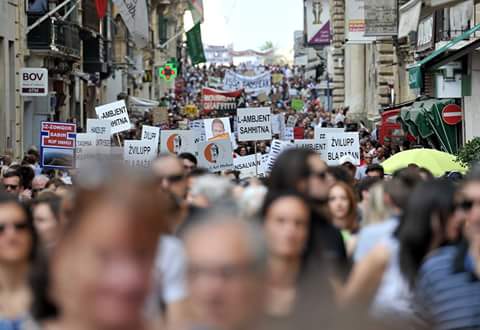
Last Saturday’s protest rally in Valletta by Front Harsien ODZ (FHODZ) is being hailed as an historic milestone in Maltese politics. Mike Briguglio listed his own reasons as to why this could be so in his post “Making history from Zonqor to Beyond – the Front phenomenon“. It is precisely the “Front” phenomenon that interests me the most – and this in the wider context of the “beyond” rather than in the limited context of Zonqor.

What is a “front” and how does it fit into the current political spectrum? What impact will it have in the long-term scenario of Maltese politics?

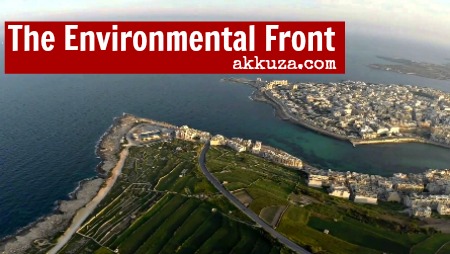
It was rather revealing to read descriptions of the FHODZ on the facebook pages in the run up to the protest. You began with a “front” which is a term that perforce implies battles and wars. A “front” implies engagement – a battle, a struggle. The term immediately recognises activism with intent to obtain direct results. This is not merely a foundation or an organisation representing a set of values – it had a target that necessarily implied direct engagement in the battle. The battlezone too was clearly defined – it was the protection of Malta’s politically defined zones that are outside development areas.

In their own descriptions of the front members quickly segued to the term “movement”. The description of the Front on its facebook page is quite clear in that respect : “Front Harsien ODZ is a citizens’ movement which welcomes support from all sectors of society. The goals of this Front are purely environmental.” The term movement has been monopolised for some time by the Taghna Lkoll wave of Maltese politics – the coalition of interests (and promises) that proved to be the right ticket to ride the wave of dissatisfaction with GonziPN. It is probably with this in mind that the name of the organisation carries the term “Front” and not “Moviment”. That such a choice would be made is quite fitting with the general attitude of the Frontists to stress their a-partisan element whenever they can.

Which brings me to the next defining point of the Front. Great pains were taken (and are still being taken) to stress that the Front is non-partisan – to the extent that some use the term non-political to describe its field of activity. In doing this the Front plays to the same sanitised collective utopic ideal that we have become used to of late when hearing speeches of the Taghna Lkoll camp (typical statements include “ma hemmx kuluri”, “ilkoll ahwa maltin”, “ma jimpurtax int min int u inti x’int”). In this utopia the collective baddie is the partisan politician and the saviour is the new style apolitical politician who supposedly has some form of national interest at heart based on some home-spun mythology or ideal.

The dynamic of political persuasion and participation as opted for by the Front is both necessary and counter-productive at the same time. On the one hand, the Maltese demos has now been fed the spin of “Politicians Do Evil” (and admittedly have had ample evidence smacked in their faces) for quite some time. This is why the Front had to provide a sanitised version of political activism. The Maltese “podemos” or CinqueStelle crowd could only be stirred into political action of some kind by being told that this is anything but political.

Having chosen that delicate road of politics with sanitary gloves and masks on the Front then had to engage with politicians because last we checked this was a working liberal democracy that has also got a role for popular pressure and lobbying. In order to get people on board this had to seem like a protest against all politicians for all the harm they caused and for all the harm they will cause. Even the church got its own dose of hand-slapping for daring to give its two-cents’ worth. The risk at that point was that the Front would be diluted by Pythonesque bickering related to who they where and what they wanted.

The holier-than-politicians attitude would provoke equally absurd reactions such as the infamous “Where were you? (fejn kontu?)” retort. Absurd might the retort be (and wholly ridiculous given the context) but it was a direct corollary of the need of the Front to define their goals in apolitical terms when every breath and step they took was steeped in politics of the finest kind. The very continuity guaranteed by the ever-present environmental activists no matter who was in government was in fact a guarantee of political perseverance and not of NGO oblivion. Which is why the Front was at its best when it could show a full curriculum of political activism as witnessed in the various Mike Briguglios and James Debonos. Their constant presence was as political as it could get – and a proof that the embracing of environmental values in politics is important: far from the ascetic crowd pooh-poohing politics with a big P.

“Politicians Protect Our Environment” read one of the banners at the hugely successful protest. Where does the Front go from there? What are its short-term goals? Are they enough? Muscat has toyed with the Zonqor ODZ as though it were another pawn in a huge chessboard to be moved at his whim and fancy. His latest comments post-protest are neither here nor there: labelling the Front as “extremist”, practically ordering the cancellation of a counter-protest (was it his to cancel?), speaking of a compromise that he apparently reached with himself to go ahead with partial destruction of the Zonqor area.

Is getting Muscat to keep his hands off Zonqor enough? When it comes to the opposition and its commitments, not a day goes by that the Front does not do its best to denigrate any attempt of the party in opposition to wipe clean its slate on environment and take on a new set of values that would be much more than Muscat’s compromise. Shouldn’t the Front be grasping this opportunity of reshaping the environmental and planning policy of one of the major parties as soon it has a chance? The snide remarks and lack of trust will get its members nowhere beyond their Warhol fifteen minutes of fame because when all is said and done and when the last poster is put away it is back to the bigger battle between two parties for the management of our nation and its heritage.

The way I see it, rather than pushing away the PN for its past errors, the Front should be embracing the goodwill of the party and getting it to commit pen on paper to a series of values. All this talk about not trusting politicians because “look what Joseph did once he got into power” is neither here nor there and politically naive. A failure to understand the dynamics of political representation is also a failure towards the people joining the movement with the intention of obtaining concrete results (excuse the unhappy pun).

My idea would be a charter on environment and planning that goes beyond building in ODZ and tackles head-on the environmental challenges for the future. A charter on sustainable development, on the use of current properties, on the preservation of ODZ and natural areas. A serious overall study of the values that should underpin our nation’s future both urban and countryside development. If all this were crystallised in a Charter then the Front’s real achievement would be getting all political parties to subscribe to it. To commit to it. In writing.

Sure you might remain cynical and claim that parties would do it for the votes but then again that is the whole dynamic of representative politics isn’t it? The Front’s role is to create civic aware citizens who are prepared to immediately hold the politicians to their promises. It’s role is to obtain clarity, its battle is to get the parties that represent the people to embrace this clarity and commitment. First in words then also in action.

11059917_10205735736565151_457901184844232376_n

Facebook Comments Box

Unprofessional

unprofessional_akkuza

Someone at the Juventus marketing division (or at a marketing firm contracted by Juventus) should be getting his knuckles rapped by now. It so happens that Juventus’ latest drive for memberships featured a picture of a woman’s face painted in the world famous black and white stripes with the wording “Pure Enjoyment”. A huge poster featuring this face was also displayed at Rome’s Stazione Termini much to the chagrin of the capitolini who probably regard the station as “home territory”. It was clear that Juventus wanted to follow up their successes last season with an aggressive membership drive, only to be spoilt by the lax laziness of some designer in an office who couldn’t be bothered with getting creative.

No. Said designer opted to plagiarise an idea from a fourth tier Spanish football team (Badajoz) who had featured the same black and white face in their own (more modest campaign). Even if the photo is sourced from some stock photo database the fact remains that the designer guy/lass copied the gist of Badajoz campaign without so much as an if you please.

It’s about standards really. Juventus FC’s image will not suffer much beyond the spoofs of rival supporters such as those of Inter FC (a team who until now has copied its logo (off Real) and plagiarised its tune (an injuction was issued by Celentano I believe to stop them playing it)).


It is the lack of professionalism that jars – and a lack of pride in one’s own work. Forgive me if I go back to Alfred E. Baldacchino’s intervention in the parliamentary Permanent Committee on Environment and Planning but it really was an example of how things should be done. Call it old style if you wish, or proper civil servant but it is there for all to see. (See Baldacchino’s post on the matter in his blog).

Pride in your own work is also important because each and every one of us is a cog in a greater wheel. This greater wheel and system is intended to function when every part of it works accordingly. If you look at MEPA as an institution that is currently under the lens we begin to understand the convoluted contradictions both in legal development as well as in planning practice that have grown over time. When architects and planners stay mum when faced with evident distortions of the law and deviations from proper policy, when the autonomy of an institution is put into serious jeopardy in order to satisfy a web of interests that have nothing to do with the aims of the institution itself then things go awry and they do so fast.

At the base of all this is an unprofessional approach to work, to ethics and to policy. This danger is all pervasive and does not stop at MEPA. Professionalism is strongly linked to dignity of the person. Dignity, in its turn is linked to happiness and enjoyment of life. Unprofessional, undignified behaviour may bring short term bursts of satisfaction to the weak minded and short-visioned but in the long term it promises misery for them and those around them.

I’ll be renewing my International Premium Membership with Juventus FC but I cannot say I am not concerned by the slip in the marketing department. It is this kind of sign of weakness that must be catered for immediately before you start a ride on the slippery slope to mediocrity. On and off the field.

Facebook Comments Box

Environmental Value

vaticn_env_akkuza

Watching Alfred Baldacchino tear the MEPA Zonqor report to shreds was a joy to behold. After years of watching politically appointed incompetents in all spheres of government deliver their business in a manner best described as “quasi-amateur” it was reassuring to see that there are still diligent, competent persons who can contribute to this nation. “Tal-affari taghhom” we would call them in Maltese.

Speaking at the Parliament Environment Committee while interviewing a hapless Johann Buttigieg, Baldacchino gave a blow by blow breakdowm of the report that MEPA prepared under strict conditions dictated by the Office of the Prime Minister. In Baldacchino’s words this was a report made to fit certain prerequisites (or as he said in Maltese “biex il-bocca tingab qrib il-likk) and there was nothing scientific about it.

Buttigieg’s feeble defence rested upon the classic “orders from above” defence that only went to show how the independence of our authorities and directorates is in tatters. Asked why the Environmental section (and experts) were not used in this report Buttigieg could only mumble something about confidentiality being imposed from above. In short he seems to mean that since this was a strictly confidential report that would not be made public they dispensed with the uncomfortable obstacles that might arise in the environmental sphere.

Through a reasoned and well argued approach Baldacchino unearthed one of the main pillars of dishonesty that underlies Joseph Muscat’s dealings with regards Zonqor Point. This was no tree-hugging conspiracy theorist on his spare time but a real scientist asking pertinent questions and exposing the gaping holes in the report. It was a report written to make the Fake University at Zonqor happen come what may.

Marlene Farrugia courageously reminded Johann Buttigieg that his duty was towards the taxpayers dishing out his and Sai Mizzi’s pay (I added Sai but it’s the same coffers) and not to suck up to his political superiors. That it might be a case of talking to a brick wall was immediately evident when Buttigieg was also told that on these issues it was he who would be made to answer not his superiors. The civil servant replied with a “no problem” that implied that taking the bullet was part of his curriculum.

In other related news it is also interesting how the other institution currently being grilled by the Front Harsien ODZ for its environmental credentials is the Church. The problem here lies in a couple of requests by the Church to build schools in ODZ area. Having become another outspoken campaigner in favour of saving Zonqor, the Curia is also being required to do some homework about its past applications in ODZ areas.

The timing could not be better. Back at the big Church HQ in Rome, copies of the upcoming papal encyclical “Laudato si’, sulla cura della casa comune” were leaked to L’Espresso. It appears that the conservative movements in the church want to undermine the progressive stance of Pope Francis in this respect but leaks apart we will have another possible set of value guidelines from an institution that does its homework well on a deontological level – one that cannot be ignored, especially by Malta’s Curia.

Alfred Baldacchino spoke not only as a well-researched scientist who knows his job but also as a man with clear values and vision. The renewed discovery of environmental sensitiveness in this country might be a welcome trigger to explore the understanding of our values in this and other fields.

In which case… laudato si’….

Facebook Comments Box

Spies like Tonio Fenech

spies_akkuza

We are slowly getting used to obtaining information from this government through some leak or better still through foreign news or media. There can no longer be any doubt that Joseph Muscat’s government is anything but forthcoming on any kind of information – just take a look at PQ time in our snazzy new parliament to get an idea.

Major contracts are hidden from view and rarely tabled as the government hides behind feeble excuses such as “commercial interests”. For a government that leaps at every chance to speak of “national interest” this one seems to be quite reluctant to acknowledge the obligation and duty that it has to act openly and transparently in order to be constantly held accountable.

A stint in government is not a stint at 5-year periods of despotism. The mechanisms of the state are such to allow constant monitoring of decision taking at government level. Both the fourth estate and the opposition have a fundamental role in all this. We are getting more and more used to “Freedom of Information” requests by newspapers to obtain information that was being held close to the chest by government. Sometimes, as happened with the head of the State Aid Monitoring Board when questioned by the Times,  an ingenious technicality is invoked. Mr Paul Zahra invoked the obligation of individual members of the board to regard all information as secret and confidential. A pity then that the request was directed to a member of the board and not to the Board as a whole under the FOI provisions.

Ministers often hide behind “commercial sensitivity” to explain why a private companies’ rights trump those of the public to know the truth. So where does that put Tonio Fenech and his Google Finance Group? Sharing of data and information that would otherwise not be made public has to be seen in two contexts. The first is the context where that data and information ought to (and will eventually when enough pressure is put on the government) be made available but the government will drag its feet on making it available. The second is the context where the data and information is indeed classified.

It is evident from the official government reaction to the idea that information was being provided to the opposition that the first is as much of a worry as the more legitimate second. The concern that such information could “damage” government is only a concern if the government is not doing its homework right. If all is fine and dandy then there would be no worry that such information is made public. What we have here is a clear attempt at trying to tighten the grip on public information and thus an attempt to choke accountability.

After all this feeds to the government idea of “persons of trust” – read incompetent persons placed in sensitive positions solely on the fact that they blindly back Labour. This is supposed to be the reason why we should accept the Phyllis Muscat’s of this world – because they would never send data and proof of their hapless management to the opposition and the public would never be able to learn how their money is being squandered to pay the salaries of incompetent sycophants.

One last thing. I sure hope that the existence of the Google ring was discovered thanks to some error by those involved. Heaven forbid that the government’s IT division hacked into a private google account in order to make such a discovery. In that scenario we would be reaching the bottom through a new set of violation of civil liberties – all in the name of Taghna Lkoll’s Chinese Wall of Secrecy.


Facebook Comments Box

Labour’s Impropriety

impropriety_akkuza

The Taghna Lkoll apologists are beginning to cut quite a sorry figure during their online interventions. Their attempts to parrot the tu quoque arguments championed by their leader have become pathetic to say the least and the main reason is that this government’s actions all round have become indefensible. That this would happen was predictable from the start – too many cheques to cash, too many contradicting promises, too many mouths to feed and most of all (as we like to repeat) the glaring absence of a real political plan.

It is blatantly evident that the only road map Labour cares about is the one dotted with milestones and achievements that are only measured by how much money ends up lining the pockets of the Taghna Lkoll extended family. If there was a political plan in Joseph Muscat’s mind it was a short-term calculation that exploited the ugly deficiencies of our political system to the maximum. Muscat will have a place in history as he so crassly aspires – he will be remembered as the Prime Minister to have dragged our politics to the pits. I still cannot understand what kind of ambition can be driven by so much negativity – there is no apparent place for the real good of the people.

It is just there that the Labour government’s performance is at its worst. The complete and utter absence of consideration for the greater good of the nation. While words and spin are all about Taghna Lkoll, the good of the south, the new middle class and such similar claptrap the actions of the Labour government are those of one big plunderer intent on ransacking the public good as quickly as possible.

It does not stop or start at the ODZ – or even more particularly at Zonqor – it is a plunder that is happening step by step and eroding the institutions and heritage of our nation in much the same way woodworm will crawl and erode a fabulous bit of furniture from within. We have seen in the past few days how the Lands Department is practically run as a Labour appointee’s fiefdom allowing for undemocratic obscenities to be perpetrated.

That we get this kind of information from a blog that has had to assume the role of a kind of Wikileaks is very telling of the current state of affairs. The opposition is still hard at work to rebuild credibility thanks to the massive bombardment that it had suffered in the eye of the public. It cannot work in parliament because Labour treats parliament like a playground for despots – hiding behind petty and trumped up excuses in order to obfuscate the truth about its contracts and dealings. You only have to look at the Konrad Mizzi AWOL farce last week to see the way Labour treats its obligations of accountability to the nation’s supreme institution.

The first sign of voters’ anger and indignation is the increased stories being passed on to willing outlets of information. No matter how much noise the rent-a-privitera movement is making on the web you can feel that there is a growing counter-movement eager to throw light on the misdoings of the government and its friends. These angry voters might still not have understood the importance of activism and participation in the anti-ODZ development movement but are sufficiently angry to start asking questions and doing their bit by providing relevant information wherever they can.

Labour’s game has been uncovered because it necessarily dealt with property in many forms. Public good in the form of ODZ was the first area in which alarm bells started ringing. Muscat and his “what’s the fuss” attitude contributed to the acceleration of the denouement – citizens were finally seeing the careless attitude Muscat had with public property. It would have been bad enough were Muscat selling land to some reputable university, but when the mask finally fell that the land was being sold to Jordanian builders who had no previous experience in education it was a bit too much.

Meanwhile we are still dragging the power station saga with the government using public funds (also public property) to guarantee a loan to a private enterprise in order to get things going. That there are some people in some quarters trying to stir the tu quoque argument even in the light of this kind of proof is an indicator of how sick our politics has become.

As for Gaffarena Gate it is an eye opener (if one was still needed) as to what the effects of Taghna Lkoll politics are. We already had a race to mediocrity fuelled by alternation whereby the only point that counted in an electoral manifesto was the not being the other party. Taghna Lkoll threw in a strong dose of mediocrity plus with its army of incompetent appointees that are only bound to expose the ugly truth of this kind of short-term power politics.

It is now the PN’s duty to first and foremost document meticulously every faux pas of the Labour government – from its birth to the current almost daily gaffe-fest. It is also its duty to continue working on real change based on politics and values while trying to attract a new wave of politicians willing to sign up on that kind of ticket. It must be a ticket that does not fear the absence of compromises for the sake of gaining power. It must be a ticket that clearly states a program not just for tomorrow but for the future. It must be a program of building, creating and inventing. It must inspire confidence.

Labour’s government by impropriety must end.


Facebook Comments Box