There's something about economics

The gaps between macro-economics, micro-economics and home economics are rarely bridged in your average person’s daily thinking. Given the worry about his wages, his electricity bill, his cable football subscription and the extra little entertainment money on the one hand and the Irish Question and EFSF financial bailout disquisitions on the other, your average Joe Borg is more likely to be immersed in the problems former. Like me he would have little or no clue (or only a vague recollection) of the EFSF – European Financial Stability Facility and would have no idea how consequential its future decisions are on the price of bread in his own little world.

Which is not to say that we should all enroll in a Masters degree in economics overnight. It would help though if things monetary were put into perspective whenever we discussed politics and policies national. Our governments tend to take notice of international scenarios only when the outlook has something positive about them to say. Behaving like organisational Lou Bondis they will only read the news if it is about them and if it is good. The biggest offender however is the opposition which continues to swagger and promise as though the international financial crisis is a thing past.

It’s funny how the opposition leaders do not notice that by acting with such naivety they confirm that Malta has hitherto been cushioned from the uglier effects from such recessions. The problem is that, as the IMF seemingly pointed out yesterday, we should not be carried away by the idea that it is all over. Malta, like the rest of the countries in the real world, is still out there in the stormy financial and economic storm – and the waters are far from being calm.

On yesterday’s episode of Vieni Via Con Me, world famous architect Renzo Piano was asked the question that most of the expat community often face at one time or another in their life. Stay or Go? Implying – would you encourage people to stay in Italy or leave the country? Piano answered unequivocally – partire (go): not out of desperation (as the emigrants of the harsh times who left for New York etc) but out of curiosity to discover the wider world.

It is sometimes this careless feeling that the outer world does not matter that drives our planning along the usual corrupt and useless ruts. Which is why we too should encourage our young to leave the country and discover the outside world.

Piano added a postilla – partire … per ritornare. Leave to come back. Which I must confess is probably the most difficult part. Someone once old me that the country that you pine for when abroad is never the same one that you left behind. Which makes the coming back part all the more difficult.

Enhanced by Zemanta
Facebook Comments Box

J'accuse : De-humanised

The end of this week was characterised by an interesting mass activity on Facebook. The billion people who choose to interact in the virtual world set themselves an interesting task. Facebook users invited other Facebook users to “change your profile picture to one of your favourite cartoon characters from your childhood. The aim of the game? To no longer see human faces on Facebook but a true invasion of childhood memories….”

So there we were. Those of us who playfully went along with the game found ourselves submerged in this massive exercise of de-humanisation as familiar faces were switched to the Jeegs (my ex aequo choice), Lupins, Goldrakes, Occhi di Gatto’s, Roadrunners, Felixes and Pink Panthers of the world of toons. Not since “Who Framed Roger Rabbit” had the fine line between the comic and the real been so heavily transcended.

Then something happened that seemed to be one of those serendipitous moments in which life throws funny coincidences that seem to have been scripted by a deity with a wicked sense of humour. For just as the frivolous faction of the facetious Facebook community toggled with the idea of transcending human form for just one day, I decided to tune in to the online live stream of Bishop Nikol Cauchi’s funeral. The man who had presided over my confirmation (December 1986) was getting his last farewell in the church in which I was baptised (November 1975). My cousin Nathaniel was doing a fine job with the commentary (could it be otherwise?) until Bishop Mario Grech kicked off with his sermon (November 2010).

Penumbra

And what a sermon that was. It was peppered with moments of chiaroscuro worthy of the best Caravaggio. Bishop Grech warned against straying away from the light and from having Christ as the purpose in our life. He warned against the short-term aims of modern materialistic society in his characteristic slow drawl interspersed with all-too long pauses. Then came the surgical cut. In exalting the qualities of the recently deceased shepherd of the Gozitan church, he stressed that Cauchi was a man who appreciated the human qualities of his brethren. Grech could not help but use this occasion to win the term human and humanist away from the heretic “humanists” who have taken up the layman’s cudgel in the modern day intellectual debate.

There we were. On the one hand an entire Facebook posse engaged in the process of de-humanisation by posting the images of a latter-day iconography in lieu of their own, while in a wonderfully decked cathedral a servant of the Lord reminded the people that his church and its love of light would best be served by respecting the “humanity” of us all. I wonder: how many roads must a man walk down before you can call him a man? And when you do, what cartoon character will best fit his profile pic?

Fl-isem tal-Missier (In the Name of the Father)

Facebook is much more than a platform for nostalgic exercises that are a sort of pop art equivalent to iconographic hagiography. One of the most precious Youtube videos doing the rounds on the social networks is an interview taken from this year’s Web 2.0 summit featuring Facebook’s eccentric founder Mark Zuckerberg. There’s an hour of hot stuff and insights into the modus operandi (or at least modus cogitandi) of one of the most powerful people on the web.

There’s something menacing about the amplitude of the spread of Facebook in the daily lives of each and every one of us. It has, in some way, been documented already in much the same way primitive man might have spent nights around the fire discussing the properties of a flame. What we are still discovering is the potential of the social network for the future. Only last week Facebook had an important announcement to make to its users. Facebook engineers had come up with a new mode of communication they insisted on calling “Messaging”. They are trying to… wait for it… make e-mailing simpler.

It would seem that such things as “subject lines” and “formal introductions” and “paragraphs” are becoming too much of an encumbrance for the latest generation of social media users. The SMS (short message service) form for messages is much more efficient according to these abusers of the opposable thumb. So they are simplifying messages. The idea is to create a seamless system between e-mail, SMS, Facebook messages and whatever other modern equivalent of the smoke signal is available. It won’t make a ‘differecet’ what you use – the message will cross barriers of form and shape but the content will get there.

Kliem ir-Rih (The words of the wind)

It is hard to summarise the importance of such tiny steps on the web. It is hard to avoid clichés about information, interaction, data processing and algorithmic sorting that are part of the package when discussing the evolution of the social media. Zuckerberg comes across as a bit of a smart arse who was at the right place (Harvard) at the right time (six years ago) with the right idea (was it his? Watch “The Social Network”) and who is now destined to eternal gloating as his personal patrimony is enough to bail Ireland out of its financial crisis.

I’d love to be able to sell the idea to Zuckerberg to try Malta out as his mini petri dish for new ideas. He could test the effectiveness of online social networks in breaking down established ones through the power of realising what people want, what people need and what actually is happening. He could move the role of social networks into places where they have not yet ventured – the real blood of political administration and governance. Not the election campaigns on Facebook. That would be the easy part. I mean the business of government.
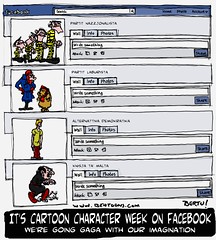
bert4j_101121

Il-Ktieb ta’ Barabba (Barabbas’ Book)

Yes, Ireland has gone off cap in hand to the EU’s leaders requesting help for a bail out from the ills and ailments caused by the big recession. It’s not potato famine material, yet, but as J’accuse documented a few weeks back, it is already causing a new exodus of young Irish to more fertile pastures. The discussion in some parts of the British press about the Irish conundrum has been very instructive. Some have felt the urge to gloat about the UK’s supposed intelligence at having avoided joining the eurozone and not having succumbed to the latest pressure from the “common market”.

The Joseph Muscats of the UK world trumpeted notes of triumphant ecstasy at the supposed brilliance of their scheming. Which would have been all right had they not got the whole factoring of cause and effect completely wrong. For Ireland is not in a worse position than the UK because of its membership of the euro. As an Irish economist pointed out, much of the blame lay with the management of the Celtic Tiger in the boom years. He called it “double-dipping”, a combination of a free-for-all on interest rates and excessive enthusiasm to milk the market that was sanctioned by the governmental administrators of the day.

As for the UK, all this Cameron-fuelled Thatcherite yelling of “No, No, No” fails to take into account the simple fact that the UK is not that great contributor to EU funds that the Tory press like to make believe that it is. Ever since Thatcher’s dealings with the EC, the UK has benefited from huge discounts from its EU duties, which made Cameron’s heading of the anti-bailout plan league of 11 nations a rather incongruous affair.

Juann Mamo (Grajja Maltija) (A Maltese happening)

Which brings us to matters budgetary closer to home. The Saturday papers reported a speech by Central Bank Governor Michael Bonello. Reading the summaries of Mr Bonello’s delivery was very salutary for the mental constitution of the sane. Here was someone with his feet stuck firmly on the ground and who had no trouble calling a spade a spade. More importantly (and thankfully for a Central Bank Governor), he does not seem to have any symptoms of the local virus of Malta-centricity displayed by politicians of all colours.

It is a pity then that such wise words as the following will be lost on the ears of the politically twisted and irrelevant world of the concerted practices of two parties. Much as columnists like Ranier Fsadni would like to capture the economic positions of the two parties as something reasonable in terms of neo-keynesianism, we will still be lumped with short-term “policies” based on populist knee-jerk assumptions. Here is what Michael Bonello stated:

“What I am advocating is not austerity but enlightened self-interest. It is a commonsensical appeal for a closer alignment of our priorities with the economy’s strategic objectives and for a more efficient allocation of resources.” Which is polite speak for: “Get your act together and punch some intelligent thinking into those marketing fuelled chicken heads. Be prudent and diligent with our money or you’ll end up like Ireland.”

What did “the people” and “the press” read in his speech? The first noise to be made was with regard to his proposal to rationalise stipends. Dear dear. Alfred Sant was right then no? Of course he was… 14 years ago. Judging by comment board reaction, it was finally time for the students to get their comeuppance. It’s Monty Python’s Yorkshire Policemen all over again. “In my days nobody paid me to study and I had papyrus books and had to go to university in a self-propelled pushchair with three wheels and we stood up all through the lectures that were delivered in a cupboard.”

Arlogg ta’ Darba (A one time clock)

Just like back in 1998, the stipend issue should not be about society’s imagined vendetta on spoilt brats. It should be a rationalisation of what the nation is prepared to invest in an educated workforce. What will HR recruiters of the future be faced with? Presumably, now (14 years on from Sant, remember – that’s 14 generations of graduates) is the time to invest in specific courses in order to incentivise certain career paths from which the nation will benefit as a whole.

Is it that difficult to conceive? A target-oriented stipend that combines elements of “means-testing” (difficult one that) with desirability of graduates in certain sectors (less difficult but badly in need of stronger uni-public-private sector collaboration). How else will we ensure that the gambling companies, which have become the bread and butter for an important part of good taxpayers, will continue to be attracted by the efficient workforce we so proudly claim to have? Electronics, IT, environmental planners and engineers, political studies (the real ones), spring to mind as obvious sectors for investment.

It won’t be up to just the government to foot the bill of specific courses. One could think about involving the private sector more and promote the idea of part-time students who are already getting their practical experience in the labour market. The difference between this kind of scheme and the Mintoffian parrini is the element of choice. Obviously, no course should be closed. If we still have 500 young men and women a year wanting to become lawyers then so be it. The difference would be that the stipend for such courses would be less than that for other courses.

I know that this idea is anathema to many – I have been through this very closely. It would be ignorant of us not to acknowledge the changing times and needs. It would be ignorant to fail to take note of Bonello’s stern but reasoned warning. A closer alignment of priorities is just what the doctor ordered. Better still. He ordered a strong dose of a rarity in these times: Common sense. Good luck with that.

Kotba (books)

This week’s subheadings were dedicated to some of the recently published books that featured in the Fiera tal-Ktieb. That is one event I hate to miss and I still have not had the opportunity to peruse any of the books mentioned. There are other books of course and the Maltese publishing industry seems to be traversing a happy moment. That’s a good sign. An even better sign would be for us to go out buy the books – Maltese and others – and get down to reading more and more. The narrative and the story is what makes us most human of all – whether it is the story of transcendental humanism of a deity made man or the travails of a boy-wizard in his battle against evil, the secret lies in not forgetting the magical stuff from which our mind weaves great ideas.

Cogito ergo sum. Isn’t it brilliant? Quick… change your status on Facebook.

www.akkuza.com is all set for the first snow in Luxembourg. Come tell us what cartoon character you are and share a thought or two.

Facebook Comments Box

My Cousin Bondi

This is a tale of two cousins. One is a self-professed journalist who has a time slot on national television the other is a thatcherite minister in the Maltese government. J’accuse does not normally take to the “pink” style references of familial links and the like but this time the coincidental operations of two cousins – one of whom we still admire – merited an appreciative pointer from this ever cynical blog.

First was the “journalism above all bloke”. This week there was another self-referential program about… himself. Or rather about the fact that assertions made by him in an earlier program did not sell very well to a large part of the population. Bondi must have been reading the news for a couple of weeks now for he planned a program full of clips and cuts from everything under the sun. Admittedly. and sticking to his philosophy, all references he read or saw or heard were to himself and his program. So he set up a new one in order to disprove his detractors.

He had planned a lovely jubbly program complete with an interview with Finance Minister Tonio Fenech. It would be a program in which he would prove that PL’s campaign depicting him as a statistic fabricating lackey for the nationalist government is completely cuckoo. It would all be as slick as a gelled hairdo. It would be. Until Bondi discovered much to his chagrin “a few minutes before the program began” (as he repeated ad nauseam) that a welcoming delegation from the PL were waiting at the studios complete with special guest Charles Mangion.

Bondi was as surprised as Alfred Sant must have been when he saw JPO sitting in the journalist benches on that fateful afternoon. He could not call for security and have the offending intrusion on his orchestrated program removed. He would have liked to. But he could not. Instead he smiled and gave Kurt Farrugia a “ma gara xejn” nod. And so the program began. It took a bouncy Bondi a full six minutes to settle down and actually start the program – not before flushing the cameras with caveats and mumbling sorry excuses about how a presenter of his international stature had been caught pants down by a rare sly move from the PL marketing team. He would have to go ahead with the program with the “adversary” in the studio watching every step.

Throughout the first part of the program (there’s a limit to how much bull we can stomach for you readers) we could feel Bondi’s discomfort as he squirmed from one figure to the next. He jumped from “zball zghir nibdluh” to “kollha l-istess baqghu il-figuri” with the grace of a clumsy donkey ride on a hot summer beach. Whenever he felt he was losing grasp of the situation (read: the program was not going according to script) he cannonballed onto Mangion with pleas for the labour parliamentarian not to “Set the agenda”. In Bondi’s mind, anything that risks disproving his theories involves setting the agenda.

Pity that Mangion was a feeble lamb and failed to live up to the occasion. He should have damn well insisted that the Beta tape he was carrying be shown. It was after all a table of figures and not – as Bondi seemed to imply – a porn video of god know what libellous nature. That Bondi managed to brush away the presentation with a feeble: “mhux fair ghax gibtha tard” spoke volumes of the worry that had planted itself firmly in the presenter’s mind. Truth is that Bondi cannot and will not take on his critics fair and square at equal arms. He needs to dance around and manage the show with clips that can be shifted and moved around at will. Even if Bondi was right, or half right – the manner in which he chooses to refute criticism makes him stink of wrong. Very wrong.

Which brings me to the much admired (in these circles) Austin. Among the sanscouillistes even the man with half a ball is king. Gatt seems to be loaded with such attributes (we are always speaking on a metaphorical level of course – I have no idea (or interest) what Gatt carries in his pants) and as such has often borne the brunt of audacious measures. Which makes his pussyfooting and excuse mongering in the BWSC affair all the more suspicious. Unlike Cousin Bondi, Gatt has never feared opposition and a good battle and prefers to take it head on.

Reading the script of the parliamentary accounts committee interview of the Auditor General was a bit of a throwback to kafquesue big brother readings. The quizzing of the AG by Austin Gatt had a bit of a stalinist feel about them that made more noise for what was not being said than what was being said. The “smoke without fire” metaphor had been stretched beyond limits. The AG had said ab initio that while all the investigations left a stinky smell of something fishy he had not managed to put his finger on the pile of stinking fish. Why then would we need the charade of Austin Gatt asking question after question about every stage to point out that no evidence was found? Had the AG not already said that?

It sounded like Pope Urban VIII vs Galileo:

He listed almost ten stages of the entire process and the persons involved during the decision process, and after each case, he asked the Auditor if there was any evidence that these people had been corrupted.

The Auditor General replied: “there was no evidence.”

Neat isn’t it? Almost ten stages. Almost like a rosary. A litany. Stage I. No Evidence. Stage II. No Evidence. Stage III. No Evidence. Stage IV. No evidence. etc etc. Ora Pro Nobis. Turris Eburniae and all.

In view of the information available to the Audit office. No corruption was found Mifsud (the AG) said, however he did add that “there had been lack of cooperation from some people who the NAO had questioned.”

Eppur si muove right? Not really. The nationalist inquisition is probably routing for an open and shut case. Austin Gatt had skillfully (not without causing a ruckus at the PMs office) set the agenda for the PAC in much the same manner as a Bondiplus programme. The obstinacy with which he opposes the calling of forgetful witnesses (a parallel with calciopoli perhaps) is baffling. Again. Whether he is right or wrong Austin Gatt’s methodology in this business has fouled the whole reasoning. The press that Bondi scours so assiduously for references to himself have been unanimous in criticising Gatt’s modus operandi this time round. He was painfully aware of this during his interview with Herman Grech.

So there you have it. Cousins Gatt and Bondi display similar traits when it comes to attempting to control a PR exercise gone wrong. These damn Gozitans… what is it they say about burning good ones?

Quotes from MaltaToday report.

Facebook Comments Box

Xellug/Lemin (Sinistra/Destra)

The values of the left and the right highlighted by Bersani and Fini at Fabio Fazio’s programme “Vieni Via Con Me”. Priceless. Io voterei Fini. E tu?

Reazione Di Pietro (porta a porta):

Facebook Comments Box

Un Mangia Mangia Generale (Calciopoli Revisited)

San Moratti has been relatively silent over the last few days. Probably mulling his next moves on how to make Juventus spend another couple of years in Serie B since his team seem to be returning to the normal place in the championship – the one they are used to: beneath Juventus. Meanwhile Uncle Fester Galliani has been trying to silence Juventus’ DG Marotta who dared point out that Milan were getting more favourable interpretations than Juventus in certain circumstances. Galliani might have to worry about other problems away from the pitch. There’s even more evidence that, like Moratti’s Inter-cettati, Galliani’s Devilish fingers also behaved in much the same manner as those who were sent to pay for whatever sins were invented in Serie B.

Here’s a phone call between Galliani and Meani:

L’INTERCETTAZIONE – Ecco la telefonata Meani-Ramaccioni- Galliani del 3 aprile 2005 ore 12.07 sul­lo slittamento per la mor­te del Papa: se ne parla, ma senza molti particola­ri sul braccio di ferro di potere con Moggi e Capel­lo nell’informativa del 21 gennaio 2006 e senza evi­denziare il ruolo assunto dal Milan nella vicenda.

Meani. Ciao Silvano ( Ramaccioni, il team manager, ndr) sono Leonar­do. Allora cosa han fatto? Hanno fatto slittare il campionato, allora, praticamente Ramaccioni. Sì, Sì Se vuoi ti pas­so il presidente, te lo passo. E’ sli­tatto.

Galliani
: Leonardo?

M: Dottore?

G. Allora abbiamo slittato, giochia­mo sabato alle 20.30, anzi alle 18 col Brescia, poi domenica andiamo Siena.

M
. Senza Kakà senza l’altro

G. Ma secondo lei io dormo?

M. No

G. Lei pensa che io dormo, ma por­ca troia. Anche perché quel figlio di puttana di Moggi, le racconto: Mog­gi, che è un figlio di puttana, faccio sentire anche a Costacurta così si carica. Ha pure chiamato Preziosi ( e gli ha detto) Adriano l’ha fatto ap­posta così recupera i sudamerica­ni, c’hanno Shevchenko che sta meglio, hanno spostato di una set­timana. Con l’Inter ce l’abbiamo già. Dopo pensiamo a quelli di Torino l’abbiamo già sistemata perché l’ac­coppiata Moggi- Capello è?

M. : E’ micidiale?

G. : Come Capello- Sensi, via Ca­pello, Sensi è tornato amico. L’ab­biamo purgato già l’anno scorso ( la Roma di Capello perse lo sprint scudetto col Milan, ndr), lo purghia­mo anche quest’anno ( allenando la Juve, ndr). Fa niente ( ride). Capito Leonardo. E’ pieno di uccelli padu-l­i, se non tiri le corde, non capisco­no?

M: Anche se ho visto che nel sor­teggio gli è saltato fuori Collina ( ar­bitrerà Fiorentina- Juve 3- 3 del 10 aprile 2005, ndr): e ciò è positivo.

G. : Tranquillo, vigilare su tutto.

Dopo il celeberrimo Sie­na- Milan 2- 1 la telefona­ta Meani- Galliani del 19 aprile 2005 in cui Gallia­ni dimostra di sapere be­ne quale sarà il futuro della Can.

Galliani: Ha parlato con qualcuno dei due ex designatori?

Meani: Dio bono, altro che parlato. Non ha visto che in macchina c’era Ancelotti e gli bestemmiavo paro­lacce, e Ancelotti mi fa: ma che co­sa gli dici.

G. A chi?

M. A Bergamo e Mazzei, perché Pairetto è in Germania

G. : E che dicono questi signori?

M. : Si cagano addosso: frasi di cir­costanza? “ chi va a pensare un er­rore del genere da uno così ( Baglio­ni, ndr)”. Con una squadra come il Milan a un minimo dubbio si sta giù con la bandiera, non si va su a van­vera. Questa è gente che non è pre­parata psicologicamente. Cosa vi preoccupate più del Palermo? Ha visto la designazione? Ci mandano persino Puglisi ( amicissimo di Mea­ni, ndr). Adesso, gli ho detto, vieta­to sbagliare e vietato sbagliare dal­l’altra parte ( della Juve, ndr), nel senso contrario però. Questo è un periodo pericolosissimo.

G. : Lo so, lo so.

M.: Anche perché lui mi fa: siete an­dati in vantaggio lo stesso? ( dopo l’annullamento del gol di Sheva, il Milan segnerà con Crespo l’ 1- 0, ndr). Gli ho detto: comincia a darmi il mio gol. Dottore, ha parlato ieri con Collina ( con cui doveva parlare segretamente per un futuro da desi­gnatore: ricordiamo che allora per la scelta del designatore serviva il placet del presidente di Lega, Gal­liani, ndr)? La cercava.

G. : No.

M. : Guardi che la chiamerà.

G. : Adesso, lo cerco io.

Un Mangia Mangia generale… altro che Moggiopoli. Vada via i ciap! Milanesi di mer…..

Facebook Comments Box

(Austin's) Time to Say Goodbye

Austin is preparing his swan song. He told Herman Grech of the Times that he has been doing so since the results of the last election were announced at the counting hall. It may be so but the fact that Austin feels that it is time to say goodbye and “enjoy his wife” does not suddenly give this Minister the license to take us all for a ride – whether or not he is the transport minister. J’accuse has often had words of praise for the Thatcherite resilience of Minister Gatt who seemed to get things done in areas were even devils feared to thread but as readers well now our criticism is equanimously balanced.

The two-part interview available on the Times contains a couple of “whoa” moments that might be an indication that notwithstanding ministerial claims otherwise, the Time to Say Goodbye might also be linked to the danger of Gatt’s decreasing capability of squirming out of hot issues.

First there are the questions on the parliamentary cock-up by the PN regarding the possibility of listening to witnesses on the BWSC question. Gatt is adamant that parliamentary procedure does not offer sufficient protection to witnesses who might incriminate themselves. Weird. Weird because, as Herman points out, Gatt had no such qualms for the Voice of the Med investigation. Weird because different political weight of the two issues is absolutely no excuse for not proceeding in the same manner for the second. Weirder still because Gatt is a member of the House of Representatives – a house that would be performing its duty if it were to investigate whether or not public monies have been subject of corrupt activities. Gatt is not the advocate for any of the witnesses and is in no way duty bound to protect them. Is Gatt aware that he actually stated that the witnesses are not protected from self-incrimination when bearing witness before the parliament? One should hope that if there is something incriminating about their behaviour then it would be in everybody’s interest that that behaviour were to be discovered (and not sheltered).

Then there’s the point of parliamentary procedure. Gatt has been serving his country since 1976 and feels it is time to retire and enjoy more worldly matters than the business of parliament. Is it possible that in all that time he did not notice this lacuna and move for a law that remedies the situation. Parliamentary democracies in the UK, US, Italy, France etc are used to examining witnesses within their legislative assemblies. It is rather sorry of a member of government to practically compare the safety of our parliament to some interrogation in Basra that could result in self-incrimination.

As for comparative studies, when Gatt is asked about the discriminatory fees in the transport system he rolls off the names of a number of city transport systems that – according to him – discriminate between residents and non-residents. He asks us to do the homework. So we do.

London:
Oyster Card: You go to the visitorshop (click here)and you can order an Oystercard delivered to your home in Malta prior to your visit to the UK. Once in London you can top up the card and use it just like any other London resident and at the same rates.

Stockholm:

Notwithstanding the fact that “By one measure—single ticket price for a 10-km (6.2 mi) journey—Stockholm has the most expensive-to-use public transport in the world, as of March 2009” – there is no discrimination between residents and non-residents on Stockholm public transport. A quick tour of the Wikipedia site for Ticket Prices in Stockholm would have given Dr Gatt that answer.

Helsinki :

Same as Stockholm. The advantages you can get in Helsinki are obtained by buying Travel Cards instead of single-fare tickets. It’s an obvious mode of discrimination that J’accuse has already pointed out but it is a discriminatory choice for the consumer and not based on the nature of the consumer. Read about it here (God bless Wikipedia).

Talinn :

Talinn is the only one of the cities mentioned by Dr Gatt that does discriminate between residents and non-residents. With all due respect to Talinn it was rather, how shall I say, unusual for that city to be thrown in within the list. You’d expect a cocksure Minister to say “Hey, London, Paris, Barcelona, Rome, Brussels and Amsterdam” discriminate against non-residents. I guess Talinn has been bandied around as an example by Austin’s advisors. So I did not just look at Wikipedia (article here
– the article does include the following unequivocal statement: Ticket prices for non-resedentials of Tallinn are more expensive than stated above!) this time – I asked an Estonian blogger- Andrei Tuch –  about this scheme. Here’s the reply:

J’accuse: Would you know if city transport systems in Talinn (buses/rail/etc) actually discriminate between residents and non-residents when charging fares?

Andrei (antyx): Yes, they do. Tallinn has a populist mayor who wanted to isolate his supporter base, bribe them with benefits. At one point the scheme was blocked because it was judged to be unconstitutional (nobody must be discriminated based on residence), but right now the scheme does operate. You can see the prices here.

There you have it Dr Gatt. Three out of four of the cities you quoted actually do not discriminate between residents and non-residents. It turns out that Talinn’s scheme was judged unconstitutional (not even at EU stage but national stage) and is only the result of “a populist minister isolating his supporter base”.

Time to say goodbye? Maybe. Just maybe.

UPDATE:

In case we get accused of biased reporting. J’accuse sent a query to the Talinn City Government with regards to the question of different fares. Here is their prompt reply:

Dear mr Zammit,

There is a slight difference between the prices for  electronical periodic cards for the city of Tallinn residents and non residents.

Prices for  non residents are approximately 15-18% higher than prices for residents.

There are no price differences among the single tickets and hourly tickets (paper tickets).

Different prices for the city residents and non residents have been in force from the 1st of February 2010.

Please find all the ticket prices from the pricelist which you can find at:

http://www.tallinn.ee/Tallinn-ticket-fare-from-01.02.2010

In case you require some additional or more detailed information, please do not hesitate to contact me.

Yours sincerely,

Eva Kärblane

Tallinn City Government

Transport Department

Chief Economist


Enhanced by Zemanta
Facebook Comments Box