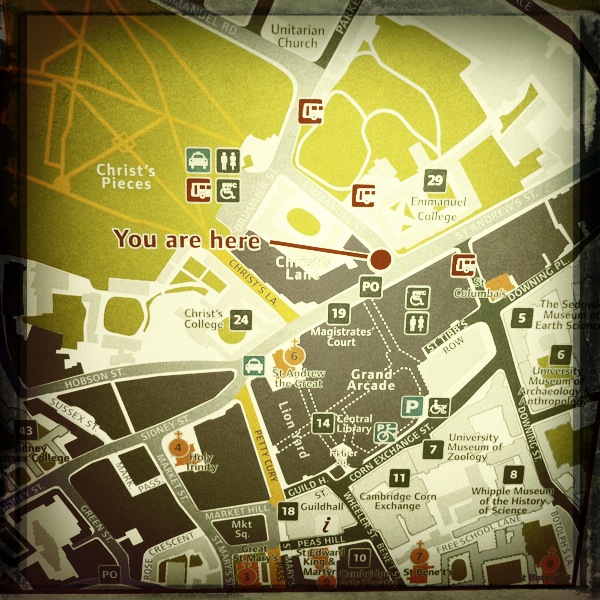
J’accuse lends itself to some experimentation for the greater glory of révù. A slide show using flickr that demonstrates both the beauty of hipstamatic shots and the maravilliouos setting of Cambridge (and a bit of toilets (don’t ask), London and food).
Feel Good Inc.
Part 1 – food
A holiday planned around a wedding in Cambridge was a great opportunity to really relax and switch off. While I could not really resist the temptation to hook onto WiFi and catch up on the news outside, I found the pull of the great town (its history, its food and its shops) to be a soothing palliative to the stress of recent months. Yep, J’accuse went on a sort of mental shut down while walking from college to college in the old University town.
Holiday also meant that the Dukan Diet got a deserved break that kicked off with pork scratching entrées at The Chophouse outside King’s College. They’re fabulous, especially dipped in an apple cider purée and washed down well with a Pinot Gris (we had to add a touch of Greater Luxembourg to the first meal). If you do get down to the Chophouse there is one desert that cannot be missed – the (gluten free) fruit crumble. Divinity on a plate.
I still get impressed at the sanitised manner in which food – packed food and food that screams “I’m both retro and healthy” – is approached in the UK. Places like PRET, EAT and the like line up salad after salad and take-away wraps confounding both stomach and mind as to the choice for the quick solution to accompany your adjective ridden coffee.
- The Anchor Pub
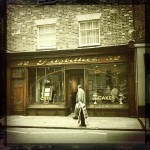
- Fitzbillie’s
- Bill’s
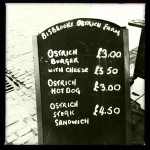
- Ostrich Burger Stand
- Sauces Light
Even the Crowne Plaza breakfast coffee is “proudly brewed by Starbucks” which means that your adventure to get the right cappuccino or espresso has to start from outside the haven of the otherwise magnificent breakfast table at the hotel. No worries – Cambridge does not even need to offer you a faux italian establishment for a good brew of the grain (vide Don Pasquale’s in the market square). Just pop over to Fitzbillie’s where your excellent espresso/capuccino/macchiato can be downed with a bite of the Chelsea buns that form the foundations of Fitzbillie’s growing reputation.
For good local food there are two solutions: a pub lunch is always a pleasant option – try the Anchor for example where you can sit back and enjoy the punters if like us you’ve found some clement weather. If you want to have the wankellectual solution then try the Eagle Pub (round the corner from the Chophouse) where Watson and Crick allegedly cracked the DNA idea. Better still nothing beats the marketplace for good food. I am told on a very good authority that the mouthwatering whiff of Ostrich Burgers that pervade the senses upon reaching market square do not lie. The burgers are phantasmagorically scrumptious.
If standing up to chew on a burger is not your style then do not miss out on Bill’s Cafe restaurant and Store. Tasty food homely decor and great service combine to give you an unforgettable dining experience (and moment of relaxation) amidst colourful surroundings. The hummous and halloumi sandwich is particularly exquisite – and you can walk out with a bill’s recipe book as well as some of their wonderful produce.
You can also walk out with a recipe book if you visit Jamie’s Italian. The design and decor is magnificent. The menu is brazenly simple and to the point. The food. Well. Nothing great there to be honest. Our waitress turned out to have worked at Sliema Pitch restaurant for two years before moving to Jamie’s in Cambridge. If I had to be perfectly honest the Angus Steak served at Sliema pitch is a hundred times better than the fare we got on the plate amidst the usual fuss of quaint presentations and “genuine” Italian at Jamie’s.
Cambrigde. Much more than a University town.
J’accuse : Apocalyptic
It’s the end of the world as we know it. Not really it isn’t. In relative terms it could be though. For the time being it’s probably best if we concentrate on the fact that the end of summer is nigh, though blessed as you are to be living on an island with a lovely climate, that kind of news might sound a little bit premature. What I really mean is that the general heavy feeling that comes with the end of summer is definitely here. It’s the end of the drunken stupor and the stolen moments of dolcefarniente. No more inhaling copious amounts of sea breezes with the only worry being the right choice of wine to go with the mixed shellfish.
The signs are all around us. The commercial motors are beginning to whirr into action after the pause mandated by the universal law which states that for a short time the only things a consumer desires is a BBQ set and a pair of flip-flops. “Back to school” offers flood the advertorials and office employees exchange stories about their summer vacation while showing off their tans. There’s all that − which is quite usual − and then there is more.
The agony of foreknowledge
It was an article in the UK Times by economics expert Anatole Kaletsky (“Take cover: a financial hurricane is blowing in”) that really made this weird feeling hit home. Kaletsky does a good job (of course) of describing how in periods of great financial crisis the worst months to look out for are September and October. He lists an incredible amount of historic financial fiascos and points out the fact that they all happen over these two ill-fated months. From Wall Street in 1929 through to the Lehman bankruptcy in 2009, a series of doomsday-like economic crises struck just as summer sailed out of sight and autumn fell into the equation.
Mine is no exercise in conspiratorial coincidences. It is not so much the pattern that is worrying as the signs that occurred throughout the soporific haze of a summer but that seem to have been ignored by all concerned. “All concerned” seemed to be sufficiently distracted by other bits of news but could not be bothered to look at a wider picture. Thank God for Anatole then. For starters I was reassured that I was not insane and that my worries (although fed from a position of relative economic ignorance) were justified.
Anatole listed four events that zoomed by us this summer: (1) the eurozone crisis (and German hesitation therewith); (2) the downgrading of US growth; (3) the collapse of confidence among US consumers; and (4) the confusing message from Ben Bernanke of the Federal Reserve as to whether he will try additional action to stimulate US growth. Yes, I got this list from Kaletsky’s article (available at a price on The Times online) and I probably would never have got the fourth point myself. What I did find reassuring was that someone somewhere outside the island at the centre of the universe seems to be sufficiently preoccupied about what he calls potential financial hurricanes coming our way.
Beyond their timid lying morality
It turns out (always in the gospel according to Anatole) that the financial hurricane’s force might be mitigated and turn out to be a false alarm. What is certain is that there is no harm in advocating both prudence and awareness given the fragility of the current economic climate. In fact, these normally come in a specific order: first there is awareness that leads to prudence. The problem we might have in this country is related mainly to awareness of what’s going on beyond our shores. Unless something apocalyptic happens to lift the veil and jolt us into reality our politicians tend to be blissfully ignorant and engaged in tremendous navel gazing.
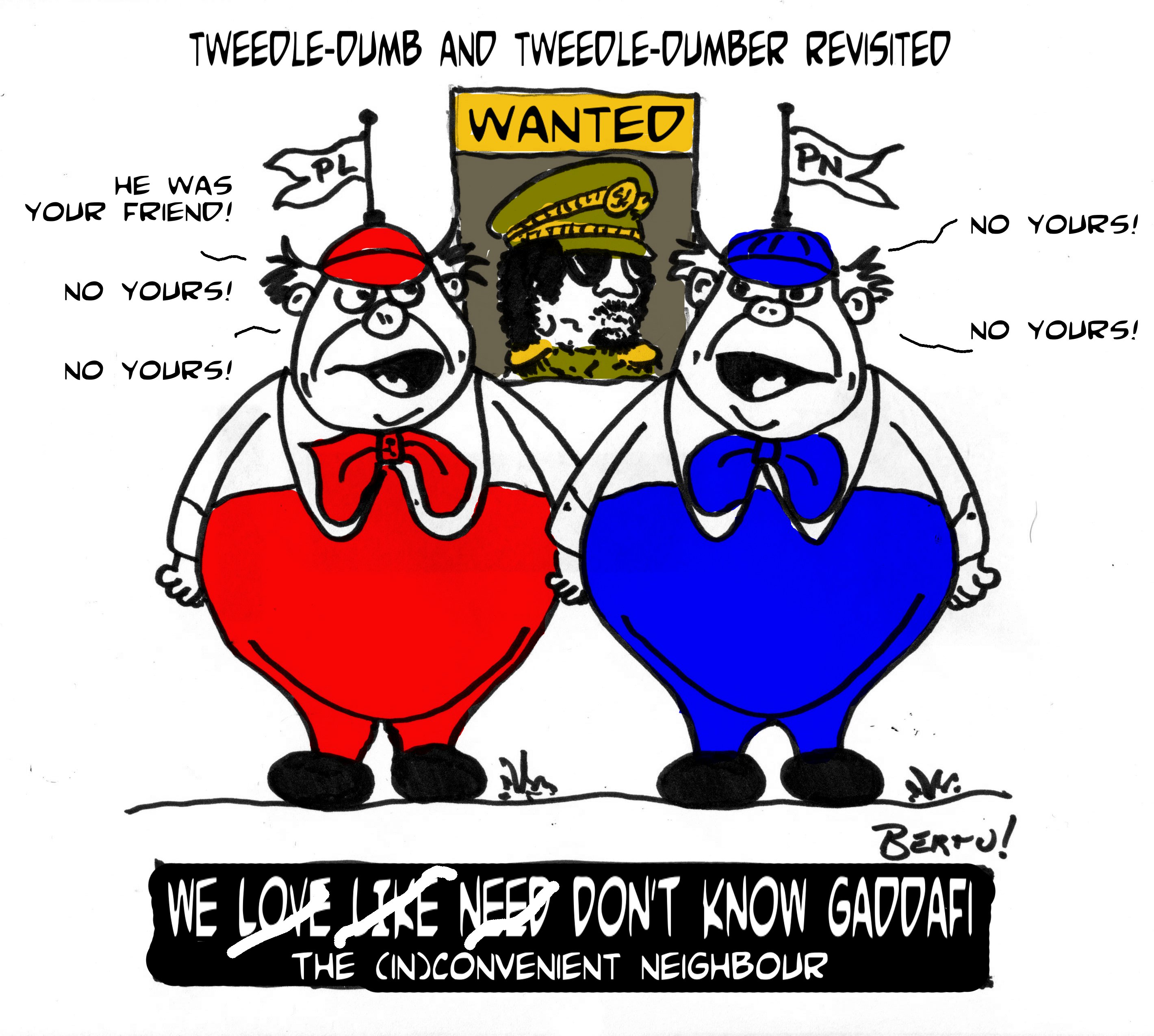
Need proof? Just look at the pot and kettle show (as James Debono so aptly put it) between the PN and PL with regard to Libya. Now that Gaddafi has shot down in the popularity ratings faster than Usain Bolt on a false start, it has become imperative for everyone and everything political on the island to wash their hands (and ever-present consciences) of any link with the Green Leader.
Lest I be misunderstood, let me be clear that I am not interested in the comparison game myself. If I were the sole and ultimate judge I would have no doubt in declaiming that Labour wins the “I Love Libya” contest by a barrow-load of points. By no stretch of the imagination can the uberfraternal relationship between Labour and Gaddafi’s Libya be compared to the dealings made by PN politicians or by the PN government over the 40 forty years.
The view at different levels does however provide different outcomes. Politicians on both sides of our poor political fence spun networks and webs with Gaddafi and his henchmen via ingratiation and friendly exchanges in order to get a foothold in the Libyan Business Circle. Blue or red was not so much the worry as the careless ignorance of how much of their “business” was obtained with the blood, sweat and tears of the Libyan people. Should the parties bear the responsibility for such individuals? Does realpolitik come into play? Well the good old J’accuse dictum about PLPN applies here: you reap what you sow.
Perhaps we are asking the wrong questions
Then there is the party level. People like myself only just missed the obligatory Arabic at school (by one year) but we grew up on a steady feed of “Green Propaganda” and developed a twisted Pavlovian response to all things Arab (an unfortunate mental default that was only eventually rectified through learning about the treasures, riches and beauty of a wider Arab world beyond Muammar’s Green Book). We automatically associate this surreal world of the Arab Oz with the Mintoffian era. Elsewhere, the PN hacks, delighting in unearthing Labour’s recent past of flirtations and love affairs with the Colonel, have documented this period well enough.
As a party, the PN has nothing as close as PL’s incestuous relationship with Gaddafi and his monetary support − I suspect that if foreign money had to come Pietà’s way it would be from some Stiftung or other in the heart of Christian-Democracy. Out of the 40 years of Gaddafi regime, there have been at least 20 years of PN government during which − as a commentator on my blog observed − the practice of realpolitik dictated that the government maintain friendly relations with the volatile neighbour.
Good point. Only, beyond the granting of honorary titles you do sense a veil of hypocrisy behind the pointed fingers. The last six months of hesitation by the PN government was sufficient proof of how convenient the “realpolitik” line really is. One cannot fail to mention the extreme misjudgement behind our Prime Minister’s last visit to Gaddafi with the fires of revolution already alight, or the caution with which the rebel government was treated for a long time.
Revelations
As the new season breaks in, J’accuse keeps the same message flying. Ask questions of your politicians. Question their promises. Look through their declared motives. Do not let them wait for the apocalypse, for the lifting of the veil, before they are shocked into action. Bring the apocalypse to them yourselves. As I’ve liked to repeat recently: ask the right questions. There’s a limit to how long they can keep up the pretence.
www.akkuza.com was in Cambridge this weekend for John’s wedding (congrats). The subtitles in today’s article are a nod to three great apocalyptic films: Twelve Monkeys, Apocalypse Now and The Matrix. Anatole Kaletsky’s article referred to here is available in the UK Times and was published on Wednesday this week. www.re-vu.org discussed stereotypes in our head this week.
Lunchbreak
Right now is the time of that gap in the time-space continuum when the General Box labelled “Summer” starts to shut slowly taking with it the smells of the sea, the sweaty brow of the aestival traveller and the dizzy dreams of dolcefarniente. At the same moment the musty smells of the humid “Autumn” box start to drift into the atmosphere – spreading like a cold virus at the break of September. It’s a general feeling of stasis before the momentum returns of “work as usual”.
The Times (UK) economic commentator Anatole Kaletsky had a great article referring to the seasonal changes in Wednesday’s edition (Take cover: A financial hurricane is blowing in – *paid subscription required). Kaletsky highlighted the fact that in moments of great financial depression, the worst period to look out for is the end of August – beginning of September period:
Almost all the great financial crises of history have occurred between late August and mid October: the Wall Street crash in September and October 1929, the collapse of the prewar gold standard in September 1931, the sterling devaluation of September 1949, the collapse of the postwar Bretton Woods currency system in August 1971, the Mexican default in August 1982, which triggered the Third World debt crisis, the stockmarket crash on Black Monday in October 1987, the break-up of the European exchange rate mechanism on Black Wednesday in September 1992, the Russian default in August 1998, the Lehman bankruptcy in September 2008 — the list goes on.
Kaletsky plugs into the general feeling of doom and gloom that your average news follower might be experiencing at this moment in history. You know that feeling don’t you – Death’s scythe all over the place, the misery of war, famine and pestilence coupled with stories of natural hurricanes and financial earthquakes. For heaven’s sake, I was reading the same issue of the Times yesterday and I had in mind to do some more honeymoon travel research after that. Sure enough, two (two I say) articles about honeymoons where disaster struck – sharing the same page. A man eaten by a shark and another couple run over by a car. And this was the Times mind you, not the Daily Mail.
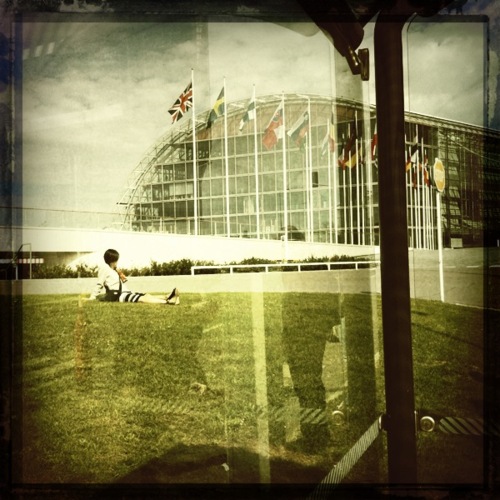
Doom and gloom or not, September has come rushing in closing what has been for the North of Europe the coldest summer in living memory. We might still be in time to witness the collapse of an economic system or at least feel the full brunt of the economic crisis. We might still witness more death and disaster before the month turns into October and drags to All Hallows Eve. September might be the time to appreciate the little moments of calm. Just like the lady I caught lounging on the grass on the bus stop behind the EIB (European Investment Bank).
The flags fluttering in the late summer breeze, the sun bearing down in a warmish afternoon and the relaxed fonctionnaire lapping up (or should I say stealing) the last of the summer rays. Forget the hurricanes for another day. It’s time for the galactic lunchbreak.
Carpe diem.
[learn_more caption=”photography”] Photo shot using Hipstamatic app on an iPhone 5. lens: Libatique 73 film: Cano Cafenol place: Kirchberg, Luxembourg (BEI Bus stop) date: 01.09.11 around lunchtime.[/learn_more]
Labour Loves Libya
George Vella, Malta’s possible future Foreign Minister has drawn his own conclusion about the best possible outcome that could result from the toppling of Gaddhafi. The Times online title says it all: “Libya can boom and ‘absorb’ immigrants“. Nothing wrong there really is there? I mean surely we cannot criticize George for hoping that Libya gets on its own two feet economically and thus act as a magnet to all potential North African emigrants. Let’s see how George put it (our highlights).
Libya could become an investment hub, “the Dubai of the Mediterranean”, and it could also capitalise on its white sandy beaches and crystal-clear waters to become a front-runner in the tourism industry, he said. Throwing into the mix its oil riches and small population density, if Libya opened to free trade it was bound to begin “absorbing” immigrants rather than remain a stepping stone into Europe, Dr Vella argued.
Right. I guess in the world of Realpolitik this is definitely much nicer and presentable than a plan to round up immigrants and send them back into the welcoming arms of deranged Colonel Gaddhafi (Gieh ir-Repubblika et al). When we remember Labour’s last pronouncement with regards to the Arab Spring though, it tends to bring out an unpleasant truth about the party that is suddenly become (at least according to some ) the bastion of Civil Liberties. Do we not remember Joseph Muscat’s gaffe that the troubles in North Africa might bring about an economic boost to Malta’s ailing tourism industry?
Joseph was busy holding an “Iftar” with the Muslim community so he might have missed George’s latest solution to Malta’s immigration woes. Pity. It would be good to know whether this reflects general Labour thinking or whether it is just a frijvowt issue – where opinions are like genitals… to each his own. Here is what Joseph said at the Iftar…
Dr Muscat said he expected that the PL would be criticised for its initiative to hold this ceremony, but this strengthened the party as an organisation which wanted to bring down barriers and believed in a society which respected everyone.
Respected everyone? Sure. So long as the dregs of the earth and the hapless immigrants find some other economy to drain. Who knows.. if Libya booms and absorbs well enough there might be no one to attend PL’s Iftar come a few years time… I wonder… would that be a bonus or a minus? Don’t ask me.
Ask George.
Or Joseph.
***
Addendum: other interesting George Vella observations:
- not too in favour of NATO (old habits die hard)
- Western countries had always been motivated by their own interests, including personal political interests and the economic interests of their countries. Malta, throughout history, also had to look after its interests, he said (Malta. L-ewwel u qabel kollox)
- “Malta did not choose its neighbour. Love or hate Gaddafi, we had to do business with him. No one ever agreed with his politics. We are democrats not dictators,” he said. All administrations had to remain close to the Gaddafi regime. (realpolitik revisited)
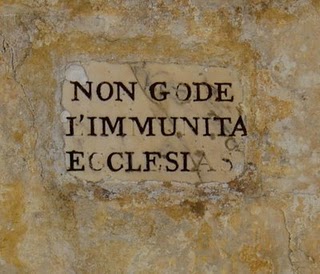
Immunità Ecclesiastica
Gode di Immunità
Debbie Schembri left a note on Facebook informing the world that she is happy to have been reinstated as a lawyer in the Ecclesiastical Tribunal. To people like myself, Schembri’s message is once again equivocal to say the least. I had high hopes that the likes of Schembri would survive the divorce debate to form a Civil Rights movement that would press on to reform our laws. One such important reform would be the divorce between Church and state matters − a marriage that has only harmed both parties since 1995.
Schembri had no obligation or duty to do any of this. It is disappointing to see the “bright star” of Maltese progressive politics melt into the establishment day after day. First there was no Civil Rights movement − Debbie preferred to join opportunist Labour; now there is no hurry to divorce Church from State − Debbie is quite happy to perform her duties as a church approved lawyer. Ah Tommasi di Lampedusa… how right you were.