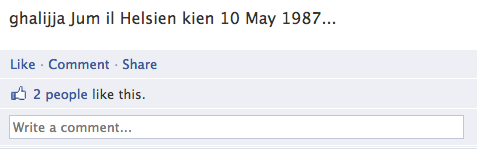
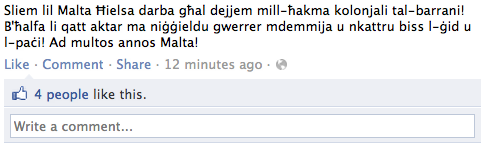
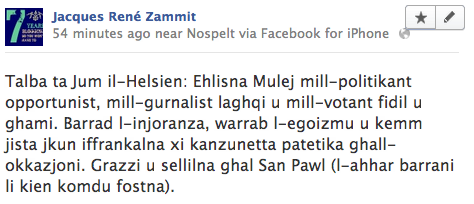
Tismagħom jitlewmu dwar festi nazzjonali u tibda taħseb u tehwden int ukoll bla ma trid.
Jgħidulek li qabel ma sirna indipendenti konna dejjem niddependu mill-barrani. Biex ksibna l-kostituzzjoni tas-64 konna xbajna telgħin u neżlin Londra nittalbu bis-sassla. U l-kolonjalist jitnejjek bina bejn bid-‘divide and rule’, bejn bil-‘language question’ bil-Malti lingwa tal-kċina u bejn bil-poteri tal-‘gvern’ Malti jingħataw u jittieħdu skond il-bżonn.
Meħud minn Facebook illum. Isem mistur.
Jgħidulek li sakemm ħadna r-repubblika fis-74 konna għadna Monarkija. Indipendenti iva imma b-wiċċ ir-Reġina tifkira ta’ passat servili ta’ ‘l fuq min 260 sena kolonjaliżmu.
Meħud minn Facebook illum. Isem mistur.
Jgħidulek li sakemm ma konniex aħna li ma ġeddidniex il-kuntratt mal-qawwa Ingliża (jew forsi ma ġeddewx huma), il-barrani kien għadu parti intrinsika fil-ħajja tagħna. Konna għadna niddependu fuqu u fuq l-infiq tiegħu. Għadna imwaħħlin maż-żejża. Jgħidulna li dakinhar ħadna rajjna f’idejna meta ħlisna mill-barrani. Dakinhar, jekk temminhom, il-Malti seta’ jibda jgħix u jkun hu biss responsabbli (u ħati) tan-nisġa tad-destin tiegħu.
Jgħidulek li mingħajr l-indipendenza, mingħajr ir-repubblika, mingħajr il-ħelsien ma konniex inkunu n-nazzjon jew ‘ġens’ li aħna. Kważi kważi iridu jiddefinixxu lil pajjiżna b’dawn it-tlett avvenimenti.
Jgħidulek dan kollu… imma allura qabel… ma konna xejn?
When author Immanuel Mifsud was last in Luxembourg he attended a Q&A session. Someone in the crowd began her question to the author with the phrase “I’ve never read any of your books but…”, I cringed and switched off after that. I had resolved not to talk about the “Dear Dom” movie until I got to actually see it – which I hopefully will this April if it’s still running after the 4th. This post is not about the movie itself but about reactions to the movie and was prompted by Yana Mintoff Bland’s comments to the Times.
In a nation that is defined with reference to “the other” where narratives are painted in dual tones and where national holidays are as divisive as ever it is hard to keep to the objective plot. The issue here is whether Pierre Ellul’s Dear Dom commits any injustice towards Dom Mintoff – the politician. By examining that issue you are also perforce obliged to tread the dangerous ground of puncturing “the Mintoff myth” – or the mythology that centres around the greater image of the man who can boast among his nicknames “Salvatur ta’ Malta” (Saviour of a nation).
From what I could gather from the blurbs and promos, Ellul’s work is a sort of letter addressed to the ageing leader that ends up becoming a carousel run through his political career. But what is Yana Mintoff Bland complaining about? Dom’s daughter is now a candidate for the Labour party in one of the districts where her dad’s myth continues to shine (notwithstanding the “traditur!” interlude). The heading of the Times article (Yana Mintoff: Family speaking to lawyers on Dear Dom film) leads one to presume that Mintoff’s family is preparing to sue Pierre Ellul (or Falkun) – at least most people do not “speak to lawyers” just for kicks.
I see two problems here. First of all Mintoff Bland’s grievances are with the bias that is apparently evident throughout the film. Mintoff Bland however seems to emphasise the character depiction of Mintoff as in his power-driven motivation as well as the idea that he is vengeful and angry. Interestingly there are very few allegations on the part of Mintoff Bland that are based on what would be a misrepresentation of facts. While she may not like the way Mintoff’s character and motivation is portrayed she has little to say about whatever facts are pictured in the movie. Whether a documentary’s judgement on somebody’s character could be subject to a challenge in the court of law is highly dubious.
There is another issue that is glaringly contradictory. On the one hand Mintoff Bland would argue that Mintoff Snr never got a chance to reply to Pierre Ellul’s letters and more importantly that he would have done so. On the other hand Mintoff Bland seems to be prepared to take legal action in the name of her father. Which would not make much sense unless her father was incapable of doing so himself.
These two issues lead me to conclude that the only reason Mintoff Bland is kicking up a fuss is to attract media attention and to appear the paladin defender of the myth that has been built around her father.
When I think back to the bio-flicks I have seen from “The Iron Lady” through “Invictus“, “Malcolm X” and “the King’s Speech” I realise that behind every politician there is a human with human traits. This humanity is defined through interaction with others and the producer of a bio-flick will inevitably set his or her angle or agenda or theme throughout the documentary. It is not to be judged as good or bad but rather with a measure that bears in mind that history and the documentation thereof is rarely, if ever objective.
You can read twenty books about the life of Fidel Castro and you are guaranteed to get twenty different versions. It’s not because it’s Castro. It could be Lenin, Kennedy, Mao, Jesus (hell, there’s not one official biography of J-dude but four – Matthew’s, Mark’s, Luke’s and John’s) or Gandhi. Paul Ellul’s movie should be taken for what it is – a perspective on the life and works of one of Malta’s noisiest politicians from the twentieth century.
Like Castro before him, Mintoff’s hard-headed reply could probably be implied without even watching the film…
It was already clear from the fact that no money votes are being taken in parliament. If we needed any confirmation then this came with the long Easter break that our elected underpaid representatives have taken. The length of this year’s parliamentary Easter recess is four weeks.
In the meantime and run up to this recess we have had the entertaining news coming from the reform committees set up in parliament in order to appease the renegade rebels turned reformers. Anything from constitutional law to bird-hunting becomes fair game (excuse the pun) for these sans-pareil legislators. Our collective political system, working in the twisted ways of which only it is capable, seems to have finally come to terms with the fact that reforms are needed. At least that is the first half of the message.
The second half brings us back to the same starting point much like the proverbial crab. Because while much parleying is being partaken of in parliament, nothing much will come out of the projects unless we will be witnessing a flurry of legislative initiatives at supersonic speed – always hoping that no other renegade majoritarian decides to rock the boat.
The opposition will complain about this but it is busily concerned with misinformation about spending cuts. This in itself is a taxing (excuse the second pun) exercise in contradictions. On the one hand the opposition has turned all its guns on the €40 million worth of expenditure cuts that the government must perforce perform while on the other that same opposition lets its imagination run wild with promises of the spending kind should it ever be relieved of its duties as eternal opposer.
As for the party in government (as distinct from the government) the whole kitchen business seems to be panning out quite unsatisfactorily. One wonders how long Simon Busuttil’s bland expression will entertain the many doubting Thomases who he set out to convert. You can only squeeze out so many half-hearted mea culpas from the nationalist fold and when you combine this fact with the menu of reality bites that Simon must explain to the masses by Pentecost (in as many languages as they can understand – thank God for the Holy Spirit) then the nationalist eggs surely cannot all lie in Busuttil’s basket.
What is really interesting is the relative silence of the usually noisy nationalist pundits and spin-machine. Aside from the various ministerial projects being rolled out in a hurry like an extended red carpet the nationalist machine remains relatively subdued. Even the blogosphere has felt the punch of this (controlled? concerted?) self-gagging exercise. Which leaves the Labour clones clucking in a cacophonous circus of empty noises and barks. Next chapter: poverty and “the precariat” (something to do with poor people or Saint George Preca, or both).
We are left with a couple of figolli to enjoy at the end of this period of fasting and self-denial. It’s also a time of reflection that should lead to the huge celebration with the return of the saviour. Only this time we are really left wondering…
Some smart alec at the European Commission decided that the best day to launch the European Citizen’s Initiative would be the first of April. As far as I know the April Fool tradition permeates most EU countries and if there are any which do not ‘celebrate’ it then they must surely have heard of it in being ‘celebrated’ in other countries.
The first of April is not a good idea to launch any kind of initiative and it is particularly inapt for the launching of an initiative that supposedly strengthens the democratic elements of an ailing European Union. So what is the ECI? If you follow the link provided earlier you will find out that the ECI opens up new possibilities for European citizens who could “force” the Commission’s hand into thinking about proposing new legislation.
Basically 7 EU citizens based in 7 different EU countries will be able to set up a committee (a “citizen’s committee”) that will then proceed to formulate a statement of intent and attempt to collect 1 million support signatures. The main obstacle (apart from getting the attention and support of 1 million EU citizens (electronically or on paper) is that the proposal must be in an area in which the Commission is already empowered to legislate.
It’s not easy. Organisations cannot technically form part of the citizen’s committee (so one would assume that pan-European organisations cannot suddenly become unique promoters of causes). On the other hand the initiative shows a lot of trust in electronic collection and promotion of the statements. Democracy does get to cross onto the net. Additionally the potential demos is increased – you do not have to be eligible to vote in your own country to take part in an ECI … you just have to be over 16.
A successful initiative that collects 1,000,000 signatures gets to be properly considered by the Commission and also gets the ear of the European Parliament. Furthermore the Commission, although not obliged to actually propose legislation, must provide a Communication addressing what it plans to do in response to the citizen’s initiative and must give reasons for every action or inaction.
The daunting size of the amount of signatures and the non-enforceability at the end of the tunnel must not discourage EU citizens. There are many positive signs in this new instrument – first among which is the acknowledgement of electronic democracy within the mechanisms of law making. Think ACTA – think how fast public support was whipped over the net. Does one million seem such a huge figure now?
Baby steps. I just wish they did not opt for the first of April for the launch.
David Cameron is in trouble. He has admitted to hosting dinners for major Tory donors at his private flat at Downing Street – against payment. Tory Chief fundraiser Peter Cruddas has had to resign in the wake of a scandal after he was filmed by undercover Sunday Times reporters “claiming that he could secure them an audience with the Prime Minister or Chancellor”. Access on offer depended on the size of the donations and he implied that the wish lists by donors could end up being considered in the “policy committee at No 10”.
This morning’s Tory position is that the party will refuse to name any donors who have already taken advantage of this “scheme”. The excuse being put out is that if there were any such dinners they were hosted within the private area of the PM’s flat in Downing Street and therefore the details pertaining to such events would also be private. Which is a load of bollocks. Put simply, if a donor paid anything up to £250,000 it was not to ogle at David and Samantha’s dinner set or sample their culinary intrepidity but rather because of the more appetizing possibilities of influencing public policy. Also David and Samantha do not live in Downing Street because one day they found a good bargain on the property market. They live in Downing Street because the British Prime Minister lives in a flat next door to his office. A flat funded by taxpayer’s money. Private my backside.
The problem here lies not with the idea of parties going round begging for money to keep their circus alive but obviously with the manner with which such monetary collection is performed. Back home Labour politicians have gone all misty eyed at the generosity apparently demonstrated by the man in the street as the PL managed to get its supporters to cough up a little less than the price of a “private dinner” at Downing Street in the course of a one day fund raising event. Evarist Bartolo went on that most public of records (facebook) to declaim that “one euro from a family is better than a million euros obtained from a contractor found on the Yellow Pages”.
Franco Debono has brought the issue of party fundraising to the forefront of Maltese politics, much to the chagrin of both behemoths in parliament who had opiated the population into a reluctant acceptance of the modus operandi. How though will we ever regulate party donations? Will not some rulebook thrown at the very custodians of our political framework fail spectacularly as the PLPN will proceed with their regular charades of “fund raising” where the anonymous benefactor (and purchaser of influence) mingles with the happy one euro families?
So what solution? Should we look across the Atlantic where dinners are openly thrown on a regular basis in order to support candidates? It’s not tombola parties or seven church visits with your local MP – that not so subtle excuse to justify electoral expenses. It’s more like gala dinners with €1,000 tickets per guest where the creme de la creme of societies lobbyists mingle with politicians and openly flirt with their affiliation. Yes, capitalist money has votes as much as your emancipated self. It either operates in the back corridors as your latest Cruddas auctions off the nation’s public policy to the highest bidder or operates in the open – where you can see who backs who and eventually might even choose to vote for the polticians who are clear about the allegiances who have curried their favour.
The fine link between the lobbyist’s influence and the politician’s decision will never be broken. What could be done is lift the veil of anonymity thus making the pacts clear and the giving the voter a clearer picture of the wider frame of the political horse-trading going on.
Will it work? Hang on to your money. I’m not taking any bets. Or donations.
Tonight between 4 and 6 a.m. the better half and I will be taking part in the Luxembourg Rally for Life (Relais pour la vie) that is being held to collect funds for cancer research as well as to express solidarity with persons who are concerned by the Big C. We were roped into this idea by a neighbour of ours who set up a team of her own to take part in the relay. It’s a twenty four hour walk/run at le Coque in Luxembourg – each participant will be doing one hour of his own. Lara will be the first at 4 a.m. and I will follow at 5. It’s a great feeling to be taking part in something so meaningful though the early hours of the day as well as the fact that I am absolutely not fit right now make it a little more daunting a task.
Here’s to the finish line…
For the Luxo based readers among you, there is the possibility to make an online donation here. That’s the Luxembourg Cancer Foundation. Cheers for the support.
This website stores cookies on your computer. These cookies are used to provide a more personalized experience and to track your whereabouts around our website in compliance with the European General Data Protection Regulation. If you decide to to opt-out of any future tracking, a cookie will be setup in your browser to remember this choice for one year.