J’accuse rarely ventures into the field of culinary blogging or, for that matter, of restaurant reviewing. We do drop a mention of a place that has tickled our senses every now and then but we very rarely sit down to blog simply to write poems and sing songs about one particular establishment. Well the time has come to do so and that is because this restaurant nestled in the heart of Sodom (aka Paceville) merits every bit of attention your eyes, your palate and your pocket can afford. This is not a restaurant review – we do not purport to be vested with that kind of expertise – this is a standing ovation that was virtually imposed by the delivery of good food in circumstances that exalt the importance of normality.
It goes without saying that Malta’s Best Restaurant (as per J’accuse) is based in Paceville. Sandwiched between on the one hand the shooter-shop clad steps that lead to the ex-O’Caseys (now a shisha bar of minimal furbishment) and on the other the ever popular Eden Cinemas that still enjoy the virtual monopoly of Hollywoodian vision on the islands is a lovely mainly fish restaurant that serves Italian inspired delicacies. The motto chosen by this establishment is “arte nel cibo” (art in food) and believe you me that art it is and food you will get.
If like me you hate the fancier side of eating out (and by fancy I mean the silver service rubbish with a waiter dedicated to topping your glass every time you dare sip out a few millilitres of the liquid) then fear not. At this restaurant you will get all the attention you deserve with the ubiquitous presence of a few ultra-efficient serveurs. Wine will be topped, chilled, decanted or whatever tickles your viticultural nerves without too much of that formal kow-towing that tends to transform a formal night out into some rigid masonic ritual.
La carte is simple without too much fluff. At the end of the day your choice is mind-blowingly basic – fresh fish or (if the creatures of the sea are not your idea of mmm) then chunks from beasts of the land are available in different forms therein to sink your teeth. Do listen to what the knowledgeable persons have to say about the specials of the day but if you are particularly curious to find out the best of what this kitchen has to offer then you will love the Menu Degustation – best ventured into in groups of 6+.
I will not describe the food itself nor the creations that I and my happy companions tasted on that particular night. I will only urge you to take a special evening out and head straight to Sciacca – for that is the establishment’s name. Sample the art that is all around you – from an unintrusive but pleasant decor to the simple delicacy of every morsel that is on offer. The only gripe I could find is the missing Gewurztraminer from the wine list – but that is a very personal gripe and peccadillo and the Australian Riesling was just fine in its stead.
So there you go. Head over to Sciacca today, or tomorrow, or as soon as you can. Trust me. It’s worth it.
Sciacca – arte nel cibo – is in Paceville, St. Julian’s.
Sitting around a table with a group of people reminescing times past is an experience that we have all gone through some time or another. I have fond memories of a parapett in Gozo that in its heyday served as a stopping point for many an ambler enjoying the summery nights of Marsalforn. Stories, rumours and recollections are part of any social fabric and their role is highlighted on a rock of a few kilometres squared inhabited by nigh half a million souls.
Among the stories that I picked up in my childhood I was always most fascinated by the accounts of the deeds and misdeeds of Mintoff and Mintoffianism. In post-war lore I believe you could equate the standard of this kind of story with that of the deeds of Arthur and his knights or those of Robin Hood and his merry band. Obviously there was less myth and much more fact in the accounts of Mintoffian errantry or socialist theft in the name of the poor, but the personal timbre and impression given by whoever took the baton of chief raconteur was just as manifest as it was inevitable.
Mintoff’s effect on the social, political and even physical lanscape of these islands is an indelible mark left by a trailblazing meteor that rose from the ashes of war torn Malta, blazed through the puberty of a nation in search of an identity and then erratically stuttered to a shaky stop in its twilight years. The Mintoffian stamp on Maltese society spans six decades and can hardly be reduced to a one hour overview.
Every step from the post-war rise within (and without) the ranks of Labour to the epic battles with the powers colonial and ecclesiastic would require contextual analysis based on a multidimensional perspective of the politician and his deeds. It is not a sense of partisan justice that underlies this requirement for rigorous analysis but a the historical paradigms of contextuality and clarity – as far as they could possibly be achieved.
Falkun Films have pulled off a magnificent feat of marketing by managing to tap into the vein of curious controversy that is the main selling point of any current affairs item in Malta. “Dear Dom” has hit the airwaves and the opinion columns in full force and the Maltese buzz is out doing what it does best – a concoction of summary exectutions, intransigent condemnations and unreserved plaudits delivered by a mixture of consenting viewers and disdained abstainers alike. In doing so, Falkun Films and Pierre Ellul proved one important point even before the cinema tickets were sold: Dom Mintoff is still hot stuff.
I wanted to reserve my judgement to when I witnessed what the movie had to offer with my own eyes and I finally got to see the film on Easter Sunday. A fitting date, many would opine, to see the return of the saviour before the eyes of his people. Waiting in the ante-chamber at the cinemas someone remarked that they could not fathom why some would choose not to watch the movie… “At least you could learn something”. That, I think is one of the main points here. Is “Dear Dom” a documentary? Does it have any educational value?
Or was “Dear Dom” after all the latest in a long line of attempts at destroying the hero-factor that the name Mintoff still carries on? Was the man worshipped by our Leader of Opposition (by his own admission) being dismantled in a new medium of local propaganda?
You do not need to sit through the full hour of Dear Dom to notice that there is nothing documentary-like about the movie. The monotonous narration reads like a long j’accuse from the beginning to an end (not this J’accuse). Intentions, motives and nefarious plans are imputed without missing a beat. What is missing is the facts that back the assertions. Sure, many sitting in the theatre – especially those who have brushed up their history lessons – would know the background to the interdett, the obsession with integration, the swing to separation from the UK, the control economy, the battle with the church and more.
I did ask myself however – what would someone who had never heard of Mintoff and his story make of this film? Not much I’m afraid. The film depends on a priori knowledge and relies strongly on preconceptions. It taps into the narrative that has been woven in the parapetti, the pjazez and the kitchens of the nation. You enter the cinema armed with your idea of Mintoff and walk out nodding or shaking your head – not because you have been given a theory based on historical investigation but because the film has touched upon those nerves that have been lying dormant for a while and you’ve risen to the provocation.
If you have none of those preconceptions you are probably still wondering who the interviewees are, you are probably asking more questions about the relationship between Mintoff and the Church, between Mintoff and the English, between Mintoff and the Nationalist party. You’re probably dying to find out what makes the torch of Mintoffianism still burn to this day and why his many followers are reluctant to shed his heritage.
The magnificent and purposely charged typographic shifts from one scene to the next will have done little to satisfy your justifiable curiousity and the motley band of interviewees might only have served to give you a tiny fraction of the impact of Dom on Maltese lives and Maltese life. Artistically I would dare say that Dear Dom is an emotionally charged “skizz” or “makkjetta“. In sharp contrast to the documentary portrait that one expects but that it is not, “Dear Dom” is a cross between a caricature, a parody and a picassian esquisse that has evident limits in both time and space.
Which is why J’accuse firmly believes that the film is a must watch. It is a must watch because we need this kind of provocation. It is a must watch because if it is true that we shy away from controversy and from dealing with our heroes (maybe thanks to the censors in our head) then any start is a good start. It is a must watch because notwithstanding the shortcomings and failings on a historical level therein lies a wealth of visual retro-porn that is awaiting the history fetishist.
I must admit that I sighed with that twisted sense of oxymoronic nostalgia for an era that I hope will never return when I saw the rows of Sanga (or was it Soldini) shoes in a factory. The short tourism ads and clips that were sampled included such wonders as the old Hilton and Gozo’s Hotel Calypso. The library of reels picturing Mintoff in various negotiating moments are also a jewel that should be preserved – hopefully for a deeper, longer and more purposive analysis that is waiting to be made.
Dear Dom is not and could never be the only source of the controversy that has dominated the scene over the Easter break. Yana Mintoff will secretly see the movie as a godsend as it has given her some popularity (notoriety?) points and drawn the media to an otherwise bland latecoming hopeful to the political scene. The naysayers who wouldn’t watch the film (and still judged it) proved that the controversy has nothing to do with any movie or its content but simply with the fact (and probably the fear) that the man elevated to hero status was being brought back into the limelight. The fact remains – Mintoff and all things Mintoffian is a recipe for controversy… even in 2012.
A recently uploaded episode of “kwartakollox” on youtube dealt with Mintoff and seemed to have kicked off on a much better track than the Dear Dom movie – ironically it took a quarter of the time. Dear Dom got much more attention than a one hour edited series of clips and photos with a voiceover plus some great typography deserved. Had it not made it to the cinemas and had there not been any well timed marketing leading to controversy it would not have caused such a stir among those who might have got down to watching it.
Rather than binning Dear Dom we can only hope that more effort is put into this kind of production. More effort could bring more perspectives, more angles and more history being put under the lens. Our young nation needs this kind of effort. So do the artists and historians who have for too long been operating under a system of self-imposed censorship.
And after that? Well, after that… the world goes on.
I found myself wondering recently where, when and how the Easter Bunny and Easter Eggs got into the traditional celebrations of Easter.
Easter
Well, believe it or not we’re entering pagan territory here – long before the Catholic monopoly on all things paschal. The word Easter or Ēostre is derived from the name of an Anglo-Saxon goddess who was celebrated through the month of April. Pasqua or paschalis is the Latin name for the passover – a Jewish feast harking back to the times of the Hebrew enslavement in Egypt and their liberation by Charlton Heston. The actual dates for Easter were set in the Catholic religion in AD 325. In Nicea they established that the feast should fall on the Sunday following the paschal full moon, which is the full moon that falls on or after the vernal (spring) equinox.
It’s the rites of spring in full swing. Whether it’s Eostre or the paschal full moon, there is no doubt that the religious rituals are guaranteed to be celebrated as they have been from the dawn of time – a celebration of the beginning of the season of Spring – a season associated with life, birth and the renewal of the circle of life. In the Christian religion the main potent symbol is that of Christ defeating death through resurrection with the concurrent ideas of redemption. Easter Sunday is the time for the triumph over death as the Christ Resurrected is carried aloft running through the streets in a frenzy of happiness.
It was curious to see the initiative to replay the passion of Christ out in the open within the temples at Mnajdra. I don’t know whether it was intentional or whether the irony was lost on the participants (markbiwwa did not miss that one) but Mnajdra would in all probability have een used in religious rituals celebrating the arrival of spring many many thousand moons before the birth and death of the Christian saviour. Back in Luxembourg the ancient ritual of burning pyres of wood to celebrate the end of winter is still performed (it was on about a month ago) only that they have taken to burning a crucifix on top of the pyre, what with Luxembourg being a deeply religious country. Another instance of religious stepping in to eclipse the profane?
What about the Easter Bunny and Egg then? Where do they come in? Well it turns out it is rather simple after all. Bunnies and Eggs both represent the same thing – fertility. We all know what the rabbit is and though it itself is not oviparous it is evident why it would be chosen as a symbol of copious reproduction. As for the egg – what can I say – it is the epitome of symbols for potential of birth.
Birth
Yes. No matter what culture and where in the world, humanity has always celebrated spring and life. It is within our nature and instinct as a sentient being to not only celebrate our existence but also the preservation of our species via its reproduction. The Catholic Churhc – as from 325 AD – could not ignore this urge to celebrate life and had no choice but to place the feast of its saviour’s resurrection bang in the middle of what had always been the period of such celebration in other cultures.
Which is why the Bishop of Gozo’s attack on IVF and the hope it brings to hundreds of thousands of couples worldwide is either a purposely ill-timed approach or an extraordinary demonstration of crass insensitivity. There is no other way to react to this kind of statement y even the most conservative among the Good Shepherd’s flock than with sincere disbelief. In a time when we are supposed to celebrate the victory of life over death of the productive over the barren and of providence instead of the bare we are wrongly directed at killing the supposed wolves among the flock whose sin is that of bringing the same hope as that shared by Sara and Abraham until the arrival of Isaac. You get the feeling that even in the reading of texts that are sacred to them there is an intentional misogyny that underlies the basic thinking – going against all natural instincts and inspirations.
Fields
Malta is beautiful at this time. I spend Good Friday in what us ignorant people call “the south”. Ghar Lapsi was idyllic and Rita’s retro service was legendary (I’d have stuck to the pyrex plates though). Driving through the back roads leading to Zejtun and detouring through Birzebbuga and Marsacala you get to appreciate the natural beauties that this island has to offer while also getting to sadly see how mistaken many a man can be when he tries to interpret what could look good and be added on to the landscape.
Life. It’s a long stretch of time (hopefully) on this world that is pregnant with choices. It’s good to remember every now and then that we are not a small and beautiful snowflake.
One of the books I’m reading deals with the issue that we were talking about on this blog yesterday (“Thrifty with facts”). “The Price of Everything” by Eduardo Porter is an interesting study into the “true cost of living” and attempts to give an interesting perspective on otherwise mundane facts. My original post had been triggered by the fact that Maltastar deemed it fit to compare average wages in Luxembourg and Malta ostensibly because the evident gap would mean that the Maltese and only the Maltese have it worse off all round.
One of Porter’s chapters deals with how firms selling goods operate on the market in such a manner as to obviate the possibilities of the consumer to purchase comparatively. In other words, firms will go through great lengths to ensure that the consumer is not in a position to compare the price of their products with those of their competitors. We see this when a price is camouflaged under a pile of add-ons, bonuses, offers etc. Another of Porter’s interesting observations is that different brackets of the population have different shopping habits for different reasons. High wage earners give less value to the time spent comparing prices and tend to shop off the cuff while low wage earners are prepared to invest time in order to get the bargain.
Studies (I know that vague term is ugly but give it a chance) have shown that the same product might sell for very different prices depending on the customer involved. I do not need to believe some obscure study. SATURN, an electronics goods operating in Luxembourg has proven to be quite a good example of this practice over the past few months. I have noticed that anything from headphones to in-car hands-free sets can vary in price depending on whether you opt to shop at Saturn in the city-centre (Gare area) or whether you drive to Esch-Belval (20 minutes highway).
It’s not just electronic goods either. Malta has now got Lidl as a household name. Luxembourg too has its different tiers – from ALDI (think lidl but cheaper – yes, cheaper) to Delhaize via Cora, Cactus and Auchan (that’s Pavi in Malta) you would have to command a panoply of comparative programs in order to get your really thrifty shopping list.
Am I making a point here? Well yes. It might be worth reflecting that when we speak of Malta’s consumers we are not talking of one homogenous block. Times may have changed from when Mintoff’s budget was eagerly awaited in order to know the going rate for the next year for a can of sardines but that does not mean that consumers are not still a varied bunch that are daily tackling the traps and offers of a myriad of shopping establishments.
One instant in the movie the Iron Lady struck me (or was it “The Road to Finchley”). Thatcher knew the price of butter in the stores (she was after all a grocer’s daughter) but her fellow politicians did not. I wonder whether some intrepid reporter could cold question Lawrence Gonzi and Joseph Muscat and find out whether they know the going rate for a carton of milk or butter (even if it’s the fake kind). Before our politicians can fan the flames of discontent with regard to the cost of living they would do well to show a little more understanding of the situation.
Is there open competition in Malta? Are your Pavi’s and Arkadia’s and Smart’s providing a range of prices that might be beneficial to the consumer? That too must be taken into account. Before we look outside our shores and focus on how much money is ending up in other people’s pockets it would be interesting to know who is spending what and where with the money that ends up in our own.
Feedback is welcome. Meanwhile here is an excerpt from the Porter book.
According to a study of Denver shoppers families that make more than 70,000 dollars a year pay 5 per cent more for the same set of goods than families making less than 30,000 dollars. Singles without children pay 10 per cent less than families with five members or more. Families headed by people in their early forties pay up to 8 per cent more than those in their early twenties or late sixties. Retirees are much more careful shoppers than middle-aged people. They search dutifully for the best deal and end up paying nearly the same amount for the same product. People in middle-age, by contrast, buy more carelessly. The prices they pay are all over the map.
Thanks to an Evarist Bartolo link on facebook I came across this article on Maltastar that compares the wages between Malta and Luxembourg taking data from a recent survey based on “average wages” and the Purchasing Power Parity. While it is interesting to look at figures consisting solely of wages as averaged out in relation to how they could be spent in the US it is obvious that a peek at the utility of that same wage in the country where it is earned would give a less skewed picture.
So while Maltastar is busy comparing Malta’s average wage of 1,808 dollars per month to Luxembourg’s whopping 4,089 dollars (top of the world) per month it would do well to look out for other stuff such as the actual cost of living in those countries.
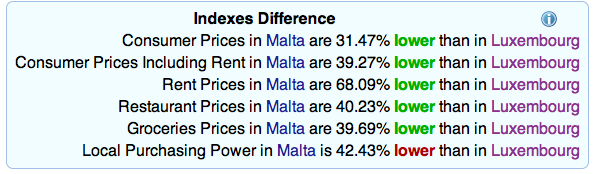
I could not find Luxembourg or Malta on the famous Economist Big Mac Index that is based on the One Price comparison for good. I don’t frequent McD mainly because of my allergy to gluten so I would not know the prices myself. I did found this site called numbeo however that does a cool comparison thingy between states. Sure enough I confirmed what I was suspecting and here are the facts for your perusal.
Just for the sake of perspective look at the rental costs for a 1 bedroom apartment – Luxembourg average is 950€ per month while Malta is 350€. As for buying property in Luxembourg compare the 5500€ price per square metre to Malta’s 2500 €.
This is not to say that Malta’s salaries are great or that prices cannot be more competitive but rather to point out that sticking to comparing wages is deceptive and intentionally portrays a fraction of the picture. Just to give you an idea of how relative the issue is, some unions of the EU fonctionnaires based in Luxembourg have been complaining that the salaries for Luxembourg workers are equal to those based in Belgium even though the cost of living in Luxembourg is much higher.
As in the case of the gas price hike J’accuse’s point is that rather than selective charts to fuel the discontent of the voter what we really need to see is what the political parties gearing up for next election are offering on their programmes so that we may be able to assess if any part of it includes – oh hope – solutions or at least attempts at solutions.
And by the way Varist, the guys at Maltastar COULD make an effort rather than cut and paste Ruth Alexander’s article from the BBC site. Next time you decide to cut and paste you should not leave out this damning assessment on the reliability of the figures:
In truth, the economists at the ILO have had to rely on very patchy statistics. Data is missing for some countries – even a country as large as Nigeria, for example. And also, the economists at the ILO are only counting wage earners.
They exclude huge numbers of people who appear in the poverty statistics but not in the calculations for the average wage – pensioners, children and stay-at-home parents, for example, and even the self-employed.
The number of self-employed is huge. In developed countries about 90% of working people are paid employees, but that figure is lower in many developing countries. For example, in South Asia, where many people are self employed or independent farmers, just 25% of workers are salaried.
The conclusion drawn by Ruth Alexander in her article must not have made for comfortable reading at Maltastar because it defeats the very (loose) point they were trying to make. Maltastar’s selective reporting (cutting and pasting) centred on comparing Malta’s wages with the best in the world. In truth the report concludes that ” that the worldwide level of economic development is in fact still pretty low, in spite of the huge affluence that we see in some places.”
Essentially an uncomfortable truth that the economic pains that are being suffered in Malta are (unfortunately) a symptom of a “worldwide level of economic development”. Sadly for Maltastar and Varist, it’s not GonziPN who is to blame.
The 6c price hike in fuel announced by Enemalta and effective today risked being a very nasty April Fools joke. Apparently it wasn’t. Fuel prices will go up in Malta, much as they are doing in the rest of Europe and the world. Only in Malta though will the blame be lain squarely at the feet of GOnZiPN. A quick run through facebook yesterday gave me a concerted effort from Labour MP’s and apparatchiks all complaining that Gonzi is adding on to the misery suffered by the Maltese families.
It’s useless arguing with a Labour diehard who is desperate to blame Gonzi for anything. Apparently Gonzi waited for the local council elections to be over before announcing the price hike. Sure. So did David Cameron, Jean-Claude Junker, Angela Merkel and the rest of the European leaders. Not to mention Barack Obama in the US. Can you picture Cameron sitting patiently waiting for the last results from the San Lawrenz count to peter out before making his move on the cost of fuel in British petrol pumps?
“Are the Saint Lawrence results in yet George? Can you be so kind and ask Cruddas to get another bottle of that Moet while we’re waiting'” Meanwhile, in the real world here’s an Essentiel article from Luxembourg explaining why the price of fuel is going up everywhere: “Porquoi l’essence flambe en Europe?“. See Edward Zammit Lewis, Chris Cardona, Evarist Bartolo? I am not motivated by a penchant at defending the current government, I am just intrigued by what Labour is proposing to do in the same circumstances.
Will Joseph Muscat give us the wild promise of subsidised petrol? Do his Labour fanatics know that voting for a government that subsidises fuel means voting for a government that will have to find a way to pinch the money for that subsidy from their pockets? Of course they don’t. Or if they do become aware of that then they will let loose with a volley of non sequiturs starting with “Mela Sant kellu ragun bl-Isvizzera fil-Mediterran”. Blind fools. The lot of them.
Luxembourg has just reached a record high price for fuel. In Britain a threatened strike by petrol pump owners led the general public to become brutally aware about the importance of alternative modes of transport. To us at J’accuse the brutal truth that is exposed by the price hike in fuel is the actual relative cost of the botched attempt to reform public transport with the Delia-Gatt Arriva Plans. In times like these your car becomes a luxury to be used sparingly. Buses become popular if their service is efficient. In Wallonia – the French-speaking part of Belgium, recent figures suggest a doubling of the public service commuters (mainly buses). From 200,000 to 400,000 users in one year.
A smart opposition would put its finger on the real problem. Now, more than ever a proper and fully functional transport system is needed. Incentives from workplaces for employees to use buses would help – a workcard that covers the bus trips for example. Of course you cannot have buses running late or running never. But opposition is not about being smart. It’s about stoking the flames of anger and relying on the cheaply available fuel of blind faith.
This website stores cookies on your computer. These cookies are used to provide a more personalized experience and to track your whereabouts around our website in compliance with the European General Data Protection Regulation. If you decide to to opt-out of any future tracking, a cookie will be setup in your browser to remember this choice for one year.