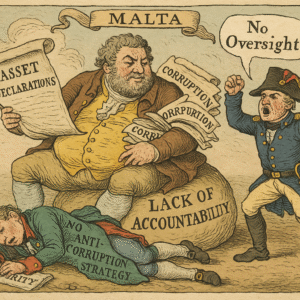
Malta’s latest GRECO compliance report again highlights systemic failures in three core areas: integrity standards for persons holding top executive functions, an effective and transparent asset-declaration regime, and the absence of a comprehensive anti-corruption strategy. GRECO’s conclusion is blunt: Malta remains in a state of insufficient compliance, with several recommendations untouched and others only partially implemented. These gaps concern the very mechanisms meant to prevent undue influence, conflicts of interest, and the misuse of public office.
The deficiencies identified by GRECO have gained renewed relevance in light of the recent scandal involving the Minister for Affordable Housing, whose unexplained personal financial arrangements and opaque dealings have raised serious questions about ethical conduct at ministerial level. In any functional integrity system, such a case would automatically trigger institutional scrutiny – but Malta’s framework remains either ineffective or deliberately under-used. This weakness is compounded by the Prime Minister’s continued refusal to publish Cabinet ministers’ asset declarations, despite years of external pressure. Without accessible declarations, there is no public or institutional ability to verify conflicts, enrichment during office, or improper benefits. GRECO has repeatedly stressed that transparency cannot exist where declarations are either incomplete, unverified, or withheld entirely. The government’s ongoing resistance transforms what should be a basic safeguard into an empty formality.
These failures collectively create an accountability vacuum. The absence of a binding anti-corruption strategy means there is no coherent framework setting out risks, sanctions, preventive measures, or oversight responsibilities. Weak or hidden asset declarations deprive journalists, civil society, and Parliament of the information necessary to detect conflicts of interest or illicit gains. The lack of integrity rules for persons at the apex of government leaves wide discretion with minimal scrutiny. The combined result is an environment where abuse is not merely possible but structurally facilitated, and where wrongdoing can remain undetected until exposed by coincidence rather than institutional design.
In the broader context of EU law, this trajectory raises serious concerns under the non-regression principle articulated by the Court of Justice in Repubblika. The Court held that Member States may not backslide on rule-of-law standards essential to maintaining judicial independence, good governance, and effective enforcement of EU law. By allowing its integrity framework to stagnate – and in key respects regress – Malta risks falling below the minimum constitutional safeguards expected of an EU Member State. The persistent refusal to strengthen transparency, regulate conflicts of interest, and implement anti-corruption structures may therefore be understood not merely as a domestic governance issue, but as a potential breach of the EU’s foundational requirements, undermining mutual trust and the proper functioning of the Union’s legal order.
