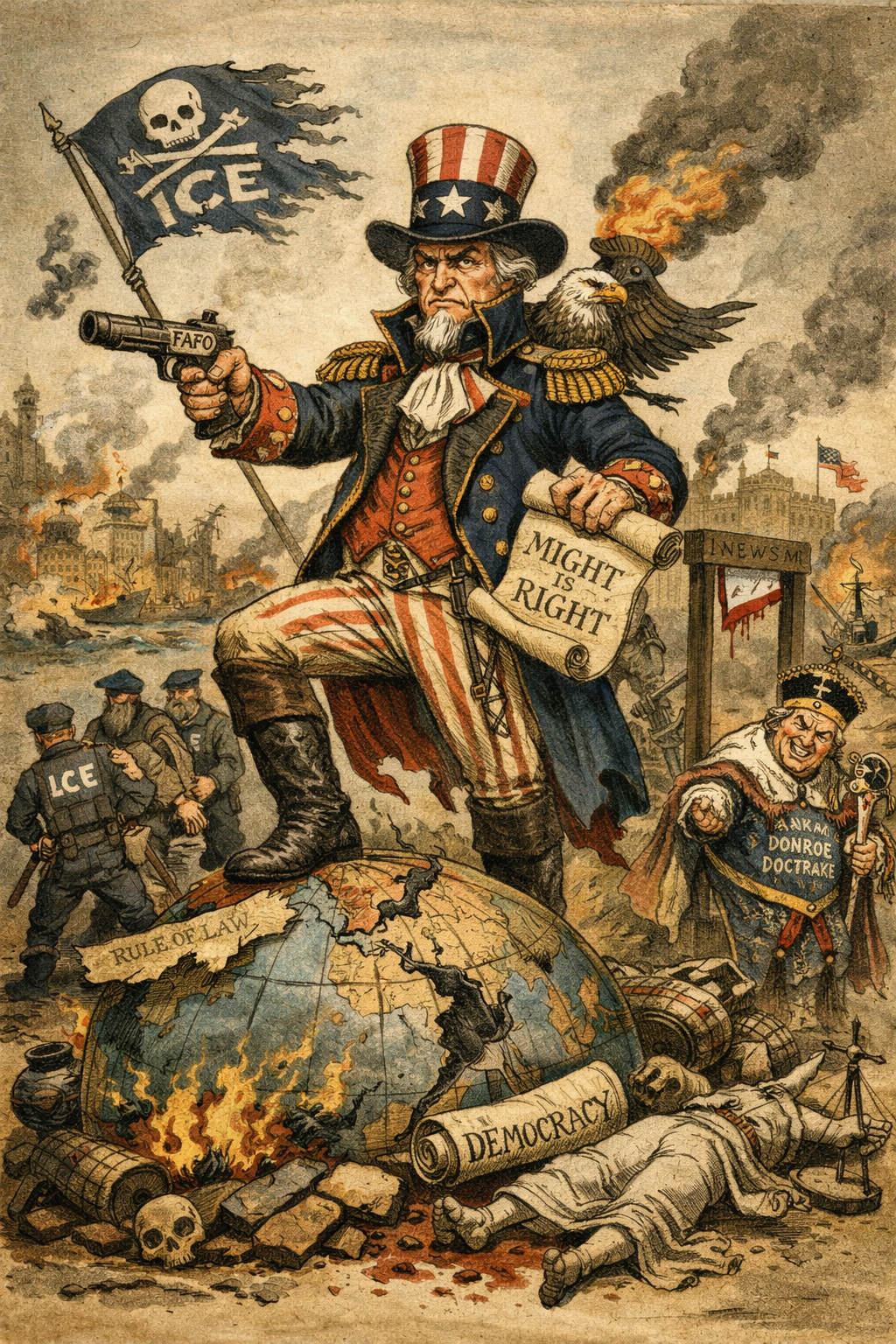
From Iraq to Kabul and from foreign battlefields to American streets the United States has drifted from law to force. This post traces how post Cold War hubris 9/11 trauma and Trump era doctrines have hollowed out the rule based order leaving the free world leaderless and at risk.
Three and a half decades after the end of the Cold War the United States has undergone a profound and troubling transformation in its posture toward international law the world order and even the trust of its own citizens. What was once a superpower championing a “rules based order” has shifted toward a posture that increasingly looks like raw authority cloaked in legal pretexts and bolstered by domestic political narratives. To understand where the United States finds itself in 2026 we must trace the arc from the 1990s to the present and confront the unsettling reality that the nation’s commitment to the law both abroad and at home has been steadily eroding.
In the 1990s the US intervened militarily in Iraq in ways that foreshadowed the long twilight struggle that would define the early years of the twenty first century. The 1991 Gulf War had broad international support under United Nations auspices yet even then the US demonstrated it would act unilaterally when it chose to maintain no fly zones over Iraqi airspace without a fresh Security Council mandate. That decision planted seeds of resentment in the Middle East and exposed the limits of a legalistic framework when convenient interpretations replaced clear legal legitimacy. These policies contributed in part to the environment that produced the attacks on September 11 2001.
9/11 was a national trauma of unparalleled intensity and the Bush Administration’s response was swift and total. The decision to invade Afghanistan was easily reconcilable with international law in its initial hunt for those responsible for the attacks. Yet as the campaign in Afghanistan expanded and then as the 2003 invasion of Iraq unfolded with no new charge of direct responsibility for 9/11 the US drifted from self-defence into a broader assertion of pre-emptive authority. The legal basis for that second war was thin at best and the human cost profound.
Once in Iraq and later in Afghanistan the US found itself on the defensive not only against militant groups but against its own strategic overreach. Two decades of war showed that technological superiority could not substitute for political legitimacy or for a coherent vision of peace and security. International law was invoked when convenient and ignored when inconvenient. The result was the paradox of spending trillions of dollars in theatre while undermining the very principles the US claimed to defend.
The tenure of the Trump Administration marked a distinct turn. By the second term of Donald Trump the foreign policy ethos had moved away from even a pretense of multilateral engagement toward doctrines that can only be described as transactional and cynical. The “Donroe Doctrine” and its associated FAFO (“Fuck Around Find Out”) mentality captured an approach that privileged unpredictability and raw force over diplomacy and restraint. These are not academic labels but real strategic departures from established norms. They represent a United States that sees international law as optional and views force projection as a tool of domestic political signaling as much as strategic necessity.
Domestically this trend has metastasised. The fatal shooting of Renee Nicole Good by an Immigration and Customs Enforcement (ICE) agent in Minneapolis in early January 2026 is a stark symbol of how far the national discourse and practice of force have shifted. Good a 37-year-old American citizen was shot and killed during a federal immigration operation an incident that has ignited protests and intensified scrutiny of federal law enforcement. Video released from multiple angles shows conflicting narratives about whether she posed an imminent danger when she was shot as she attempted to drive her vehicle away from the scene. Federal authorities including the President and the Secretary of Homeland Security have labelled her actions as “domestic terrorism” a claim sharply contested by local officials and protesters. The FBI has assumed exclusive control of the investigation limiting access by state investigators and deepening distrust of federal motives. Thousands have taken to the streets not only in Minneapolis but in other cities nationwide demanding accountability and transparency.
This episode is striking not merely because a federal agent killed an American citizen but because of the public rhetoric deployed to defend and justify it. The swift adoption of a narrative that frames a civilian as a terrorist without presenting clear evidence reflects a broader shift in official newspeak. It mirrors the way the government rationalizes actions abroad without transparent legal justification. It reflects a political culture where force is valorized and skepticism of official lines is labelled subversive. In this context the law becomes a malleable instrument rather than a constraint on power.
Critics argue that what we are witnessing is not merely a backsliding but a descent into an authoritarian mindset. When federal power is deployed against citizens with scant accountability and when official narratives dismiss contrary evidence the line between law enforcement and political performance blurs. The Minnesota shooting is not an isolated incident it is the culmination of a trend in which the United States increasingly subordinates the rule of law to the imperatives of political survival and dominance. The consequences extend beyond American borders because when the self proclaimed leader of the free world abandons its legal moorings it signals to other powers that might makes right and that international commitments are disposable.
The upcoming midterm elections thus represent more than a routine contest for seats in Congress. They are a referendum on whether the United States will reclaim its commitment to the rule of law or continue down a path where law is trumped by might and messaging. The choices voters make will not only shape domestic policy but inform global perceptions of American leadership. The world is watching as once again the United States stands at a crossroads between its ideals and its instincts for unilateral action.
The Cold War ended with the promise that the rule of law would anchor the international order. Yet what has emerged in the decades since is a United States that increasingly treats legal norms as flexible depending on the audience and the agenda. From no fly zones to 9/11 interventions from the battlefields of Iraq and Afghanistan to the streets of Minneapolis the arc of American power reveals a profound ambivalence toward the law that once defined its leadership. The question now is whether the next chapter will be a renewal of those principles or further surrender to the ICE age of force devoid of the legal and moral framework that once justified them.
