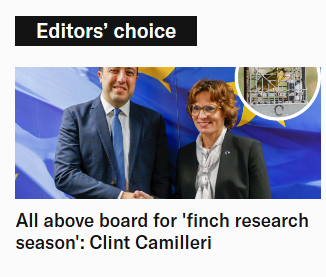
The Times of Malta recently reported that Minister Clint Camilleri met the European Environment Commissioner to discuss Malta’s latest “finch research” season. The article’s headline — “All above board for finch research season” — suggests that Brussels has given Malta’s new trapping rules a clean bill of health. Yet on closer reading, there is no indication that the European Commission confirmed any such thing.
The piece simply recounts the Minister’s visit and his own assertions that Malta’s revised framework now complies with EU law and with last year’s Court of Justice judgment that struck down the previous derogation. Nowhere does it cite a statement from the Commissioner or the Commission affirming that the new rules are indeed in line with EU requirements. The most that can be said is that the Commissioner “welcomed dialogue” — a standard diplomatic courtesy that should not be mistaken for approval.
This matters. Malta’s record in the field of hunting and trapping is one of chronic friction with the EU’s environmental acquis. For years, governments have skirted or stretched the limits of the Birds Directive, invoking “research” or “tradition” to justify practices the Court has repeatedly condemned. Each time, reassurances are offered that “Brussels understands” or “the Commission agrees,” and each time the facts tell a different story once legal scrutiny sets in.
Until the Commission itself publicly confirms that Malta’s new system satisfies the Court’s judgment and the Directive’s strict conditions, it is premature — and misleading — to claim compliance. A meeting in Brussels does not change legal reality; it changes optics. The real test will come when the Commission assesses Malta’s measures on their merits, not on the strength of a press release or a photo opportunity.
Malta’s relationship with EU environmental rules has long been erratic. One can only hope that this time, conformity will be measured by law and science, not by wishful interpretation.
The Times of Malta article would have served the public better by highlighting the gap between ministerial assertions and legally binding validation, rather than implicitly treating the meeting as de facto endorsement.
