Long before it was cast in bronze and made to carry emperors, the horse was already present in art as force, movement, and instinct. From the caves to the triumphal squares of Europe, it has endured as one of the most charged figures in visual culture. But something happens when the horse enters the monumental tradition. It is no longer simply itself. It becomes a vehicle for power.
The logic is familiar. In works like the Equestrian Statue of Marcus Aurelius, or later Renaissance condottieri, the rider claims authority by mastering the animal beneath him. The horse is elevated, but only to elevate someone else. Its energy is frozen, its wildness disciplined into a symbol of control. Monumental equestrian sculpture tells a very old story. Power presents itself as natural, inevitable, almost serene.
And yet the horse never fully submits. There is always tension in the form, a sense that what is being contained could just as easily break free. That ambiguity is what has kept the horse alive in art long after the empires that appropriated it have faded.
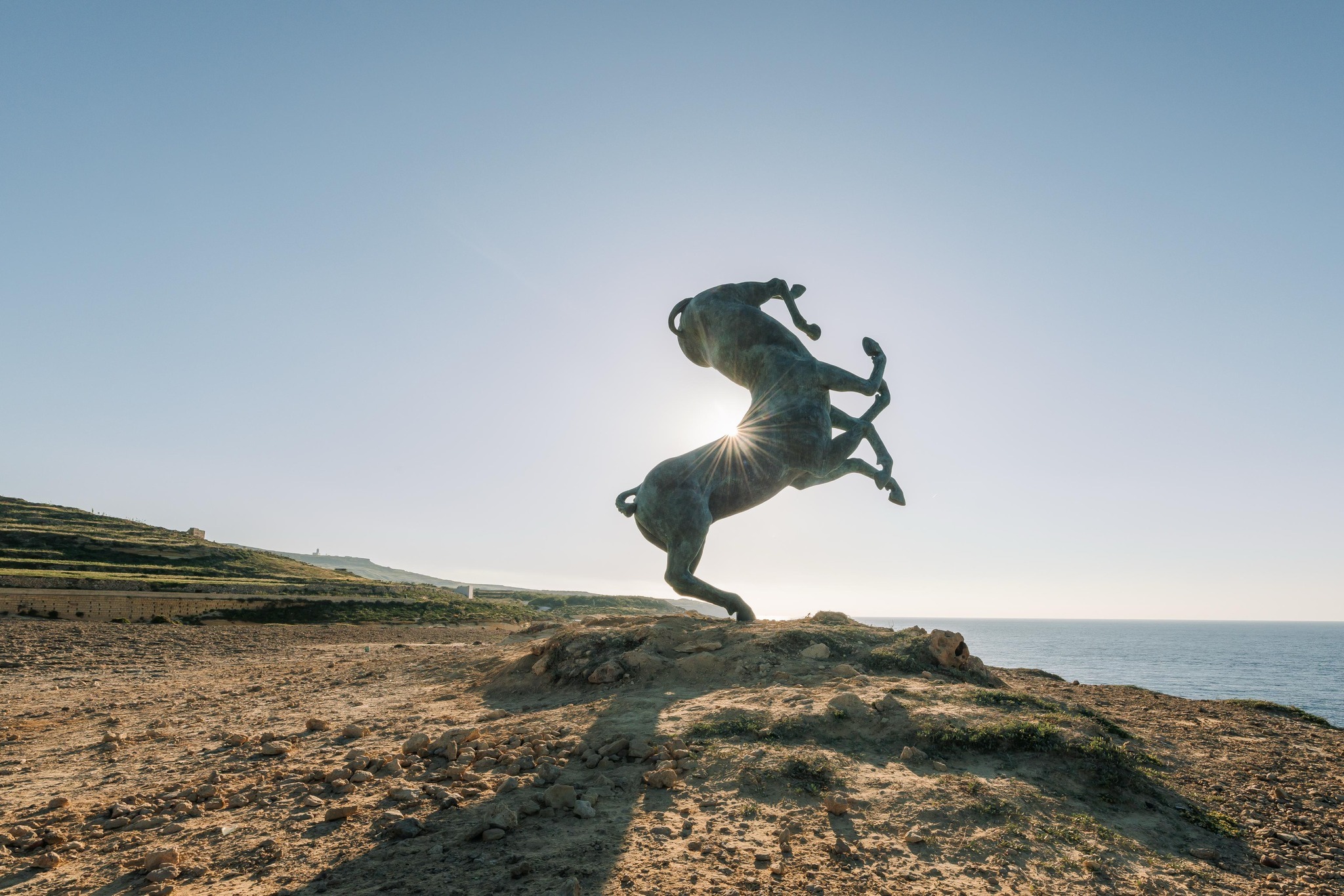
This is where Wieħed by Austin Camilleri enters the conversation. Not as a continuation, but as a rupture.
This is not a monument in the traditional sense. There is no triumph here, no rider, no narrative being imposed. It is simple, almost disarmingly so. Stunning in its restraint. Barely touching the ground. The equine form is still there, but it has been stripped of its historical burden. What remains is presence, and something close to defiance.
And crucially, it is placed where it should be. Away from the usual choreography of plaques, ceremonies, and self-congratulation. One can only hope it has been spared the inevitable little sign announcing which minister or bureaucrat needs to be remembered for having stood near it at some point. If that has been avoided, then the work has already won half the battle.
Because here the sculpture does something rare. It looks out to sea. It turns its back on the creeping line of concrete that continues to disfigure the horizon. It occupies one of the last fragments of landscape that still feels like itself. In that posture there is something unmistakable. A quiet majesty, yes, but also a kind of contained fury. Not theatrical, not exaggerated, just there. Present. Watching.
The history of the horse in monumental art is largely a history of appropriation. The animal is used to project power outward. Wieħed reverses that direction. It absorbs the landscape, reflects it, and in doing so exposes everything around it. The contrast is brutal. On one side, simplicity and form. On the other, the accumulated noise of development.
It is difficult not to think how different things might look if more of our spaces were treated this way. Fewer declarations. Fewer plaques. Fewer attempts to monumentalise the banal. More restraint. More attention to what is already there. There is a clarity in this work that makes everything else feel unnecessarily loud.
The horse no longer carries anyone. It does not need to. It stands, it looks, and it leaves the rest of us to explain ourselves.
[photo taken from AUSTIN CAMILLERI STUDIO -either by Austin Camilleri or Darren Cassar]

Comment here