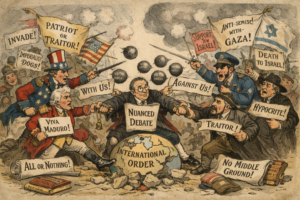
Public debate is losing its ability to handle complexity. Arguments are increasingly forced into tribal binaries: for or against, pure or condemned. The invasion of Venezuela, the Gaza tragedy, and the EU dispute over using frozen Russian assets for Ukraine all reveal the same reflex. It is now difficult to say two true things at once, to condemn authoritarianism while also condemning unlawful intervention, or to criticise a state without attacking a people. This black and white mindset weakens international norms and nourishes demagogues. Democracy requires nuance, patience and good-faith disagreement. Reality is complicated. Our thinking should be too.
There was a time when disagreement was an art. You could walk into a bar or a family lunch and discover that people could argue over politics, football and philosophy and still recognise that the world is complicated. Today that space is shrinking. The appetite for complexity has been replaced by an insistence on purity tests. You are either fully with us or fully against us. Min mhux magħna, kontra tagħna. Nuance is not only unwelcome. It is treated as betrayal.
The past months have offered an almost laboratory perfect demonstration of this drift. The reaction to the decision by Donald Trump to invade Venezuela has unfolded not as a debate about sovereignty, international law, regional stability and the Venezuelan people themselves, but as an online morality play. Choose your colours and shout. That is the extent of it.
It is apparently no longer possible to say the following simple adult sentence: Nicolás Maduro presided over an authoritarian and economically disastrous regime, and at the same time the United States is in clear violation of international norms by invading a sovereign state. The first half of that sentence will get you branded as an apologist for imperialism. The second half will earn you the label of socialist sympathiser. In some corners you will be accused of both simultaneously. The problem is not only intellectual laziness. It is a deeper abandonment of the idea that two truths can coexist, that moral judgment requires more than a team scarf.
The same flattening of thought is visible in the debate over Israel and Gaza. It should be straightforward to condemn the actions of the Israeli government and the devastation visited upon civilians in Gaza, while also rejecting any form of hatred toward Jewish people. Yet the public square rewards those who refuse this distinction. If you criticise the state of Israel you are suspected of hating Jews. If you are vigilant about antisemitism you are assumed to be endorsing every policy of the Israeli government. Whole histories, legal frameworks and human tragedies disappear into this binary grinder.
The same reflex has marked the European debate on whether to deploy frozen Russian assets to support Ukraine. What is in truth a complex web of legal constraints, property rights, market stability risks and the creation of precedents in international financial governance has been flattened into a shouting match. EU institutional leaders who counsel caution are instantly branded as timid bureaucrats indifferent to Ukrainian suffering. Those who advocate rapid and expansive use of the assets are dismissed as reckless ideologues ready to shatter the rule of law when it suits them. Member states with deep exposure to financial markets or constitutional limits on expropriation are accused of selfishness, while states urging faster action are caricatured as naïve moralists. Lost in the noise is any recognition that democratic leaders may be grappling in good faith with genuinely difficult trade offs, where support for Ukraine must be reconciled with the long term credibility of Europe’s legal order and the stability of its financial architecture.
There is a hidden cost to this constant demand for black and white answers. It corrodes the very architecture of the international order. That order is not a slogan. It is a mesh of norms, institutions, messy compromises and evolving jurisprudence that has been built to prevent precisely the rule of the strongest from becoming the only rule. When citizens lose the habit of thinking in layers, of holding tension, of accepting that rights and wrongs can intersect in uncomfortable ways, they also lose the instinct to defend that order. If every conflict is simply a clash between absolutely good and absolutely evil, then treaties, courts and multilateral processes are just inconvenient obstacles.
Social media has rewarded outrage and punished hesitation. Politicians have learned to fear the fifteen second clip more than the considered argument. Academia sometimes retreats into jargon while journalists are pushed toward headlines that perform rather than inform. Each of these trends narrows the space for complexity. The end result is a civic culture that treats reflection as weakness.
Yet reality stubbornly remains complicated. Venezuela is a country of immense suffering whose people deserve democratic dignity without foreign tanks rolling across their soil. Israel is a state with real security concerns whose government can still commit grave wrongs. The United States can speak the language of liberty and simultaneously trample the very rules it once helped to draft. These are not contradictions to be resolved by erasing half of the picture. They are the texture of the world we actually inhabit.
Recovering the capacity for nuanced judgment is a democratic necessity. Citizens who cannot think beyond binary choices are easy prey for demagogues. Institutions that depend on public understanding become brittle when that understanding collapses into slogans. International law becomes performative when publics refuse to see its value except when it flatters their tribe.
The antidote is unfashionable and slow. It requires reading rather than scrolling, listening rather than waiting to speak, arguing in good faith rather than hunting for trophies. It requires the humility to admit that one can be wrong about part of an issue and right about another, that moral clarity is not the same thing as intellectual simplicity.
We do not need a world with fewer disagreements. We need disagreements that are worthy of the complexity of the world. The alternative is already visible. It looks like foreign policy by thunderclap, public debate by accusation, and a steady erosion of the fragile agreements that keep power in check. Black and white may be easier on the eye. It is a disastrous way to see reality.
